A synopsis of the Great Lakes Near shore Initiative attached algae - - PowerPoint PPT Presentation

a synopsis of the great lakes near shore initiative
SMART_READER_LITE
LIVE PREVIEW

A synopsis of the Great Lakes Near shore Initiative attached algae - - PowerPoint PPT Presentation

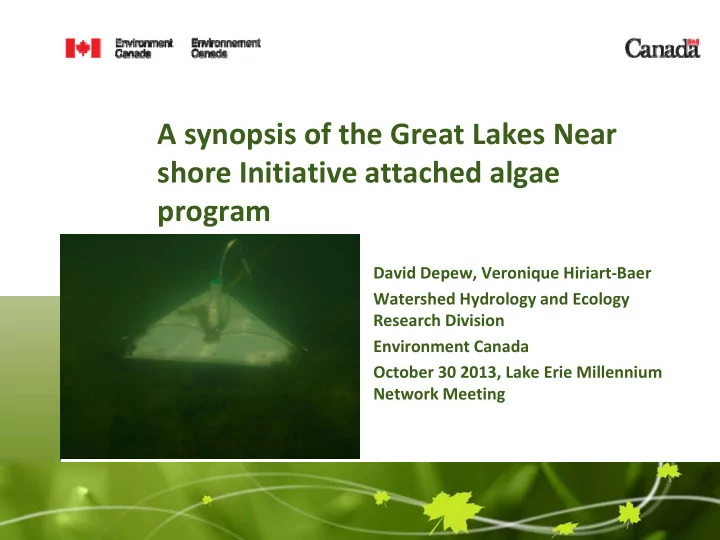
A synopsis of the Great Lakes Near shore Initiative attached algae program David Depew, Veronique Hiriart Baer Watershed Hydrology and Ecology Research Division Environment Canada October 30 2013, Lake Erie Millennium Network Meeting


slide-1
SLIDE 1

A synopsis of the Great Lakes Near shore Initiative attached algae program

David Depew, Veronique Hiriart‐Baer Watershed Hydrology and Ecology Research Division Environment Canada October 30 2013, Lake Erie Millennium Network Meeting

slide-2
SLIDE 2

DRAFT – Page 2 – December 3, 2013

Background

1970s 1980s 1990s 2000s Present

  • Implementation of GLWQA, beginning of point source P control
  • Dreissenid mussels invade L. Erie, P loads continue to decline
  • Blooms of Cladophora recur along north shore of E. L. Erie
  • Revival of Cladophora related research in E. L. Erie and elsewhere
slide-3
SLIDE 3

DRAFT – Page 3 – December 3, 2013

Background

Rock Pt. Prov. Pk. 2006 Image: S Higgins Rathfon Pt. July 2013 Volume of algal material collected on Intake screens: OPG Pickering.

slide-4
SLIDE 4

DRAFT – Page 4 – December 3, 2013

Soluble Reactive P levels (2 – 10 m)

Apr – May 2005 July – Aug 2005 MDL = 0.35 µg L-1

slide-5
SLIDE 5

DRAFT – Page 5 – December 3, 2013

Present Status…

  • Benthic algal blooms continue to impair near shore

water quality, habitat and recreational uses.

  • Near shore P levels not indicative of excessive

nutrient loading.

  • Temporal trends not easy to identify.
  • Elucidation of causal factors has proven

challenging, but evidence to‐date supports the role

  • f dreissenid mussels as key agents of change.
slide-6
SLIDE 6

DRAFT – Page 6 – December 3, 2013

Key Question

What, if any nutrient target(s) may provide reasonable protection of near shore regions from recurrent blooms of benthic algae?

slide-7
SLIDE 7

DRAFT – Page 7 – December 3, 2013

GLNI attached algae program objectives

  • Identify proximate sources of P contributing to

nuisance blooms

  • Quantify P processes in and above dreissenid beds

in Eastern Lake Erie (R. Smith, J. Majarreis, U Waterloo)

  • Reconstruct historical timeline of benthic algal

resurgence in E. Lake Erie (K. Mueller, U Waterloo)

slide-8
SLIDE 8

DRAFT – Page 8 – December 3, 2013

Study Area

slide-9
SLIDE 9

DRAFT – Page 9 – December 3, 2013

Approach

  • δ18OPO4 to delineate P sources responsible for

Cladophora blooms

– SRP – Cladophora tissue – Dreissenid tissue – Dreissenid “wastes”

  • Use of other isotope based tracers (e.g., DOC13,

15N18O3) to constrain sources

  • Standard physical and chemical water quality

metrics with quantitative benthic survey data

slide-10
SLIDE 10

DRAFT – Page 10 – December 3, 2013

δ18O – PO4 Primer

P O O O O = O18 = O16 H O H P O O O O H O H H O H H O H H O H H O H Enzyme mediated O exchange drives δ18O-PO4 to equilibrium based on temperature

slide-11
SLIDE 11

DRAFT – Page 11 – December 3, 2013

δ18O – PO4 of different P sources

δ18OP of potential P sources

7 8 9 10 11 12 13 14 15 16 17 18 19 20 21 22 23 24 25 26 Chemical fertilizers Detergents Semi processed P ores Aerosols WWTP effluent Fecal leachate

(Data from Young et al. 2009)

Do different P sources have different δ18O – PO4 ?

slide-12
SLIDE 12

DRAFT – Page 12 – December 3, 2013

δ18O – PO4 in different freshwaters

  • Isotopic disequilibrium
  • bserved in freshwaters

to date

  • Biological processing of

P does not completely eliminate source signatures in freshwaters

  • Indication of at least 2

distinct sources in C and W basin L. Erie

(Data: McLaughlin et al. 2006a,b, Elsbury et al. 2009, Young et al. 2009)

δ18O - PO4

8 10 12 14 16 18

δ18Ο− PO4 offset from equilibrium

  • 6
  • 4
  • 2

2 4 6 Lake Tahoe Tributaries Lake Erie Tributaries SJR Tributaries SJR mainstem

Does rapid P cycling overprint source signature too quickly?

slide-13
SLIDE 13

DRAFT – Page 13 – December 3, 2013

Progress to date

  • Cons

– Low SRP (< 1 µg L‐1) requires large volumes of lake water (> 100 L) – Organic matter contamination – Long sample processing time

  • Pros

– Suitable optimization of purification protocol for low SRP waters is close – Good recovery of free phosphate from Cladophora tissues without structural P components (e.g., hydrolyzed biological molecules) – does this reflect “recent” P sources?

slide-14
SLIDE 14

DRAFT – Page 14 – December 3, 2013

Future outlook

  • Cautious optimism – little good data for low P freshwater

systems

  • More samples – help to constrain the range of variability

expected in δ18O – PO4 in lake waters, Cladophora tissues and dreissenid wastes

  • Need a better grasp of fractionation effects induced by

extra‐cellular enzymes and digestive processes