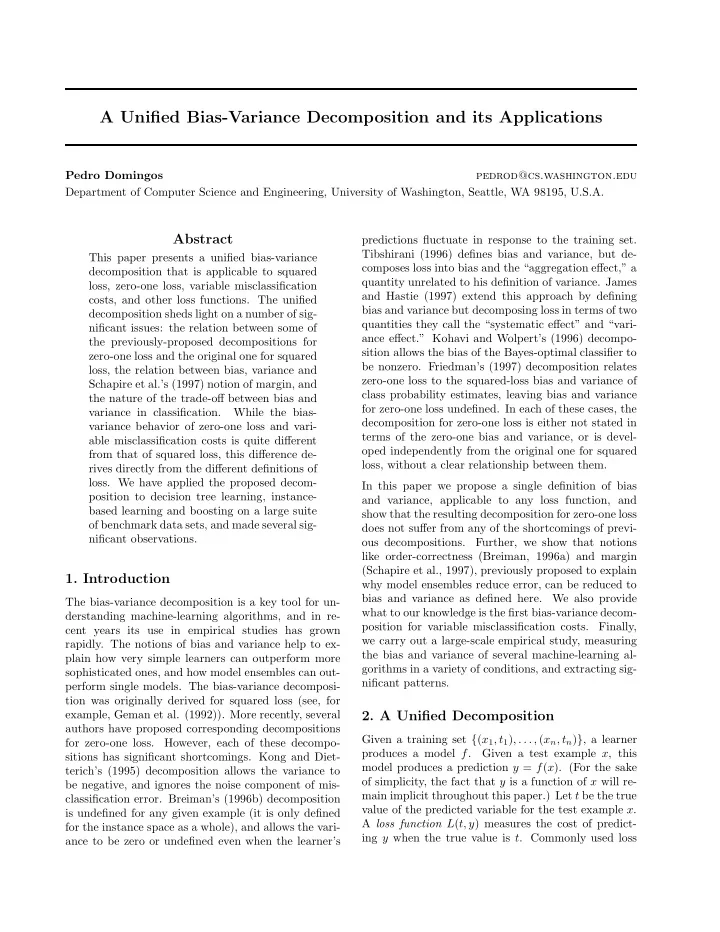
A Unified Bias-Variance Decomposition and its Applications Pedro - - PDF document

a unified bias variance decomposition and its applications
SMART_READER_LITE
LIVE PREVIEW

A Unified Bias-Variance Decomposition and its Applications Pedro - - PDF document

A Unified Bias-Variance Decomposition and its Applications Pedro Domingos pedrod@cs.washington.edu Department of Computer Science and Engineering, University of Washington, Seattle, WA 98195, U.S.A. Abstract predictions fluctuate in response to


slide-1
SLIDE 1

A Unified Bias-Variance Decomposition and its Applications

Pedro Domingos pedrod@cs.washington.edu Department of Computer Science and Engineering, University of Washington, Seattle, WA 98195, U.S.A.

Abstract

This paper presents a unified bias-variance decomposition that is applicable to squared loss, zero-one loss, variable misclassification costs, and other loss functions. The unified decomposition sheds light on a number of sig- nificant issues: the relation between some of the previously-proposed decompositions for zero-one loss and the original one for squared loss, the relation between bias, variance and Schapire et al.’s (1997) notion of margin, and the nature of the trade-off between bias and variance in classification. While the bias- variance behavior of zero-one loss and vari- able misclassification costs is quite different from that of squared loss, this difference de- rives directly from the different definitions of

  • loss. We have applied the proposed decom-

position to decision tree learning, instance- based learning and boosting on a large suite

  • f benchmark data sets, and made several sig-

nificant observations.

  • 1. Introduction

The bias-variance decomposition is a key tool for un- derstanding machine-learning algorithms, and in re- cent years its use in empirical studies has grown

  • rapidly. The notions of bias and variance help to ex-

plain how very simple learners can outperform more sophisticated ones, and how model ensembles can out- perform single models. The bias-variance decomposi- tion was originally derived for squared loss (see, for example, Geman et al. (1992)). More recently, several authors have proposed corresponding decompositions for zero-one loss. However, each of these decompo- sitions has significant shortcomings. Kong and Diet- terich’s (1995) decomposition allows the variance to be negative, and ignores the noise component of mis- classification error. Breiman’s (1996b) decomposition is undefined for any given example (it is only defined for the instance space as a whole), and allows the vari- ance to be zero or undefined even when the learner’s predictions fluctuate in response to the training set. Tibshirani (1996) defines bias and variance, but de- composes loss into bias and the “aggregation effect,” a quantity unrelated to his definition of variance. James and Hastie (1997) extend this approach by defining bias and variance but decomposing loss in terms of two quantities they call the “systematic effect” and “vari- ance effect.” Kohavi and Wolpert’s (1996) decompo- sition allows the bias of the Bayes-optimal classifier to be nonzero. Friedman’s (1997) decomposition relates zero-one loss to the squared-loss bias and variance of class probability estimates, leaving bias and variance for zero-one loss undefined. In each of these cases, the decomposition for zero-one loss is either not stated in terms of the zero-one bias and variance, or is devel-

  • ped independently from the original one for squared

loss, without a clear relationship between them. In this paper we propose a single definition of bias and variance, applicable to any loss function, and show that the resulting decomposition for zero-one loss does not suffer from any of the shortcomings of previ-

  • us decompositions.

Further, we show that notions like order-correctness (Breiman, 1996a) and margin (Schapire et al., 1997), previously proposed to explain why model ensembles reduce error, can be reduced to bias and variance as defined here. We also provide what to our knowledge is the first bias-variance decom- position for variable misclassification costs. Finally, we carry out a large-scale empirical study, measuring the bias and variance of several machine-learning al- gorithms in a variety of conditions, and extracting sig- nificant patterns.

  • 2. A Unified Decomposition

Given a training set {(x1, t1), . . . , (xn, tn)}, a learner produces a model f. Given a test example x, this model produces a prediction y = f(x). (For the sake

  • f simplicity, the fact that y is a function of x will re-

main implicit throughout this paper.) Let t be the true value of the predicted variable for the test example x. A loss function L(t, y) measures the cost of predict- ing y when the true value is t. Commonly used loss

slide-2
SLIDE 2

functions are squared loss (L(t, y) = (t−y)2), absolute loss (L(t, y) = |t − y|), and zero-one loss (L(t, y) = 0 if y = t, L(t, y) = 1 otherwise). The goal of learning can be stated as producing a model with the smallest possible loss; i.e., a model that minimizes the average L(t, y) over all examples, with each example weighted by its probability. In general, t will be a nondetermin- istic function of x (i.e., if x is sampled repeatedly, dif- ferent values of t will be seen). The optimal prediction y∗ for an example x is the prediction that minimizes Et[L(t, y∗)], where the subscript t denotes that the ex- pectation is taken with respect to all possible values of t, weighted by their probabilities given x. The optimal model is the model for which f(x) = y∗ for every x. In general, this model will have non-zero loss. In the case of zero-one loss, the optimal model is called the Bayes classifier, and its loss is called the Bayes rate. Since the same learner will in general produce differ- ent models for different training sets, L(t, y) will be a function of the training set. This dependency can be removed by averaging over training sets. In particular, since the training set size is an important parameter

  • f a learning problem, we will often want to average
  • ver all training sets of a given size. Let D be a set
  • f training sets. Then the quantity of interest is the

expected loss ED,t[L(t, y)], where the expectation is taken with respect to t and the training sets in D (i.e., with respect to t and the predictions y = f(x) pro- duced for example x by applying the learner to each training set in D). Bias-variance decompositions de- compose the expected loss into three terms: bias, vari- ance and noise. A standard such decomposition exists for squared loss, and a number of different ones have been proposed for zero-one loss. In order to define bias and variance for an arbitrary loss function we first need to define the notion of main prediction. Definition 1 The main prediction for a loss func- tion L and set of training sets D is yL,D

m

= argminy′ED[L(y, y′)]. When there is no danger of ambiguity, we will repre- sent yL,D

m

simply as ym. The expectation is taken with respect to the training sets in D, i.e., with respect to the predictions y produced by learning on the training sets in D. Let Y be the multiset of these predictions. (A specific prediction y will appear more than once in Y if it is produced by more than one training set.) In words, the main prediction is the value y′ whose aver- age loss relative to all the predictions in Y is minimum (i.e., it is the prediction that “differs least” from all the predictions in Y according to L). The main prediction under squared loss is the mean of the predictions; un- der absolute loss it is the median; and under zero-one loss it is the mode (i.e., the most frequent prediction). For example, if there are k training sets in D, we learn a classifier on each, 0.6k of these classifiers predict class 1, and 0.4k predict 0, then the main prediction under zero-one loss is class 1. The main prediction is not nec- essarily a member of Y ; for example, if Y = {1, 1, 2, 2} the main prediction under squared loss is 1.5. We can now define bias and variance as follows. Definition 2 The bias of a learner on an example x is B(x) = L(y∗, ym). In words, the bias is the loss incurred by the main prediction relative to the optimal prediction. Definition 3 The variance of a learner on an exam- ple x is V (x) = ED[L(ym, y)]. In words, the variance is the average loss incurred by predictions relative to the main prediction. Bias and variance may be averaged over all examples, in which case we will refer to them as average bias Ex[B(x)] and average variance Ex[V (x)]. It is also convenient to define noise as follows. Definition 4 The noise of an example x is N(x) = Et[L(t, y∗)]. In other words, noise is the unavoidable component of the loss, incurred independently of the learning algo- rithm. Definitions 2 and 3 have the intuitive properties associ- ated with bias and variance measures. ym is a measure

  • f the “central tendency” of a learner. (What “central”

means depends on the loss function.) Thus B(x) mea- sures the systematic loss incurred by a learner, and V (x) measures the loss incurred by its fluctuations around the central tendency in response to different training sets. If the loss function is nonnegative then bias and variance are also nonnegative. The bias is in- dependent of the training set, and is zero for a learner that always makes the optimal prediction. The vari- ance is independent of the true value of the predicted variable, and is zero for a learner that always makes the same prediction regardless of the training set. The

  • nly property that the definitions above require of the

loss function is that its expected value be computable. However, it is not necessarily the case that the ex- pected loss ED,t[L(t, y)] for a given loss function L can be decomposed into bias and variance as defined

  • above. Our approach will be to propose a decomposi-

tion and then show that it applies to each of several

slide-3
SLIDE 3

different loss functions. Even when it does not apply, it may still be worthwhile to investigate how the ex- pected loss can be expressed as a function of B(x) and V (x). Consider an example x for which the true prediction is t, and a learner that predicts y given a training set in D. Then, for certain loss functions L, the following decomposition of ED,t[L(t, y)] holds: ED,t[L(t, y)] = c1Et[L(t, y∗)] + L(y∗, ym) + c2ED[L(ym, y)] = c1N(x) + B(x) + c2V (x) (1) c1 and c2 are multiplicative factors that will take on different values for different loss functions. It is easily seen that this decomposition reduces to the standard

  • ne for squared loss with c1 = c2 = 1, considering that

for squared loss y∗ = Et[t] and ym = ED[y] (Geman et al., 1992): ED,t[(t − y)2] = Et[(t − Et[t])2] + (Et[t] − ED[y])2 +ED[(ED[y] − y)2] (2) We now show that the same decomposition applies to a broad class of loss functions for two-class problems, including zero-one loss. (Below we extend this to mul- ticlass problems for zero-one loss.) Let PD(y = y∗) be the probability over training sets in D that the learner predicts the optimal class for x. Theorem 1 In two-class problems, Equation 1 is valid for any real-valued loss function for which ∀y L(y, y) = 0 and ∀y1=y2 L(y1, y2) = 0, with c1 = PD(y = y∗)− L(y∗,y)

L(y,y∗)PD(y = y∗) and c2 = 1 if ym = y∗,

c2 = − L(y∗,ym)

L(ym,y∗) otherwise.

  • Proof. We begin by showing that

L(t, y) = L(y∗, y) + c0L(t, y∗) (3) with c0 = 1 if y = y∗ and c0 = − L(y∗,y)

L(y,y∗) otherwise.

If y = y∗ Equation 3 is trivially true with c0 = 1. If t = y∗, L(t, y) = L(y∗, y) − L(y∗,y)

L(y,y∗)L(t, y∗) is true

because it reduces to L(t, y) = L(t, y) − 0. If t = y, L(t, y) = L(y∗, y) − L(y∗,y)

L(y,y∗)L(t, y∗) is true because it

reduces to L(t, t) = L(y∗, y) − L(y∗, y), or 0 = 0. But if y = y∗ and we have a two-class problem, either t = y∗ or t = y must be true. Therefore if y = y∗ it is always true that L(t, y) = L(y∗, y) − L(y∗,y)

L(y,y∗)L(t, y∗),

completing the proof of Equation 3. We now show in a similar manner that L(y∗, y) = L(y∗, ym) + c2L(ym, y) (4) with c2 = 1 if ym = y∗ and c2 = − L(y∗,ym)

L(ym,y∗) otherwise.

If ym = y∗ Equation 4 is trivially true with c2 = 1. If y = ym, L(y∗, y) = L(y∗, ym) − L(y∗,ym)

L(ym,y∗)L(ym, y)

is true because it reduces to L(y∗, ym) = L(y∗, ym) −

  • 0. If y = y∗, L(y∗, y) = L(y∗, ym) − L(y∗,ym)

L(ym,y∗)L(ym, y)

is true because it reduces to L(y∗, y∗) = L(y∗, ym) − L(y∗, ym), or 0 = 0. But if ym = y∗ and we have a two- class problem, either y = ym or y = y∗ must be true. Therefore if ym = y∗ it is always true that L(y∗, y) = L(y∗, ym) − L(y∗,ym)

L(ym,y∗)L(ym, y), completing the proof of

Equation 4. Using Equation 3, and considering that L(y∗, y) and c0 do not depend on t and L(t, y∗) does not depend on D, ED,t[L(t, y)] = ED[Et[L(t, y)]] = ED[L(y∗, y) + c0Et[L(t, y∗)]] = ED[L(y∗, y)] + ED[c0]Et[L(t, y∗)] (5) Substituting Equation 4 and considering that ED[c0] = PD(y = y∗) − L(y∗,y)

L(y,y∗)PD(y = y∗) = c1 re-

sults in Equation 1.

  • In particular, if the loss function is symmetric (i.e.,

∀y1,y2L(y1, y2) = L(y2, y1)), c1 and c2 reduce to c1 = 2PD(y = y∗) − 1 and c2 = 1 if ym = y∗ (i.e., if B(x) = 0), c2 = −1 otherwise (i.e., if B(x) = 1). Specifically, this applies to zero-one loss, yielding a decomposition similar to that of Kong and Dietterich (1995). The main differences are that Kong and Diet- terich ignored the noise component N(x) and defined variance simply as the difference between loss and bias, apparently unaware that the absolute value of that dif- ference is the average loss incurred relative to the most frequent prediction. A side-effect of this is that Kong and Dietterich incorporate c2 into their definition of variance, which can therefore be negative. Kohavi and Wolpert (1996) and others have criticized this fact, since variance for squared loss must be positive. How- ever, our decomposition shows that the subtractive ef- fect of variance follows from a self-consistent definition

  • f bias and variance for zero-one and squared loss, even

if the variance itself remains positive. The fact that variance is additive in unbiased examples but subtrac- tive in biased ones has significant consequences. If a learner is biased on an example, increasing variance de- creases loss. This behavior is markedly different from that of squared loss, but is obtained with the same def- initions of bias and variance, purely as a result of the different properties of zero-one loss. It helps explain how highly unstable learners like decision-tree and rule induction algorithms can produce excellent results in

slide-4
SLIDE 4

practice, even given very limited quantities of data. In effect, when zero-one loss is the evaluation criterion, there is a much higher tolerance for variance than if the bias-variance decomposition was purely additive, because the increase in average loss caused by vari- ance on unbiased examples is partly offset (or more than offset) by its decrease on biased ones. The av- erage loss over all examples is the sum of noise, the average bias and what might be termed the net vari- ance, Ex[c2V (x)]: ED,t,x[L(t, y)] = Ex[c1N(x)] + Ex[B(x)] +Ex[c2V (x)] (6) by averaging Equation 1 over all test examples x, with c2 positive for unbiased examples and negative for bi- ased ones. The c1 factor (see Theorem 1) also points to a key dif- ference between zero-one and squared loss. In squared loss, increasing noise always increases error. In zero-

  • ne loss, for training sets and test examples where

y = y∗, increasing noise decreases error, and a high noise level can therefore in principle be beneficial to performance. The general case of Theorem 1 is also important. In many practical applications of machine learning, loss is highly asymmetric; for example, classifying a can- cerous patient as healthy is likely to be more costly than the reverse. In these cases, Theorem 1 essentially shows that the loss-reducing effect of variance on bi- ased examples will be greater or smaller depending on how asymmetric the costs are, and on which direction they are greater in. Equation 1 does not apply if L(y, y) = 0; in this case the decomposition contains an additional term corresponding to the cost of the correct predictions. Whether it applies in the general multiclass case is an

  • pen problem. However, it applies to the general mul-

ticlass problem for zero-one loss, as described in the following theorem. Theorem 2 Equation 1 is valid for zero-one loss in multiclass problems, with c1 = PD(y = y∗) − PD(y = y∗) Pt(y = t | y∗ = t) and c2 = 1 if ym = y∗, c2 = −PD(y = y∗ | y = ym) otherwise. We omit the proof in the interests of space; see Domin- gos (2000). Theorem 2 means that in multiclass prob- lems not all variance on biased examples contributes to reducing loss; of all training sets for which y = ym,

  • nly some have y = y∗, and it is in these that loss is

reduced.

  • 3. Properties of the Unified

Decomposition

One of the main concepts Breiman (1996a) used to ex- plain why the bagging ensemble method reduces zero-

  • ne loss was that of an order-correct learner. A learner

is order-correct on an example x iff ∀y=y∗ PD(y) < PD(y∗). Breiman showed that bagging transforms an

  • rder-correct learner into a nearly optimal one. Order-

correctness and bias are closely related: a learner is

  • rder-correct on an example x iff B(x) = 0 under

zero-one loss. (The proof of this is immediate from the definitions, considering that ym for zero-one loss is the most frequent prediction.) Schapire et al. (1997) proposed an explanation for why the boosting ensemble method works in terms of the notion of margin. For algorithms like bagging and boosting, which generate multiple hypotheses by ap- plying the same learner to multiple training sets, their definition of margin can be stated as follows. Definition 5 (Schapire et al., 1997) In two-class problems, the margin of a learner on an example x is M(x) = PD(y = t) − PD(y = t). A positive margin indicates a correct classification by the ensemble, and a negative one an error. Intuitively, a large margin corresponds to a high confidence in the

  • prediction. D here is the set of training sets to which

the learner is applied. For example, if 100 rounds of boosting are carried out, |D| = 100. Further, for algo- rithms like boosting where the different training sets (and corresponding predictions) have different weights that sum to 1, PD(.) is computed according to these

  • weights. Definitions 1–4 apply unchanged in this sit-
  • uation. In effect, we have generalized the notions of

bias and variance to apply to any training set selection scheme, not simply the traditional one of “all possible training sets of a given size, with equal weights.” Schapire et al. (1997) showed that it is possible to bound an ensemble’s generalization error (i.e., its zero-

  • ne loss on test examples) in terms of the distribution
  • f margins on training examples and the VC dimen-

sion of the base learner. In particular, the smaller the probability of a low margin, the lower the bound

  • n generalization error. The following theorem shows

that the margin is closely related to bias and variance as defined above. Theorem 3 The margin of a learner on an example x can be expressed in terms of its zero-one bias and variance as M(x) = ±[2B(x) − 1][2V (x) − 1], with positive sign if y∗ = t and negative sign otherwise.

slide-5
SLIDE 5

Proof. When y∗ = t, M(x) = PD(y = y∗) − PD(y = y∗) = 2PD(y = y∗) − 1. If B(x) = 0, ym = y∗ and M(x) = 2PD(y = ym) − 1 = 2[1 − V (x)] − 1 = −[2V (x) − 1]. If B(x) = 1 then M(x) = 2V (x) − 1. Therefore M(x) = [2B(x)−1][2V (x)−1]. The demon- stration for y∗ = t is similar, with M(x) = PD(y = y∗) − PD(y = y∗).

  • Conversely, it is possible to express the bias and vari-

ance in terms of the margin: B(x) = 1

2[1±sign(M(x))],

V (x) =

1 2[1 ± |M(x)|], with positive sign if y∗ = t

and negative sign otherwise. The relationship between margins and bias/variance expressed in Theorem 3 im- plies that Schapire et al.’s theorems can be stated in terms of the bias and variance on training examples. Bias-variance decompositions relate a learner’s loss on an example to its bias and variance on that example. However, to our knowledge this is the first time that generalization error is related to bias and variance on training examples. Theorem 3 also sheds light on the polemic between Breiman (1996b, 1997) and Schapire et al. (1997)

  • n how the success of ensemble methods like bagging

and boosting is best explained. Breiman has argued for a bias-variance explanation, while Schapire et al. have argued for a margin-based explanation. Theo- rem 3 shows that these are two faces of the same coin, and helps to explain why the bias-variance explana- tion sometimes seems to fail when applied to boosting. Maximizing margins is a combination of reducing the number of biased examples, decreasing variance on un- biased examples, and increasing it on biased ones (for examples where y∗ = t; the reverse, otherwise). With-

  • ut differentiating between these effects it is hard to

understand how boosting affects bias and variance.

  • 4. Experiments

We applied the bias-variance decomposition of zero-

  • ne loss proposed here in a series of experiments

with classification algorithms. To our knowledge this is the most extensive such study to date, in terms

  • f the number of data sets and number of algo-

rithms/parameter settings studied. This section sum- marizes the results. We used the following 30 data sets from the UCI repository (Blake & Merz, 2000): annealing, audiology, breast cancer (Ljubljana), chess (king-rook vs. king-pawn), credit (Australian), di- abetes, echocardiogram, glass, heart disease (Cleve- land), hepatitis, horse colic, hypothyroid, iris, labor, LED, lenses, liver disorders, lung cancer, lymphogra- phy, mushroom, post-operative, primary tumor, pro- moters, solar flare, sonar, soybean (small), splice junc- tions, voting records, wine, and zoology. As the noise level N(x) is very difficult to estimate, we followed previous authors (e.g., Kohavi & Wolpert (1996)) in assuming N(x) = 0. This is not too detri- mental to the significance of the results because we are mainly interested in the variation of bias and vari- ance with several factors, not their absolute values. We estimated bias, variance and zero-one loss by the following method. We randomly divided each dataset into training data (two thirds of the examples) and test data (one third). For each dataset, we generated 100 different training sets by the bootstrap method (Efron & Tibshirani, 1993): if the training data consists of n examples, we create a bootstrap replicate of it by taking n samples with replacement from it, with each example having a probability of 1/n of being selected at each

  • turn. As a result, some of the examples will appear

more than once in the training set, and some not at

  • all. The 100 training sets thus obtained were taken

as a sample of the set D, with D being the set of all training sets of size n. A model was then learned on each training set. We used the predictions made by these models on the test examples to estimate average zero-one loss, average bias and net variance, as defined in Section 2. We also measured the total contribu- tion to average variance from unbiased examples Vu =

1 n[n i=1(1−B(xi))V (xi)] and the contribution from bi-

ased examples Vb = 1

n[n i=1 cB(xi)V (xi)], where xi is

a test example, n is the number of test examples, c = 1 for two-class problems, and c = PD(y = y∗|y = ym) for multiclass problems (see Theorem 2), estimated from the test set. The net variance is the difference of the two: V = Vu − Vb. We carried out experiments with decision-tree induc- tion, boosting, and k-nearest neighbor; their results are reported in turn. Space limitations preclude pre- sentation of the complete results; see Domingos (2000). Here we summarize the main observations, and present representative examples. 4.1 Decision-Tree Induction We used the C4.5 decision tree learner, release 8 (Quin- lan, 1993). We measured zero-one loss, bias and vari- ance while varying C4.5’s pruning parameter (the con- fidence level CF) from 0% (maximum pruning) to 100% (minimum) in 5% steps. The default setting is 25%. Surprisingly, we found that in most data sets CF has only a minor effect on bias and variance (and there- fore loss). Only at the CF=0% extreme, where the tree is pruned all the way to the root, is there a major im- pact, with very high bias and loss; but this disappears by CF=5%. These results suggest there may be room for improvement in C4.5’s pruning method (cf. Oates & Jensen (1997)).

slide-6
SLIDE 6

In order to obtain a clearer picture of the bias-variance trade-off in decision tree induction, we replaced C4.5’s native pruning scheme with a limit on the number of levels allowed in the tree. (When a maximum level

  • f m is set, every path in the tree of length greater

than m is pruned back to a length of m.) The dom- inant effect observed is the rapid decrease of bias in the first few levels, after which it typically stabilizes. In 9 of the 25 data sets where this occurs, bias in fact increases after this point (slightly in 6, markedly in 3). In 5 data sets bias increases with the number of levels

  • verall; in 3 of these (echocardiogram, post-operative

and sonar) it increases markedly. Variance increases with the number of levels in 26 data sets; in 17 of these the increase is generally even, and much slower than the initial decrease in bias. Less-regular patterns oc- cur in the remaining 9 data sets. Vu and Vb tend to be initially similar, but Vb increases more slowly than Vu, or decreases. At any given level, Vb typically off- sets a large fraction of Vu, making variance a smaller contributor to loss than would be the case if its effect was always positive. This leads to the hypothesis that higher-variance algorithms (or settings) may be better suited to classification (zero-one loss) than regression (squared loss). Perhaps not coincidentally, research in classification has tended to explore higher-variance algorithms than research in regression. Representative examples of the patterns observed are shown in Figure 1, where the highest level shown is the highest produced by C4.5 when it runs without any limits. Overall, the expected pattern of a trade-

  • ff in bias and variance leading to a minimum of loss

at an intermediate level was observed in only 10 data sets; in 6 a decision stump was best, and in 14 an unlimited number of levels was best. 4.2 Boosting We also experimented with applying AdaBoost (Fre- und & Schapire, 1996) to C4.5. We allowed a maxi- mum of 100 rounds of boosting. (In most data sets, loss and its components stabilized by the 20th round, and only this part is graphed.) Boosting decreases loss in 21 data sets and increases it in 3; it has no effect in the remainder. It decreases bias in 14 data sets and in- creases it in 7, while decreasing net variance in 18 data sets and increasing it in 7. The bulk of bias reduction typically occurs in the first few rounds. Variance re- duction tends to be more gradual. On average (over all data sets) variance reduction is a much larger con- tributor to loss reduction than bias reduction (2.5% vs. 0.6%). Over all data sets, the variance reduction is sig- nificant at the 5% level according to sign and Wilcoxon tests, but bias reduction is not. Thus variance reduc-

10 20 30 40 50 60 1 2 3 4 5 6 7 8 9 10 Loss (%) Level L B V Vu Vb 10 20 30 40 50 60 70 80 2 4 6 8 10 12 Loss (%) Level L B V Vu Vb Figure 1. Effect of varying the number of levels in C4.5 trees: glass (top) and primary tumor (bottom).

tion is clearly the dominant effect when boosting is applied to C4.5; this is consistent with the notion that C4.5 is a “strong” learner. Boosting tends to reduce both Vu and Vb, but it reduces Vu much more strongly than Vb (3.0% vs. 0.5%). The ideal behavior would be to reduce Vu and increase Vb; it may be possible to design a variant of boosting that achieves this, and as a result further reduces loss. Examples of the boosting behaviors observed are shown in Figure 2. 4.3 K-Nearest Neighbor We studied the bias and variance of the k-nearest neighbor algorithm (Cover & Hart, 1967) as a func- tion of k, the number of neighbors used to predict a test example’s class. We used Euclidean distance for numeric attributes and overlap for symbolic ones. k was varied from 1 to 21 in increments of 2; typically

  • nly small values of k are used, but this extended range

allows a clearer observation of its effect. The pattern

slide-7
SLIDE 7

5 10 15 20 25 30 5 10 15 20 Loss (%) Round L B V Vu Vb 1 2 3 4 5 6 7 8 9 10 5 10 15 20 Loss (%) Round L B V Vu Vb Figure 2. Effect of boosting on C4.5: audiology (top) and splice junctions (bottom).

  • f an increase in bias and a decrease in variance with

k producing a minimal loss at an intermediate value

  • f k is seldom observed; more often one of the two ef-

fects dominates throughout. In several cases bias and variance vary in the same direction with k. In 13 data sets, the lowest loss is obtained with k = 1, and in 11 with the maximum k. On average (over all data sets) bias increases markedly with k (by 4.9% from k = 1 to k= 21), but variance decreases only slightly (0.8%), resulting in much increased loss. This contra- dicts Friedman’s (1997) hypothesis (based on approxi- mate analysis and artificial data) that very large values

  • f k should be beneficial. This may be attributable to

the fact that, as k increases, what Friedman calls the “boundary bias” changes from negative to positive for a majority of the examples, wiping out the benefits of low variance. Interestingly, increasing k in k-NN has the “ideal” effect of reducing Vu (by 0.5% on average) while increasing Vb (0.3%). Figure 3 shows examples

  • f the different types of behavior observed.

5 10 15 20 25 30 35 40 45 5 10 15 20 Loss (%) k L B V Vu Vb 2 4 6 8 10 12 14 5 10 15 20 Loss (%) k L B V Vu Vb Figure 3. Effect of varying k in k-nearest neighbor: audi-

  • logy (top) and chess (bottom).
  • 5. Future Work

The main limitation of the definitions of bias and vari- ance proposed here is that many loss functions can- not be decomposed according to them and Equation 1 (e.g., absolute loss). Since it is unlikely that meaning- ful definitions exist for which a simple decomposition is always possible, a central direction for future work is determining general properties of loss functions that are necessary and/or sufficient for Equation 1 to apply. Even when it does not, it may be possible to usefully relate loss to bias and variance as defined here. (For example, in Domingos (2000) we show that, as long as the loss function is a metric, it can be bounded from above and below by linear functions of the bias, vari- ance and noise.) Another major direction for future work is applying the decomposition to a wider variety of learners, in

  • rder to gain insight about their behavior, both with

respect to variations within a method and with respect

slide-8
SLIDE 8

to comparisons between methods. We would also like to study experimentally the effect of different domain characteristics (e.g., sparseness of the data) on the bias and variance of different learning algorithms. The re- sulting improved understanding should allow us to de- sign learners that are more easily adapted to a wide range of domains.

  • 6. Conclusion

This paper proposed unified definitions of bias and variance, applicable to any loss function. The resulting decomposition specializes to the conventional one for squared loss, avoids the difficulties of previous ones for zero-one loss, and is also applicable to variable misclas- sification costs. While the decomposition is not always purely additive, we believe that more insight is gained from this approach—formulating consistent definitions and investigating what follows from them—than from crafting definitions case-by-case to make the decom- position purely additive. For example, uncovering the different role of variance on biased and unbiased exam- ples in zero-one loss leads to an improved understand- ing of classification algorithms, and of how they differ from regression ones. This was illustrated in an exten- sive empirical study of bias and variance in decision tree induction, boosting, and k-nearest neighbor. The bias-variance decomposition proposed in this pa- per is available in C code at http://www.cs.washing- ton.edu/homes/pedrod/bvd.c.

Acknowledgments

This research was partly supported by a PRAXIS XXI

  • grant. The author is grateful to all those who provided

the data sets used in the experiments.

References

Blake, C., & Merz, C. J. (2000). UCI repository of machine learning databases. Department of Infor- mation and Computer Science, University of Califor- nia at Irvine, Irvine, CA. http://www.ics.uci.edu/- ∼mlearn/MLRepository.html. Breiman, L. (1996a). Bagging predictors. Machine Learning, 24, 123–140. Breiman, L. (1996b). Bias, variance and arcing classi- fiers (Technical Report 460). Statistics Department, University of California at Berkeley, Berkeley, CA. Breiman, L. (1997). Arcing the edge (Technical Report 486). Statistics Department, University of California at Berkeley, Berkeley, CA. Cover, T. M., & Hart, P. E. (1967). Nearest neighbor pattern classification. IEEE Transactions on Infor- mation Theory, 13, 21–27. Domingos, P. (2000). A unified bias-variance decompo- sition (Technical Report). Department of Computer Science and Engineering, University of Washington, Seattle, WA. Efron, B., & Tibshirani, R. J. (1993). An introduction to the bootstrap. New York, NY: Chapman and Hall. Freund, Y., & Schapire, R. E. (1996). Experiments with a new boosting algorithm. Proceedings of the Thirteenth International Conference on Machine Learning (pp. 148–156). Bari, Italy: Morgan Kauf- mann. Friedman, J. H. (1997). On bias, variance, 0/1 - loss, and the curse-of-dimensionality. Data Mining and Knowledge Discovery, 1, 55–77. Geman, S., Bienenstock, E., & Doursat, R. (1992). Neural networks and the bias/variance dilemma. Neural Computation, 4, 1–58. James, G., & Hastie, T. (1997). Generalizations of the bias/variance decomposition for prediction error (Technical Report). Department of Statistics, Stan- ford University, Stanford, CA. Kohavi, R., & Wolpert, D. H. (1996). Bias plus vari- ance decomposition for zero-one loss functions. Pro- ceedings of the Thirteenth International Conference

  • n Machine Learning (pp. 275–283).

Bari, Italy: Morgan Kaufmann. Kong, E. B., & Dietterich, T. G. (1995). Error- correcting output coding corrects bias and variance. Proceedings of the Twelfth International Conference

  • n Machine Learning (pp. 313–321).

Tahoe City, CA: Morgan Kaufmann. Oates, T., & Jensen, D. (1997). The effects of train- ing set size on decision tree complexity. Proceedings

  • f the Fourteenth International Conference on Ma-

chine Learning (pp. 254–262). Madison, WI: Mor- gan Kaufmann. Quinlan, J. R. (1993). C4.5: Programs for machine

  • learning. San Mateo, CA: Morgan Kaufmann.

Schapire, R. E., Freund, Y., Bartlett, P., & Lee, W. S. (1997). Boosting the margin: A new explanation for the effectiveness of voting methods. Proceedings

  • f the Fourteenth International Conference on Ma-

chine Learning (pp. 322–330). Nashville, TN: Mor- gan Kaufmann. Tibshirani, R. (1996). Bias, variance and predic- tion error for classification rules (Technical Report). Department of Statistics, University of Toronto, Toronto, Canada.