Variable selection bias Bias in Ensemble Bias in Ensemble Methods - - PowerPoint PPT Presentation

variable selection bias
SMART_READER_LITE
LIVE PREVIEW

Variable selection bias Bias in Ensemble Bias in Ensemble Methods - - PowerPoint PPT Presentation

Variable Selection Variable Selection Variable selection bias Bias in Ensemble Bias in Ensemble Methods Methods Variable selection Variable selection Variable Selection Bias in Classification bias bias rpart Trees and Ensemble Methods


slide-1
SLIDE 1

Variable Selection Bias in Ensemble Methods Variable selection bias Random forests Implication References

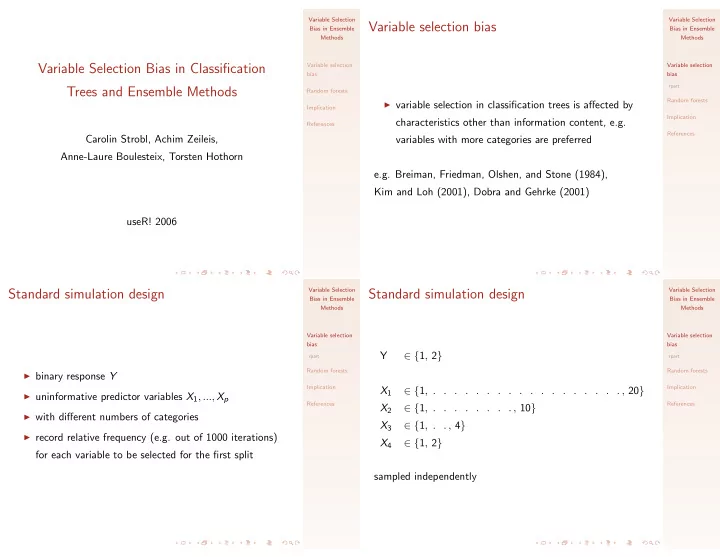
Variable Selection Bias in Classification Trees and Ensemble Methods

Carolin Strobl, Achim Zeileis, Anne-Laure Boulesteix, Torsten Hothorn useR! 2006

Variable Selection Bias in Ensemble Methods Variable selection bias

rpart

Random forests Implication References

Variable selection bias

◮ variable selection in classification trees is affected by

characteristics other than information content, e.g. variables with more categories are preferred e.g. Breiman, Friedman, Olshen, and Stone (1984), Kim and Loh (2001), Dobra and Gehrke (2001)

Variable Selection Bias in Ensemble Methods Variable selection bias

rpart

Random forests Implication References

Standard simulation design

◮ binary response Y ◮ uninformative predictor variables X1, ..., Xp ◮ with different numbers of categories ◮ record relative frequency (e.g. out of 1000 iterations)

for each variable to be selected for the first split

Variable Selection Bias in Ensemble Methods Variable selection bias

rpart

Random forests Implication References

Standard simulation design

Y ∈ {1, 2} X1 ∈ {1, . . . . . . . . . . . . . . . . . . , 20} X2 ∈ {1, . . . . . . . . , 10} X3 ∈ {1, . . , 4} X4 ∈ {1, 2} sampled independently

slide-2
SLIDE 2

Variable Selection Bias in Ensemble Methods Variable selection bias

rpart

Random forests Implication References

Variable selection bias in classification trees

package: rpart function: rpart

X1 X2 X3 X4

relative variable selection frequency

0.0 0.2 0.4 0.6 0.8 1.0

Variable Selection Bias in Ensemble Methods Variable selection bias

rpart

Random forests Implication References

Sources of variable selection bias

◮ estimation bias and variance of empirical entropy

measures (Strobl, Boulesteix, and Augustin, 2005)

◮ in binary splitting: multiple testing

(combined variable and cutpoint selection)

Variable Selection Bias in Ensemble Methods Variable selection bias Random forests

randomForest cforest

Implication References

Random forests

package: randomForest functions: randomForest, importance

variable importance measure: permutation accuracy importance

“In every tree grown in the forest, put down the oob cases and count the number of votes cast for the correct class. Now randomly permute the values of variable Xj in the oob cases and put these cases down the tree. Subtract the number of votes for the correct class in the variable-j-permuted oob data from the number of votes for the correct class in the untouched oob data. The average of this number over all trees in the forest is the raw importance score for variable Xj.”

Variable Selection Bias in Ensemble Methods Variable selection bias Random forests

randomForest cforest

Implication References

Permutation accuracy importance

◮ informative variables produce a systematic decrease in

accuracy when permuted

◮ uninformative variables produce a random decrease or

increase in accuracy when permuted

slide-3
SLIDE 3

Variable Selection Bias in Ensemble Methods Variable selection bias Random forests

randomForest cforest

Implication References

Permutation accuracy importance

employed as a criterion for variable selection in many recent publications in biochemistry, neurology, forestry, etc., e.g. by Bureau et al. (2005), Chen and Lin (2005), Cummings and Segal (2004), Diaz-Uriarte and de Andr´ es (2006), Furlanello et al. (2003), Guha and Jurs (2003), Jong et al. (2005), Lunetta et al. (2003), Lunetta et al. (2004), Ward et al. (2006) etc.

Variable Selection Bias in Ensemble Methods Variable selection bias Random forests

randomForest cforest

Implication References

Permutation accuracy importance

function: importance

  • ption: scale=FALSE
  • X1

X2 X3 X4 −0.05 0.00 0.05

variable importance

Variable Selection Bias in Ensemble Methods Variable selection bias Random forests

randomForest cforest

Implication References

Permutation accuracy importance

function: importance

  • ption: scale=TRUE
  • X1

X2 X3 X4 −2 −1 1 2

variable importance

Variable Selection Bias in Ensemble Methods Variable selection bias Random forests

randomForest cforest

Implication References

Permutation accuracy importance

◮ due to variable selection bias in individual trees

⇒ variables with more categories end up closer to root node of individual tree

◮ potential change in accuracy is more pronounced for

variables closer to root node ⇒ variable importance of variables with more categories shows higher deviation

slide-4
SLIDE 4

Variable Selection Bias in Ensemble Methods Variable selection bias Random forests

randomForest cforest

Implication References

Expectation

random forests built from unbiased trees do not produce biased variable selection measures

Variable Selection Bias in Ensemble Methods Variable selection bias Random forests

randomForest cforest

Implication References

Unbiased variable selection criteria for classification trees

◮ Strobl, Boulesteix, and Augustin (2005)

exact p-value of maximally selected Gini gain

package: exactmaxsel function: maxsel.test

◮ Hothorn, Hornik, and Zeileis (2006)

p-value of independence test in conditional inference framework

package: party functions: ctree, cforest internal: party:::varimp

Variable Selection Bias in Ensemble Methods Variable selection bias Random forests

randomForest cforest

Implication References

Permutation accuracy importance

internal: party:::varimp

  • X1

X2 X3 X4 −0.05 0.00 0.05

variable importance

Variable Selection Bias in Ensemble Methods Variable selection bias Random forests

randomForest cforest

Implication References

Number of times variable is selected in individual trees

X1 X2 X3 X4

50 100 150 200

slide-5
SLIDE 5

Variable Selection Bias in Ensemble Methods Variable selection bias Random forests

randomForest cforest

Implication References

Bootstrap bias

distribution of the p-values of a χ2-test before and after bootstrapping (1000 iterations, each n = 10 000)

  • 0.0

0.2 0.4 0.6 0.8 1.0

X1

  • 0.0

0.2 0.4 0.6 0.8 1.0

X2

0.0 0.2 0.4 0.6 0.8 1.0

X3

0.0 0.2 0.4 0.6 0.8 1.0

X4

Variable Selection Bias in Ensemble Methods Variable selection bias Random forests

randomForest cforest

Implication References

Bootstrap bias

◮ bootstrap sampling with replacement artificially

induces an association

◮ the effect is more pronounced for contingency tables

with more cells and more df

Variable Selection Bias in Ensemble Methods Variable selection bias Random forests

randomForest cforest

Implication References

Expectation

when samples (e.g. of the size 0.632·n) are drawn without replacement the bias is eliminated

Variable Selection Bias in Ensemble Methods Variable selection bias Random forests

randomForest cforest

Implication References

Number of times variable is selected in individual trees

X1 X2 X3 X4

50 100 150 200

slide-6
SLIDE 6

Variable Selection Bias in Ensemble Methods Variable selection bias Random forests

randomForest cforest

Implication References

Permutation accuracy importance

internal: party:::varimp

  • ption: replace=FALSE
  • X1

X2 X3 X4 −0.05 0.00 0.05

variable importance

Variable Selection Bias in Ensemble Methods Variable selection bias Random forests Implication References

Implication

if your potential predictors vary in their number of categories or scale level

◮ use variable importance of unbiased cforest ◮ with option replace=FALSE

for the evaluation of variable importance and for variable selection

Variable Selection Bias in Ensemble Methods Variable selection bias Random forests Implication References Variable Selection Bias in Ensemble Methods Variable selection bias Random forests Implication References Bureau, A., J. Dupuis, K. Falls, K. Lunetta, B. Hayward, T. Keith, and P. V. Eerdewegh (2005). Identifying SNPs predictive of phenotype using random forests. Genetic Epidemiology 28, 171–182. Chen, Y.-W. and C.-J. Lin (2005). Combining SVMs with various feature selection strategies. In M. N.

  • I. Guyon, S. Gunn and L. Zadeh (Eds.), Feature extraction, Foundations and Applications.

Cummings, M. and M. Segal (2004). Few amino acid positions in rpoB are associated with most of the rifampin resistance in Mycobacterium tuberculosis. BMC Bioinformatics 5, 137. Diaz-Uriarte, R. and S. A. de Andr´ es (2006). Gene selection and classification of microarray data using random forest. BMC Bioinformatics 7, 3. Guha, R. and P. Jurs (2003). Development of linear, ensemble, and nonlinear models for the prediction and interpretation of the biological activity of a set of PDGFR inhibitors. Journal of Chemical Information and Computer Sciences 44, 2179–2189. Hothorn, T., K. Hornik, and A. Zeileis (2006). Unbiased recursive partitioning: A conditional inference

  • framework. Journal of Computational and Graphical Statistics (to appear).

Jong, O., M. Laubach, and A. Luczak (2005). Estimating neuronal variable importance with random

  • forest. In Proceedings of 29th Annual Northeast Bioengineering Conference, pp. 33–34.

Lunetta, K., L. Hayward, J. Segal, and P. V. Eerdewegh (2003). Random forest: a classification and regression tool for compound classification and QSAR modeling. Journal of Chemical Information and Computer Sciences 43, 1947–1958. Lunetta, K., L. Hayward, J. Segal, and P. V. Eerdewegh (2004). Screening large-scale association study data: exploiting interactions using random forests. BMC Genetics 5, 32. Strobl, C., A.-L. Boulesteix, and T. Augustin (2005). Unbiased split selection for classification trees based on the Gini Index. SFB-Discussion Paper 464, Department of Statistics, University of Munich LMU. Ward, M., S. Pajevic, J. Dreyfuss, and J. Malley (2006). Short-term prediction of mortality in patients with systemic lupus erythematosus: classification of outcomes using random forests. Arthritis and Rheumatism 55, 74–80.