ABI/TBI-Induced Vision Impairment Adressed in a Multidiciplinary - - PowerPoint PPT Presentation

abi tbi induced vision impairment adressed in a
SMART_READER_LITE
LIVE PREVIEW

ABI/TBI-Induced Vision Impairment Adressed in a Multidiciplinary - - PowerPoint PPT Presentation

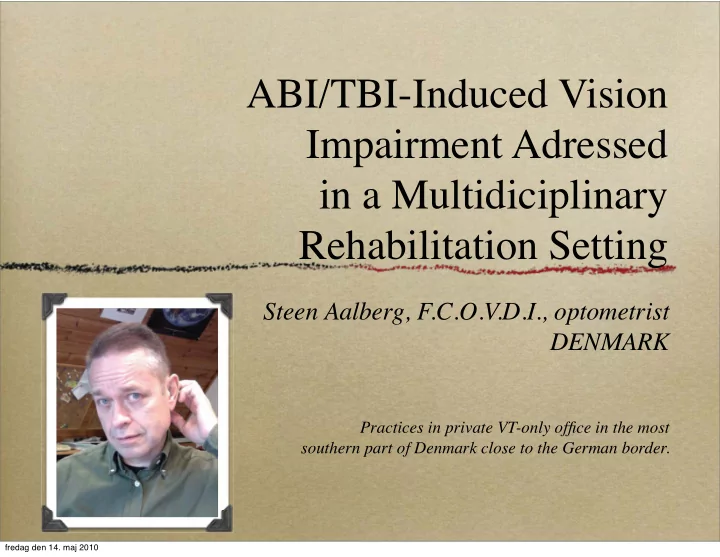
ABI/TBI-Induced Vision Impairment Adressed in a Multidiciplinary Rehabilitation Setting Steen Aalberg, F.C.O.V.D.I., optometrist DENMARK Practices in private VT-only office in the most southern part of Denmark close to the German border.


slide-1
SLIDE 1

ABI/TBI-Induced Vision Impairment Adressed in a Multidiciplinary Rehabilitation Setting

Steen Aalberg, F.C.O.V.D.I., optometrist DENMARK

Practices in private VT-only office in the most southern part of Denmark close to the German border.

fredag den 14. maj 2010

slide-2
SLIDE 2

A pilot study

Purpose: To identify the prevalence of untreated visual problems in the ABI/TBI group To highlight the value of adding

  • ptometry and optometric vision training

to the existing rehabilitation programs

fredag den 14. maj 2010

slide-3
SLIDE 3

Right now very few visual problems are addressed in current rehab programs in Europe. Even though visual problems can form massive obstacles for

  • ther types of

rehabilitation, optometric intervention is rare. Problems:

fredag den 14. maj 2010

slide-4
SLIDE 4

Interdiciplinary contact

After stating to a group of decision makers on the field of brain damage, that vision is the director of movement, and every movement in it’s precision, efficiency and elegance depends fully

  • n the quality and richness of the vision guiding it, a meeting

was set up. Realizing, (After a few hours of more detailed explanation of vision from an optometric

viewpoint), the importance of the above statement for other rehab

work, the group decided to set up this pilot study at Center for rehabilitation of brain injury in Copenhagen to clarify the prevalence of visual problems, and how they are addressed.

fredag den 14. maj 2010

slide-5
SLIDE 5

The initial plan was, among patients entering a program at the facility, to identify the ones presenting with visual problems. Once identified, to form two groups of patients for a brief VT-program, offset in time thus serving as control groups for each other

Plan and design

fredag den 14. maj 2010

slide-6
SLIDE 6

Lacking resources we were forced to reduce the model and go for one group, and do the VT part after the scheduled rehab in order to separate effects. Patients were to be examined three times: Before entering rehab at the center, after their four months program and then again after six sessions of VT

Plan and design

fredag den 14. maj 2010

slide-7
SLIDE 7

Nine patients were offered an exam and participation if problems were found that were regarded amenable to VT. Three declined for personal reasons, mostly because the VT part and further exams would follow after their rehab program and they did not feel up to it.

Patients

fredag den 14. maj 2010

slide-8
SLIDE 8

Patients

Of the remaining six subjects,

  • ne was rejected after the

initial exam, although having potential benefit, he lacked motivation and had acquiesced in his visual situation with hemianopia and simpler refraction issues. He was given a new prescription for near and far.

fredag den 14. maj 2010

slide-9
SLIDE 9

The remaining five subjects agreed to the exams and to participate in six VT-sessions within six weeks in June and July 2009. The program was on informed consent basis without ethical issues. Patients were between 35 and 55 years of age. We tried to get as much information on the brain damage as possible, but only got one scan and some written descriptions from patient files.

Patients

fredag den 14. maj 2010

slide-10
SLIDE 10

Results of examination

(only the 5 subjects went through 2. exam)

Visual field defects and/

  • r neglect, 5/5

Diplopia, 2/5 Eye motor problems, 5/5 Fixation problems, 5/5 Binocular problems, 5/5

  • Acc. insufficiency and/
  • r presbyopia, 5/5
  • Cvg. insufficiency, 4/5

Suppression, 4/5 Decreased stereo acuity, 5/5 Refraction issues, 5/5

fredag den 14. maj 2010

slide-11
SLIDE 11

Results of examination

The listing is incomplete, but illustrates the massive unmet need for optometric

  • intervention. Only visual field defects

and neglect was mentioned in the patient files in spite of comprehensive examinations from medicine and neuropsychology.

fredag den 14. maj 2010

slide-12
SLIDE 12

Results of examination

At the second exam after the patients finished their general rehab program, there were no significant changes in the repeated measures. Compensatory strategies (closing an eye, head turns,

withdrawal) were more prevalent, and

suppression tendencies had increased, indicating maladaptation.

fredag den 14. maj 2010

slide-13
SLIDE 13

Optometric Visual Therapy

Available was six time slots of 3 hours at the rehab center spread over a six week

  • period. The three hours included all

necessary breaks. Training was done in a group setting, partly one on one and partly self training following individual instructions. When possible two optometrists were present.

fredag den 14. maj 2010

slide-14
SLIDE 14

Optometric Visual Therapy

All procedures were individually loaded and instructed. Procedures fell in the following categories: Eye control, balance, fixation, tracing, timing, eye-hand coordination, antisuppression, binocularity, chalk board work (fields,

timing and motor symmetry).

fredag den 14. maj 2010

slide-15
SLIDE 15

Top left is a drawing three months after a “Clean V1” left

  • hemianopsia. Patient was instructed to fixate the “x” and draw

straight lines of equal length by the feel of it. Top right is a training set up for the same kind of situation.

fredag den 14. maj 2010

slide-16
SLIDE 16

Other samples: Balance and eye control was trained on a balance board with a wide base initially, decreasing the base width with progress. Rotator tasks were used for fixation, pursuits, eye- hand coordination, fine spatial control and balance Inch cubes build - draw - rebuild for visual memory, visual spatial relationship, visualization, visual manipulation in internal space world

fredag den 14. maj 2010

slide-17
SLIDE 17

Experiences

Disregarding field problems for a moment, the most affected areas (really surprising the therapists and

patients) were binocularity, timing, balance and

speed. Once we began working on these, the problems were popping into consciousness of the patients and their watching therapists, making the optometric needs very obvious.

fredag den 14. maj 2010

slide-18
SLIDE 18

Experiences, snakes sneaking in and out...

Scores on the QOL- questionnaire got worse, as subjects got better and discovered their own level of performance, making statistic evaluation very difficult. Just being conscious of your problems can make you feel worse! This transition phase may reoccur at different levels. This has already led to efforts originating from COVD (initiated by Dr. W.C. Maples at

SCO) on creating a QOL-

questionnaire designed for mild ABI/TBI patients, in

  • rder to overcome or bypass

these problems and develop a new tool for evaluation of progress in this group.

fredag den 14. maj 2010

slide-19
SLIDE 19

Experiences, snakes sneaking in and out...

With such a small group, limited resources and a short time frame, a project is prone to suffer from external influence. Due to different personal issues, not all subjects were able to participate for all offered sessions, and the need for breaks variated greatly.

fredag den 14. maj 2010

slide-20
SLIDE 20

Only one (20%) was present during all sessions. Three missed out one full day or three hours in total One missed two days and always needed to leave early, missing 9 hours Two were able to participate at the last exam, the rest were evaluated based on notes from training sessions

20% 60% 20%

18 hours 15 hours 9 hours

fredag den 14. maj 2010

slide-21
SLIDE 21

The rehab center realized the benefits right away and expressed their wish to offer optometric intervention on a permanent basis. The patients all expressed the program as a positive experience and hoped for this kind of treatment to be permanent and initiated up front in a rehab program My personal interest is to be able to work with these patients not having to actually fight for it

Outcome

fredag den 14. maj 2010

slide-22
SLIDE 22

Outcome

Right now we have a grant application pending that, IF, we get the funds we can do a 2-3 year trial on 50-100 patients, with optometric exams and training being an integrated part of the rehab.

fredag den 14. maj 2010