Abstract We present a novel model for an origin of life situated - - PDF document

abstract we present a novel model for an origin of life
SMART_READER_LITE
LIVE PREVIEW

Abstract We present a novel model for an origin of life situated - - PDF document

An Origin of Life through Three Coupled Phases in Cycling Hydrothermal Pools with Distribution and Adaptive Radiation to Marine Stromatolites Bruce Damer 1,2 *, David Deamer 1 , Martin Van Kranendonk 3 , Malcolm Walter 3 1 U.C. Santa Cruz, 2


slide-1
SLIDE 1

An Origin of Life through Three Coupled Phases in Cycling Hydrothermal Pools with Distribution and Adaptive Radiation to Marine Stromatolites

Bruce Damer1,2*, David Deamer1, Martin Van Kranendonk3, Malcolm Walter3

1U.C. Santa Cruz, 2DigitalSpace Research, 3Australian Centre for Astrobiology at the University of New

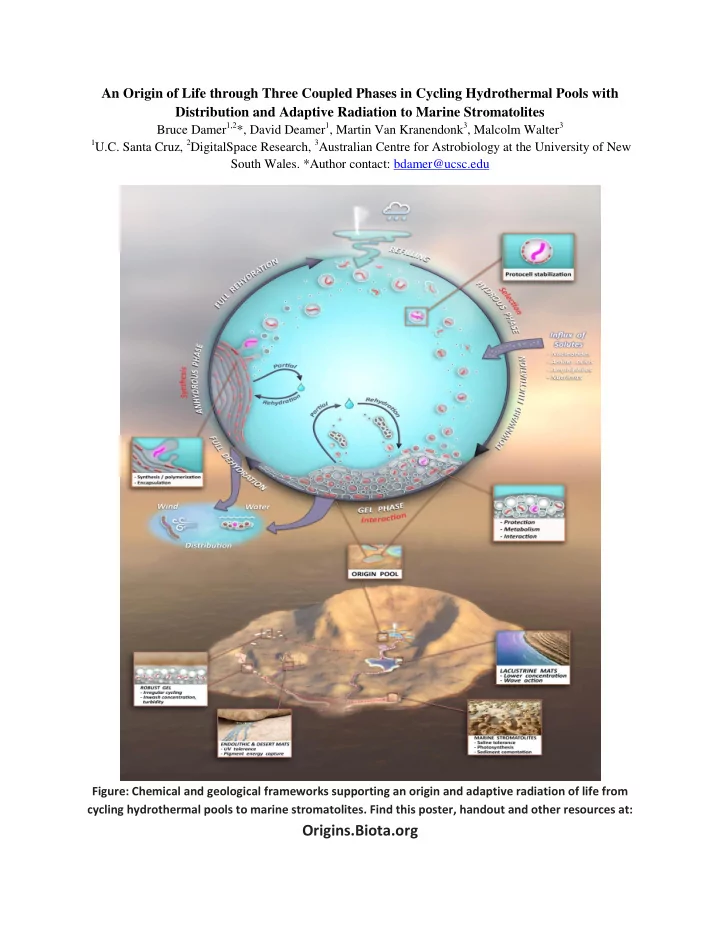
South Wales. *Author contact: bdamer@ucsc.edu Figure: Chemical and geological frameworks supporting an origin and adaptive radiation of life from cycling hydrothermal pools to marine stromatolites. Find this poster, handout and other resources at:

Origins.Biota.org

slide-2
SLIDE 2

Abstract We present a novel model for an origin of life situated within inland freshwater hydrothermal pools subject to periodic filling and evaporation. The model incorporates the combinatorial selection and evolution of systems of functional polymers enclosed in anhydrous, hydrated, and gel phases of lipid membranes cycling in a kinetic trap (figure-upper). The anhydrous phase supports synthesis of random polymers between dehydrating lipid lamellae. Upon rehydration these polymers become encapsulated in lipid compartments (protocells). The hydrous phase selects the encapsulated polymers for their ability to stabilize the surrounding membrane. Stable protocells survive and accumulate along with concentrated solutes in a gel phase during downward pool fluctuation. We predict that the gel phase will exhibit properties of growth and adaptation and is a prototypical microbial community undergoing a transition to life through a network of shared metabolic and genetic functions, competitive and cooperative interactions, niche construction, and adaptive radiation through distribution to a variety of venues. Chemical Framework This model is based on previous work that demonstrated nonenzymatic polymerization driven by cycles of hydration and dehydration (Rajamani et al., 2008; De Guzman et al., 2014; Da Silva et al., 2015; Forsythe et al., 2015), but goes one step further to propose a natural combinatorial system of selection and stepwise molecular evolution (Damer and Deamer, 2015). These functions emerge as an evolutionary process that involves the following steps:

  • An S-polymer arises by chance that stabilizes protocell membranes allowing them to

cycle their contents through the gel and anhydrous phases forming a kinetic trap.

  • Functional polymers are initially produced through random synthesis. However, to

support evolution through heritable traits, polymers must become expressed by informational, or I-polymers. An I-polymer arising through random synthesis which expresses a useful functional polymer will be selected for. Replication of sets of I- polymers to successive generations of protocells establishes a primitive genetic code.

  • Protocells expressing pore-forming P-polymers are selected for additional stability

through equilibration of osmotically active species and also gain access to nutrients.

  • Access to nutrients supports the emergence of metabolism through M-polymers.
  • Metabolism generates products that support replication (R-polymers) and systems of

molecules that catalyze (C-polymers) their own replication. Molecular systems supporting feedback (F-polymers) provide controls for the rates of the above processes. Geological & Evolutionary Frameworks A recent field trip to Archaean fossil sites of Western Australia placed this model in a geological

  • context. New evidence for fresh water hydrothermal systems at 3.5gya (Van Kranendonk et al.,

2015) and other comparative work (Deamer and Georgiou, 2015) provides further support for an

  • rigin of life in a terrestrial rather than a marine setting. On a volcanic island (figure-lower),

water and wind would dislodge segments of stable, adaptable protocell gel and anhydrous films from the surfaces of a hydrothermal “origin pool”. Downhill water distribution of segments to lakes, estuaries and protected marine shorelines provides an adaptive gradient to saline tolerance. Windborne distribution of segments to isolated pools and moist rock undersurfaces provides the dual selection pressures of varying UV exposure and solute scarcity, selecting for protective pigments, which capture energy for photoautorophy. Protocell communities adapt to sedimentary covering by precipitating carbonate minerals, building the distinctive layers of stromatolites,

slide-3
SLIDE 3

which dominate much of Earth’s fossil record. These gel protocell communities constitute the roots of the tree of life before the emergence of more evolved microbial mats and free-living prokaryotes. Experimental and Observational Foundations The scenario proposed here builds on the results of multiple previous studies, and it is useful to summarize this weight of evidence:  All of the primary species of organic compounds that are required -- amino acids, nucleobases and monocarboxylic acids -- are present in carbonaceous meteorites. This fact makes it plausible that they were likely to be available in the prebiotic environment, either delivered during late accretion or synthesized geochemically (Chyba and Sagan 1992; Sephton 2002; Pizzarello et al. 2013).  A variety of amphiphilic compounds form membranous vesicles by self-assembly. Some

  • f these are as simple as fatty acids, also present in carbonaceous meteorites (Deamer and

Pashley 1989).  Cycles of hydration and dehydration are ubiquitous in hydrothermal fields.  Upon drying, amphiphilic compounds fuse into multilamellar structures that capture and concentrate monomers between bilayers (Toppozini et al. 2013).  Water activity is reduced during dehydration to the point that condensation reactions link the concentrated monomers into polymers (Rajamani et al. 2008; De Guzman et al. 2014; DaSilva et al. 2014).  Polymers are readily encapsulated in membranous vesicles by HD cycles (Deamer and Barchfeld 1982). Testable Predictions The following is a thought experiment intended to guide experimental designs to test the initial steps of the coupled phases model. The following prediction can be tested utilizing prebiotically plausible conditions, reagents and mineral surfaces. It is predicted that populations of protocells will undergo measurable fluctuations as the innovations of selected functional polymers are

  • expressed. These changes would be most clearly observed through the varying size and longevity
  • f a gel phase which forms as increasing populations of stable, entrapped protocells resist water

loss and share functions. Sequencing of distinct, amplifying populations of gel polymers would provide insight into the coupling of emergent function and gel growth. This simple experiment would test whether a system of three coupled phases in a fluctuating hydrothermal pool can promote generations of coherent compartmentalized polymers moving away from equilibrium, suggesting a viable pathway to an origin of life. Project Web Site Find a full treatment of the coupled phases model, research results and a guide for experimenters at: http://origins.biota.org Acknowlegements We would like to acknowledge the strong scientific support of Martin Van Kranendonk and Malcolm Walter of the Australian Centre for Astrobiology and of Ryan Norkus for the poster art.

slide-4
SLIDE 4

References

Adamala K, Szostak JW. (2013) Competition between model protocells driven by an encapsulated catalyst. Nat

  • Chem. 5, 495–501

Chyba, C., Sagan, C. (1992) Endogenous production, exogenous delivery and impact-shock synthesis of organic molecules: An inventory for the origins of life. Nature, 355, 125–132. Damer, B., Deamer, D. (2015) Coupled phases and combinatorial selection in fluctuating hydrothermal pools: A scenario to guide experimental approaches to the origin of cellular life. Life 5:872-887. Da Silva, L., Maurel, M.C.; Deamer, D. (2014) Salt-Promoted Synthesis of RNA-like Molecules in Simulated Hydrothermal Conditions. J. Mol. Evol., doi:10.1007/s00239-014-966. De Guzman V, Shenasa H, Vercoutere W, Deamer D (2014) Generation of oligonucleotides under hydrothermal conditions by non-enzymatic polymerization. J Mol Evol 78:251-262 Deamer, D.W., Barchfeld, G.L.(1982) Encapsulation of macromolecules by lipid vesicles under simulated prebiotic

  • conditions. J. Mol. Evol., 18, 203–206.

Deamer, D.W., Pashley, R. (1989) Amphiphilic components of the Murchison carbonaceous chondrite: Surface properties and membrane formation. Orig. Life Evol. Biosph., 19, 21–38. Deamer D., Georgiou C. (2015) Hydrothermal conditions and the origin of cellular life. Astrobiology Forsythe G, Yu S, Mamajanov I, Grover A, Krishnamurthy R, Fernandez M, Hud N. (2015) Ester-mediated amide bond formation driven by wet-dry cycles: A possible path to polypeptides on the prebiotic Earch. Angew Chem Int Ed Engl. 54, 9871-5. Gordon M, Black R, Blosser M, Keller S (2015), Amino Acids and Peptides Stabilize Fatty Acid Membranes against Salt-Induced Flocculation, Biophysical Journal , Volume 108 , Issue 2 , 542a Pizzarello, S., Williams, L.; Holland, G.; Davidowski, S. (2013) Processing of meteoritic organic materials as a possible analog of early molecular evolution in planetary environments. Proc. Natl. Acad. Sci. USA, 110, 15614– 15619. Rajamani, S, Vlassov, A., Benner, S., Coombs, A., Olasagasti, F., Deamer, D. (2008) Lipid-assisted synthesis of RNA-like polymers from mononucleotides. Origins of Life and Evolving Biospheres 38, 57-74. Sephton, M.A. (2002) Organic compounds in carbonaceous meteorites. Nat. Prod. Rep., 19, 292–311. Toppozini, L., Dies, H.; Deamer, D.W.; Rheinstädter, M.C. (2013) Adenosine monophosphate forms ordered arrays in multilamellar lipid matrices: Insights into assembly of nucleic acid for primitive life. PLoS One, 8, e62810. Van Kranendonk, M.J., Djokic, T., Poole, G., Nakamura, E. (2015) The elements of life at a 3.5 Ga subaerial hotspring: Evidence from the Dresser Formation, Pilbara Craton, Australia. Abstract 7136, Astrobiology Science Conference 2015, Chicago, Illinois.

Find this poster, handout and other resources at:

Origins.Biota.org