Active Galactic Nuclei (AGNs): General Astronomy: Another Type of - - PowerPoint PPT Presentation

active galactic nuclei agns
SMART_READER_LITE
LIVE PREVIEW

Active Galactic Nuclei (AGNs): General Astronomy: Another Type of - - PowerPoint PPT Presentation

ASTR 1120 REVIEW Active Galactic Nuclei (AGNs): General Astronomy: Another Type of Galactic Fireworks Stars & Galaxies Galaxies with strange stuff going on in their NNOUNCEMENTS NNOUNCEMENTS centers Some galaxies at high


slide-1
SLIDE 1

ASTR 1120 General Astronomy: Stars & Galaxies

NNOUNCEMENTS NNOUNCEMENTS

  • Homework #8 due next Tue, Nov. 17, by 5pm
  • Midterm #3 on Thu, Nov.19
  • EXTRA OBSERVING NIGHT - TONIGHT,

from 8:30pm (20 students every 1/2 hr)

Active Galactic Nuclei (AGNs): Another Type of Galactic Fireworks

  • Galaxies with strange stuff going on in their

centers

  • Some galaxies at high redshift (large

lookback times) have extremely active centers

– More than 1000 times the light of the entire Milky Way combined from a point source at the center!!

REVIEW

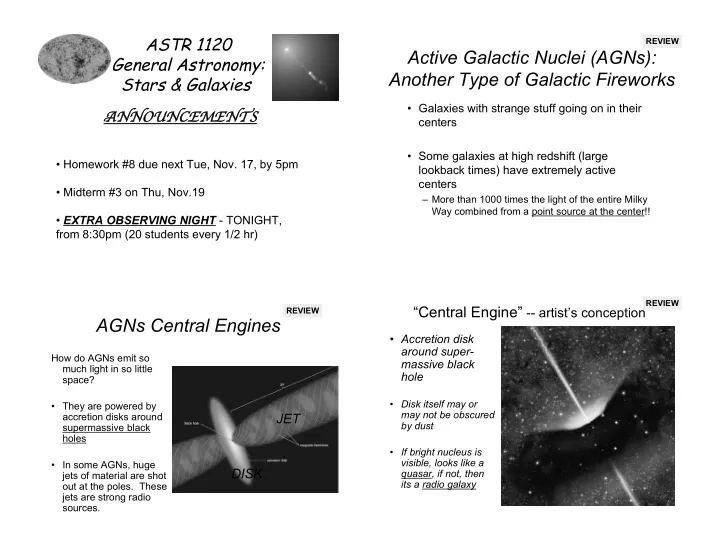
AGNs Central Engines

How do AGNs emit so much light in so little space?

  • They are powered by

accretion disks around supermassive black holes

  • In some AGNs, huge

jets of material are shot

  • ut at the poles. These

jets are strong radio sources.

JET DISK

REVIEW

“Central Engine” -- artist’s conception

  • Accretion disk

around super- massive black hole

  • Disk itself may or

may not be obscured by dust

  • If bright nucleus is

visible, looks like a quasar, if not, then its a radio galaxy

REVIEW

slide-2
SLIDE 2

Cygnus A radio jets

Jet as fine thread, big lobes at end, central hot spot

VLA 400,000 ly

REVIEW

Another example of “central beaming engine”

  • 400 light year wide disk of material in core of elliptical galaxy with radio

jets – looks like a supermassive black hole at work!

active nucleus - HST radio

REVIEW

Do ALL galaxies have supermassive black holes in their centers?

  • likely YES!
  • Linked to the process of galaxy formation
  • More quasars seen in the distant (early)

universe than now

  • Black holes gradually grow, but can run out
  • f available fuel and become nearly

invisible (like in our Milky Way)

Somehow, the rest of the galaxy knows about the SMBH during formation!!

REVIEW

slide-3
SLIDE 3

Resurrected by galaxy collisions?

  • Many galaxies with bright nuclei

show signs of being disturbed

  • Collisions funnel material down

into the black hole lurking at the core

  • Expect more such collisions in

denser early universe

– This may help explain why fewer quasars today

Supermassive black holes at the center

  • f galaxy are believed to be produced
  • A. by the death of supermassive stars
  • B. by mergers of many solar mass black

holes

  • C. during the process of galaxy formation
  • D. soon after the creation of the universe
  • E. by a magician :-)

Clicker Question

Supermassive black holes at the center

  • f galaxy are believed to be produced
  • A. by the death of supermassive stars
  • B. by mergers of many solar mass black

holes

  • C. during the process of galaxy formation
  • D. soon after the creation of the universe
  • E. by a magician :-)

Clicker Question

Next…. more on the..

PAST of the Universe: structure formation FUTURE of the Universe: what is its fate?

slide-4
SLIDE 4

Both our past and our future depend on amount of matter in Universe

  • Past: Birth of galaxies and clusters

– Matter provided the first tugs to assemble galaxies and clusters out of protogalactic

  • clouds. Most of the mass is in dark matter.
  • Future: Fate of the universe

– Is there enough total matter in the universe to reverse the expansion and pull the universe back together again?

Formation of Structure

  • In the beginning:

– Density distribution mostly smooth but very small “ripples” exist in density – Gravity pulls together dark matter in slightly denser regions to form dark halos – “Light” matter radiates energy and sinks to the middle to form galaxies

Numerical simulations of structure formation

  • Simulations show that gravity of dark matter pulls

mass into denser regions – universe grows lumpier with time

– Those “lumps” are galaxy clusters

slide-5
SLIDE 5

vs Real data Computer simulations

  • Agreement is generally pretty good!
  • Despite the fact that we don’t know what the DM is!

Structures in galaxy observations look very similar to the

  • nes found in models in which dark matter is WIMPs

Lessons from Imaginary Universes

  • Cold (Slow) dark matter

works better than hot (fast) dark matter

  • Neutrinos are too fast–

structure would be smeared out

  • What is slow and dark

enough? We don’t know yet!

– Particle experiments under way…..

slide-6
SLIDE 6

What do we mean by “large-scale structures?”

  • A. Massive central dominant elliptical galaxies.
  • B. Massive spiral galaxies with star birth rates

more than 100x that in the Milky Way

  • C. Supermassive black holes that reside at the

centers of galaxies

  • D. Huge walls of galaxies and clusters of galaxies
  • E. The giant architectural structure that is the

engineering building on CU’s campus

Clicker Question

What do we mean by “large-scale structures?”

  • A. Massive central dominant elliptical galaxies.
  • B. Massive spiral galaxies with star birth rates

more than 100x that in the Milky Way

  • C. Supermassive black holes that reside at the

centers of galaxies

  • D. Huge walls of galaxies and clusters of galaxies
  • E. The giant architectural structure that is the

engineering building on CU’s campus

Clicker Question

The Fate of the Universe

  • Expansion begins with the Big Bang (we’ll talk about

this next week)

  • At that point, everything in the universe is flung

apart at outrageous speeds!

  • Several different models for Past and Future

depending upon the amount of dark matter

Some say the world will end in fire Some say with ice From what I’ve tasted of desire I hold with those who favor fire But if I had to perish twice I think I know enough of hate To say that for destruction ice Is also great And would suffice

  • - Robert Frost (1874-1963)

National Poet Laureate

slide-7
SLIDE 7

Predictions of General Relativity Theory (GTR)

  • Einstein in 1917 realized GTR predicted universes in motion,

but preferred `steady state’ – added `cosmological constant’ (CC) as repulsive force in space-time to counteract attractive force of gravity (A fudge factor!)

  • Willem de Sitter (A, Dutch, 1917) solves GTR equations with

no CC and low density of matter: showed universe must expand

  • Alexander Friedmann (M, Russian, 1920) solves GTR with no

CC but any density of matter: universe can expand forever, or collapse again, depending on mean matter density

  • Georges Lemaitre (P, Belgian, 1927) rediscovers Friedmann

solutions, told Hubble (observing redshifts since 1924) that cosmic expansion suggests more distant galaxies should have greater redshifts (Hubble publishes V = Hod in 1929)

  • Einstein visited Hubble in 1932, said CC was “the greatest

blunder” of his career

Very important diagram

“Average distance between galaxies”

measure of “expansion factor

  • f Universe”

Hubble constant NOW sets how fast universe is expanding NOW Big Bang = when distance zero TIME SIZE

NOW

The expansion rate of the universe is not necessarily constant for all time

  • GRAVITY should SLOW

expansion rate deceleration

  • Different models for

different amounts of dark matter

– Let’s ignore accelerating for now

Since gravity is what pulls everything back in, there must be a magic number

  • Just the right amount of mass (in our current universe) to

pull everything back together in an infinite amount of time

  • Just like the exact escape velocity for a rocket fired up
  • We call this exact amount of matter, the CRITICAL

DENSITY ~10-29 grams/cm3 = a few atoms in a closet

slide-8
SLIDE 8

Critical Universe

  • Density of

matter = “critical density”

  • Will expand

forever, but more and more slowly with time

Flat Universe

Recollapsing Universe

  • Dark matter

density is greater than “critical density”

  • Expansion will

stop in the future, will collapse back in

– Big Crunch – Oscillations?

Closed Universe

Coasting Universe

  • The universe

has always expanded at the same rate (no deceleration due to gravity!)

  • The age of the

Universe = 1/Ho

Open Universe

Three models for fates of universe

CLOSED OPEN FLAT

slide-9
SLIDE 9

Which model predicts the largest age for the universe today?

  • A. Recollapsing

(closed)

  • B. Critical

(flat)

  • C. Coasting

(open)

Clicker Question

  • C. Coasting
  • Age of universe

is how far to left curves hit horizontal axis (distance between galaxies = 0)

  • Recollapse to gnaB giB:

– Crushing heat – Destruction of all matter – Rebirth?

  • Eternal expansion:

– Cold, galaxies dimming – Star formation slowing – Everything winds up as a brown dwarf, black dwarf, neutron star or black hole

What is the fate of the Universe? Is there enough dark matter to recollapse the universe?

Baryonic matter: only a few % of critical density Dark matter: only about 25% of what is needed

  • Universe should be in between the “coasting”

and “critical” models

The Universe will expand forever

Which is it?

… and with an unexpected twist…

slide-10
SLIDE 10

A New Twist for the 21st Century

  • Scientists using white

dwarf supernovae to measure distances discovered something quite strange

Using supernovae to determine the fate of the Universe

  • Redshifts of the

supernovae gives their vertical position

– Space has stretched since they gave off their light

  • Apparent

brightness gives their horizontal position

– Dimmer=more distant = high lookback

Supernovae are not consistent even with the expectations of a coasting universe!!!

Universe is accelerating?!?!

How can the universe be accelerating???????

A force that counteracts gravity? “Dark energy”– outweighs every other form of mass/energy! Truly an unknown force in all of physics The Cosmological Constant actually exists!

(Check out “Einstein’s Greatest Blunder” p 679)

slide-11
SLIDE 11

Four models for fates of universe

CLOSED OPEN FLAT ACCELERATING