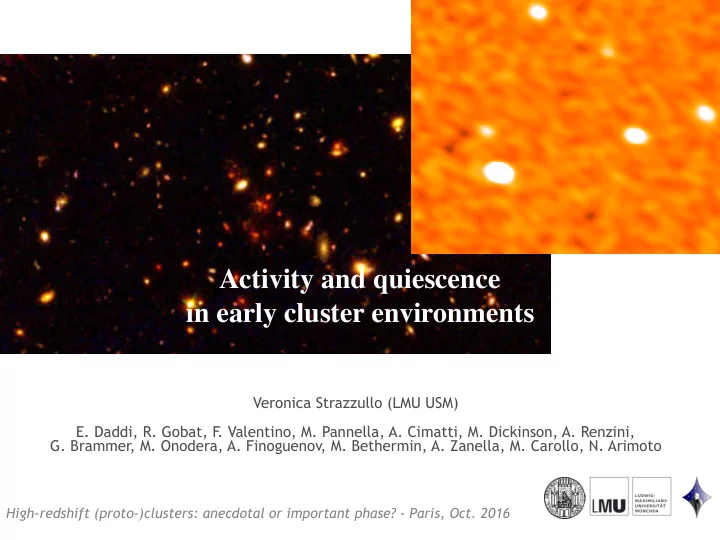
SLIDE 1 High-redshift (proto-)clusters: anecdotal or important phase? - Paris, Oct. 2016
Veronica Strazzullo (LMU USM)
. Valentino, M. Pannella, A. Cimatti, M. Dickinson, A. Renzini,
- G. Brammer, M. Onodera, A. Finoguenov, M. Bethermin, A. Zanella, M. Carollo, N. Arimoto
Activity and quiescence in early cluster environments
SLIDE 2
Brodwin+ 2013
On-going star formation even deep into cluster cores
Cluster galaxies at z≳1.5 – the SF vs quiescent views
Some fraction of already evolved galaxies in the core population
(Tran+2010, Hayashi+2010, Santos+2011, Fassbender+2011, Stanford+2012, Zeimann+2012, Brodwin+2013, Alberts 2013, Bayliss+2014, Stacey+2014, Ma+2014, Santos+2015, Alberts+2016, …) (Kurk+2009, Papovich+2010, Andreon+2011, 2014, Spitler+2012, Stanford+2012, Zeimann+2012, Tadaki+2012,Tanaka+2013ab, Strazzullo+2013, Newman+2014, Cooke+2015, … )
Newman+ 2014
SLIDE 3
Tran+2015 Smail+2014 CIG J0218-0510, z=1.6 (Papovich+2010, Tanaka+2010, Tran+2010, 2015, Rudnick+2012, Smail+2014, Santos+2014, …)
Papovich+2010
…in some cases, within the same cluster
Tran+2010
SLIDE 4
What was the forecast…?
De Lucia+ 2006
Observations to z~1: Simulations:
Gobat+2008 Thomas+2005
Fossil record (z~0): Fossil record (z~1):
MB Mei+ 2009 U-B
Observations to z>2:
SLIDE 5
Cluster diversity and/or mass dependence?
Dependence of galaxy population properties on cluster mass are possible/likely, but younger populations and/or high SF levels found also in very massive clusters
Stanford+2012 Santos+2015
SLIDE 6
Fakhouri+2010
By z≈2, an average mid-1014 M◉ today’s cluster is formally well into group regime…
Brodwin+2012
What clusters ?
SLIDE 7 Strazzullo+13
A „typical“ cluster progenitor, Cl J1449+0856 at z=2
(Gobat+2011, 2013, Strazzullo+2013, Valentino+15,16)
Strazzullo+13
IR-selected, X-ray detected (Gobat+2011). A low-mass structure typical of a massive cluster progenitor at z~2.
morphologically early-type) galaxies in the cluster central region (<200kpc)
- at the same time – and in
contrast with z<1.5 cluster cores – central regions also host still actively star forming sources
SLIDE 8 A „typical“ cluster progenitor, Cl J1449+0856 at z=2
(Gobat+2011, 2013, Strazzullo+2013, Valentino+15,16)
IR-selected, X-ray detected (Gobat+2011). A low-mass structure typical of a massive cluster progenitor at z~2.
morphologically early-type) galaxies in the cluster central region (<200kpc)
- at the same time – and in
contrast with z<1.5 cluster cores – central regions also host still actively star forming sources
Strazzullo+13
SLIDE 9
A further look at galaxy populations in Cl J1449+0856:
Strazzullo+in prep.
200 kpc
SLIDE 10
Red sequence seeds at z~2
A clear, small population of red sources …
SLIDE 11
Red sequence seeds at z~2
… mostly seemingly quiescent galaxies
SLIDE 12
Red sequence seeds at z~2
… clearly segregated deep into the cluster center
r<150 kpc
SLIDE 13
Red sequence seeds at z~2
Statistically subtracted CMD - (largely) independent of individual membership determination.
(… independent of photo-zs… )
SLIDE 14
Red sequence seeds at z~2
Statistically subtracted CMD - (largely) independent of individual membership determination.
r<150 kpc
Quite a clear signature of the inner, densest cluster core
SLIDE 15
Red sequence seeds at z~2
SLIDE 16
- Further constrains BCG complex
- All but one sources on the bright red-sequence are undetected at
870μm (<2σ, ~40M⊙/yr) ➜ would suggest suppressed SF for most massive red galaxies
A different viewpoint – a 10x overdensity of ALMA 870μm sources
SLIDE 17
- Further constrains BCG complex
- All but one sources on the bright red-sequence are undetected at
870μm (<2σ, ~40M⊙/yr) ➜ would suggest suppressed SF for most massive red galaxies
A different viewpoint – a 10x overdensity of ALMA 870μm sources
SLIDE 18 A different viewpoint – a 10x overdensity of ALMA 870μm sources
One bright red-sequence source 870μm-detected: new cycle 3
- bservations of CO(4-3) confirm it at the cluster redshift.
SLIDE 19
BCG building site…
At the cluster center, a complex of multiple sources, apparently a mixture of star-forming and suppressed/quiescent galaxies, is likely the future BCG still in its build-up phase.
r∼1.8“, ~15 kpc F105W F140W Ks quiescent SF/suppressed? 870μm-source, ~200 M⊙/yr
SLIDE 20
- In densest regions of (one, supposedly) ordinary cluster progenitor
environment(s), some massive galaxies are already evolved and make for a first red sequence seedling at z~2. This population is confined to the very central cluster region.
- Star formation is still occurring even deep into the cluster core -
different selections and observations highlight different aspects of a likely diverse galaxy population. Among the points deserving further thought:
- the link between suppression of star formation and densest
environments at this redshift - this tells something more/different than environmental effects due to few/several billion years spent in a massive hot halo
- stellar populations of passive cluster galaxies vs field analogs -- at z≈2
SLIDE 21 Following up on two crucial issues (for galaxy population studies):
- probe established, massive clusters, at the high extreme of the density range
- avoid cluster selection biases involving galaxy population properties
Five very massive (M200≳5x10¹⁴M⊙) SZ-selected clusters at z≥1.4
(only very few confirmed such massive structures found to date at this redshift, by different means (X-ray, SZ, red galaxies, Rosati+2009, Santos+2011/Tozzi+2015, Stanford+2012/ Brodwin+2012,2015, Andreon+2009,2014, Bleem+2015/Bayliss+2014, Mantz+2015)
0.0 0.5 1.0 1.5 1 10 SPT-SZ 2500 deg2 ROSAT-All sky Planck-DR1 ACT
Redshift
M500c [1014 MO
Quick ad – Galaxy populations in the high-z SPT tail
with J. Mohr, M. Pannella, A. Saro, M. Ashby, S.A. Stanford and SPT-clusters
Bleem+2015
SLIDE 22 Following up on two crucial issues (for galaxy population studies):
- probe established, massive clusters, at the high extreme of the density range
- avoid cluster selection biases involving galaxy population properties
- A complete sample of massive distant clusters over 2500 deg2, among the
few most massive clusters known at these redshifts
- Cluster selection independent of cluster galaxies - ideally suited for
galaxy populations studies
- High cluster mass ideal for probing environmental effects on galaxy
populations in most massive haloes, and to improve statistics
- A dedicated deep optical/NIR follow-up with HST (F105+F140, 2+1
- rbits) & Spitzer (3.6+4.5𝜈m, 6000-8000s per channel).
Quick ad – Galaxy populations in the high-z SPT tail
with J. Mohr, M. Pannella, A. Saro, M. Ashby, S.A. Stanford and SPT-clusters
SLIDE 23 Star formation and quenching
- quiescent fraction
- environmental
dependence of stellar populations
Stellar mass assembly
to M*+3
and mass assembly at z>1.3
Structural evolution
- morphological vs. stellar
population properties in dense environments
environmental dependence
Composite LF simulation Wylezalek+2014 Newman+2014 Wang+ 2016 Alberts+ 2016
A first, „minimal“ 4-bands study…
SLIDE 24
z~1.4 z~1.5 z~1.7
first-look, preliminary!
SLIDE 25
SPT-CLJ2040 z=1.48
full WFC3 field core (<280 kpc) >280 kpc