SLIDE 1
Activity
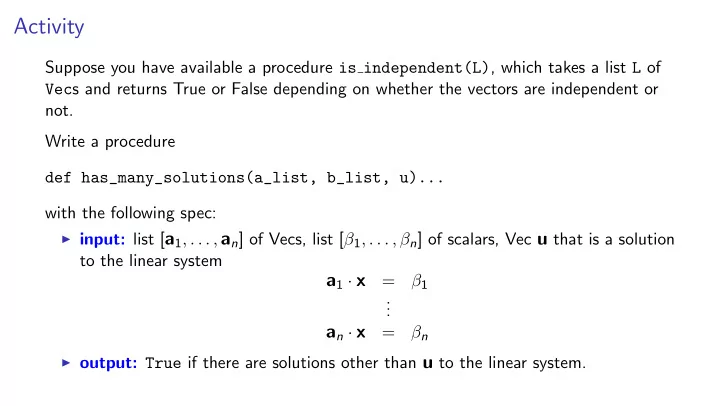
Suppose you have available a procedure is independent(L), which takes a list L of Vecs and returns True or False depending on whether the vectors are independent or not. Write a procedure def has_many_solutions(a_list, b_list, u)... with the following spec:
I input: list [a1, . . . , an] of Vecs, list [β1, . . . , βn] of scalars, Vec u that is a solution
to the linear system
a1 · x
= β1 . . .
an · x
= βn
I output: True if there are solutions other than u to the linear system.
SLIDE 2
Activity
So far we’ve done paths = spanning and cycles = linearly dependent over GF(2). How would you achieve the same over R?
SLIDE 3
Properties of linear (in)dependence
Linear-Dependence Lemma Let v1, . . . , vn be vectors. A vector vi is in the span of the other vectors if and only if the zero vector can be written as a linear combination of v1, . . . , vn in which the coefficient of vi is nonzero. Contrapositive:
vi is not in the space of the other vectors
if and only if for any linear combination equaling the zero vector
0 = α1 v1 + · · · + αi vi + · · · + αn vn
it must be that the coefficient αi is zero.
SLIDE 4
Analyzing the Grow algorithm
def Grow(V) S = ∅ repeat while possible: find a vector v in V that is not in Span S, and put it in S. Grow-Algorithm Corollary: The vectors obtained by the Grow algorithm are linearly independent. In graphs, this means that the solution obtained by the Grow algorithm has no cycles (is a forest).
SLIDE 5
Analyzing the Grow algorithm
Grow-Algorithm Corollary: The vectors obtained by the Grow algorithm are linearly independent. Proof: For n = 1, 2, . . ., let vn be the vector added to S in the nth iteration of the Grow algorithm. We show by induction that v1, v2, . . . , vn are linearly independent. For n = 0, there are no vectors, so the claim is trivially true. Assume the claim is true for n = k − 1. We prove it for n = k. The vector vk added to S in the kth iteration is not in the span of v1, . . . , vk−1. Therefore, by the Linear-Dependence Lemma, for any coefficients α1, . . . , αk such that
0 = α1v1 + · · · + αk−1vk−1 + αkvk
it must be that αk equals zero. We may therefore write
0 = α1v1 + · · · + αk−1vk−1
By claim for n = k − 1, v1, . . . , vk−1 are linearly independent, so α1 = · · · = αk−1 = 0 The linear combination of v1, . . . , vk is trivial. We have proved that v1, . . . , vk are linearly independent. This proves the claim for n = k. QED
SLIDE 6
Analyzing the Shrink algorithm
def Shrink(V) S = some finite set of vectors that spans V repeat while possible: find a vector v in S such that Span (S − {v}) = V, and remove v from S. Shrink-Algorithm Corollary: The vectors obtained by the Shrink algorithm are linearly independent. In graphs, this means that the Shrink algorithm outputs a solution that is a forest. Recall: Superfluous-Vector Lemma For any set S and any vector v ∈ S, if v can be written as a linear combination of the other vectors in S then Span (S − {v}) = Span S
SLIDE 7 Analyzing the Shrink algorithm
Shrink-Algorithm Corollary: The vectors obtained by the Shrink algorithm are linearly independent. Proof: Let S = {v1, . . . , vn} be the set of vectors obtained by the Shrink algorithm. Assume for a contradiction that the vectors are linearly dependent. Then 0 can be written as a nontrivial linear combination
0 = α1v1 + · · · + αnvn
where at least one of the coefficients is nonzero. Let αi be one of the nonzero coefficients. By the Linear-Dependence Lemma, vi can be written as a linear combination of the
Hence by the Superfluous-Vector Lemma, Span (S − {vi}) = Span S, so the Shrink algorithm should have removed vi. QED
SLIDE 8 Basis
If they successfully finish, the Grow algorithm and the Shrink algorithm each find a set
- f vectors spanning the vector space V. In each case, the set of vectors found is
linearly independent. Definition: Let V be a vector space. A basis for V is a linearly independent set of generators for V. Thus a set S of vectors of V is a basis for V if S satisfies two properties: Property B1 (Spanning) Span S = V, and Property B2 (Independent) S is linearly independent. Most important definition in linear algebra.
SLIDE 9
Basis: Examples
A set S of vectors of V is a basis for V if S satisfies two properties: Property B1 (Spanning) Span S = V, and Property B2 (Independent) S is linearly independent. Example: Let V = Span {[1, 0, 2, 0], [0, −1, 0, −2], [2, 2, 4, 4]}. Is {[1, 0, 2, 0], [0, −1, 0, −2], [2, 2, 4, 4]} a basis for V? The set is spanning but is not independent 1 [1, 0, 2, 0] − 1 [0, −1, 0, −2] − 1 2 [2, 2, 4, 4] = 0 so not a basis However, {[1, 0, 2, 0], [0, −1, 0, −2]} is a basis:
I Obvious that these vectors are independent because each has a nonzero entry
where the other has a zero.
I To show
Span {[1, 0, 2, 0], [0, −1, 0, −2]} = Span {[1, 0, 2, 0], [0, −1, 0, −2], [2, 2, 4, 4]}, can use Superfluous-Vector Lemma: [2, 2, 4, 4] = 2 [1, 0, 2, 0] − 2 [0, −1, 0, −2]
SLIDE 10
Basis: Examples
Example: A simple basis for R3: the standard generators
e1 = [1, 0, 0], e2 = [0, 1, 0], e3 = [0, 0, 1].
I Spanning: For any vector [x, y, z] ∈ R3,
[x, y, z] = x [1, 0, 0] + y [0, 1, 0] + z [0, 0, 1]
I Independent: Suppose
0 = α1 [1, 0, 0] + α2 [0, 1, 0] + α3 [0, 0, 1] = [α1, α2, α3]
Then α1 = α2 = α3 = 0. Instead of “standard generators”, we call them standard basis vectors. We refer to {[1, 0, 0], [0, 1, 0], [0, 0, 1]} as standard basis for R3. In general the standard generators are usually called standard basis vectors.
SLIDE 11
Basis: Examples
Example: Another basis for R3: [1, 1, 1], [1, 1, 0], [0, 1, 1]
I Spanning: Can write standard generators in terms of these vectors:
[1, 0, 0] = [1, 1, 1] − [0, 1, 1] [0, 1, 0] = [1, 1, 0] + [0, 1, 1] − [1, 1, 1] [0, 0, 1] = [1, 1, 1] − [1, 1, 0] Since e1, e2, e3 can be written in terms of these new vectors, every vector in Span {e1, e2, e3} is in span of new vectors. Thus R3 equals span of new vectors.
I Linearly independent: Write zero vector as linear combination:
0 = x [1, 1, 1] + y [1, 1, 0] + z [0, 1, 1] = [x + y, x + y + z, x + z]
Looking at each entry, we get = x + y = x + y + z = x + z Plug x + y = 0 into second equation to get 0 = z. Plug z = 0 into third equation to get x = 0. Plug x = 0 into first equation to get y = 0. Thus the linear combination is trivial.
SLIDE 12
Basis: Examples in graphs
Athletic Complex Main Quad Pembroke Campus Keeney Quad Wriston Quad Bio-Med Gregorian Quad Pem Bio-M
One kind of basis in a graph G: a set S of edges forming a spanning forest.
I Spanning: for each edge xy in G, there is an x-to-y path consisting of edges of S. I Independent: no cycle consisting of edges of S
SLIDE 13
Towards showing that every vector space has a basis
We would like to prove that every vector space V has a basis. The Grow algorithm and the Shrink algorithm each provides a way to prove this, but we are not there yet:
I The Grow-Algorithm Corollary implies that, if the Grow algorithm terminates, the
set of vectors it has selected is a basis for the vector space V. However, we have not yet shown that it always terminates!
I The Shrink-Algorithm Corollary implies that, if we can run the Shrink algorithm
starting with a finite set of vectors that spans V, upon termination it will have selected a basis for V. However, we have not yet shown that every vector space V is spanned by some finite set of vectors!.
SLIDE 14 Computational problems involving finding a basis
Two natural ways to specify a vector space V:
- 1. Specifying generators for V.
- 2. Specifying a homogeneous linear system whose solution set is V.
Two Fundamental Computational Problems: Computational Problem: Finding a basis of the vector space spanned by given vectors
I input: a list [v1, . . . , vn] of vectors I output: a list of vectors that form a basis for Span {v1, . . . , vn}.
Computational Problem: Finding a basis of the solution set of a homogeneous linear system
I input: a list [a1, . . . , an] of vectors I output: a list of vectors that form a basis for the set of solutions to the
system a1 · x = 0, . . . , an · x = 0