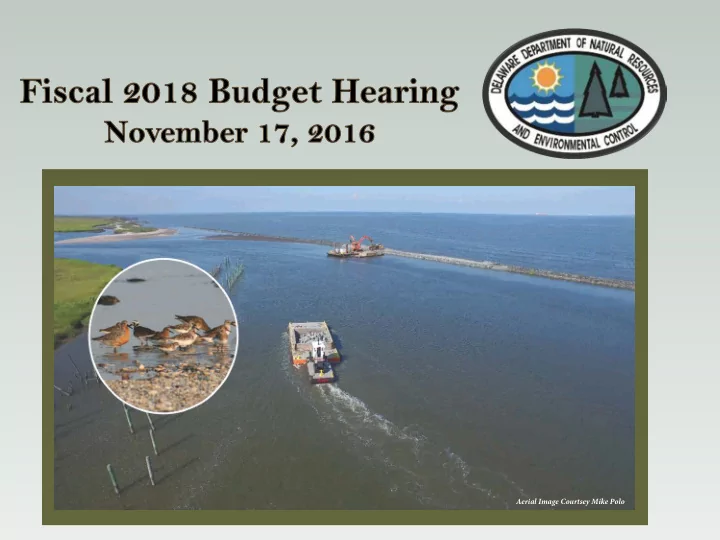
SLIDE 1 Aerial Image Courtsey Mike Polo
SLIDE 2 DNREC OPERATING BUDGET
- FY2017 General Fund Budget
$38,023,800
- FY2018 request to support:
- State Salary Policy Contingency
$ 744,100
- New Operations at Michael Castle Trail (C & D Canal)
$ 197,200
- Statewide Tick Control Program
$ 140,900
- Youth Conservation Corps & Children in Nature
$ 72,300
- Network Infrastructure Support
$ 167,000
- Structural Changes and FTE Movements (related to ITC)
($ 209,000)
- FY2018 General Fund Budget Request
$39,136,300
- Other Requests: FY2018 Appropriated Special Fund Adjustments for Fish &
Wildlife, Waterway Mgmt. and RGGI - Spending Authority Only.
- As per the Budget Guidance, proposed 1% reductions
($70,400) from GF appropriations across DNREC in contractual, supply, TMDL and Energy Assistance that would result in reduced services and delayed projects.
SLIDE 3 FISCAL YEAR 2018 GENERAL FUND REQUESTED BUDGET: $39,136,300
Personnel Costs $29,967.9 Travel $11.8 Contractual, 3,799.4 Energy $1,619.0 Supplies $938.3 Capital Outlay $46.2 Other Items $2,753.7
Pe rso nne l Co sts T ra ve l Co ntra c tua l E ne rg y Supplie s Ca pita l Outla y Othe r I te ms
SLIDE 4 FISCAL 2018 REQUESTED BUDGET
ASF $112,485,000 56% NSF $47,599,900 24% GF $39,136,300 20%
Total of All Funds: $199,221,200
ASF (Authority Only) NSF (Authority Only) GF
SLIDE 5 DNREC GF BUDGET HISTORY
0.0 5,000.0 10,000.0 15,000.0 20,000.0 25,000.0 30,000.0 35,000.0 40,000.0 45,000.0 50,000.0
Thousands $$
GF > 11-Year Avg.
SLIDE 6 DNREC POSITION HISTORY
100 200 300 400 500 600 700 800 900 FY07 FY08 FY09 FY10 FY11 FY12 FY13 FY14 FY15 FY16 FY17 FY18 Req TOTAL FILLED
REQUESTED FY2018 BUDGET
* Of the 768 FTE total positions, 691 are currently filled for FY2017.
> 11-Year Total Avg. > 11-Year Filled Avg.
SLIDE 7 MICHAEL CASTLE TRAIL - $197.2K
Legacy – First State Trails & Pathways Initiative DNREC & DelDOT:
- 42.5 miles of trails have been built with another
22 miles pending construction
- An investment of $29.16 million has been made
- n connecting communities
- Nearly 40% of Delaware’s population live within
a 10-minute bike ride of a trail
- More than 255,000 visitors have biked/hiked the
Michael Castle Trail since the trail’s opening in 2013 Fiscal 2018 Request:
- Third and final phase – due south of Lums
Pond State Park, east & west of Rt 896
- ~2.9 miles and a third trailhead with
parking and restrooms
- Operating funds will provide for daily
- perations, maintenance and public safety.
SLIDE 8
SLIDE 9 STATEWIDE TICK CONTROL PROGRAM - $140.9K
- Funding HB 290 for DNREC to implement Tick Control and Lyme Disease prevention
elements of the June 1, 2015 General Assembly Task Force Report.
- Involves statewide development and implementation of a science-based Integrated Pest
Management (IPM) strategy.
- Expected performance:
- Prudent pesticide use on public lands
- Engage biological controls
- Research tick-host animal relationship
- Recommend backyard habitat management
practices
- Educate public about tick problems and
control
- Anticipated Results:
- Reduce exposure to tick bites
- Lower the incidence of Lyme Disease
and other tick-borne maladies
SLIDE 10 YOUTH CONSERVATION CORPS & CHILDREN IN NATURE $72.3K
Fiscal 2018 Request:
- High-quality practical work experience for
young people through environmental and park-focused activities;
- Outdoor learning opportunities;
- Job and/or college preparation.
Legacy – Children in Nature:
- Fulfilled the Children in Nature
Task Force recommendations and launched a Youth Conservation Corps for teenagers
- In 2016 the Corps expanded
statewide with more than 40 members
SLIDE 11 NETWORK INFRASTRUCTURE SUPPORT - $167K
- Provides vital connectivity for internal use and for customers and constituents
who rely on environmental information.
- Supports 2,500+ annual software licenses and ensures current technology
standards are met to maintain >230 environmental and recreational applications that require a variety of data classifications to include public, confidential and legally protected data.
SLIDE 12 STRENGTHENING COMMUNITY PARTNERSHIPS
DCEC
Keeping it Clean and Green
SLIDE 13 LEGACY: OUR CONSERVATION ECONOMY
Redevelopment of Strategic Sites - NVF is unique model where state and private sector are co-developing a residential and destination community that includes lands for recreational use. Delaware Bayshore – Protected1,614 acres -- total 120,000
- acres. Enhanced public access, and habitat restoration
Land Conservation/Ecological Preservation - Through 104 projects 7,721 acres have been protected through the Open Space Program Delaware Wildlife Action Plan- Conservation partners, state and regional wildlife experts, key stakeholders and with public input, developed Plan that assessed wildlife and habitats, identified the challenges they face, and outlined actions needed for conservation. Waterway Management- New legislation allocates increased revenue from boat registration to Waterway Management Fund to keep channels open and safe Reef Program - 2011 sinking of the Navy destroyer, Arthur W . Radford. At 565’ longest vessel reefed along the Atlantic Coast
SLIDE 14 Clean Energy - Delaware’s power sector has been completely transformed under the Markell administration. Nine of the state’s 10 “dirtiest” power plants have been shut down
- r switched fuel to cleaner energy sources, while the one remaining coal-fired unit installed
$300 million in pollution controls. Reduced annual emissions of sulfur dioxide, oxides of nitrogen, and mercury by more than 90% and significantly reducing in-state particulates
CLEANER, CHEAPER AND MORE RELIABLE ENERGY
Alternative-Fueled Transportation - In the first 14 months, more than 215 rebates for electric vehicles to Delaware residents and businesses result in reducing over 1.8 million pounds of carbon dioxide per year from entering the atmosphere. Energy Efficiency Investment fund (EEIF) - has helped fund over 380 projects, leveraged $33M+ in private investments since 2012, and saved >62 million kwh per year. These energy savings translate into a combined savings of over $6.2 million each and every year – often for 10 years or more. EO 18 -- DNREC implemented conservation measures and changes in the R&R Building that reduced energy use by 54%; saved ~$650k; and reduced emissions by 54%. LEED certified
SLIDE 15
Universal Recycling -- Diversion rate is 43% -
higher than the national rate of 34.3%, as reported by EPA.
SUPPORTING SAFE AND SUSTAINABLE COMMUNITIES
Brownfields -- There have been 166 Brownfield sites
certified during the Markell administration with 93 under active remediation; 26 completed; and 47 completed
Heating Fuel Underground Storage Tank Closure Assistance - Since March 2015 DNREC has received 458
applications for UST assistance from homeowners. 411 removals have been completed Since 2009, more than $35 million invested to bring properties back into productive use and increase the Delaware tax base. Sites include the Wilmington Riverfront area, key redevelopment sites in northeast Wilmington and the former Berry Plastics Site in Harrington.
SLIDE 16
First State Trails and Pathways Initiative (w/DelDOT) - World-class statewide network of new pathways and trails for citizens and visitors for biking, hiking, walking and active living. Created jobs, both in construction and recreation-related businesses, and has steered Delawareans toward healthy activity. Regional and national recognition
SUPPORTING HEALTHY FAMILIES
Children In Nature - Thousands of children across Delaware have benefited from increasing opportunities to take part in outdoor activities Outdoor Recreation, Parks & Trails Program - Provided nearly $5.5 million in matching assistance to 24 municipal and county agencies in the state. Recreational Assets and Amenities - By leveraging federal grants and private funding, Delaware State Parks has invested more than $35 million in park infrastructure, resulting in a 19 percent increase in campground occupancy between 2014 and 2015.
SLIDE 17 Ocean Coast Beach Protection - $7B coastal economy Sustaining and improving our clean beaches in Delaware has been a priority. Emphasis on shoreline resiliency through beach nourishment to protect lives and infrastructure at the same time bolstering the status of recreational beaches.
IMPROVING DELAWARE’S PREPAREDNESS
Climate Vulnerability and Sea Level Rise Adaptation - Delaware is a recognized leader in climate change planning -
- made strides by developing the plans and tools for making
strategic decisions for the future. Dam Safety and Rehabilitation – Coordinated program with DOT to leverage state and federal funds. Priority based on assessment of state’s highest risk dams. Drainage and Flood Abatement - Studies performed along 247 miles of stream to support more accurate flood risk mapping to try and reduce flood insurance for some River/Bay Coast Protection - Five historic levees that provide the first line of defense for much of the City of New Castle against Delaware Bay storm surges were repaired and
- upgraded. The road/pathway atop the levees has also been reconstructed for recreational use
by the public.
SLIDE 18 Watershed Improvements - Through partnerships within the state’s major watersheds, focus has shifted to better controlling stormwater and runoff through restoration and green technologies such as living shorelines, rather than hardened structures such as those built with riprap.
ENSURING CLEAN WATER
Watershed Approach to Toxics Assessment & Restoration (WATAR) -Accelerated the cleanup of toxics in Delaware's surface waters, sediments and fish by using innovative assessment methods and clean up
- technologies. Projects include Mirror Lake in Dover
and Little Mill Creek in Elsmere Water Infrastructure with DHSS and Finance - Combined funding of in the Clean Water State Revolving Fund and the Drinking Water State Revolving Fund, and the 21st Century Fund, critical projects to help farmers, homeowners, municipalities and counties were built or designed. Septic system replacements, farming best management practices, and repair and expand wastewater facilities, flooding and stormwater and erosion control projects; drinking water well protection; water quality protection of bays, rivers and streams; and energy efficiency improvements at wastewater facilities. Projects saved taxpayers money and improved water quality.
SLIDE 19 FISCAL 2016 LAND ACQUISITION
- 20 projects across all counties
- 1,599 additional acres
- $5.9M leveraged funds
SLIDE 20 FY2018 CAPITAL BUDGET REQUEST ~$53.1M
- Shoreline and Waterway Management
$7,500,000
3,000,000
- Conservation Reserve Enhancement Program (CREP)
500,000
- Clean Water State Revolving Fund
1,400,000
1,400,000
- Park and Wildlife Area Critical Facilities
8,500,000
1,500,000
3,000,000
- Resource Conservation and Development (RC&D)
3,000,000
- Redevelopment of Strategic Sites (NVF and Fort DuPont)
5,500,000
- Coastal Impoundments and Water Control Structure Rehab
587,500
- Killens Pond Waterpark Improvements
3,500,000
- Delaware Bayshore Initiative
500,000
- Critical Equipment for Operations
2,726,300
- Permitting, Registration & Licensing Technology
3,300,000
500,000
- Minor Capital Improvements for Operations
1,500,000
1,000,000
- Customer Relationship Management Technology
1,000,000
- Phase I Refitting of the Env. Lab in the R&R Building
902,426
500,000
500,000
- Consolidation of Dover Campus Offices
1,300,000
SLIDE 21
- Managed lands = over 103,300 acres
- Recreational areas = 32 park and wildlife areas, 10 preserves, 124 other
conservation easements, Brandywine Zoo, Baynard Stadium
- Wildlife Recreation Participants = ~423,000
- Freshwater ponds and marine fishing access areas = 58
- Miles of roads = 100+
- Miles of trails = 244
- Miles of managed shoreline = 56
- State-owned dams = 42
- Tax ditches = 2,000 miles
- Park Visitors = >5.5 million visitors
- Students/Educators (served) = 51,500+
- Anglers (registered) = 118,700
- Hunters (registered) = 21,393
- Boaters (registered) = 59,337
- Waterways = 71 miles
FOCUSED ON PROTECTING AND ENHANCING DELAWARE’S NATURAL RESOURCES AND CAPITAL INVESTMENTS
SLIDE 22 SHORELINE AND WATERWAY MANAGEMENT - $7.5M
CRITICAL INFRASTRUCTURE INVESTMENTS
Supports:
- Ocean and Bay Beach nourishment
- Erosion control and Dune maintenance
- Storm repair and clean up
- Cost share for federal beach nourishment
- UD Citizens Monitoring of water quality
- Channel dredging and beneficial use
- Navigational markings and debris removal
- Macro-algae harvesting
Benefits:
- Protection from flooding & storms
- Provides safe navigation for boaters
- Improves water quality
- Coastal economy generates $7 billion
annually and employs ~60,000
SLIDE 23 SHORELINE AND WATERWAY
Projects Underway:
- Rehoboth/Dewey Nourishment w/USACE
- Massey’s Channel Design and Permitting
- Broadkill Beach Dune Fencing and
Crossings
- Indian River & Marina Dredging and Sand
Bypass Facility Improvements
- UD College of Marine Studies Harbor
Maintenance Dredging Upcoming Projects:
- Bethany/South Bethany Nourishment
Fenwick Nourishment
- Bowers Nourishment & S. Bowers Jetty
- Ocean Beach Maintenance
- Massey’s Channel Dredging
- Lewes-Rehoboth Canal Dredging
- Assawoman Canal Maintenance
Dredging
- Augustine Beach Boat Ramp
Maintenance Dredging
Photograph Courtsey of Kevin Fleming
SLIDE 24 CRITICAL INFRASTRUCTURE INVESTMENTS
CONSERVATION COST SHARE - $3.0M
- For every $1 of State Cost Share, $5.78 in federal
and private dollars are invested to BMPs.
- Planted 55,474 acres of cover crop with available
resources in 2015
- Annually reduced total nitrogen by 522,914
pounds, total phosphorus by 1,087 pounds
SLIDE 25 CONSERVATION RESERVE ENHANCEMENT PROGRAM (CREP) - $500K
CRITICAL INFRASTRUCTURE INVESTMENTS
Supports:
- $500k investment leverages $1.5M of Federal USDA funds
- Removes up to 20,000 acres of marginal agriculture lands from production and enrolls
the acreage in conservation practices Benefits
- Reduce nutrient and sediment loads to impaired
waterbodies of Delaware
- Improves aquatic temperature and dissolved
- xygen criteria necessary to support biology and
wildlife
- Increase upland wildlife habitat and create
wildlife corridors
SLIDE 26 CLEAN WATER STATE REVOLVING FUND - $1.4M
CRITICAL INFRASTRUCTURE INVESTMENTS
CWSRF Capitalization Grant Required Match:
- Anticipating $7M in federal funding
- Loan applications received for FY2017 = $115M
- Program has leveraged >$268M in federal dollars since
inception and closed on 84 municipal loans for nearly $324M Benefits:
- Reduces costs of financing
- Protects water quality and
public health
- Supports local economies
- Creates and supports
thousands of jobs
SLIDE 27 TAX DITCH / PUBLIC DITCH - $1.4M
CRITICAL INFRASTRUCTURE INVESTMENTS
Provides support to 240 organizations on more than 2,000 miles of drainage infrastructure, channels, and related water management projects statewide:
- Planning, surveying & engineering
- Permitting and construction inspections
SLIDE 28 SUPPORTING HEALTHY FAMILIES - INVESTING IN RECREATIONAL ASSETS
PARK AND WILDLIFE AREA CRITICAL FACILITY REHABILITATION - $8.5M
- Facility Maintenance
- Road & Parking Rehabilitation
- Historical Structure Repairs
- Critical Roofing
- Utility Infrastructure
- Recreational Access
SLIDE 29
PARK AND WILDLIFE AREA CRITICAL FACILITY REHABILITATION
SLIDE 30 DAM AND DIKE REPAIR/REPLACEMENT - $1.5M
CRITICAL INFRASTRUCTURE INVESTMENTS
- Provides emergency planning, monitoring,
engineering, and maintenance repairs to state-
- wned dams in partnership with DelDOT
- Provides for investigation and minor repairs to
state dikes
- Protects communities and infrastructure
- Highest priority projects:
- Hearns and Records
- Garrison Lake
- Chipmans Pond
- Concord Pond
- Craigs Mill Pond
- Mudmill Pond
SLIDE 31 TRAILS AND PATHWAYS - $3.0M
SUPPORTING HEALTHY FAMILIES
2017-2018 Priorities DNREC trail projects in design or construction include:
- White Clay Creek SP - Tri-Valley Trail
- Lums Pond SP - Buck Jersey Pathway
- Killens Pond State Park - pedestrian
bridge connector
- Auburn Heights Preserve
- Cape Henlopen SP – east leg of the
Georgetown-Lewes-Cape Trail
- Holts Landing SP – trail loop connector bridge
- Assawoman Canal Trail - Phase 2, Route 26
Underpass
- Augustine WA - Lang Marsh Loop
- Aquatic Resource Education Bayshore - Taylors
Gut Trail
- Little Creek Wildlife Boardwalk & Loop Trail
SLIDE 32 21ST CENTURY (RC&D) - $3M
CRITICAL INFRASTRUCTURE INVESTMENTS
Provide continued funding for engineering and construction
projects:
completed since 1996 ($61M)
- More than 700 projects approved
in all counties for funding
- All current funding will be fully
- bligated in fiscal 2017.
SLIDE 33 PRESERVING NATURAL HERITAGE & EXPANDING ECOTOURISM
REDEVELOPMENT OF STRATEGIC SITES - $3M
NVF:
- Remediated more than 233 tons of contaminates
in the soils and groundwater (with HSCA funds)
- Continue to stabilize/rehabilitate key structures
- Continue to develop recreational amenities
- Expand open space and trails
- Establish wetland areas and flood mitigation
SLIDE 34 Fort DuPont Redevelopment and Preservation Corporation - $2.5M
- Created July 2014 through HB310
- Charged with the management,
preservation and development of the Fort DuPont
- Development plans underway include:
- The restoration of 7 residences
- Site design and engineering – phase
1 includes 91 homes.
- Infrastructure improvements
- The design of a new marina
Fiscal 2017 Funding Request:
- $ 250k -Administrative Expenses
- $ 130k -Property Management
- $2.12M -Restoration of the historic War Theater;
Remediation of the Mortar Bunker; & Additional Residence Restorations
- Funds will leverage historic tax credits
SLIDE 35 CRITICAL INFRASTRUCTURE INVESTMENTS
COASTAL IMPOUNDMENT & WATER CONTROL STRUCTURE REHABILITATION - $587.5K
- Opportunities to leverage federal funds
- Priority Structures in Augustine, Woodland
Beach, Little Creek, Ted Harvey, and Assawoman Wildlife Areas Coastal Impoundments:
- Nourish beach habitats
- Protect shoreline from storm
surge
wetlands
- Protect recreational areas
- Reduce flooding and protect
transportation infrastructure
SLIDE 36
KILLENS POND WATERPARK PHASE II-$3.5M
SLIDE 37 PRESERVING NATURAL HERITAGE & EXPANDING ECOTOURISM
DELAWARE BAYSHORE INITIATIVE - $500K
2018 Priorities Include:
- Augustine Wildlife Are Cooper-Cross Wildlife Viewing Boardwalk and Platform
- Augustine Wildlife Area Lang Marsh Loop
- Little Creek Wildlife Viewing Boardwalk and Platform, Trail and Bayshore Visitor Center
- Aquatic Resource Education – Taylors Gut Bayshore Trail
- Kiosk, roadway wayfinding signs, interpretive signs
SLIDE 38 CRITICAL EQUIPMENT - $2,726.3M
- Environmental and natural resource
- perations
- Conservation, protection and research
activities
- Public services and infrastructure
- ~103,000 acres of public land
- 58 freshwater ponds and marine
fishing / boating access areas
- 71 miles of Delaware waterways
- Coastal and bay shoreline
- Environmental laboratory services
SLIDE 39 OTHER KEY INVESTMENTS
- Little Creek Boat Ramp - $500K
- Minor Capital Improvements – $1.5M
SLIDE 40 OTHER KEY INVESTMENTS Cape Pier Design - $1 M
- Closed in October 2014 due to
structural integrity.
- All-wooden pier was built
during World War II by the US Army.
- Several rehabilitative efforts
have been undertaken since 2007 as short-term fixes, including repairs completed in 2015.
recreational pier in the region
- $1M requested would provide
for site investigation, design and engineering of a new pier.
SLIDE 41 OTHER KEY INVESTMENTS
- Fort Miles - $500K
- Debris Pits - $500K
SLIDE 42
- Consolidation of applications, where possible, will reduce the overhead associated with duplicative
applications, reduce technical support requirements, increase efficiencies by focusing on citizen needs by utilizing current technology.
- One critical example – the current F&W license and registration applications is over 10 years old
and manages 350,000 licenses/permits and all sales revenue for over $10M in annual federal support.
- Current systems reside on multiple platforms built up over years with web frontends added as each
group came online and requires costly upgrades to meet state and industry standards (Server 2003) without enhanced functionality.
- Replacement solution will standardize the platform and increase administration and cost efficiencies
- New solution will ensure compliance with:
- Interstate Wildlife Violator Compact (IWVC)
- DE Criminal Justice Information System (DELJIS)
- DHSS Child Support- Revocation/Suspension Program
- Federal reporting requirements
DEPARTMENT-WIDE PERMITTING, LICENSING, REGISTRATION & DATA COLLECTION TECHNOLOGY - $3.3M
Over decades DNREC has developed customized software solutions, many of them singular in nature, resulting in a large portfolio of 236 applications. Across DNREC there are ~42 individual applications that serve similar customer and data functions.
SLIDE 43 CUSTOMER RELATIONS MANAGEMENT (CRM) TECHNOLOGY DEVELOPMENT - $1M
- The CRM approach analyses
data about customers' historical interaction with a department and seeks to improve relationships and interactions with customers.
customer profile would allow customers to logon to a portal and have a shopping cart experience, where they provide their information just once, and then are able to make use
- f DNREC’s services across
the department in a seamless manner.
SLIDE 44
QUALIFIED, DEDICATED STAFF
SLIDE 45
DNREC VOLUNTEERS
SLIDE 46 DEL ELAWARE’S ’S GOOD NATURE D DEPENDS O ON YOU!
Photograph Courtsey of Chris Bennett