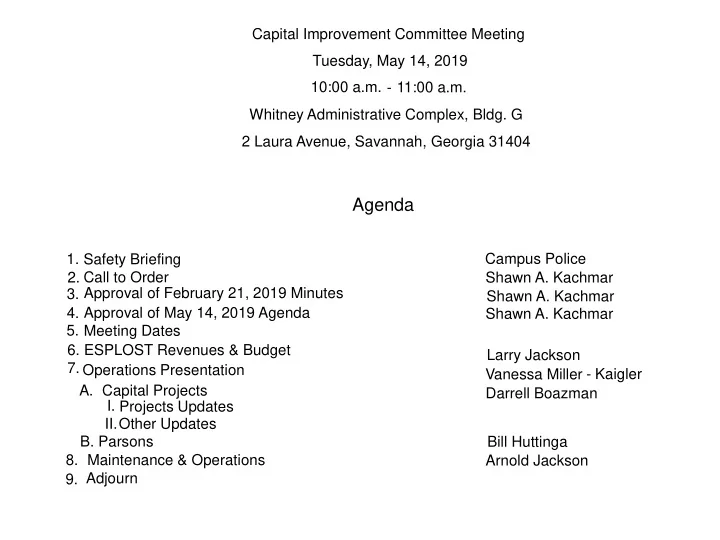
SLIDE 1 Capital Improvement Committee Meeting 10:00 a.m. - 11:00 a.m. Whitney Administrative Complex, Bldg. G 2 Laura Avenue, Savannah, Georgia 31404
Agenda
1. 2. Safety Briefing Call to Order Shawn A. Kachmar
- 3. Approval of February 21, 2019 Minutes
Shawn A. Kachmar
- 4. Approval of May 14, 2019 Agenda
Meeting Dates Shawn A. Kachmar ESPLOST Revenues & Budget Larry Jackson 6.
- 7. Operations Presentation
Vanessa Miller - Kaigler
Darrell Boazman
II.Other Updates Maintenance & Operations Bill Huttinga 8. Arnold Jackson
Campus Police Tuesday, May 14, 2019 5.
SLIDE 2 2
Capital Improvement Committee Meeting Minutes
Thursday, February 21,2019 9:00 AM -10:30 AM 2 Laura Avenue, Bldg. G Savannah, GA 31404
BOE Staff Present:
Ann Levett, Superintendent Vanessa Miller-Kaigler,Deputy Superintendent-Chief Operations Officer Larry Jackson, Chief Financial Officer Arnold Jackson, Executive Director of Operations Ramon Ray, Chief of Human Resources Officer Terry Enoch, Chief of Campus Police Kevin Ralston, Senior Director of Capital Projects Roger Roriex, Budget Analyst Marshall Withers, Director Internal Audit Tiffany Lovezzola, Senior Internal Auditor Terry Alexander, Office Manager of Operations Slade Hemly, Project Manager
Other Board Members Present:
Joe Buck, Board President Cornelia Hall, District 3
Others in Attendance:
Bill Huttinga, Parsons Timothy Sparks, Parsons Sylvester Formey, Parsons and Vanguard Lorne George, Parsons Brett Lundy, Parsons Ross Cairney, Parsons Ivan Cohen, Community Stakeholder Irene Hines, District 5
Capital Committee Members Present:
Shawn Kachmar, District 4 Tonia Howard-Hall, District 8
SLIDE 3 3
Capital Improvement Committee Meeting Minutes
9:00 AM -10:30 AM 2 Laura Avenue, Bldg. G Savannah, GA 31404
Safety Briefing Officer Ware provided the audience with a public safety briefing in the event of an emergency or an unexpected crisis within the facility. He identified all exit doors, fire extinguishers, and AED’s. Welcome/Introduction February 21,2019 the meeting of the Capital Improvement Committee was chaired by Mr. Kachmar and was called to order at 9:04 a.m. Mr. Kachmar welcomed the committee and other attendees. Approval of the November 15, 2018, Minutes: Mrs. Hines moved; Mr. Kachmar seconded. The motion carried. Approval of the February 21, 2019 Agenda: Mrs. Hines moved; Mr. Kachmar seconded. The motion carried. Meeting Dates
- Mr. Kachmar: “The current iteration of the Capital Improvement Committee is myself, Mrs. Hines, and Dr. Bringman. Dr. Bringman has
some scheduling challenges, so we are still working on meeting dates for the rest of the year. As soon as we have those finalized we will update the Board and the community as well.” ESPLOST Revenues & Budgets-Larry Jackson
- Mr. Roriex: Reported on ESPLOST Tax Revenue Collections. Our local ad valorem we collected $183,214.40 for a total collection of
$7,510,541.09. If we can slide to page twenty-two you can see the yellow line represents the ESPLOST 2018 collection. You can notice that we are still trending upward, and we are still over our projected budget, which is showing that we are still getting good collections, especially in the month of December where we did get a good collection. I think I will yield to Mr. Jackson for the rest of the report.”
- Mr. Jackson: “As we get into the expenditures again we are going to let the operations team and Parsons talk about the actual project
expenditures as they go through their part of the presentation. I’m going to skip to the summary pages that are near the end of the financial
- section. As you see with ESPLOST I we are getting to the point where we are trying to get rid of spending these last few pennies in
ESPLOST I. I believe the only projects that are remaining in I; as you know we are paying for the gym floors, so once we finish those projects I think there are a couple minor items and we will be able to close out ESPLOST I. ESPLOST II as you know is going to be around
Thursday, February 21, 2019
SLIDE 4 4
for a while. We have some state funding with some projects that are in ESPLOST III and following that again you have the funding summary for ESPLOST III. As a committee we may look at the prior pages, which are the detail of all of the expenditures. I believe most of the committee is probably getting the monthly report. Does everyone get that monthly report that’s sent out by the accounting department? That has a lot of detail and we can keep from duplicating pages that are in this report. That is something we can look at to cut down the number of pages in this report.”
- Mr. Kachmar: “So, we do get at least quarterly and maybe monthly overall financial reports but what’s in here is a repeat
- f some of that.”
- Mr. Jackson: “Yes. There are reports that are produced monthly. Every month there are separate reports; one is for
ESPLOST I, one for ESPLOST II, and one for ESPLOST III and I wasn’t sure if all you all were receiving those reports but if you are we can cut out some pages that are…”
- Mr. Kachmar: “We are going to keep these.” I think not only do we get them, but the entire slide will be posted on our
website and it’s an easy way for the public to access all the information in one place.”
- Mr. Jackson: “That’s fine because at one time we were posting the monthly reports. We can stick with the quarterly.”
- Mr. Kachmar: “We can revisit this to be sure we are being efficient too. As long as we are still posting the information
and it’s accessible that’s the main goal. Just for those of you sitting in the audience I know we went from page twenty to page sixty but what Mr. Jackson’s talking about is forty pages of detailed line item reports for each project and each expenditure on each project for E-I, E-II, and E-III. I know many of you love reading those in detail and they will be available on our website after this meeting and previous line item information is available as well. So, on that point any Board Members or Committee Members any questions on any of the detailed expenditures on E-I, E-II, or E-III.”
- Mr. Jackson: “Again, as the design team goes through some of the projects they are going to talk about the expenditures
and where they are with them. There are three additional new slides that are in the report. We are going to give you a summary of the revenues. At the beginning of the slides we only talk about the ESPLOST revenue a tad bit. Slides number sixty, sixty-one, and sixty-two actually gives you all revenue to include interest, capital outlay, and
- funding. On page sixty you see a slide for ESPLOST I. Again, we are almost finished with ESPLOST I; it gives you all
- f the budgets and all of the collections to date. There is some adjustments for e rate that you will see in the next
quarterly report but hopefully by the next quarterly report we will be able to finish ESPLOST I. In this slide again is ESPLOST II. Again, that gives all of the revenue sources, the budgets, and the actual year to date as of December 31,
- 2018. Again, for ESPLOST interest we had a state technology grant, a couple of outlay e rate, and so on. Again, we just
wanted to bring you some slides that shows all of the revenues that are involved in ESPLOST.
SLIDE 5 5
The same thing you will see again on slide sixty-two for ESPLOST III. Here again it includes the adopted budget, the current modified budget, and the recognized amounts. Are there any questions about those three slides?” Operations
- Mrs. Miller-Kaigler: “Good morning. Good morning to all. Thank you for your patience as we are coming forward with our first
Capital Improvement meeting of the year. Mr. Jackson and his team went through those slides as it relates to the financials. Relatively quickly, but we want to spend some specific time and work on some specific areas today, so it’s going to look a little different. Mr. Jackson spoke about the fact that we produce the documents, we post them on our website, and we make sure that our Board Members receive the documents in advance, so we are going to kind of summarize for you the status of a lot of our projects. Where we are, we are on time, there are no major concerns, there is no funding issues associated with those projects but if you have any specific questions relating to them certainly we can address those for you if it’s not included in the information that’s before you. Our focus today is we are going to talk a little bit about where we are with capital outlay dollars, how that budget looks, and where we are in terms of enrollment. Capital outlay is based on that five-year projection; a part of our local facilities plan that’s submitted to the state and then the dollars that are available for us based on our enrollment. In addition, traditionally those areas that we look at are inclusive and I will speak about the schedule before you all. This is the schedule that we’ve put in front of you each month as well as when we have updates to tell you where we are with each project. As it relates to capital outlay; our funding is based on enrollment, it’s based
- n those trends. Those dollars were included as a part of our budget as well as our projections for the five years. Enrollment as we
knew it has declined. We’ve seen a reduction in the number of students. We’re are building bigger schools, better school, so the number of instruction units are there. It needs to match what the number of students that you have. So, we see a reduction in the amount of available funds for new school construction. Let me be very clear. There are several other categories that we are eligible for from capital out lay as it relates to renovations, HVAC equipment, roof repairs, and now they’ve added an additional category that referred to as modernization, which we can certainly apply for those dollars. Not just building the schools; do we still have some needs for some new schools. We are doing an analysis; we’re still trending well as you heard them say. E-III is set, so I don’t want you to get alarmed and say now they are going to go in and start reducing the number of buildings that E-III has set. But we do need to make sure that we are fiscally responsible and sound as to how we use those available dollars. Fortunately for us the pennies are coming in; they are coming in above our projections for this year. We were not as high in year one, so year two we were able to do extremely well and what you see thus far for year three we are very excited about that. So, how do we make sure that we’re going to be able to complete all of our projects; promises made, promises kept. Make sure that we are repairing those roofs and those HVAC systems, and making sure that all of those projects that are in year five will be completed. So, I want you to bring that look down. We’re still trending, and we are going to talk about some opportunities that we want you to consider. How can we be more flexible in developing and building these schools? Building twenty-first century schools that is designed to meet whatever the needs are for our students. How we continue to make Savannah-Chatham County a world class district. Believe it or not we play a part in that. Operations recognized that. The climate of the school, the condition of the school, the cleanliness of the school, and the interior and the exterior of the school plays a valid part in the instructional process. We understand that, we embrace that, and we are in constant communication with academics and with the Superintendent and just how we make sure that we are designing those schools that are going to be conducive for
- learning. We build schools every fifty years. We build it just to be to be able to accommodate elementary school students and
elementary instruction.
SLIDE 6 6
Our needs change and we see a shift in population as kids and families come in and out of the community. So, we have to be a little more aggressive and think long term in how we design the schools that we’ll be able to use them for all grade levels. So, you’ll hear us talking about something that’s kind of different. Something that we’ve not done. We have some colleagues around the state that have done it successfully and they’ve done it in some other areas. Right down the road – you can see it a lot in rural areas but now you’re seeing it in more of the urban school districts as well. So, we’ve looked at the dollars, looked at what that cash flow is and we’re going to talk about that in detail. Then we are going to talk about some opportunities that we want you to seriously consider. We will continue to bring that forth. We wanted to start here in CIC; this is our committee where we have all discussions and then take it to the full Board for consideration. So, I’m going to ask Bill to get started as he talks about the cash flow and the two of us will work through this particular piece. You’ll see a lot of information and a lot of data; we are not going to go over every slide, but it is important that you know what our current capacity is for each school. We want to make sure that you understand what the current utilization is. It’s going to probably require some re-districting. We have some schools that are over capacity and we have some that are under capacity. Over capacity schools have an impact on your infrastructure. If you’ve ever had an opportunity to go
- ut to Godley Station; if you’ve not I’d be more than happy to put you on a bus and take you out there. We have to have some relief
- ut there. It’s taxing to the infrastructure to have as many students that we do on that campus as well as the number of modular
classrooms on there. We’re continuing and trying to get in front of the growth in western Chatham County. They are continuing to
- build. We’ve been in communication with the housing authority as it relates to their building program. It’s going to have an impact
- n that area as well. They’re continuing to issue building permits, which is going to occur near to New Hampstead. Ninety-five
hundred units on target there, so we are getting out in front of that as well in terms of how we design that K-8 building out there. We know they are coming, so we need to address it now versus coming back and ask the question ‘How do we fix this?’ So, that’s how we’ve been spending our time is in the market, in the industry, in the community looking at how can we be fiscally sound and responsible with those dollars because they are limited. We are responsible for academics. We play a part and we want to see as many dollars as possible from the general fund going to academics and we want to be able to manage the capital dollars that come from ESPLOST well, masterfully, and give academics what they need to be able to provide and support the instructional process. So, I’m going to let Bill get started and I’m recovering from the flu, so I’m going to come back in when I get my voice back, so we can make sure that you have a full understanding and we’re going to work through some of the specifics that we want to bring before you for some communication this morning.” Facilities Management/ Capital Projects
- Mr. Huttinga: “Let me first start with E-II and just give the good news. We qualified for GADOE capital outlay funds for every
new project in E-II and that amounted to over fifty-seven million dollars that we earned. As the projects were finishing up; we were completing them, sending all the paperwork into the state that is required for reimbursement and I’m very happy to say that that is
- ne hundred percent complete today with the final envelope gone to the state today that will contain all the final paperwork for
Spencer/Williams. Of course, the state just recognizes that school as Spencer yet, so that’s why it’s up there as Spencer/Williams. That completes all the paperwork, so we have $3,945,953 still remaining to be received from the state. That’s all under contract; it’s not a matter of if, but it’s a matter of when they actually deliver it. So, with that and the slides that you saw that Mr. Jackson
SLIDE 7 7
presented E-II is finishing very strong and it’s very positive as far as variance is concerned. So, this program is finishing on a very positive note. Looking at E-III, our cash flow – we spent just a little time on this. First of all, 2017-18 are actual figures. We have a very large report that we put together. All of the projects down the one side and the timeline across the top and we know what the schedules are for these projects. We can put in what we estimate are going to be our monthly expenditures, so that goes back to our program schedule that we went through. As we move these projects around our timelines our cash flow changes also. So, we expect obviously that we are going to be receiving more money in the first few years. Fewer expenditures but it’s going to catch up. So, you look at 2017; ten million in expenditures, seventy-three proceeds, so sixty-three million dollars. That’s their variance in the bank. Next year, 2018 last year was $20,000,086, a variance of sixty-five. So, right now we are at about $130,000,000 that has been built up and is earning interest and waiting for the expenditures from the projects. 2019 is kind of the peek of the curve. It looks like our expected expenditures and our expected proceeds are pretty much the same. Then from there we start heading down obviously expending much more then what we have in proceeds. Expending our money down to the point where we get to the end of our available cash flow. You see that right now it shows a negative fourteen million dollars and we’re not surprised by this. This is not something that catches us off guard. We’ve got plenty of time to look at this and obviously this is a result of the fact that our capital outlay dollars are just not going to be earned like we had anticipated with the growth that we were anticipating, so whereas we earned fifty-seven million dollars in E-II, the projected for E-III that we would need thirty million of capital outlay in order to make our budget and it looks like we are going to come short with that. So, that’s really kind
- f where that difference comes in. So, now again you don’t want to wait until 2021 and 2022 and say, ‘Hey, we’ve got to deal
with this,’ so we start looking at what and how we are going to work our way through this. So, again under the leadership of Mrs. Miller-Kaigler, we took a hard look at where we are at, where we are going, develop strategies on how we can best handle this
- situation. Obviously the one thing that we really studied hard and keep looking at is a reconfiguration that we are going to talk
about next. There are as Mrs. Miller-Kaigler noted other capital outlay opportunities and we need to maximize these. Sometimes it’s easy not to do that because it is a lot of paperwork that has to go into the state but if we are diligent and we submit this paperwork and these applications we do have opportunities there. There are potential for additional proceeds. Again, we mentioned those ESPLOST proceeds; you know that they are coming in very well. Interest earnings on the monies that is right now in the bank is all positive money. Of course, we look for unallocated funds. E-II as we completed these projects we closed these contracts out. Any dollars that were in those contracts they went over, and they went down to the unallocated budget. So, as we go through E-III we are going to go through the same process and what we expect is we see savings in our projects that we’re going to be able to keep building in the unallocated funds. So, with all of that we are saying fifteen to twenty million dollars of potential additional funds. So, we have a plan and that’s what we want you to certainly understand, upcoming activities. We are going to talk about most of these as we go through, so I’m not going to necessarily read through those. So, let’s take a look at Groves.”
SLIDE 8 8
- Mrs. Miller-Kaigler: “As Mr. Huttinga gets to this particular slide and I have kind of regained a little bit of my voice back, what we
want you to do is we are going to go through this and make sure you get a full understanding of it and recognize what we are going to be proposing here. If you look back at your ESPLOST referendum and look at the plan that you all approved it for elementary school, it called for a K-8 school, and it called for a new Groves High School all in a very similar area. We were going to include
- Mercer. We’ve been working with our colleagues in Garden City as they have a master plan for that particular area. We welcome the
- pportunity to be able to partner with one of our jurisdictions as it related to road work, traffic signals, which is always a challenge
for our school district. So, as we looked at where our funding was at that particular time we included in our budget land for a Gould Elementary School. We are still working to determine what will be best for that facility where Mercer is currently located. So, as a part of our brainstorming we want to consider a new configuration that will be new to the district. The opportunity to have a K-12 on a complex. Is it new in Georgia, is it new around the country? Absolutely not. There is a brand new one in Jenkins County in Milton, Georgia that opened this school year. One site under one roof with egress, transportation would clear the lineation of how those students are brought into the buildings. Instruction, how lunch is served, media center, corridors. We’ve actually had a team that’s already had an opportunity to visit that site and we’re in the process of developing a schedule for an additional site visit there. So, I’m going to ask Mr. Huttinga to go ahead and go through what we would like to propose for that complex. Again, continuing to work with our partners at the City of Garden City. We want to be able to propose how can we take and consolidate these offerings – designing it to be flexible, so if there is a need for additional elementary seats, middle school seats, or high school seats – have that
- pportunity under one roof and being able to ensure that we can provide the athletic offerings that’s necessary where we have
existing land without having to go out and purchase existing land and being able to then take a look at where and how we can make sure that that fourteen million dollars is not a detriment to our plan. Mr. Huttinga, I’m going to go ahead and let you get started and walk us through that.”
- Mr. Huttinga: “Thank you. As we started this study and embarked on this we took a look at the enrollment. This shows all of
the schools along the west side. You’ll identify all of them. Looking at what that current enrollment is right now and then back in 2016 we had a study completed by MGT and they are an expert in master planning districts. They looked at the master plan for the school and they did a study. From their study they came up with a functional capacity for all of the schools. They did an educational specification study. A functional capacity is quite frankly just explained as the number of students that the school can accommodate. It looks at factors such as the programs that are offered in that school. Schedules, student teacher ratios that’s desired, and the size of the rooms themselves. So, they went through and actually visited every school and put together a list or an index here of what the functional capacity of the school is. So, what this does is it says look at the school, what is the enrollment, what is the current utilization based upon the functional capacity. Also, in their study they projected
- ut to 2026 for the enrollment of these schools and again projected what that utilization would be. Everything in red obviously
is over one hundred percent, so when you look at the elementary schools as noted here. By 2026 these buildings are going to be exceeding their potential functional capability. So, that’s something as we look at – we need to address this in our solution. We also looked at the K-8s, middle schools, and the high schools and you can see the results of those but obviously it’s the elementary schools and the K-8s that are ones that based upon this area where there is so much growth and there is projected to be so much growth, we have to come up with a plan in order to satisfy that. The other considerations that we looked at. Just recently the Board was presented with an extension for Port Wentworth Elementary School. That however is going to expire and when that
SLIDE 9 9
expires those children have to go somewhere, so that has to be brought into it. New Hampstead. The new K-8 is going to be constructed opening in 2021. That’s going to provide fifteen hundred new seats. That was just recently increased from twelve to fifteen hundred, so that’s going to help and that’s going to factor into this. Then of course anything that we do we have a goal of lowering that FCI. The Facility Condition Index. That index then tells us how our schools are as far as maintaining repairs and things like that, so we want to continue to lower that. The Groves Campus and we’ve talked about this one I think for the last few CIC meetings. It’s forty-three acres including the Garden City Stadium. There is a major roadway. The size of it is very constraining as far as what can be done. We’ve always talked about how that is a hardship and something that are we going to be able to work through. We also talked of course the capital outlay and I won’t necessarily get into that one, but it brings us to really what are we trying to accomplish here. The main study had to be can we configure the growth site to support a K-12 school on the existing site with all of the issues that were brought up. So, that brought us into a master plan. Can we do that? We said, ‘Well, we need to do a master plan.’ So, we brought a master planner on and the master planner studied the site. They looked at two separate buildings on the site, they looked at a single building on the site, and from that what we look at now as the master plan that developed from it. We are able to put single K-12 school on site. If you’re not real familiar and if you don’t quite see how this lies; along the top right angle is Hwy. 21 and then along the bottom on the left side is the railroad tracks, so the stadium is right there. There is another slide, which puts this on the existing layout and it helps for you to see it a little better. Maybe we’ll just look at that quickly - it was a pdf and I don’t think it’s going to show through. Here is Hwy. 21, here is the railroad tracks. The existing stadium is located here, and you can kind of see the existing buildings if you look real carefully on this; they are in gray. So, the entrance of 21 is right here. You can see that gray road coming down. The annex building here, and the school is all located in here. Now, here is the thing that we looked at and we wanted to be sure that we were going to be able to do in this school also because we really studied this, and Jenkins and we think it’s so important that the existing school if at all possible be able to stay and we can. All of the school buildings are located right here. This is the new facility, and this is just a representation of what the new facility is. Obviously with a master plan you kind of just work in bulk type blocks and areas. So, we want to construct a new building kind of where the existing track is right now – it fits in there. There will be a new drive coming off and over on this side is a CTAE facility which is parking for that. One thing that’s always important as we go into the development of this we talk about how important it is that we have good separation between the grades but that also we are able to utilize shared spaces such as kitchens and potentially the media center area and little larger
- areas. We saw that when we toured some of the K-12 buildings, so that was important in this too that we got some elementary
K-8 type play areas here. Very, very large parking area where the existing school is right now. Again, play fields, baseball, softball fields and then a big parking lot where the existing stadium is located right now. Moving the stadium up here to where the annex building is. In order to get enough room for that we will have to kind of reconstruct the road here and kind of bend it in a little bit because the existing one looks like it would pretty much go right through the stadium. So, this entry would be the same and there would need to be a new entry created off here. A study about buses and parent traffic has all been looked at; how that can all be organized on the site, and of course how would we be able to build the new building, stay in the existing building, and then in time tear the old buildings down and finish up the park and all of the axillary areas. So, that told us that based upon just the big components of this that we can make this work. We have gone one step further and we are doing programming in this building right now because if you put a small building in there; it may have to be three or four stories high but is that going to be practical.
SLIDE 10 10
Can you educate in that type of a facility? So, realizing that schools have lots of rooms that can not be on upper floors we needed to and have gone through and are just finishing up on a programming right now that looks at the net spaces that we need in there; determines what those growth spaces are going to be, and then we can start laying that out just to ensure
- urselves that yes, it can fit in there. When we first put it on there we thought that was really, really tight but it will; it will fit,
we have our program developed, and we can make this work. So, it’s extremely great utilization for this site and it provides for some expanded parking areas, a very nice stadium with nice approach, and the building itself we feel is going to be a very nice addition.”
- Mrs. Hines: “Thank you so far for your presentation it sounds good but let me just throw out a couple of questions here.
Number one, K-12 school we are expecting about how many students? Just an approximation.”
- Mr. Huttinga: “Twenty-four hundred.”
- Mrs. Hines: “Twenty-four hundred, okay. Now, from what I understand Port Wentworth is eventually going to close, so
where do we plan to put those children? That’s Pre-K, right? What are we going to do with those children and where are they are they going to be located?”
- Mrs. Miller-Kaigler: “As stated in the slides we’ve received additional approval from the state to remain in that building.
What I mentioned – modernization had the opportunity to sit down with Mickey Shubert, our State Representative. It would be the District’s decision if you wanted to remain in that building. We can actually put that building into our local facilities plan and continue to use it. We will not be eligible for any capital outlay dollars for it; as you are all aware the renovations made to that building was made through general funds. So, now there may be an opportunity if it’s the desire of the district to continue to operate that program we could then put that school back into our local facilities plan. That is an option for the
- District. If the decision is made that we no longer want to remain in that building, then as a part of our redistricting we could
consider Rice Creek as an area for that program to function.”
- Mrs. Hines: “I have one other question and that is that this plan sounds very good but what are the possible push backs that
we may encounter in getting this project completed? I know the railroad is not going to move.”
- Mrs. Miller-Kaigler: “If you look at – Mr. Huttinga, if you could point to where the railroad is, we are planning to make sure
there’s not a lot of obstruction where the railroad track is. Certainly, the rail road tracks will remain there. So, if you look here; that’s primarily where parking is proposed where the rail road track is.”
- Mrs. Hines: “Okay, thank you.”
SLIDE 11 11
- Mrs. Hall: “I’m very excited about this. I think we’re really stepping into the twenty-first century the way we should.
There are certainly many K-12 complexes across the country and in fact in economically stressed Jasper County, South Carolina a K-12 complex is there, and it’s been there since 2007 and it seems to be going very well. So, I think that this is a very positive solution to our situation over there. I just want to mention that while we are stepping into the twenty- first century it’s like we could be in a 1950’s Happy Days sitcom at three of our other schools. Bloomingdale Elementary I’m concerned about, Pooler Elementary, and Woodville Forest Elementary. If you go there it is like you are in the 1950’s, so while we are moving forward so beautifully I just don’t want us to leave our little – there are so spread out. That’s the other thing; the geographical situation that we are in that I just hope that we are looking at those schools and not forgetting about them as we move forward.”
- Dr. Howard-Hall: “Myself being from the west side of town and going to football games – I actually cheered on the
- field. I’m excited about the plan. It makes sense to have one building as opposed to three separate buildings on that
- property. I think it’s a great idea. My main concern is looking at the projected utilization for elementary. We have to
make sure that we do have enough classrooms and everything for those students because the Groves and Mercer’s projected utilization is only twenty-nine percent for Mercer and thirty-six for Groves. So, I just want to make sure that there is ample space for continued growth.”
- Mrs. Miller-Kaigler: “The key there is the flexibility in how we design it. So, for the first five years if our needs are
greater in the elementary grade bands then we should be able to manage that. Then in the next five years if we see it greater in the middle school versus in the elementary that school has been designed where we can go in and utilize those spaces or instructional units for either elementary or for middle to make sure that we can meet those needs. That’s going to be the key there; is making sure that we have that flexibility to meet that growth and that’s what we’re looking for.”
- Mr. Kachmar: “I’ll just make a couple of comments. This plan would replace the plan to have a new Gould, a new K-8
- n Groves, and Groves itself. It would consolidate all that. Current enrollment for those schools are seventeen hundred.
The projected enrollment was nineteen hundred. The plan if we had built those schools separately would have been twenty-six fifty. We have to build for an FTE of that and this consolidation would plan for twenty-four hundred total. So, it’s more then even the planners said for 2026 but it also gives us the flexibility. One of the things that we discussed at a previous – I don’t remember if it was a Board meeting or a planning meeting but we all know that the projections for our birth rates locally and nationally are down and at the same time education has become more digital and more
- nline and it’s not just in the buildings any more. While we’re not certainly moving to all computer based at-home
education flexibility is the thing that we all seem to agree is something we need to have. So, we’ve already been successful in splitting up programs within buildings; either academic programs with schools, so we can do it
SLIDE 12 12
- successfully. What I’m really excited about here is if we do this it looks like just on paper we can save about ten million dollars
projected give or take but then in addition it gives us the flexibility if suddenly there is an influx of high school and middle school students we can reconfigure space relatively easily without having to redistrict, build a new building, squeeze a middle school into an elementary school or a high school into a middle school if we plan ahead. I’m really excited about the flexibility this gives us short term and long term as well. Also, I know – I just want to say thank you to staff and to Parsons. We’ve talked about these issues for years now. We’ve had meetings with the City of Garden City about long term planning and they are very forward thinking as well. Dr. Levett has led the charge in thinking long term and not just short term. So, I think this ticks all the boxes for sound fiscal management, flexible planning. Generally, you save money for building one building and one roof rather than three buildings and three roofs, but the devil is in the details. The academic programming is going to be really important and constant communications with Garden City and the impacted parents. I just think back to Mrs. Hines and Dr. Buck; y’all were on the Board for E-II and E-I and I’ve been here seven years now. At the end of E-I into E-II. I just think about some of the conversations we had planning for E-II what has materialized and what hasn’t. We talked about the growth on the westside and to a certain extent it’s happened but not necessarily in the areas we thought it would, but it’s happened in other areas. So, we weren’t really planning on building Rice Creek as big as we did and as quickly as we did until we saw where we thought the growth was didn’t materialize. So, the lesson I learned there was be flexible in your planning and be adaptable. So, I just want to say thank you for this plan; I’m excited about it as well. We’ll have to do the same thing we do with all of our other programs, which is community meetings; making sure people are aware of what’s going on and then as we move forward with the planning make sure just to give us regular updates is something I would ask.”
- Dr. Buck: “I think this is exciting and I think it’s certainly something this district used to not do very well, which is project the
- future. Not to muddy the water but the last time we redistricted with the county we had to move all of our districts – these folks here
westward because the downtown area was losing enrollment. As we project all these new K-12 schools we need to also be looking at some of our new schools and old schools in the downtown area that are going to see severe drops in enrollment and what to do with those because we are going to own a lot of classrooms.”
- Mrs. Miller-Kaigler: “Thank you for that observation.”
- Mr. Kachmar: “Dr. Levett and Mrs. Hall.”
- Dr. Levett: “I’ll defer to Mrs. Hall.”
- Mrs. Hall: “I just want to say since we are pushing the date on now on Gould what are we saying to the community and what are we
doing with that building that they are going to have to stay in longer now because that is another cousin of the ones from the 1950’s.”
- Mrs. Miller-Kaigler: “We wanted to be able to have the opportunity to have the dialogue with the CIC Committee then a full
conversation with the Board in March. Then we’ll be going to the community. Those needs whatever they are in that existing
SLIDE 13 13
building we are making sure that we continue to address those. There is no short comings, nothing that we’re not meeting whenever there is a need. We will make sure that it’s taken care of and we will continue to operate in that vein.”
- Dr. Levett: “Good morning everyone. It is an exciting day for us as we have presented this to you this morning. Certainly,
we appreciate the warm reception to it and your understanding of what we are trying to accomplish. When we bring it to the entire Board for review we will also provide the pieces around academics; at least helping everyone understand how we will maintain the three building structures as well. That academic piece is really important; you hear this morning the information about ingress/egress, but you’ll need to hear also about the schedules and the way we will manage the complex, so that we will still be able to maintain the integrity of each of those programs. What we’re excited about is the flexibility, so that that building will be able to serve us well and the community well through the decades. We’re excited also that we’ll be able to bring this concept to life in that we’ve been talking about it and researching it for several months now. So, thank you for the opportunity to bring this into the twenty-first century and as Mrs. Hall said, we want to make sure all of our cousins understand we’re moving forward. But it is this committee as well as our leadership that allows us to explore some ideas that are already in place in other parts of our state and the country. Thank you so much.”
- Mr. Kachmar: “I’m going to add one other item. We’ve been on a building and renovation spree in E-I – even before that
we floated bonds for new buildings, etc. but we are always mindful of the capacity we have in terms of the number of buildings, the maintenance cost, the utility costs, and we’re trying to be very strategic in terms of where we are building new schools but where we are also repurposing properties or selling or closing them. Given the birth rates and our enrollment who knows where our enrollment is going to be in ten or fifteen years but we are mindful of the fact that we don’t want to be land or building property owners that we have to maintain in perpetuity, so this also gives us the
- pportunity as we empty out older buildings and replace them with newer facilities many of our older buildings have been
- repurposed. Thunderbolt, Pulaski, and Derenne. We’re going to have more inventory and the potential to get some of these
- lder buildings off of our maintenance and utility list and realize the cost savings as well. So, I don’t want the message to
just to be that we are building, building, new buildings, new buildings all the time. We’re trying to be responsible and look at our space utilization. One of the things that isn’t in this data that we look at as part of our yearly Das Remi is what are
- ur overall utility costs, what are our costs per square foot, how much space do we have that we aren’t properly utilizing
with the goal being try to get as close to one hundred percent utilization of all of our space as possible and being fiscally responsible there. So, part of these conversations have included what are we going to do with our older buildings long term. There are some proposals where we’re trading buildings for services with local municipalities, etc., so we’re not just accumulating property and just letting it sit, so we have to maintain it and pay utilities. I just want to make that point clear as well.”
- Dr. Howard-Hall: “On a positive note it’s good that the schools can remain in their old school until the school that is going
to have to be demolished as opposed to White Bluff having to be demolished and then the entire school, faculty, and body had to go into another building. So, it’s exciting to know that they can remain in their current building until the school is
SLIDE 14 14
- Mr. Huttinga: “Thank you, we also agree with that. Let me continue just quickly again. New building. Just to get the size
- f this thing; three hundred eighty thousand square feet. Much, much larger obviously then any building that you
currently have. Additional fifty thousand square foot building for the CTAE; fourteen hundred FTAE for the K-8 and
- ne thousand for the high school. One hundred eighteen million dollars total cost. We have been talking to the city of
Garden City and we are continuing our discussion with the city of Garden City particularly now as it starts going into the MOU because there is property that has to be dealt with, there is a roadway as you saw that needs to be intersections and things like that. So, that will all be part of the discussion with the city of Garden City. Our schedule. We need a good year in order to design this building and get it ready for bid, so we started taking off with it now. 2020 we would be looking at having the documents ready to bid and construction starting probably in late 2020. This project is going to take three years to complete. We have a thirty-three/thirty-six-month construction time, so it’s out at a completion; school starting tentative right now for August 2023. Obviously, you saw with the plan the building goes up first and we can move the school in and then we would have to complete the site work, so that would go out completing the site into pretty much the end of 2023 and early 2024. What is it going to look like? Again, just kind of confirming the kids of things that we had previously talked about. Groves moving into the new building for the start of 2023. Grove would move into the building for the start of 2023, Mercer would move into the building for the start of 2023, New Hampstead K-8 opens up to accommodate fifteen hundred FTE and that would be in 2021 and then obviously looking at how are you going to be able to handle overcrowding in other areas and having these building that have open classrooms. Certainly, Godley Station is one that has to be looked at. We’re always excited about this also and kind of like, ‘We can look at it on a plan but what potentially could it look like.’ This a sample building render. We had our master plan architect just kind of put out something here to look at what this building could potentially look like. Again, very large building, so it will have a very nice presence. What is the district going to look like after this building is open; let’s take a look at the FTE. Currently where the schools that are designated we have a current FTE of 7,314. Some of the other
- nes that are over-crowded we can look at having FTE available of 9,550. If you go back about five or six slides or
projected 2026 FTE for these schools is 8,126, so again those are high school, middle school, K-8’s, elementary schools
- combined. But as we talked about there has got to be some flexibility in these spaces to be able to utilize them. One of
the goals was to lower the facility condition index; for y’all that may not be familiar with what the facility condition index is, you look at a building and go through and determine what are the current costs of repairs in the building then you divide that by what the replacement cost would be. So, as you can tell if you go through a building and you have ten million dollars of repair and you can build a new building for twenty million dollars that’s an FCI of fifty percent and that would probably not be good. So, we look at what our current FCI’s are in these schools. We updated this just last year, so right now based upon the schools again that we show we have 24.35 percent FCI. When we do this and move
- ut of those buildings that have some problems and look to have new buildings we can lower that FCI to 14.87 percent.
Now again, just for these numbers we have done standards and there are all different types of standards that can be used but for this district we look at anything under fifteen percent as good. That’s where you would want to be. Fifteen to thirty is fair, thirty to fifty is poor, and over fifty you can be unsatisfactory. Now of course an FCI is driven a lot on renewal costs. Sometimes you could look at ‘Well your electrical doesn’t necessarily need to be upgraded with those kinds of dollars in your finishes and such;
SLIDE 15 15
they can go a few more years.’ So, there is a play in the FCI, but I think all in all it gives you sort of a good idea. You’ve got to put dollars into schools that have high FCI’s; if not this year then next year or the following year. So, always a goal whenever we do something and as we start getting into looking at our renovation work in E-3; that’s going to be the goal too, to try and keep lowering the district FCI. That will complete the Groves and if there aren’t any other questions.”
- Mr. Kachmar: “Let’s move on.”
Parsons
- Mr. Huttinga: “I’m going to go through these very quickly. The Jenkins High School end design. I do want to make a
point here because I do think it’s important for us to remember; we can do things quickly or we can do things right. We have gone through a very deliberate process with this project looking at the site, where to put it, move the kids out, where to put the new building, the exteriors, and now we are looking through the interiors and it is taking time, but it is going to be done right. We do not want to rush any project and make mistakes because we have rushed it. So, this is a very, very complicated project and we knew that, so we are going through these processes and being sure that community, staff, and everybody is totally on line with what is proceeding. So, the design is ongoing; we are looking at the summer of 2019 work. Those are the items that we’ve talked about before. The kids of things that we have to address and those are what we are looking at. Schedule hasn’t really changed. Still looking at completion of school starting on this building starting on 2021 and as we continue to work through our design we be able to update that. You’ve seen the phasing plan and what building will need to be taken out first in order to construct the new building. That has not
- changed. That’s all part of what the summer work is going to be needed for. Then of course the final site plan, which
hasn’t changed except for a few minor little details. The floor plans – we have these on the boards too. Then we have
- rendering. There’s a number of renderings I think around the room, but this is really starting to show a very, very nice
- building. We’ve gone through some very extensive studies and lots of different exteriors. Community meetings, on line
survey, and from that has resulted renderings that we’ve had and again we’ve had a number of them throughout the room from the different elevations.”
- Mr. Huttinga: “Islands High School. The bids are due today and they are there. They were due at 11:00 A.M., so we’re
all kind of sitting on pins and needles here wondering how those numbers came in and who may be the low bidder. We’re going to have it ready for the March Board. We are doing an evaluation on the artificial turf. We’ve talked about that a lot during previous meetings which are being considered and we will have that recommendation ready also. Then Georgia Power. We’re going to have that contract; they will be doing the field lighting, so all of that will be presented at the March Board.”
- Mr. Kachmar: “Just to make a point; back on that slide the artificial turf and the field lighting. Those aren’t going to be
just for Islands. It’s going to be district wide, so we are doing bulk purchases for multiple sites as part of that right?”
- Mrs. Miller-Kaigler: “Exactly.”
SLIDE 16 16
- Mr. Huttinga: “Scheduling to get the contractor on board. Hope to be awarding him in March. Construction would get
started immediately afterward. We are targeting to have this facility ready by the first of the year; not football this fall. Football next fall.”
- Mr. Kachmar: “But soccer this spring.”
- Mr. Huttinga: “But soccer this spring, yes sir.”
- Mr. Kachmar: “Next spring.”
- Mr. Huttinga: “Next spring. This is the site plan; you’ve seen this one before too, so I will not spend any time on it. I
think we have a board for that too if you want to take a look at it and ask any questions.”
- Mr. Huttinga: “New Hampstead. At the last Board meeting you voted to increase this building from twelve hundred to
a fifteen hundred FTE. Our architect very creatively has added additional classrooms. They didn’t put them on a pod at the end of it but they’ve actually kind of inserted those classrooms in those wings. Those red hashed areas are where the new classrooms are located in order to bring this up to a fifteen hundred. This is the first floor; it shows the layout if you look from the bottom up. That’s coming up from the parent parking lot. From the top down is where the buses will be dropping off. Along the right side of course is the gymnasium and the cafeteria then the blue is the music areas and then all of your classes. The media center in that darker blue. Then that center area – kind of a white area in between there with those blocks; that’s play areas. That’s outdoor area. That’s going to be where all of the play areas are going to be. Children are going to be very protected in there. Then we have those renderings for that also and we’ve got those board’s around.”
- Mr. Huttinga: “Beach High School. Again, the auditorium. We have presented that one in previous meetings. Looking
to bid that job in April and that’s staying on schedule.”
- Mr. Huttinga: “Woodville Thompkins. We’ve just started getting into the study of this; looking at where the
gymnasium can be located. The green is the new gymnasium and the yellow is the old gymnasium, which is going to be converted into the auditorium. The schedule for that is showing design completing along and bidding that project in August or September of this year and getting started with construction.”
- Mr. Kachmar: “Mrs. Hines.”
- Mrs. Hines: “I just have a quick question. Where are we with the Windsor Forest High School auditorium?”
SLIDE 17 17
- Mr. Huttinga: “That project is scheduled to start in 2019 based upon the program schedule.
- Mrs. Hines: “Okay, thank you.”
- Mr. Huttinga: “White Bluff. Getting started with construction in the next couple weeks. They will be out there
starting today.”
- Mr. Huttinga: “Savannah High School CTAE is in finishes and that will be completing next month. If I could just
take a minute. We are continuing with outreach; we have newsletters that we’re publishing, we had a vendor update meeting on February 7, 2019 where we brought the contractors in and went through the schedules with them to keep them up to date. Last if I could just make a quick introduction. Ross Carney, who was with us has gone on to Greener Pastures and I’m real excited to introduce his replacement who is Dwayne Stevens. Dwayne is a local Savannahian born and raised.”
- Mr. Stevens: “I’m Dwayne Stevens. I graduated Jenkins High School. I’m excited about working with you all. Thank
you.
- Mr. Kachmar: “Welcome.”
- Mr. Huttinga: “So, we have a lot of work planned for Dwayne. Thank you.”
- Mr. Kachmar: “He seems excited.”
- Mrs. Hall: “Mr. Kachmar, can I have one comment?”
- Mrs. Hall: “Mr. Huttinga, just going back to the whole capacity question for a minute. It just seems to me that if you
are riding on I-95, Benton Blvd, and all that where Godley Station is that is exit 106. Rice Creek is exit 109. Is it impossible for us to think about Godley Station becoming a K-6 and the seventh and eighth graders make that three- exit ride to Rice Creek that under capacity? Is that farfetched?”
- Mr. Huttinga: “That was designed as a K-8, so consequently they already have that type of flexibility I would say,
yes.”
- Mrs. Hall: “Okay, just thinking about it. Thank you.”
- Mr. Kachmar: “Dr. Howard-Hall and then Mrs. Hines.”
SLIDE 18 18
- Dr. Howard-Hall: “I’m just disappointed in the Woodville-Tompkins time line. I’m looking at it; at the beginning of 2020 Islands
have their field ready and Beach July 2020 the auditorium and will be moving in and Tompkins won’t be moving into their gym until possible January 2021. As I looked and said before currently they have the number one girl and boys’ team in the state. I’ve attended basketball games just to see cars being turned around because of lack of parking. It is pushed at the bottom of the totem pole as far as I’m concerned when I’m looking at the planning and everything. It’s just disappointing to know that we aren’t moving on that; there is no secret there that they are at the bottom. I wish that there was some kind of way that this could possibly be pushed forward. Probably not because it’s already been going through design phases but it’s just hard to me to see Woodville-Tompkins. That’s just the gym that they are moving to the auditorium November 2021, which you can plan in order. Activities are concerned but as far as the sports – the basketball the gym not being available for parents, students, and community to attend. Just tonight they are in state playoffs and they are in the Savannah High School gym hosting a regional play-off game.”
- Mrs. Miller-Kaigler: “It is an exciting time at Woodville-Thompkins and we are one hundred percent behind and support the
academics as well as the instruction and the athletics at the building. This is their regional schedule. The schedule has not changed. We had to start somewhere. We have a five-year program, so we couldn’t start all of our programs at the beginning of a five-year
- program. We looked at the overall needs of the district and had to make some tough decisions as to what would be designs in year
- ne, what would be designs in year two, and what would be designed in year three. Then you still have some projects that will not
come along until year five based on availability of funds and cash flow. So, it’s difficult and we can’t legally commit where we don’t have dollars for projects. You heard us this morning talking about how we can be strategic in making sure that we’re not going to have to defer any projects, so we want to make sure that we’re always being fiscally sounds and making sure that we meet the overall
- needs. If there is any opportunities for us to take a look at that schedule that is not going to compromise the quality of the overall
project by having the condense of the schedule changed then certainly we will do that. We’re not opposed to sitting down with our design professional once we have a contractor on board and having those conversations. You saw that we had a rendering this morning and it’s different from what we originally had because we had to go back and make sure that there was going to be parking because that was a very tight site. It was designed as you know for a middle school, so there is limited parking there now. You see where we’ve worked with our design professional and you saw the parking on the sides, so we’re still working through that piece, so we don’t want to rush it. We’ll sit down with them and we’ll make sure that if there is any opportunity to do better with the time we will certainly do that. We don’t want to increase the cost and we certainly don’t want to sacrifice the quality. So, your points are taken, so we’ll work with it.”
SLIDE 19 19
- Mrs. Hines: “Let me just go back to Groves High School. With the new school being built there will the city of Garden City
put in a turn light for that school because it’s awful.”
- Mrs. Hall: “It’s dangerous.”
- Mrs. Miller-Kaigler: “Yes.”
- Mrs. Hines: “Okay, so that will be taken care of?”
- Mrs. Miller-Kaigler: “Yes, ma’am. We’re partnering with them.”
- Mrs. Hines: “Thank you.”
- Mrs. Miller-Kaigler: “We provided you with a list of all of our projects; so, if there is any specific questions you’ll see the
summary of the projects that Kevin is responsible for – the HVAC system, security vestibules, the ADA renovations, - all of those projects are managed by Mr. Ralston. There are no projects that are behind schedule or any problems with any of
- those. He can certainly answer any of those questions for you. Where we are as it relates to the tornado repairs at
- Marshpoint. I think that the students are close to being ready to move in; there is a projected completion date there of April
15, 2019, so we are looking forward to having those students move back into the building. Here is your update on your security vestibules. We are continuing to work through that particular project. If you have any questions for Kevin, he’ll certainly answer those. Mr. Jackson will give you a brief summary on the Maintenance projects as well.” Maintenance and Operations
- Mr. Jackson: “Good morning again. I’m going to give a brief summary of seven projects. The first project is the emergency
generator project. This project is one hundred percent complete. All the generators are operational. The next project is transportation roll-up doors replace project; we are replacing twenty-eight roll-up doors. The doors have been ordered and the roll doors are expected to be delivered in the next six to eight weeks. The next project is one of my favorite projects; the Gadsden solar panel selection. We’ve completed this project. We installed ninety-six panels and so far, these panels have generated six thousand kilowatts of energy in the last two months, so it’s doing really well.”
- Mrs. Hall: “We need some kind of celebration of that. The community needs to know that we have something like that.”
- Mr. Jackson: “But it is complete, and monitors have been installed in the cafeteria and students are able to monitor energy
use on line.”
SLIDE 20 20
- Mr. Kachmar: “Mr. Jackson, how are we tying that in? Are we tying that in to the building’s electrical?”
- Mr. Jackson: “No. It’s tied into the electrical transfers at the school.”
- Mr. Kachmar: “So, we are using this power?”
- Mr. Jackson: “Yes.”
- Mr. Kachmar: “Okay. Are we tracking – I’d like us to track what we are generating and what we are using and
what we are offsetting from before because we’ve talked about alternate energy before, whether to put solar on our roofs, etc., so this will give us a small data point to try to extrapolate information from and I just want to make sure we are taking advantage of that.”
- Mr. Jackson: “Yeah. Actually, we got a grant from Georgia Environmental Finance Agency and we have to report
back every year. We are expected to save about five percent in electrical costs every year.”
- Mr. Kachmar: “Five percent on…”
- Mr. Jackson: “From the solar panel.”
- Mr. Kachmar: “When do we report that? Do you remember off hand?”
- Mr. Jackson: “Every January.”
- Mr. Kachmar: “When was this installed?”
- Mr. Jackson: “January. We just installed it.”
- Mrs. Miller-Kaigler: “We’ll take a look at it…”
- Mr. Kachmar: “Next January, let’s distribute that if we can.”
- Mrs. Miller-Kaigler: “We can monitor it as we go along and take a look at it mid-year as to kind of where we are
and bring that to you.”
SLIDE 21 21
- Mr. Jackson: “The next project is Savannah High cooling tower project. We are going to replace a water-
cooling tower and the cooling tower has been ordered and we are planning to install the cooling tower during the spring break. The next project is the gymnasium replacement project. This project is about seventy-five percent complete. We have completed the abatement at all eleven sites, we have completed the flooring at three sites, and right now we are beginning to do the swiping at Georgetown. Next week we are going to start the scrapping at East Broad. We are installing three of the last rubber floors right now and this project is scheduled to be completed on March 8, 2019 at all of the sites.”
- Mrs. Hines: “Are we going to be reimbursed for any of this work that is being done for these
replacements?”
- Mr. Jackson: “Yeah. We’ve submitted the information to insurance.”
- Mrs. Miller-Kaigler: “ We have been working and communicating with GSBA.”
- Mrs. Hines: “Okay, thank you.”
- Mr. Jackson: “The next project is replacing the rooftop units at Hubert and Southwest Middle School. This
project we will be replacing even rooftop units. This project is on the agenda for approval at the next Board meeting. The last project is the kitchen upgrade at J.G. Smith, upgraded electrical. Right now, the electrical is at capacity and we needed to upgrade the electrical to add more capacity for ovens and kitchen equipment, so we could improve the service and feeding the kids more efficiently. This project at Hubert is being fabricated right now and is expected to be completed in the next eight to ten weeks. This project will be installed in the summer. That concludes.”
- Mrs. Hines: “I have a question and it probably needs to be directed to Mrs. Miller-Kaigler. Where are we
with the Largo Tibet project?”
- Mrs. Miller-Kaigler: “Renovations. It’s on the schedule for renovations; they are on the schedule.”
- Mr. Huttinga: “That one also is a 2019, so we’ll start design on that later this year.”
- Mrs. Hines: “Okay, thank you.”
- Mr. Kachmar: “If you look at the project schedule it’s got the projected start dates for planning, bidding,
and construction as well. Not only in the schedule they give us but also in the financial twenty-page reports that we breeze through. It has a projected start and end date in there as well.”
SLIDE 22 22
- Mrs. Hines: “Okay.”
- Mr. Kachmar: “Did you have something else?”
- Dr. Howard-Hall: “I’m in dismay about what’s going on at the Woodville.”
- Mr. Kachmar: “Okay. Any other questions or comments related to capital projects or maintenance and
- perations?
- Mrs. Hines: “Just thank you for all this hard work. It’s a lot of work and we’re definitely excited about it.
- Mr. Kachmar: “As announced at the beginning of the meeting we are still working on a meeting schedule for
the rest of 2019. As soon as we finalize that we will post it on our website and we will send some emails out as well to Board Members.” Meeting adjourned at 12:28 P.M.
SLIDE 23
23
ESPLOST I: $293,508,961.49 (60 of 60 Months Received) ESPLOST II: $335,539,372.22 (60 of 60 Months Received) ESPLOST III: $7,424,470.99 for March 2019 $173,567,541.79 (27 of 60 Months Received)
SLIDE 24
24
SLIDE 25
25
SLIDE 26
26
SLIDE 27
27
SLIDE 28
28
SLIDE 29
29
SLIDE 30
30
SLIDE 31
31
SLIDE 32
32
SLIDE 33
33
SLIDE 34
34
SLIDE 35
35
SLIDE 36
36
SLIDE 37
37
SLIDE 38
38
SLIDE 39
39
SLIDE 40
40
SLIDE 41
41
SLIDE 42
42
SLIDE 43
43
SLIDE 44
44
SLIDE 45
45
SLIDE 46
46
SLIDE 47
47
SLIDE 48
48
SLIDE 49
49
SLIDE 50
50
SLIDE 51
51
SLIDE 52
52
SLIDE 53
53
SLIDE 54
54
SLIDE 55
55
SLIDE 56
56
SLIDE 57
57
SLIDE 58
58
SLIDE 59
59
SLIDE 60
60
SLIDE 61
61
SLIDE 62
62
SLIDE 63
63
SLIDE 64
SLIDE 65
65
▪ eBuilder ▪ Marshpoint Field ▪ Design Guidelines ▪ City of Port Wentworth ▪ City of Savannah
SLIDE 66
66
▪ Security vestibules to be constructed at 41 school locations. ▪ Total estimated construction cost 5.3 million ▪ Approved budget 1.5 million ▪ SCCPSS architectural designs completed and GADOE approval has been received for 9 school locations:
▪ Three high schools ▪ Four middle schools ▪ Two elementary schools
▪ Designs for 3 school locations are in progress in house. ▪ Executing design professional contract for security vestibules at 2 school locations. ▪ Contractors progressing with construction of security vestibules at 2 school locations. ▪ Executing construction contract for 7 school locations. ▪ Additional funding needed ( 3.8 million) ▪ Security metal detectors
▪ 22 schools require power for the metal detectors District wide. ▪ The total budgetary cost to install all 22 outlets is $30,000.
SLIDE 67
67
SLIDE 68
68
SLIDE 69
69
SLIDE 70
70
SLIDE 71
71
SLIDE 72
72
SLIDE 73
73
SLIDE 74
74
SLIDE 75
75
Potential Additional Funding Sources
❑ EII Unallocated Funds
$3,643,722
❑ Capital Outlay Funds due for
$5,109,657 work completed
❑ Earned Interest
$1,500,000
❑ ESPLOST Collections ❑ Capital Outlay
SLIDE 76
76
Project Entitlement Shuman ES $ 569,184 Bartlett MS $ 108,093 Islands HS – Roof $ 613,536 E Broad K-8 – HVAC $1,063,355 Coastal MS $ 154,231 Georgetown K-8 – HVAC $ 593,611 Hubert MS $ 184,113 Pooler ES $ 195,554 JG Smith ES $ 556,816 Garden City ES Intercom & Cooling Tower $ 63,815 Garrison K-8 Intercom $ 3,300 JG Smith ES Intercom $ 6,666 Myers MS $ 7,315 Savannah HS Chiller & RTU $ 250,770 $4,370,359
SLIDE 77
77
Project Construction Budget GC Bid Amount + CMA Cost Initial CMR Construction Estimate Final Projected CMR GMP w/ Phase I GC Bid
Savannah HS CTAE $2,772,345 $2,702,039 White Bluff ES $19,738,000 $18,567,625 Jenkins HS $55,405,000 $63,426,987 $58,588,614 Islands HS Athletic Complex $5,299,000 $5,193,570
SLIDE 78
78
Team:
A/E: Buckley & Associates Contractor: TQ Construction, Inc CMA: Brownstone
Status: Construction
Foundations, Masonry Walls, Mech & Elect Rough in; fire lane
SLIDE 79
79
Team:
A/E: HGB CM PreConstruction: JE Dunn
Status: Design
Phase I Bid Package – Bid June 4 Summer work – Move in Modular Classrooms
SLIDE 80
80
Team:
A/E: Perkins + Will Contractor : TBD
Status: Design
Logging Package Project bids in July 2019
SLIDE 81
81
Team:
MasterPlanner: Cogdell & Mendrala Architect: TBD
Status: Pre-Design
Masterplan Completed RFP for Architect Community Meeting
SLIDE 82
82
Team:
A/E: Cogdell & Mendrala Contractor: Dabbs Williams CMA: Polote
Status: Construction
Completion of Addition and Renovation Equipment Installation
SLIDE 83
83
Team:
Civil Engineer: Thomas & Hutton Contractor: Lavender CMA: Polote
Status: Construction
Scoreboard Purchase
SLIDE 84
84
Team:
A/E: J.W. Robinson Contractor: TBD CMA: Pat Mathis
Status: Design
Additional Parking
SLIDE 85
85
Team:
A/E: Buckley Contractor: TBD CMA: Polote
Status: Design
*Phase Construction* Additional Parking/Site work Additional Cost
SLIDE 86
86 JG Smith – Addition & Modifications
⚫ Budget: $3,622,000 ⚫ Design Professional by December 2019
Largo-Tibet Additions & Renovations
⚫ Budget: $7,250,000 ⚫ Design Professional by December 2019
Windsor Forest Auditorium
⚫ Budget: $7,982,000 ⚫ Design Professional by December 2019
SLIDE 87
87 Savannah Arts – Café Addition Modifications
⚫ Budget: $19,560,000 ⚫ Design Professional by January 2020
Field Lighting
⚫ Beach HS – October 2020 ⚫ New Hampstead HS – February 2021 ⚫ Islands HS – October 2020
SLIDE 88
SLIDE 89 89
CONTRACT AMOUNT EXPENDED Design Professional Rosser $ 13,000 $11,675 Construction Professional Advanced Door Systems $146,382
PROJECT DATES SCHEDULE START ACTUAL START SCHEDULE FINISH ACTUAL FINISH
Design May 2018 May 2018 July 2018 July 2018 Contractor Solicitation Oct 2018 Oct 2018 Nov 2018 Nov 2018 Construction Feb 2019 Feb 2019 May 2019
LMWBE SUMMARY PERCENTAGE LOCAL MWBE
Design Professional Rosser 100% Construction Advanced Door Systems Inc. 100%
CURRENT ACTIVITIES ▪ Installation of electrical raceways and electrical panels. ▪ Installation of roll-up bay doors is 90% complete. UPCOMING ACTIVITIES ▪ Inspection of electrical and roll up door installation.
❑Project Manager: Arnold Jackson ❑Funding Source: 308 ❑Building Constructed: 1959 Age:59
SLIDE 90 90
Local Non-Local Local Non-Local Rosser
22 Park of Commerce Drive Savannah, Ga.
Design Professional $13,000 100% 11,675 $ Advanced Door Systems,Inc.
106 Sharon Court Pooler,Ha. 31322
Contractor 146,382
Total
$159,382 $11,675 $0 $0
Contract Amount Firm Address Role Expended to Date Non-MWBE MWBE % Complete
Summary thru April 30, 2019
SLIDE 91 91
CONTRACT AMOUNT EXPENDED Design Professional Chatham Engineering $10,450 $9,310 Construction Professional Southeastern Air Conditioning $220,000 $176,000
PROJECT DATES SCHEDULE START ACTUAL START SCHEDULE FINISH ACTUAL FINISH
Design May 2018 May 2018 July 2018 July 2018 Contractor Solicitation Sept 2018 Sept 2018 Oct 2018 Oct 2018 Construction Jan 2019 Jan 2019 April 2019 April 2019
LMWBE SUMMARY PERCENTAGE LOCAL MWBE
Design Professional Chatham Engineering 100% Construction Southeastern Air Conditioning 100%
CURRENT ACTIVITIES ▪ Project is complete. ▪ All punch list items are complete. UPCOMING ACTIVITIES ▪ Processing close out documents.
❑Project Manager: Randy West ❑Funding Source: 311 ❑Building Constructed: 1998 Age: 20
SLIDE 92 92
Local Non-Local Local Non-Local Chatham Engineering
109 Park of Commerce Drive Savannah, Ga.
Design Professionals $10,450 100% 9,310 $ Southeastern Air Conditioning
5515 Export Blvd. Savannah, Ga. 31408
Contractor $220,000 $176,000
Total
$230,450 $185,310 $0 $0
Contract Amount Firm Address Role Expended to Date Non-MWBE MWBE % Complete
Summary thru April 30, 2019
SLIDE 93 93
CONTRACT AMOUNT EXPENDED Design Professional GEL Engineering $7,045 $7,045 Construction Professional Savannah Abatement United Grounds Services Continental Floor Rubber Flooring System $637,231 $605,634
PROJECT DATES SCHEDULE START ACTUAL START SCHEDULE FINISH ACTUAL FINISH
Design Sept 2018 Sept 2018 Sept 2018 Sept 2018 Contractor Solicitation Sept 2018 Sept 2018 Oct 2018 Nov 2018 Construction Oct 2018 Oct 2018 Mar 2019 Mar 2019
LMWBE SUMMARY PERCENTAGE LOCAL MWBE
Design Professional Construction Savannah Abatement, LLC 100%
CURRENT ACTIVITIES ▪ All rubber flooring installations are 100% complete. ▪ All punch list items are complete.
❑Project Manager: Frank Hendrix ❑Funding Source: 308 ❑Building Constructed:2012,’96,’92 Age:20
SLIDE 94 94
Local Non-Local Local Non-Local GEL Engineering 2040 Savage Road Charleston, SC 29407 Contractor $7,045 100% 7,045 $ Savannah Abatement, LLC 1110 Atlantic Ave. Savannah, Ga. 31401 Contractor $88,344 100% 88,344 $ United Grounds Maintenance Services Inc. 31 Jay Boy Lane Glennvile, Ga. 31405 Contractor $9,444 100% 9,444 $ Continental Floor
9319 N. 94th Way Ste. 1000 Scottsdale, Az 85258
Contractor $7,060.00 100% 7,060 $ Rubber Flooring System
375 Columbis Memorial
Contractor $53,040.00 100% 53,040 $ Savannah Abatement, LLC 1110 Atlantic Ave. Savannah, Ga. 31401 Contractor- Phase 2 $205,412.50 100% 205,413 $ Continental Floor
9319 N. 94th Way Ste. 1000 Scottsdale, Az 85258
Contractor- Phase 2 $13,886.24 100% 13,886 $ United Grounds Maintenance Services Inc. 31 Jay Boy Lane Glennvile, Ga. 31405 Contractor- Phase 2 26,862 $ 98% 26,862 $ Dynamic Sports Construction 301 Sonny Drive Leander,TX 78671 Contractor- Phase 2 233,182 $ 201,584 $
Total
$644,276 $0 $318,922 $293,757
Contract Amount Firm Address Role Expended to Date Non-MWBE MWBE % Complete
Summary thru April 30, 2019
SLIDE 95 95
CONTRACT AMOUNT EXPENDED Design Professional Chatham Engineering $18,000 $14,400 Construction Professional Edge Air Conditioning Waters Mechanical $414,080
PROJECT DATES SCHEDULE START ACTUAL START SCHEDULE FINISH ACTUAL FINISH
Design Aug 2018 Aug 2018 Oct 2018 Oct 2018 Contractor Solicitation Nov 2018 Nov 2018 Dec 2018 Dec 2018 Construction Apr 2019 Apr 2019 July 2019
LMWBE SUMMARY PERCENTAGE LOCAL MWBE
Design Professional Chatham Engineering 100% Construction
CURRENT ACTIVITIES ▪ Pre-construction meeting. ▪ Approval of submittals. UPCOMING ACTIVITIES ▪ Delivery of materials and installation of roof top units.
❑Project Manager: Randy West ❑Funding Source: 311 ❑Building Constructed:1960/1998 Age: 58/20
SLIDE 96 96
Local Non-Local Local Non-Local Chatham Engineering
109 Park of Commerce Drive Savannah, Ga.
Design Professionals $18,000 75% 14,400 $ Edge Air Conditioning and Refrigeration LLC
P.O.Box 80 Pooler, Georgia 31322
Contractor $248,580 Waters Mechanical
802 Walter Dasher Rd. Glennville, Ga. 30427
Contractor $165,500
Total
$432,080 $14,400 $0 $0
Contract Amount Firm Address Role Expended to Date Non-MWBE MWBE % Complete
Summary thru April 30, 2019
SLIDE 97 97
CONTRACT AMOUNT EXPENDED Design Professional Chatham Engineering $15,300 $8,188 Construction Professional Waters Mechanical $117,750 $41,805
PROJECT DATES SCHEDULE START ACTUAL START SCHEDULE FINISH ACTUAL FINISH
Design April 2018 April 2018 May 2018 May 2018 Contractor Solicitation Nov 2018 Dec 2018 Dec 2018 Dec 2018 Construction Mar 2019 Mar 2019 June 2019
LMWBE SUMMARY PERCENTAGE LOCAL MWBE
Design Professional Chatham Engineering 100% Construction
CURRENT ACTIVITIES ▪ Approval of submittals. ▪ Delivery of kitchen hood. UPCOMING ACTIVITIES ▪ Project is scheduled to start 5-20-19.
❑Project Manager: Randy West ❑Funding Source: 311 ❑Building Constructed: 1951 Age: 67
SLIDE 98 98
Local Non-Local Local Non-Local Chatham Engineering
109 Park of Commerce Drive Savannah, Ga.
Design Professionals $15,300 50% 8,188 $ Waters Mechanical Inc.
P.O Box 23 802 Walter
Glenville, Ga. 30427
Contractor $117,750 41,805 $
Total
$133,050 $8,188 $41,805 $0
Contract Amount Firm Address Role Expended to Date Non-MWBE MWBE % Complete
Summary thru April 30, 2019
SLIDE 99 99
CONTRACT AMOUNT EXPENDED Design Professional Raymond Engineering $15,000 Construction Professional
PROJECT DATES SCHEDULE START ACTUAL START SCHEDULE FINISH ACTUAL FINISH
Design May 2019 May 2019 June 2019 Contractor Solicitation Aug 2019 Sept 2019 Construction Nov 2019 Jan 2020
LMWBE SUMMARY PERCENTAGE LOCAL MWBE
Design Professional Raymond Engineering 100% 100% Construction
CURRENT ACTIVITIES ▪ Designing of new metal roofing system and creating project specifications. UPCOMING ACTIVITIES ▪ Reviewing architectural design and specifications.
❑Project Manager: Arnold Jackson ❑Funding Source: 308 ❑Building Constructed: 1962 Age:57
SLIDE 100 100
Local Non-Local Local Non-Local Raymond Engineering- Georgia,Inc.
351 Commercial Dr. Suite E Savannah,Ga. 31406
Design Professional $15,000
Total
$15,000 $0 $0 $0
Contract Amount Firm Address Role Expended to Date Non-MWBE MWBE % Complete
Summary thru April 30, 2019
SLIDE 101 101
CONTRACT AMOUNT EXPENDED Design Professional SCCPSS Construction Professional PlayPower LT Farmington Inc. $129,105
PROJECT DATES SCHEDULE START ACTUAL START SCHEDULE FINISH ACTUAL FINISH
Design Contractor Solicitation Construction May 2019 May 2019 Sept 2019
LMWBE SUMMARY PERCENTAGE LOCAL MWBE
Design Professional SCCPSS Construction PlayPower LT Farmington Inc.
CURRENT ACTIVITIES ▪ Playground equipment will be replaced at Coastal Ga. Comprehensive, Garrison K-8, Windsor Forest ES and Marshpoint ES. UPCOMING ACTIVITIES ▪ Installation of playground equipment is scheduled to start in September 2019.
❑Project Manager: Robert Youngblood ❑Funding Source: 308 ❑Building Constructed: Age:
SLIDE 102 102
Local Non-Local Local Non-Local Playpower LT Farmington, Inc.
878 US HWY. 60 Monett,MO 65708 Construction Professional
$129,105
Total
$129,105 $0 $0 $0
Contract Amount Firm Address Role Expended to Date Non-MWBE MWBE % Complete
Summary thru April 30, 2019
SLIDE 103