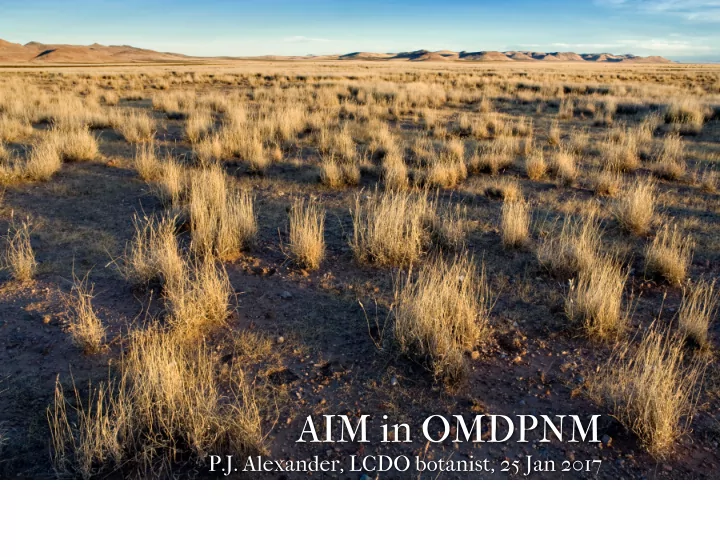
AIM methods photographs line-point intercept with veg. heights - PowerPoint PPT Presentation
AIM methods photographs line-point intercept with veg. heights canopy gap soil stability soil pit (first plot visit) plot species inventory supplementary plant production plot photographs line-point intercept
AIM methods • photographs • line-point intercept with veg. heights • canopy gap • soil stability • soil pit (first plot visit) • plot species inventory supplementary • plant production
plot photographs
line-point intercept • recorded every 25 cm along transects
line-point intercept • a pin flag (minus the flag) is dropped vertically at the appropriate point on the transect • any plants touching the pin are recorded, as well as the soil surface • used to estimate % cover of different plants, % of soil covered by litter, % rock cover, % bare ground • analogous to boot tip pace transects, but more accurate
vegetation height • recorded every 2.5 meters along each transect • particularly useful for wildlife habitat (e.g., cover for greater sage-grouse)
canopy gap • records the spatial distribution of vegetation: are there lots of small, evenly-spaced plants, or a few big clumps?
soil stability test • a small ped (piece of the soil surface) is collected, placed in a piece of PVC pipe with mesh at the bottom
soil stability test • soil stability is determined by how quickly the ped dissolves in water & with agitation (“dips”) to estimate how easily the soil will erode
soil pit • dug to 70 cm or until an impermeable layer (e.g., caliche) is reached • texture, color, % rock, & effervescence recorded for each soil horizon • used in AIM primarily to verify ecological site identification
electronic data capture • data is stored in DIMA, a Microsoft Access database • electronic data entry reduces the work of data entry in the office and increases our ability to catch errors in the field
plot species inventory • record all plant species occurring on the plot • estimates plant biodiversity across the landscape, records plants too sparse to show up in line-point intercept plant production • follows the protocols of LCDO range condition / trend plots • estimates forage production for stocking rate calculations • can be compared with production-based reference conditions for ecological sites • measured only on plots that fit our traditional criteria for range plot location: not within the sacrifice zone of a livestock water, but close enough to a water that it is used by livestock training videos for all of these methods are online http://www.landscapetoolbox.org/training/resources/
Sample design: spatially-balanced stratified random sampling • define the sample area • all BLM land within allotments that intersect the monuments • decide on sample size • 300 plots, based on 60 plots per year, 5-year revisit cycle • split the sample area into smaller pieces (strata) • based on ecological sites • decide how many plots we want to put into each stratum • based on acreage and variation / ROVs in each stratum • within each stratum, plots are random but spatially balanced (not as “clumpy” are purely random sampling)
total study area
strata
2016 plot locations
Recommend
More recommend
Explore More Topics
Stay informed with curated content and fresh updates.