An analysis of faster convergence in certain finance applications - - PowerPoint PPT Presentation

an analysis of faster convergence in certain finance
SMART_READER_LITE
LIVE PREVIEW

An analysis of faster convergence in certain finance applications - - PowerPoint PPT Presentation

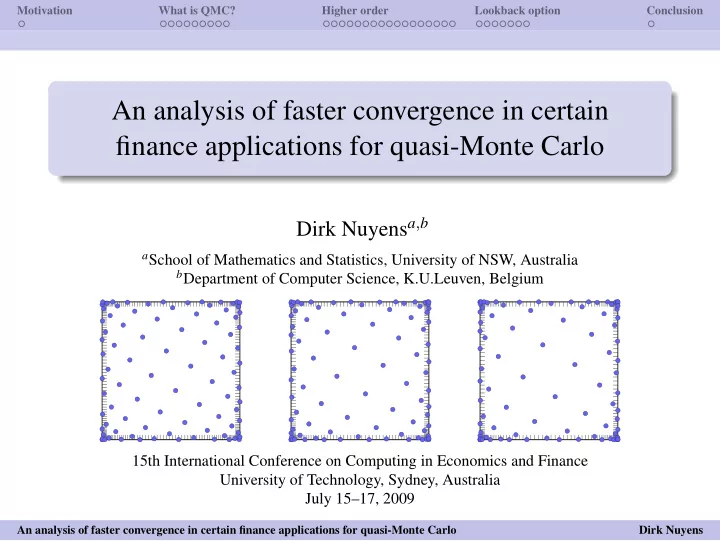
Motivation What is QMC? Higher order Lookback option Conclusion An analysis of faster convergence in certain finance applications for quasi-Monte Carlo Dirk Nuyens a , b a School of Mathematics and Statistics, University of NSW, Australia b


slide-1
SLIDE 1

Motivation What is QMC? Higher order Lookback option Conclusion

An analysis of faster convergence in certain finance applications for quasi-Monte Carlo

Dirk Nuyensa,b

aSchool of Mathematics and Statistics, University of NSW, Australia bDepartment of Computer Science, K.U.Leuven, Belgium

15th International Conference on Computing in Economics and Finance University of Technology, Sydney, Australia July 15–17, 2009

An analysis of faster convergence in certain finance applications for quasi-Monte Carlo Dirk Nuyens

slide-2
SLIDE 2

Motivation What is QMC? Higher order Lookback option Conclusion New things have happened

Motivation

A paper by Boyle, Lai and Tan (2005) discusses the usage of lattice rules (a quasi-Monte Carlo technique) for derivative pricing. Shows very impressive results using quasi-Monte Carlo methods.

(Their paper is a good introduction to QMC for finance.)

Lattice rules perform dramatically better than Monte Carlo and even Sobol’ (a favorite quasi-Monte Carlo method in finance). But: Nevertheless: lattice rules are not the magic bullet. Fact: the periodization used is a very delicate process in practice. Since then, there is new technology and theory:

Lattice sequences (instead of fixed lattice rules); Higher order digital nets.

This talk tries to address these new developments.

An analysis of faster convergence in certain finance applications for quasi-Monte Carlo Dirk Nuyens

slide-3
SLIDE 3

Motivation What is QMC? Higher order Lookback option Conclusion The problem

What is QMC?

The underlying numerical problem we are solving is approximating I( f) :=

  • [0,1]s f(x) dx,

by an equal-weight quadrature/cubature rule Q( f, {xk}N−1

k=0 ) := 1

N

N−1

  • k=0

f(xk). If the points xk (≡ samples ≡ paths) are taken

1

(pseudo) randomly, then this the Monte Carlo method;

2

deterministically, then this is the Quasi-Monte Carlo method, using low-discrepancy points.

E.g., using Sobol’ & Niederreiter sequences or lattice sequences.

An analysis of faster convergence in certain finance applications for quasi-Monte Carlo Dirk Nuyens

slide-4
SLIDE 4

Motivation What is QMC? Higher order Lookback option Conclusion The problem

Derivative pricing. . .

Lets assume a stock to adhere to S(t) ∼ S(t0) e(µ−σ2/2) t + σ W(t), with W(t) ∼ BM(0, 1), and thus W(t) ∼ N(0, t), then for a discretization on 0 = t0 < t1 < . . . < tn = T we have W := (W(t1), W(t2), . . . , W(tn))⊤ ∼ Nn(0, C), with Ci,j = min(ti, tj).

An analysis of faster convergence in certain finance applications for quasi-Monte Carlo Dirk Nuyens

slide-5
SLIDE 5

Motivation What is QMC? Higher order Lookback option Conclusion The problem

. . . as a multi-dimensional integral

Since the price of a derivative contract is defined as the expected payoff; this expectation can be written as an integral over all possible underlier paths. Since W ∼ Nn(0, C), the payoff is given by E(payoff) =

  • Rn g(w)exp(−1

2 w⊤C−1 w)

  • (2π)n det(C)

dw =

  • Rn g(A z)exp(−1

2 z⊤z)

  • (2π)n

dz =

  • [0,1]n g(A Φ−1(x)) dx,

for some factorization C = AA⊤.

An analysis of faster convergence in certain finance applications for quasi-Monte Carlo Dirk Nuyens

slide-6
SLIDE 6

Motivation What is QMC? Higher order Lookback option Conclusion Low-discrepancy point sets

What sample points to use?

Figure: Three point sets with each 64 samples in the unit square.

1

The product left-rectangle rule. → Classical product rule

Note: grids don’t work for high dimensions since, e.g., taking the minimum 2 points per dimensions in 100 dimensions requires a total of 2100 = 1267650600228229401496703205376 points.. . ≈ 1030, a quintillion

2

Pseudo-random numbers. → Monte Carlo

3

Low-discrepancy points. → Quasi-Monte Carlo

An analysis of faster convergence in certain finance applications for quasi-Monte Carlo Dirk Nuyens

slide-7
SLIDE 7

Motivation What is QMC? Higher order Lookback option Conclusion Low-discrepancy point sets

What sample points to use?

Figure: Three point sets with each 64 samples in the unit square.

1

The product left-rectangle rule. → Classical product rule

2

Pseudo-random numbers. → Monte Carlo

(Fig: mt19937, the Mersenne Twister, with default initial state.)

3

Low-discrepancy points. → Quasi-Monte Carlo

(Fig: A good lattice sequence in base 3.)

An analysis of faster convergence in certain finance applications for quasi-Monte Carlo Dirk Nuyens

slide-8
SLIDE 8

Motivation What is QMC? Higher order Lookback option Conclusion Low-discrepancy point sets

Lattice rules and sequences

An N-point lattice rule with generating vector z ∈ Zs: xk = k z N mod 1, for k = 0, 1, . . . , N − 1. A lattice sequence generates points xk = ϕb(k) z mod 1, for k = 0, 1, . . . , with ϕb a “good permutation”. E.g. radical inverse in base b.

Figure: A lattice sequence in base 3 with maximal 729 = 36 points and z = [1, 140, . . .] stopped at 81, 100, 600, 700 and 729 points.

An analysis of faster convergence in certain finance applications for quasi-Monte Carlo Dirk Nuyens

slide-9
SLIDE 9

Motivation What is QMC? Higher order Lookback option Conclusion Low-discrepancy point sets

Digital sequences (e.g., Sobol’ and Niederreiter sequence)

A digital sequence in base b (for efficiency, think b = 2) generates points {xk}bm−1

k=0 by taking for the j-th dimension

  • xk,j = Cj

k, i.e.,    xk,j,1 . . . xk,j,m    =    Cj,1,1 · · · Cj,1,m . . . ... . . . Cj,m,1 · · · Cj,m,m       k0 . . . km−1    over Fb, where the xk,j,i, for i = 1, . . . , m, and ki, for i = 0, . . . , m − 1, are the base b digits of xj and k, xk,j =

m

  • i=1

xk,j,i b−i ∈ [0, 1), k =

m−1

  • i=0

ki bi ∈ Zbm.

(In reality this can be a little bit more complicated.)

An analysis of faster convergence in certain finance applications for quasi-Monte Carlo Dirk Nuyens

slide-10
SLIDE 10

Motivation What is QMC? Higher order Lookback option Conclusion Low-discrepancy point sets

Lattice sequences

Note: “lattice” here has *nothing* to do with binomial pricing. A lattice sequence in base b (again, think b = 2) generates points {xk}bm−1

k=0 by setting

xk = ϕb(k) z mod 1, where typically ϕb is the radical inverse in base b (or its Gray code variant). E.g., the radical inverse φb just reverses the digits: φb(k) :=

m−1

  • i=0

ki b−m−1, given k =

m−1

  • i=0

ki bi. Typically for a digital sequence C1 = I, the identity matrix, and for a lattice sequence z1 = 1. Then the first dimensions coincide.

(And form the van der Corput sequence.)

An analysis of faster convergence in certain finance applications for quasi-Monte Carlo Dirk Nuyens

slide-11
SLIDE 11

Motivation What is QMC? Higher order Lookback option Conclusion Digital sequences versus lattice sequences

Digital versus lattice sequences: Practical differences

For a digital sequence

  • ne needs good generating matrices C1, C2, . . . , Cs ∈ Fm×m

b

; preferably base 2, then each of the columns of the matrices can be represented by an integer and adding up columns is done by xor’ing; preferably the k’s are taken in Gray code ordering such that only

  • ne column has to be xor’d to the previous result when

generating sequence elements. For a lattice sequence

  • ne needs a good generating vector z ∈ Zs

bm;

multiplication modulo 1 is no problem at all; preferably base 2, then radical inverse can be done by bit masks in O(log2(m)); or Gray code variant by 2 assembly instructions.

An analysis of faster convergence in certain finance applications for quasi-Monte Carlo Dirk Nuyens

slide-12
SLIDE 12

Motivation What is QMC? Higher order Lookback option Conclusion Some examples of usage

Pricing of an Asian option

10−6 10−5 10−4 10−3 10−2 10−1 100 101

  • std. err.

100 101 102 103 104 105 106 n asian-64-random asian-64-sobol asian-64-lattice asian-64-sobol-BB asian-64-lattice-BB asian-64-sobol-PCA asian-64-lattice-PCA

Figure: 64 dimensions, 10 random shifts

An analysis of faster convergence in certain finance applications for quasi-Monte Carlo Dirk Nuyens

slide-13
SLIDE 13

Motivation What is QMC? Higher order Lookback option Conclusion Some examples of usage

Pricing of an Asian option

10−6 10−5 10−4 10−3 10−2 10−1 100 101

  • std. err.
  • std. err.

100 101 102 103 104 105 106 n n Order-2 lattice Monte Carlo

Figure: 100 dimensions, 10 random shifts

An analysis of faster convergence in certain finance applications for quasi-Monte Carlo Dirk Nuyens

slide-14
SLIDE 14

Motivation What is QMC? Higher order Lookback option Conclusion The need for speed

A reprise on the multivariate integration

We are interested in approximating I( f) :=

  • [0,1]s f(x) dx

by some quadrature / cubature rule of the form QN( f; {xk}k, {wk}k) :=

N−1

  • k=0

wk f(xk). For moderate to high dimensions: equal weights wk = N−1 are nice, with random points (Monte Carlo, error O(N−1/2)); or low-discrepancy points (quasi-Monte Carlo, error ∼ O(N−1)). Here: not so interested in high dimensions and wish error ∼ O(N−α).

An analysis of faster convergence in certain finance applications for quasi-Monte Carlo Dirk Nuyens

slide-15
SLIDE 15

Motivation What is QMC? Higher order Lookback option Conclusion Smooth functions

Smooth functions

Consider the class Hα

s of s-dimensional functions for which all

∂v1,...,vsf(x) ∂xv1

1 · · · ∂xvs s

are of BV for all 0 ≤ vi ≤ α − 1.

(Bounded variation (BV) in the sense of Hardy and Krause: s-dimensional.)

E.g., if for a 1-dimensional function f we have

(sufficient, not necessary)

1 | f ′(x)| dx < ∞, then it is of bounded variation (BV). (In the sense of Vitali: 1-dimensional.)

An analysis of faster convergence in certain finance applications for quasi-Monte Carlo Dirk Nuyens

slide-16
SLIDE 16

Motivation What is QMC? Higher order Lookback option Conclusion Smooth functions

Smooth functions

Consider the class Hα

s of s-dimensional functions for which all

∂v1,...,vsf(x) ∂xv1

1 · · · ∂xvs s

are of BV for all 0 ≤ vi ≤ α − 1.

(Bounded variation (BV) in the sense of Hardy and Krause: s-dimensional.)

It follows that if

(sufficient, not necessary)

∂αsf(x) ∂xα

1 · · · ∂xα s

exists and is continuous on [0, 1]s, then f ∈ Hα

s .

If this holds than we might expect the error |I( f) − QN( f)| of a good cubature rule QN to decrease like almost O(N−α).

An analysis of faster convergence in certain finance applications for quasi-Monte Carlo Dirk Nuyens

slide-17
SLIDE 17

Motivation What is QMC? Higher order Lookback option Conclusion Smooth functions

Smooth periodic functions

Consider a similar class Eα

s of s-dimensional functions for which all

∂v1,...,vsf(x) ∂xv1

1 · · · ∂xvs s

are of BV for all 0 ≤ vi ≤ α − 1 and additionally the multivariate analog of f (v)(1) = f (v)(0), 0 ≤ v ≤ α − 2, holds: ∂v1,...,vsf(x) ∂xv1

1 · · · ∂x vs s

  • xj=1

= ∂v1,...,vsf(x) ∂xv1

1 · · · ∂xvs s

  • xj=0

for all j and 0 ≤ vi ≤ α − 2.

An analysis of faster convergence in certain finance applications for quasi-Monte Carlo Dirk Nuyens

slide-18
SLIDE 18

Motivation What is QMC? Higher order Lookback option Conclusion Smooth functions

Then by a theorem of Zaremba (1968, 1972): the Fourier series of f ∈ Eα

s converges uniformly and the Fourier coefficients are bounded

by |ˆ f(h)| ≤ 3Vα( f) (2π)α r(h)α ≤ c r(h)α , (denote f ∈ Eα

s (c) for a fixed c) where

r(h) :=

s

  • j=1

r(hj), r(hj) := max(1, |hj|), and Vα( f) is a bound on the variation of ∂(α−1)sf/∂xα−1

1

· · · ∂xα−1

s

;

  • r if ∂αsf/∂xα

1 · · · ∂xα s is continuous the largest maximum of

∂v1+···+vsf ∂xv1

1 · · · ∂xvs s

  • ver all choices of 0 ≤ vi ≤ α.

An analysis of faster convergence in certain finance applications for quasi-Monte Carlo Dirk Nuyens

slide-19
SLIDE 19

Motivation What is QMC? Higher order Lookback option Conclusion Lattice rules and periodization

In come lattice rules.. .

Suppose f ∈ Eα

s (c), then, using a (rank-1) lattice rule

QN( f; z) := 1 N

N−1

  • k=0

f k z mod N N

  • ,

the error is given in terms of the Fourier coefficients of f by

  • QN( f; z) − I( f) =
  • 0=h∈Zs

h·z≡0 (mod N)

ˆ f(h)

c

  • 0=h∈Zs

h·z≡0 (mod N)

1 r(h)α . For a “good lattice rule” the last sum can be estimated as Pα(z) :=

  • 0=h∈Zs

h·z≡0 (mod N)

1 r(h)α = O(N−α(log N)α(s−1)).

An analysis of faster convergence in certain finance applications for quasi-Monte Carlo Dirk Nuyens

slide-20
SLIDE 20

Motivation What is QMC? Higher order Lookback option Conclusion Lattice rules and periodization

. . . and lattice sequences

Good lattice rules and good lattice sequences can be constructed by the fast component-by-component algorithm (Nuyens and Cools, 2005, 2006; and Cools, Kuo and Nuyens, 2006). With a good lattice sequence One can get successive approximations of lattice rules.

By stopping at powers of the base bm.

One can stop at any point (like with Monte Carlo).

But then one can never do better than O(N−1), whatever the point set, see Hickernell, Kritzer, Kuo and Nuyens (2009).

Using a weighted QMC algorithm (WQMC), one can stop at any point and have higher order of convergence O(N−α).

New algorithm from Hickernell, Kritzer, Kuo and Nuyens (2009). Note: There is a published lattice sequence generator in Cools, Kuo and Nuyens, SIAM Journal on Scientific Computing, 28(6):2162–2188, 2006.

An analysis of faster convergence in certain finance applications for quasi-Monte Carlo Dirk Nuyens

slide-21
SLIDE 21

Motivation What is QMC? Higher order Lookback option Conclusion Lattice rules and periodization

Periodization

Given f ∈ Hα

s , i.e., all

∂v1+···+vsf(x) ∂xv1

1 · · · ∂xvs s

are of BV for all 0 ≤ vi ≤ α − 1, then we want to replace f by F ∈ Eα

s for which

1

  • [0,1]s F(x) dx =
  • [0,1]s f(x) dx.

2

∂v1+···+vsF(x) ∂xv1

1 · · · ∂xvs s

are of BV for all 0 ≤ vi ≤ α − 1;

3

∂v1,...,vsF(x) ∂xv1

1 · · · ∂x vs s

  • xj=1

= ∂v1,...,vsF(x) ∂xv1

1 · · · ∂xvs s

  • xj=0

for all j and 0 ≤ vi ≤ α − 2.

An analysis of faster convergence in certain finance applications for quasi-Monte Carlo Dirk Nuyens

slide-22
SLIDE 22

Motivation What is QMC? Higher order Lookback option Conclusion Lattice rules and periodization

Variable transformation

Given a smooth increasing function ϕ : [0, 1] → [0, 1] for which ϕ(0) = 0 ϕ(1) = 1 ϕ(v)(0) = ϕ(v)(1) for v = 1, . . . , α − 1, then set F(x) = f(ϕ(x1), . . . , ϕ(xs)) ϕ′(x1) · · · ϕ′(xs). Periodizers by Korobov (1963): polynomial forms; Sag & Szekeres (1964): tanh transform; Iri (1970): IMT transform; Mori (1978): double exponential transform; Sidi (1993): sinm forms; Laurie (1996): polynomial forms.

An analysis of faster convergence in certain finance applications for quasi-Monte Carlo Dirk Nuyens

slide-23
SLIDE 23

Motivation What is QMC? Higher order Lookback option Conclusion Lattice rules and periodization

A weighted cubature formula

As expliticized by Hickernell (2002), periodizing a function f gives a new weighted cubature rule QN(F; g) = 1 N

N−1

  • k=0

f(ϕ(xk,1), . . . , ϕ(xk,s)) ϕ′(xk,1) · · · ϕ′(xk,s) =

N−1

  • k=0

s

j=1 ϕ′(xj)

N f(ϕ(xk,1), . . . , ϕ(xk,s)) = QN(f; {ϕ(xk)}k, {N−1

s

  • j=1

ϕ′(xk,j)}k).

An analysis of faster convergence in certain finance applications for quasi-Monte Carlo Dirk Nuyens

slide-24
SLIDE 24

Motivation What is QMC? Higher order Lookback option Conclusion Lattice rules and periodization

A change of point set

The stronger the periodization the more the points are pushed to the edges.

An analysis of faster convergence in certain finance applications for quasi-Monte Carlo Dirk Nuyens

slide-25
SLIDE 25

Motivation What is QMC? Higher order Lookback option Conclusion Lattice rules and periodization

And non-equal weights

0.1 0.2 0.3 0.4 0.5 0.6 0.7 0.8 0.9 1 0.5 1 1.5 2 2.5 3 equal weights ! = 3 ! = 4 ! = 5

The stronger the periodization the more the weights deviate from their

  • riginal equal weight situation.

An analysis of faster convergence in certain finance applications for quasi-Monte Carlo Dirk Nuyens

slide-26
SLIDE 26

Motivation What is QMC? Higher order Lookback option Conclusion Lattice rules and periodization

Some problems with this approach

Korobov (1963) and Zaremba (1972) already show problems for increasing α and s. Recent work by Kuo, Sloan & Wo´ zniakowski (2007) adds to this picture. Periodization can only work in low dimensions (say s ≤ 7). Periodization needs high precision.

At least for calculating weights and points.

Periodization costs time!

But can be pre-calculated and traded for memory.

However: Very impressive results by Boyle, Lai and Tan (2005) on derivative pricing. Nice and effective quadrature packages by Robinson et al.

An analysis of faster convergence in certain finance applications for quasi-Monte Carlo Dirk Nuyens

slide-27
SLIDE 27

Motivation What is QMC? Higher order Lookback option Conclusion Lattice rules and periodization

Exit periodization, enter higher order nets?

The paper by Kuo, Sloan and Wo´ zniakwoski (2007), titled Periodization strategy may fail in high dimensions, has the following footnote: Since this paper was finished, we became aware of a result by Dick and Pillichshammer (2007): the optimal convergence rate of O(N−α), i.e., a rate matching the smoothness of the integrands, can be nearly achieved by digitally shifted polynomial lattice rules; moreover, the implied constant can be bounded independently of s under appropriate conditions on the weights. This further undermines the motivation for periodizing the integrands.

An analysis of faster convergence in certain finance applications for quasi-Monte Carlo Dirk Nuyens

slide-28
SLIDE 28

Motivation What is QMC? Higher order Lookback option Conclusion Higher order nets

An explicit construction for higher order d

Dick (2007, 2008, . . . ) gave an explicit construction based on the generating matrices of existing nets and sequences to get higher order. Given a (t′, m, ds)-net or (t′, ds)-sequence over Fb with points in ds dimensions xk =

  • xk,1

xk,2 · · · xk,ds ⊤ , k = 0, 1, . . . , where xk,j = xk,j,1 b−1 + xk,j,2 b−2 + · · · = ∞

i=1 xk,j,i b−i, and all

xk,j,i ∈ Zb. Then define new points in only s dimensions yk =

  • yk,1

yk,2 · · · yk,s ⊤ , for which yk,j = yk,j,1 b−1 + yk,j,2 b−2 + · · · =

  • i=1

d

  • v=1

xk,(j−1)d+v,i b−((i−1)d+v). It follows that yk,j,(i−1)d+v = xk,(j−1)d+v,i.

An analysis of faster convergence in certain finance applications for quasi-Monte Carlo Dirk Nuyens

slide-29
SLIDE 29

Motivation What is QMC? Higher order Lookback option Conclusion Higher order nets

Convergence

What to expect when using such a higher order net / sequence up to N = bm points? For a function f ∈ Hα

s one can construct a net of order d from a

(t′, m, ds)-net for which the error behaves like b− min(α, d) max(0, m − (t′ + ⌊s(d − 1)/2⌋)). Then we need to have m > t′ + s(d − 1) 2

  • ,

to see the higher order convergence of ∼ O(N−d).

An analysis of faster convergence in certain finance applications for quasi-Monte Carlo Dirk Nuyens

slide-30
SLIDE 30

Motivation What is QMC? Higher order Lookback option Conclusion Higher order nets

Need for precision

Assuming one picks basis b = 2, then a higher order net with N = 2m points needs md bits. Using double precision with 53 bits of precision:

d 2 3 4 5 6 7 maximum N = 2m possible 226 217 213 210 28 27

On the other hand we need m > t′

sd + ⌊(s(d − 1))/2⌋. Using

Niederreiter-Xing points, mmin is

s\d 2 3 4 5 6 7 1 2 3 3 5 6 8 2 3 6 9 12 14 18 3 4 9 13 18 22 28 4 7 13 18 26 31 – 5 8 16 25 – – – 6 11 20 30 – – – 7 13 25 – – – –

An analysis of faster convergence in certain finance applications for quasi-Monte Carlo Dirk Nuyens

slide-31
SLIDE 31

Motivation What is QMC? Higher order Lookback option Conclusion Periodization versus higher order nets

Periodization versus higher order nets

Periodization by variable transformation blows up variation: possible exponential (in α and s) constant for convergence. Periodization needs high precision; mainly for calculating the weights and points. Periodization takes time, but can be pre-computed. Higher order nets are still equal-weight! Amazing! Higher order nets also need high precision. High precision is also directly needed in evaluating f; unless f is periodic (see Dick (2007)); this is more problematic.

An analysis of faster convergence in certain finance applications for quasi-Monte Carlo Dirk Nuyens

slide-32
SLIDE 32

Motivation What is QMC? Higher order Lookback option Conclusion A lookback option

Lookback option

The payoff for a lookback call option with s discrete monitoring steps is given by P(S, T) = max(max(S(t1), . . . , S(tn)) − K, 0). In the paper by Boyle, Lai and Tan (2005) lattice rules are shown to do “dramatically” better than the Sobol’ sequence. Two reasons:

1

Black-Scholes kind of analytic solution in function of multivariate normal distribution. Genz (1992) did some work on approximating this integral. (Hard for high dimensions.)

2

For this function periodization works nice.

The “analytic solution” works so well because there the integrand function is smooth!

An analysis of faster convergence in certain finance applications for quasi-Monte Carlo Dirk Nuyens

slide-33
SLIDE 33

Motivation What is QMC? Higher order Lookback option Conclusion A lookback option

The solution

The value of this option can be expressed as V(S0, K, r, σ, T) = exp(−rT) S0  

n

  • j=1

exp(rtj) Hj In−j − (1 − Ln) K   , where Hj, In−j and Ln are all multivariate normal probabilities 1

  • |Σ|(2π)n

b1

−∞

. . . bs

−∞

exp(−1

2 x⊤Σ−1x) dx,

with different dimensions and covariance matrices.

An analysis of faster convergence in certain finance applications for quasi-Monte Carlo Dirk Nuyens

slide-34
SLIDE 34

Motivation What is QMC? Higher order Lookback option Conclusion Multivariate normal integrals

Multivariate normal integrals

Consider calculating 1

  • |Σ|(2π)n

b1

−∞

· · · bn

−∞

exp(−1

2 x⊤Σ−1x) dx,

then following Genz (1992) this can be written as an in effect (n − 1)-dimensional integral e1 1 e2(e1, w1) 1 · · · es(e1:n−1, w1:n−1) 1 dw, with ei(e1:i−1, w1:i−1) = Φ

  • bi − i−1

j=1 cijΦ−1(wjej)

cii

  • and C the lower triangular Cholesky factorization of Σ.

An analysis of faster convergence in certain finance applications for quasi-Monte Carlo Dirk Nuyens

slide-35
SLIDE 35

Motivation What is QMC? Higher order Lookback option Conclusion Multivariate normal integrals

Using WQMC

For the numerical tests it is nice to see the whole convergence graph, not just powers of 2. Furthermore: that is the usual practice for Monte Carlo simulations. However, it can be shown that only O(N−1) can be obtained for all N. Therefore the graphs are made using a reweighted sum from Hickernell, Kritzer, Kuo & Nuyens (2009). For powers of 2 the approximations obtained by the WQMC algorithm are exactly the same as those for a standard QMC algorithm.

An analysis of faster convergence in certain finance applications for quasi-Monte Carlo Dirk Nuyens

slide-36
SLIDE 36

Motivation What is QMC? Higher order Lookback option Conclusion Multivariate normal integrals

Mvn in 3 dimensions (2 dimensional integral)

10 10

1

10

2

10

3

10

4

10

5

10

6

10

−16

10

−14

10

−12

10

−10

10

−8

10

−6

10

−4

10

−2

N stderr (10 shifts) s=2 MC wlatseq baker wlatseq sin3 sobol ho3 sobol nx ho3 nx

An analysis of faster convergence in certain finance applications for quasi-Monte Carlo Dirk Nuyens

slide-37
SLIDE 37

Motivation What is QMC? Higher order Lookback option Conclusion Multivariate normal integrals

Mvn in 5 dimensions (4 dimensional integral)

10 10

1

10

2

10

3

10

4

10

5

10

6

10

−12

10

−10

10

−8

10

−6

10

−4

10

−2

N stderr (10 shifts) s=4 MC wlatseq baker wlatseq sin3 sobol ho3 sobol nx ho3 nx

An analysis of faster convergence in certain finance applications for quasi-Monte Carlo Dirk Nuyens

slide-38
SLIDE 38

Motivation What is QMC? Higher order Lookback option Conclusion Multivariate normal integrals

Mvn in 7 dimensions (6 dimensional integral)

10 10

1

10

2

10

3

10

4

10

5

10

6

10

−10

10

−9

10

−8

10

−7

10

−6

10

−5

10

−4

10

−3

10

−2

N stderr (10 shifts) s=6 MC wlatseq baker wlatseq sin3 sobol ho3 sobol nx ho3 nx

An analysis of faster convergence in certain finance applications for quasi-Monte Carlo Dirk Nuyens

slide-39
SLIDE 39

Motivation What is QMC? Higher order Lookback option Conclusion New things will happen

Conclusion

For the derivatives in Boyle, Lai and Tan (2005) lattice sequences work very well!

Not so surprising.

One can recover O(N−α), but α ≥ 1 should be carefully chosen such that periodization does not backfire. One should pre-calculate weights and points in high precision if pushing the limits. The new higher order nets are not yet up to the task, but look promising and are easy to use. The higher order nets perform better than plain Monte Carlo anyway and are very useful by that fact alone already. Anyone interested in software for lattice sequences or other quasi-Monte Carlo techniques: please contact me! dirk.nuyens@cs.kuleuven.be

An analysis of faster convergence in certain finance applications for quasi-Monte Carlo Dirk Nuyens