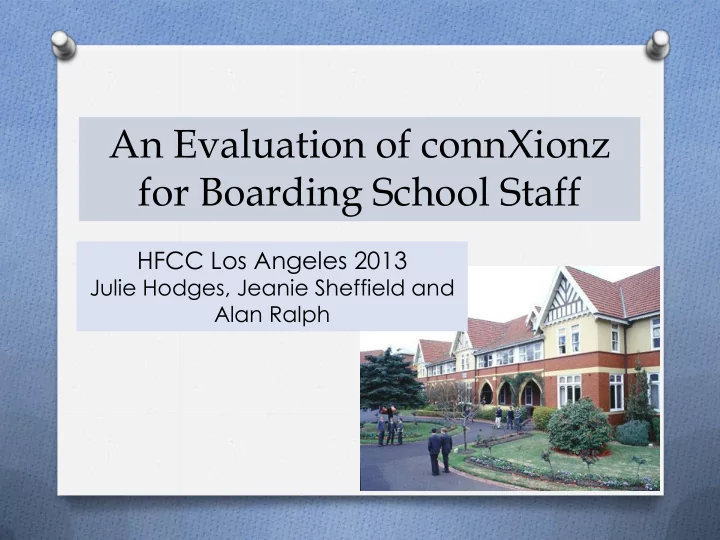
SLIDE 1
HFCC Los Angeles 2013
Julie Hodges, Jeanie Sheffield and Alan Ralph
An Evaluation of connXionz for Boarding School Staff
SLIDE 2
Overview
O Rationale for the research OComparison between staff and boarders’
perceptions of the boarding environment
OEvaluation of the staff training program
connXionz for Boarding School Staff
OChallenges OFuture directions OQuestions
SLIDE 3
The boarding environment and the role of boarding staff
SLIDE 4
In loco parentis role of boarding staff
O‘in place of a parent’ O ‘having or taking on the
responsibilities of a parent when dealing with somebody else's child’
SLIDE 5
How many boarders?
Currently around 20,000 young Australians aged 12-17 years live in the in loco parentis care of boarding school staff for 38 weeks each year.
SLIDE 6
Is the boarding environment influential in boarders development?
SLIDE 7 Home away from home? Study 1
Comparison between staff and boarders’ perceptions of the boarding environment
- conflict
- social support
- boarding school climate
- 2 open-ended questions
- enjoy?
- difficult or don’t enjoy?
SLIDE 8
Who participated?
121 staff and 415 boarders from nine boarding schools across South East Queensland, Australia
SLIDE 9
Demographics – Study 1
Staff
O 20 – 60 years O 57% parents O <1 -15 years in boarding
Boarders
O 13-17 years O <1 – 5 years boarding
SLIDE 10
Measures
Measure (Scales scored 1-10) Staff internal consistency Boarder internal consistency Conflict – CBQ -10 .87 .90 Climate - Life in Your Boarding School - 10 .87 .84 Social Support – Board4S .95 .94
SLIDE 11
Home away from home? Empirical support
SLIDE 12 Conflict (low scores = less conflict)
1 2 3 4 5 6 Boarders Staff
SLIDE 13 Boarding School Climate (high scores = more positive climate)
1 2 3 4 5 6 7 8 9 Boarders Staff
SLIDE 14 Social Support (high scores = more support)
2 4 6 8 10
Boarders Staff
SLIDE 15
Qualitative accounts
The literature presents polarised perspectives on boarder outcomes.
‘independence’ Vs ‘emotional deprivation’
SLIDE 16
“Boarding makes you more independent and free thinking” “it teaches me to respect others and listen to their opinions” (White, 2004)
SLIDE 17
Boarding is equivalent to socially condoned child abuse (Duffell, 2005; Schaverien, 2011)
SLIDE 18
Randomised Conrolled Trial of connXionz for Boarding School Staff
SLIDE 19
So.......what does a parenting program have to offer boarding staff acting in loco parentis ?
SLIDE 20
O The importance of the in loco parentis
role
O Complex boundaries between staff
and boarders
O Consistent application of strategies
connXionz and Triple P Tailoring the Program
SLIDE 21 CONNXIONZ STRATEGY DESCRIPTION APPLICATION TO THE BOARDING CONTEXT
Spending time with boarders Spending frequent, brief amounts of time when no pressure to get other things done Opportunities for boarders to enjoy adult contact; to demonstrate an interest in boarders Talking to boarders Having brief conversations about topics that are of interest to them Promoting opportunity to voice opinions and to discuss issues and interests important to them Showing appropriate affection Adult-to-teenager displays of affection that don’t cause embarrassment Demonstrate appropriate ways of showing affection
connXionz and Triple P
SLIDE 22
Staff Training
O Duty of Care – A Certificate Course in
Residential Care (Hawkes, 2001, 2010)
O Currently 382 boarding staff of an
estimated 1500 have been accredited in this training course (ABSA. 2013)
SLIDE 23
RCT of connXionz for Boarding School Staff
O 9 boarding schools in South East
Queensland
O Schools matched on population
and sex of boarders then randomly allocated to condition
O N = 58 staff members participated in
connXionz training course
SLIDE 24 RCT of connXionz for Boarding School Staff
Variable Intervention (N=32) Wait-list (N-26)
Sex* Female 14 Male 18 Female 18 Male 8 Age* 45.66 (12.34) 30.38 (10.05) Parent* 75% 35% Years in boarding* 7.55 (7.23) 4.35 (4.28) University Education* 45.7% 53.8%
SLIDE 25 RCT- Measures
Variable Pre-intervention Post-intervention Difference score I WL I WL I WL Competence 78.69 80.96 88.83 86.04 10.13* 5.08* Self-efficacy and role satisfaction 34.96 40.59 36.47 38.42 2.65*
Adjustment Stress Anxiety Depression 7.76 9.01 4.07 2.44 3.07 4.85 2.41 .67 5.67 6.23 3.04 2.06 3.56 4.53 1.72 .95
- 2.09
- 2.78*
- 1.01
- .57
- .41
- .32
- .69
.18
SLIDE 26
Competence – Intervention, Control
SLIDE 27 Competence – further analyses
O Intervention group reported
significantly greater increase in 13 of 15 competencies measured
O Greatest improvements in:
- Establishing positive relationships
- Promoting boarders’ development
- Negotiating behaviour contracts to
promote self-control
SLIDE 28 Satisfaction ratings
6.45 6.32 6.2 6.05 6.1 6.15 6.2 6.25 6.3 6.35 6.4 6.45 6.5 Active participation Overall rating Corse Content
SLIDE 29
Challenges
O Recruitment O School terms O Time constraints O Staff commitment
(voluntary/conscripted)
O Data collection & follow-up
SLIDE 30
Future Directions
O Which model? O Accreditation O Supervision and support
SLIDE 31
Questions?