
SLIDE 1
An inclusive politics of urban mobility
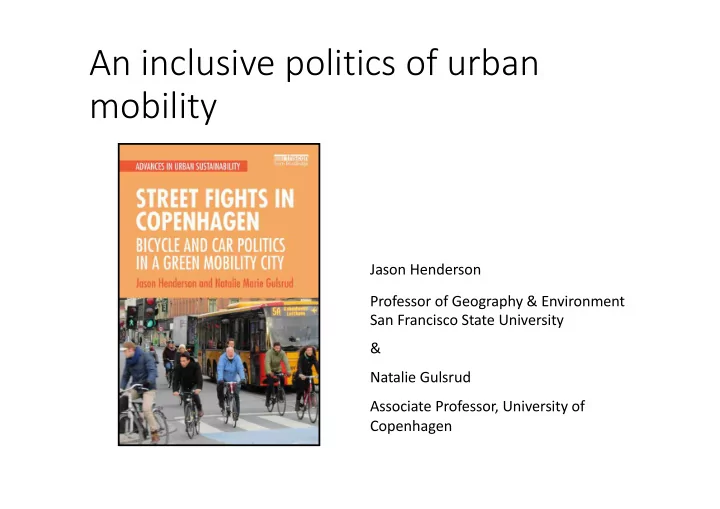
Jason Henderson Professor of Geography & Environment San Francisco State University & Natalie Gulsrud Associate Professor, University of Copenhagen
An inclusive politics of urban mobility Jason Henderson Professor - - PowerPoint PPT Presentation
An inclusive politics of urban mobility Jason Henderson Professor of Geography & Environment San Francisco State University & Natalie Gulsrud Associate Professor, University of Copenhagen About us Why we wrote this book How can
Jason Henderson Professor of Geography & Environment San Francisco State University & Natalie Gulsrud Associate Professor, University of Copenhagen
IPCC 5th Assessment: “Transport Daunting” IPCC (2018) Global Warming of 1.5 °C “Rapid and far reaching transformations” “Deep emissions reductions” “Unprecedented in terms of scale” Need for immediate and rapid de-carbonization by 2030 Inequity between North & South needs to be addressed
Jason Henderson, SF State University: Jhenders@sfsu.edu
Mode shift Compact City Transportation Demand Management “Sustainable consumption lifestyles”
[IPCC (2018) CH 4]
Jason Henderson, SF State University: Jhenders@sfsu.edu
Jason Henderson, SF State University: Jhenders@sfsu.edu
Jason Henderson, SF State University: Jhenders@sfsu.edu
Queen Louises Bridge at morning rush hour. 48,500 cyclists cross it each day (vs. 10,000 cars) (CPH, 2017)
Jason Henderson, SF State University: Jhenders@sfsu.edu
Jason Henderson, SF State University: Jhenders@sfsu.edu
Pucher & Buehler “World’s best” Captured the imagination
Newman & Kenworthy “Pin-up city” IPCC 5th Assessment CH 8 Transport Mode shift to cycling
Jason Henderson, SF State University: Jhenders@sfsu.edu
Copenhagen has remarkably similar density to major California urban areas
Population Density
(Pers./Mi2)
Density
(Pers/ Km2)
Copenhagen
(Stats Denmark 2017)
611, 822 18,318 7,071 San Francisco
CA Dpt. Finance (2017)
874,228 18,500 7,111 CPH Bridge Districts
(City of CPH, 2017 & Fred 2016)
383,171 25,545 9,876 SF Market & Octavia
(2010 US Census)
30,800 27,000 10,424 LA: Korea Town- Westlake-East Hollywood (LA Times) 320,000 37,311 14,440 Greater CPH Urbanized Area Stats
DK 2017
1,319996 6,554 2,530 SF-Oak Urbanized
(2010 US Census)
3,281,000 6,226 2,403 Los Angeles Urbanized
(2010 US Census)
12,150,000 6,999 2,702
Table 1.8: Copenhagen’s city center and suburban density compared to the San Francisco Bay Area and Los Angeles, California.
Europe car trips (WHO, 2014) 50% of all car trips < 3 mi. 30% < 1.8 mi. (3km). US car trips (NHTS 2017) 21% < 1 mi 46% < 3 mi 60% < 5 mi. Bay Area car trips 72% < 3 miles
Drive: 7 minutes Walk: 46 minutes Bike: 17 minutes
Jason Henderson, SF State University: Jhenders@sfsu.edu
Remarkably Similar
Jason Henderson, SF State University: Jhenders@sfsu.edu
Jason Henderson, SF State University: Jhenders@sfsu.edu
Jason Henderson, SF State University: Jhenders@sfsu.edu
Jason Henderson, SF State University: Jhenders@sfsu.edu
City of Copenhagen (2016). CPH 2025 Climate Plan: Roadmap 2017-2020. Copenhagen, Technical and Environmental Administration: .
Jason Henderson, SF State University: Jhenders@sfsu.edu
Jason Henderson, SF State University: Jhenders@sfsu.edu
Ideology Role of Government Politics of Mobility
Left/Progressive
Enhedslisten Socialist Workers Alternative Radikal Venstre
Reduce car space through government intervention Pricing: public/redistribute Mobility is systematic problem, livability is social responsibility Slow down, reduce consumption Neoliberal
Venstre Social Democrats Liberal Alliance
Government investment for capital accumulation Pricing; private/ “efficiency” Market is best way to organize mobility; livability as economic development Privatized, non-union creative class consumption Conservative
Danish People’s Conservative
Government should preserve space of automobility Little/ no pricing Automobile is way of life/ car is culture Individual responsibility/ spatial secession
Jason Henderson, SF State University: Jhenders@sfsu.edu
Jason Henderson, SF State University: Jhenders@sfsu.edu
Jason Henderson, SF State University: Jhenders@sfsu.edu
Taastrup, outside of Copenhagen
Jason Henderson, SF State University: Jhenders@sfsu.edu
No Congestion Toll Ring No more Parking Removal (without 1:1 replacement) No more increased parking charges More Off-street parking Harbor Tunnel
Jason Henderson, SF State University: Jhenders@sfsu.edu
Jason Henderson, SF State University: Jhenders@sfsu.edu
New luxury housing in Copenhagen Island Brygge (2016)
(2016) Annual Parking Report
2025 CPH will add 100,000 more people, at 1,000 persons/month – Car ownership will increase 1.2% annually – 20,000 new cars in Copenhagen between 2016- 2025 – The largest increase in new cars is in the Harbor and redevelopment areas where parking is being built with new housing
New luxury housing Island Brygge (Iceland Wharf) (2016) City states desire to stop increase in car ownership in redevelopment areas?
Jason Henderson, SF State University: Jhenders@sfsu.edu
Jason Henderson, SF State University: Jhenders@sfsu.edu
Social Democrats “love their cars” “The Social Democrats are all-in
when it comes to parking, invoke rhetoric that a single mother with two children must have a car and parking”
Politiken (2018) Politiken (1960s)
Jason Henderson, SF State University: Jhenders@sfsu.edu
Jason Henderson, SF State University: Jhenders@sfsu.edu
Danish Broadcasting 2018
Jason Henderson, SF State University: Jhenders@sfsu.edu
Jason Henderson, SF State University: Jhenders@sfsu.edu
Jason Henderson, SF State University: Jhenders@sfsu.edu
Jason Henderson, SF State University: Jhenders@sfsu.edu
Jason Henderson, SF State University: Jhenders@sfsu.edu
50% Bicycle Mode Share 25% Car Mode Share 30km/h citywide Transit First Social Housing Congestion Toll Ring: $4.00 to cross On-street Parking Permit: € 1,500/ yr. Car Free Core Car free/ car light housing (Off-street parking reform) Free/reduced fares on public transit
Jason Henderson, SF State University: Jhenders@sfsu.edu
Jason Henderson, SF State University: Jhenders@sfsu.edu
Jason Henderson, SF State University: Jhenders@sfsu.edu
Jason Henderson, SF State University: Jhenders@sfsu.edu
Ideology Role of Government Politics of Mobility
Left/Progressive
Enhedslisten Socialist Workers Alternative Radikal Venstre
Reduce car space through government intervention Pricing: public/redistribute Mobility is systematic problem, livability is social responsibility Slow down, reduce consumption Neoliberal
Venstre Social Democrats Liberal Alliance
Government investment for capital accumulation Pricing; private/ “efficiency” Market is best way to organize mobility; livability as economic development Privatized, non-union creative class consumption Conservative
Danish People’s Conservative
Government should preserve space of automobility Little/ no pricing Automobile is way of life/ car is culture Individual responsibility/ spatial secession
Jason Henderson, SF State University: Jhenders@sfsu.edu