
SLIDE 1
An introduction to magnetism in three parts
Wulf Wulfhekel Physikalisches Institut, Karlsruhe Institute of Technology (KIT) Wolfgang Gaede Str. 1, D-76131 Karlsruhe
An introduction to magnetism in three parts Wulf Wulfhekel - - PowerPoint PPT Presentation
An introduction to magnetism in three parts Wulf Wulfhekel Physikalisches Institut, Karlsruhe Institute of Technology (KIT) Wolfgang Gaede Str. 1, D-76131 Karlsruhe 0. Overview Chapters of the three lectures 1. Maxwell equations 2. Quantum
Wulf Wulfhekel Physikalisches Institut, Karlsruhe Institute of Technology (KIT) Wolfgang Gaede Str. 1, D-76131 Karlsruhe
Chapters of the three lectures
Literature Soshin Chikazumi, Physics of Ferromagnetism Oxford University Press, 2nd edition, 672 pages (2009). Detailed and easy to understand. Stephen J. Blundell, Magnetism in Condensed Matter, Oxford University Press, 256 pages (2001). Very easy to read, gives a condensed overview. J.M.D. Coey, Magnetism and Magnetic Materials, Cambride University Press, 628 pages (2010). Extremely detailed and nicely illustrated book. Also available as e-book (b/w).
The four electromagnetic fields E, D, B, and H Symbol Name SI unit electric field electric displacement magnetic flux density magnetic field permittivity = 8.854*10-12 Permeability = 4π*10-7 E D B H ϵ0 μ0 [V m]=[ N C ]=[ kgm s
2C ]
[ C m
2]=[ N
Vm] [T ]=[Vs m
2]
[ A m] [ F m]=[ As Vm]=[ C
2
N m
2]
[ N A
2]=[Vs
A ] In vacuum: D=ϵ0 E H = 1 μ0 B
Maxwell equations in matter ∇ D=ρ ∇ B=0 Electrical charges are sources of D (not E) Magnetic flux density is free of sources (not H) Induction is caused by magnetic flux density (not H) Currents are sources for magnetic field (not B) ∇×E=−∂ B ∂t ∇×H=J +∂ D ∂t In matter: D=ϵ0 ϵr E H = 1 μ0μr B Matter acts oppositely on electrostatic and magnetostatic forces!
CGS units – a must not do
from: Coey
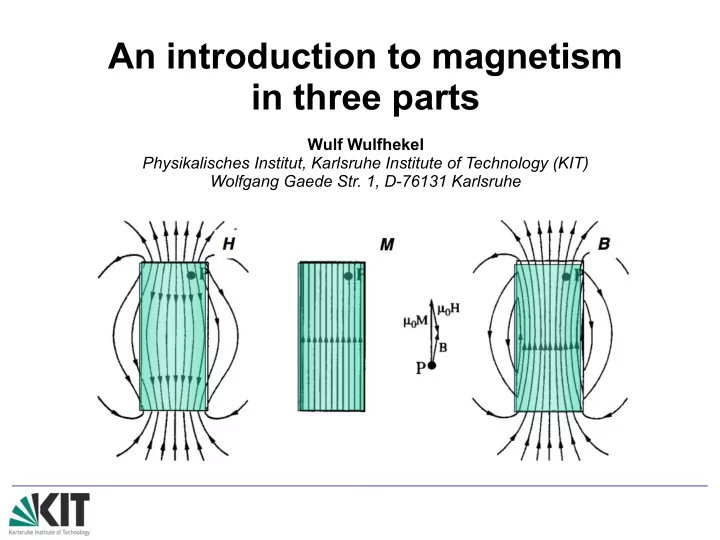
from: Coey The fields in and around a magnet B=μ0(H +M )→ H = B μ0−M Outside the magnet: B and H are proportional, H is the stray field of the magnet Inside the magnet: B, H and M are not parallel, H is the demagnetizng field Qualitatively, the demagnetizing field opposes M and B.
Magnetic susceptibility Magnetization M : density of magnetic moments Inside matter: Magnetic susceptibility: B=0 H M ,0=4×10
−7 Hm −1
M = 1 0 B= H χ<0: material is diamagnetic Diamagnetism is caused by induction currents of the
the external field. χ>0: material is paramagnetic Paramagnetism is caused by orientation of local magnetic moments along the external filed. Graphite
Magnetic Susceptibility from: Blundell
The magnetic moment of a bound electron l=I A=−e r
2=−e
2m mr
2=−e
2m ℏ l =− B l B= e ℏ 2m=9.27×10
−24 J /T
Magnetic moment of ring current (orbital moment) Bohr magneton Magnetic moment of spin (spin moment) S=−B g s Landé factor of the electron g=2.0023≈2 Magnetic moment of nucleus is neglected as mn≫me Attention: The magnetic moment behaves like an angular moment.
The magnetic moment of an atom N electrons are filled into orbitals Orbital quantum number Magnetic quantum number g JLS=1 J J 1S S1−LL1 2JJ 1 Spin quantum number Principal quantum number n=1,2,3 ,....K :n=1, L:n=2, M :n=3.. l=0,1 ,...n−1(s:l=0, p:l=1,d :l=2, f :l=3) ml=−l ,−l1,.... ,l−1,l ms=±1 2 z-components of l and s
Total magnetic moment of all electrons ⃗ μ=−μB∑
i=1 N
⃗ li+g ⃗ si=−g JLS μB ⃗ J J =∑
i=1 N
ji , ji= li si
Hund´s rule Due to Pauli´s principle, a complete atomic shell has one electron for each spin and each magnetic state. → Both the total spin and orbital angular moment vanish, as well as J. Complete shells have no magnetic moment. An atom with an nth incomplete shell and orbital momentum L can be in 2(2L+1) degenerate states, if we neglect Coulomb interaction between the electrons and spin orbit interaction. Taking into account both interactions, the states split up and a unique ground state is established that determines the magnetic moment. Hund´s rules describe how to fill in the electrons for weak spin-orbit interaction.
Hund´s rule
because two electrons with opposite spin are allowed to be in the same orbital (magnetic state), i.e. close to each other (Pauli´s principle), causing a large Coulomb repulsion.
because Coulomb repulsion is smaller, if electrons orbit in the same rotation sense (sign of magnetic quantum number) around the nucleus.
because spin-orbit interaction is given by , in which λ changes sign from positive to negative at half filled shell. L S
Hund´s rule from: Blundell Sidenote: Half filled shells have L=0 and shells with one less electron have J=0.
Hund´s rule Example: Fe 3d6
½ ½ ½ ½
1
2 1
|L+S| half full S=½(5-1)=2 L=0+2=2 J=|L+S|=4 µ=6µB 3d
6= 5 D6
Spectroscopic term (2S+1)LJ
bcc Fe with 2 atoms per unit cell of (286 pm)3 leads to M= 12 μB / (286 pm)3 =4,75 MA/m2 But experimental value is 1.71 MA/m2
Slater-Pauling curve
Problems with Hund´s rules
Hund's rule assumes that the spin-orbit interaction is a small correction
Experimental values for atoms in the gas phase slightly deviate from Hund`s rules Hund´s rule assumes free atoms (isotropic situation)
Effects are very strong for 3d but almost negligible for 4f elements. from Coey
The crystal field The electric fields of neighboring atoms can perturb the centro-symmetric potential of the free atom. The new orbital eigenstates are thus mixtures of the free atom eigenstates. If crystal field is not too strong, the orbital states in the presence of a crystal field are states with a good L2 but not with a good Lz. More details will be given by Kuzmin
The orbital states in a cubic crystal field =Y 20 = i
2 Y 21−Y 2−1
= 1
2 −Y 21Y 2−1
= i
2 Y 22−Y 2−2
= 1
2 Y 22Y 2−2
Quenching of the orbital moment While L2 is not influenced Lz is quenched < d xy | L
2|d xy >=LL1
< d xy | Lz|d xy >=1 2 <Y 22| Lz|Y 22 ><Y 2−2| Lz|Y 2−2 >= 1 2 2−2=0 So, if you apply a magnetic field along z, you see to first order no magnetic moment along z. In second order perturbation theory, you see eventually an orbital moment. Perturbation: L=∑n
excited
−2B B x|< 0| Lx| n >|
2
En−E0 x− 2 B B y |< 0| L y| n >|
2
E n−E0 y−2B Bz|< 0| Lz| n >|
2
E n−E0 z n : multi-electron wave function V i= B Li Bi < Li>= E
i
Quenching of the orbital moment L=∑n
excited −2B B x|< 0| Lx| n >| 2
En−E0 x− 2 B B y |< 0| L y| n >|
2
E n−E0 y−2B Bz|< 0| Lz| n >|
2
E n−E0 z A closer look: Lz can only be caused by mixing of states that contain same Lz components d xz ,d yz and d xy ,d x
2− y 2
Lx or Ly can only be caused by mixing of states that contain Lz components that differ by one as Lx and Ly can be written as superpositions of L- and L+.
Crystal field splitting in an octahedral crystal field eg: t2g: e1=d z
2=Y 20
e2=d x
2−y 2= 1
2 Y 22Y 2−2
fully quenched t1= 1
2 d xz−id yz=Y 2−1
t 2= 1
2 −id xzd yz=Y 21
t3=d xy=−i
2 Y 22−Y 2−2
partially quenched
Weak octahedral crystal field Hund´s rules hold: S=2 L quenched.
Strong octahedral crystal field Hund´s rules fail: S=1 Degenerate ground state! L is not fully quenched.
High-spin low-spin transitions High spin Low spin S=2 S=0
Comparison between theory and experiment
From Coey Orbital moments Fe: 0.09 μB Co: 0.15 μB Ni: 0.05 μB
The Zeeman energy and the Brillouin function Interaction between paramagnetic moment and magnetic field in z-direction: E Z=−⃗ μ ⃗ B=mJ g JLS μB B J=1/2, L=0, S=1/2 ms=±1/2 mS=1/2 mS=−1/2 E=ℏ =2 B B With partition function Z, the expectation value of mJ can be calculated
Z= ∑
mJ=−J +J
e
mJ g JLSμB B /k B T
< mJ >=−k BT d lnZ d B =g JLS B J ×BJ g JLS B J B/k BT
The Zeeman energy and the Brillouin function from: Kittel BJ y=2J1 2J coth 2J1 2J y− 1 2J coth y 2J Curie - Weiss
y=g μB J B k BT
The Brillouin Function from: Blundell
slope 1 slope 1/3
Adiabatic demagnetization NASA: X-ray calorimeter of the international X-ray observatory PTB: Micro-Kelvin nuclear demagnetization of Cu
Continuum model of magnetism
Atomic picture of individual quantum-mechanical moments is not feasible for even moderate numbers of atoms. Example: Already a cube of 3x3x3 Gd atoms, each with J=7/2, build a Hilbert space of (2J+1)3*3*3=827 ≈ 2.417.851.639.229.260.000.000.000 states. Is there a classical equation of the magnetization that captures the main aspects? Solution: Take the limit of slow variations of the direction of magnetization
a classical magnetization. M=M (r) Zeeman energy then turns into: E Z=−∫ M (r)Bext d r
Direct exchange interaction between two electrons Quantum mechanical system with two electrons : total wave function must be antisymmetric under exchange of the two electrons, as electrons are fermions. 1,2=− 2,1 Wave function of electron is a product of spatial and spin part: 1= r1× 1 For antiparallel spins (singlet): (↑↓ - ↓↑) antisymmetric For parallel spins (triplet) : = ↑↑, (↑↓ + ↓↑), ↓↓ symmetric 1,2 1
1,2= 1
→ Spatial part of wave function has opposite symmetry to spin part
Direct exchange interaction between two electrons r1,r2= 1
2 ar1 br2 ar2 br1
→ Coulomb repulsion is lower for antisymmetric spatial wave function and thus its energy Is lower than that of the symmetrical spatial wave function r1,r2= 1
2 ar1 br2− ar2 br1
symmetric for singlet antisymmetric for triplet For the antisymmetric wave function : r1, r2=− r2, r1 In case r1=r2 follows : r ,r=0 Exchange interaction between two spins: difference of the coulomb energy due to symmetry E S−ET=2∫ a
*r1 b *r2
e
2
4 0∣r1−r2∣ ar2 br1dr1dr2
Direct exchange between localized electrons J = ES−ET 2 , Eex=−2J S1 S 2 J>0 : parallel spins are favoured (ferromagnetic coupling) J<0: antiparallel spins are favoured (antiferromagnetic coupling) Heisenberg model for N spins: Nearest neighbor Heisenberg model: E=− ∑
i,j=1 N
J ij S i S j E=−∑
i,j NN
J S i S j As electrons are assumed as localized, wave functions decay quickly and mainly nearest neighbors contribute to exchange.
Continuum description of exchange
Quantum mechanics: ̂ H ex=−2∑ij J ij ̂ S i ̂ S j Continuum description: E ex=A∫(∇ m(r))
2 d r=A∫[(∇ mx) 2+(∇ m y) 2+(∇ mz) 2]d r
Easy and hard magnetic directions Along easy axis of magnetization the sample can be saturated with small fields. Along the hard axis higher fields are necessary. E A=K 1mx
2 m y 2my 2 mz 2mz 2 mx 2K 2mx 2 my 2 mz 2K 3mx 2 m y 2my 2 mz 2mz 2 mx 22.....
Cubic crystal: Hexagonal crystal: E A=K 1sin 2K 2sin4K 3cos6sin6.... K 1=5.48×10
4 J /M 2
K 1=−1.26×10
4 J /m 2
K 1=7.66×10
5 J /m 2
10
4 J /m 2≈1 eV /atom
The basics of micromagnetism In micromagnetism, the magnetic moments of a ferromagnet are approximated by a continuous vector field of variable direction but constant length. A stable magnetic state is a local minimum of the energy functional of this vector field. M r=∣M∣ m r Zeeman energy density : Exchange energy density : Anisotropy energy density : Dipolar energy density : Total energy : E Z r=−0 M H ext m r Eex r=A ∇ m r
2
E A r= f m r E D r=∫
V
0 M 2 m r ∇ ´ m r ´ r ´− r 4∣ r− r ´∣
3
d r ´ E=∫
V E Z
rEex rE A rE D rd r
The basics of micromagnetism If we neglect the non local dipolar energy, the energy density is given by local properties. To minimize the exchange energy, the vector field homogeneously points in one direction. The direction is chosen to minimize the Zeeman and anisotropy energy. The magnet is in the single domain state. Basically all complexity of the magnetic structures of magnets is caused by the complex dipolar energy. H D(⃗ r)=−M∫
V
⃗ ∇ ´ (⃗ m(⃗ r ´)(⃗ r ´−⃗ r)) 4π∣⃗ r−⃗ r ´∣
3
d ⃗ r ´=−∫
V
ρ(⃗ r ´)(⃗ r ´−⃗ r) 4π∣⃗ r−⃗ r ´∣
3
d ⃗ r ´+∫
S
σ(⃗ r ´)(⃗ r ´−⃗ r) 4π∣⃗ r−⃗ r ´∣
3
d ⃗ r ´ where ρ is the magnetic volume charge density and σ is the magnetic surface charge density r=−M ∇ m r r=M m r n r
The basics of micromagnetism In case the dipolar energy is the dominant energy, the ground state configuration will avoid both volume and surface magnetic charges. Volume charges are created e.g. by head-to-head or tail-to-tail configurations. Surface charges can be avoided, if magnetization is always tangential to edge of sample. Dipolar energy depends on shape of sample → shape anisotropy