
1
Today
Digital filters and signal processing
Filter examples and properties FIR filters Filter design Implementation issues DACs PWM
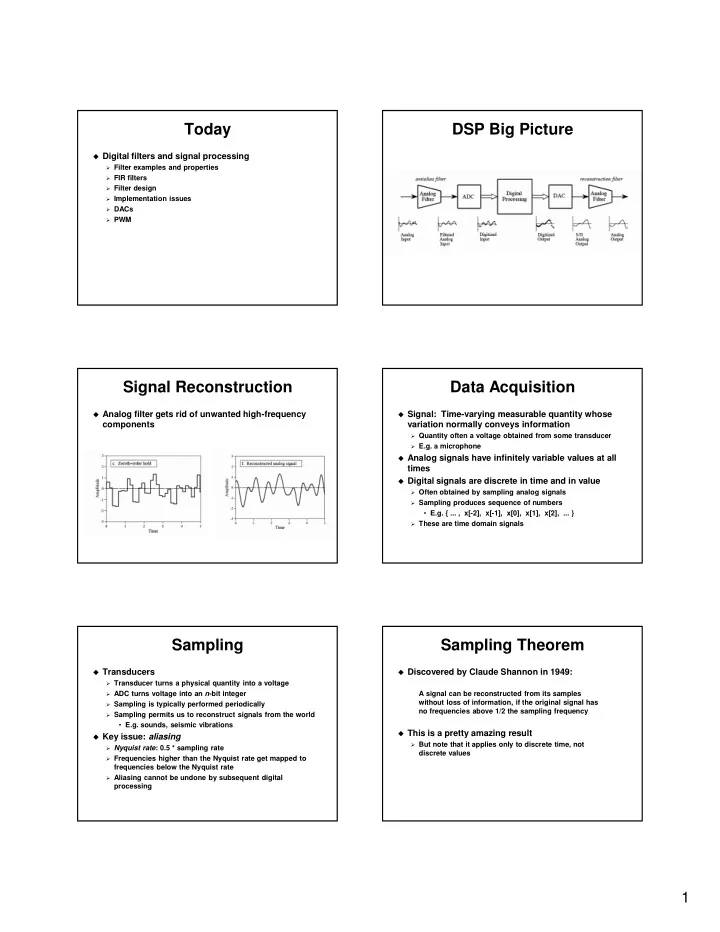
DSP Big Picture Signal Reconstruction
Analog filter gets rid of unwanted high-frequency
components
Data Acquisition
Signal: Time-varying measurable quantity whose
variation normally conveys information
Quantity often a voltage obtained from some transducer E.g. a microphone
Analog signals have infinitely variable values at all
times
Digital signals are discrete in time and in value
Often obtained by sampling analog signals Sampling produces sequence of numbers
- E.g. { ... , x[-2], x[-1], x[0], x[1], x[2], ... }
These are time domain signals
Sampling
Transducers
Transducer turns a physical quantity into a voltage ADC turns voltage into an n-bit integer Sampling is typically performed periodically Sampling permits us to reconstruct signals from the world
- E.g. sounds, seismic vibrations
Key issue: aliasing
Nyquist rate: 0.5 * sampling rate Frequencies higher than the Nyquist rate get mapped to
frequencies below the Nyquist rate
Aliasing cannot be undone by subsequent digital
processing
Sampling Theorem
Discovered by Claude Shannon in 1949:
A signal can be reconstructed from its samples without loss of information, if the original signal has no frequencies above 1/2 the sampling frequency
This is a pretty amazing result
But note that it applies only to discrete time, not
discrete values