Anatomy of a full-stack Scala/Scala.js Web App Intro to Self - - PDF document

anatomy of a full stack scala scala js web app
SMART_READER_LITE
LIVE PREVIEW

Anatomy of a full-stack Scala/Scala.js Web App Intro to Self - - PDF document

Anatomy of a full-stack Scala/Scala.js Web App Intro to Self Previous at Dropbox Currently at Bright Technology , a Data-Science/Scala consultancy We do training and consulting projects around Python / Numpy / Scipy , Scala & related tech


slide-1
SLIDE 1

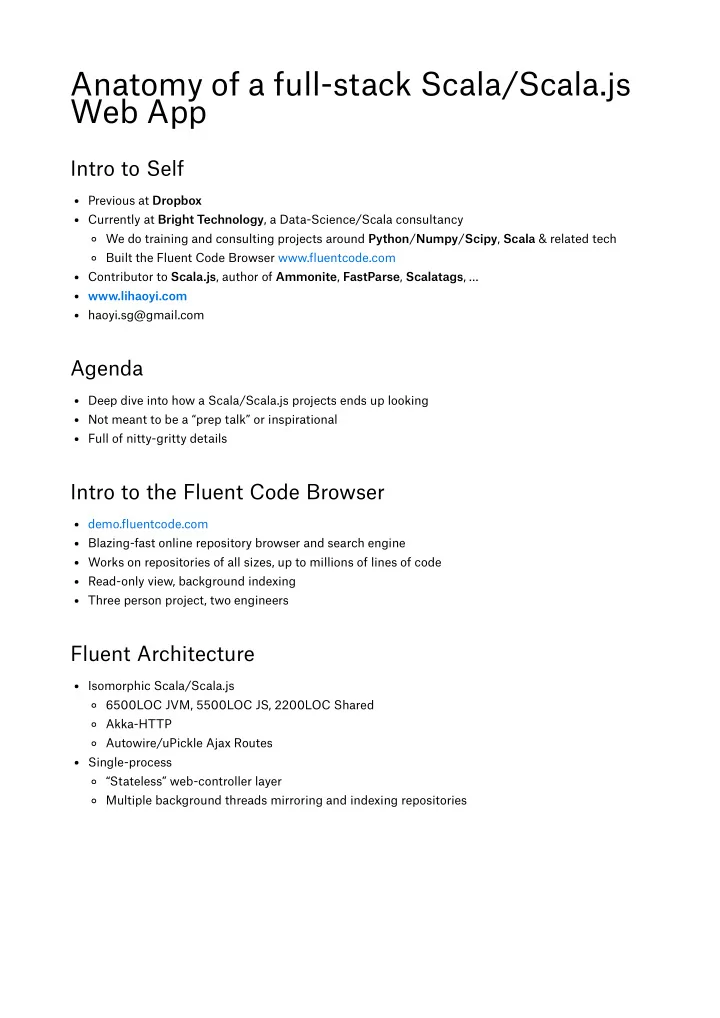
Anatomy of a full-stack Scala/Scala.js Web App

Intro to Self

Previous at Dropbox Currently at Bright Technology, a Data-Science/Scala consultancy We do training and consulting projects around Python/Numpy/Scipy, Scala & related tech Built the Fluent Code Browser www.fluentcode.com Contributor to Scala.js, author of Ammonite, FastParse, Scalatags, … www.lihaoyi.com haoyi.sg@gmail.com

Agenda

Deep dive into how a Scala/Scala.js projects ends up looking Not meant to be a “prep talk” or inspirational Full of nitty-gritty details

Intro to the Fluent Code Browser

demo.fluentcode.com Blazing-fast online repository browser and search engine Works on repositories of all sizes, up to millions of lines of code Read-only view, background indexing Three person project, two engineers

Fluent Architecture

Isomorphic Scala/Scala.js 6500LOC JVM, 5500LOC JS, 2200LOC Shared Akka-HTTP Autowire/uPickle Ajax Routes Single-process “Stateless” web-controller layer Multiple background threads mirroring and indexing repositories

slide-2
SLIDE 2
slide-3
SLIDE 3

1 2

Shared Code

Constants

Colors

  • bject Colors {
slide-4
SLIDE 4

3 4 5 6 7 8 1 2 3 4 5 6 7 1 2 3 4 5 1 2 3 4 5 6 7 8 1 2 3 4 5

val sidePane = "#212121" val browsePane = "#2b2b2b" val topPane = "#424242" ... }

Misc

  • bject Constants{

val gitIdLength = 12 val searchResultBatchSize = 100 val searchResultPauseSize = 500 ... }

Data Structures

FileTree

case class FileTree[+T](name: String, value: T, children: IndexedSeq[FileTree[T]]){ ... }

CommitId

case class CommitId(w1: Int, w2: Int, w3: Int, w4: Int, w5: Int){

  • verride def toString = {

val dst = new Array[Char](40) CommitId.formatHexChar(dst, 0, w1) ... new String(dst) } }

Helper Functions

def prettyMillisDelta(millisDelta: Long) = { val second = 1000L val minute = second * 60 ... if(millisDelta / year > 1) millisDelta / year + " years ago"

slide-5
SLIDE 5

6 7 8 9 1 2 3 4 5 6 1 2 3 4 5 6 7 8 9 10

else if(millisDelta / year == 1) "1 year ago" else if(millisDelta / month > 1) millisDelta / month + " months ago" ... }

Scalatags HTML Templates

Standard Icons

def devopsIcon(name: String) = { span( cls := s"devicons devicons-$name", styles.Base.devopIconStyle ) }

Standard Tables

def wrappingTable(tableHead: Option[Frag], contents: Frag*) = { table( cls := "table", tableLayout.fixed, styles.Base.normalTxt )( tableHead, tbody(contents) ) }

Wildly Different code

Backend web server Frontend GUI

Backend

Split into Stateless and Stateful code Stateless code is your typical web front-end: controllers, templates, etc. No mutable state Pure-ish functional Stateful code dealing with cloning/indexing git repos lives in repo-manager threads Some mutable state No global state Lives in same process for simplicity; could easily be split into separate workers Pure-ish Functional Controller Code

slide-6
SLIDE 6

1 2 3 4 5 6 7 8 9 10 1 2 3 4 5 6 7 8 9 10 11 1 2 3 4 5

def fetchPreview(filePath: GitPath, commitId: String) = { val commit = resolveIndexed(commitId) gitApi.queryFileOrFolder(commit, filePath) match{ case Some(Left(objectId)) => val lines = gitApi.open(objectId).lines.toArray PreviewResult.File(lines) case Some(Right(_)) => PreviewResult.Folder(...) case None => ??? } }

Stateful Background Indexer

var lastVersion = "..." var currentIndex: Option[Index] = None while(true){ pullRepo() val newVersion = currentVersion() if (newVersion == lastVersion) sleep() else{ currentIndex = reIndex() lastVersion = currentVersion } }

Frontend

Lots of globals Lots of mutation via the DOM; currently not using React or other frameworks Decomposed hierarchically into Views Lots of globals: Global click handler to close popups when you click somewhere else Global resize handler to make sure we only respond to resize events once Global Highlight.js lang-pack downloader & cache Modeled as top-level objects with mutable state Intrinsic global state in DOM WindowResize

  • bject WindowResize {

def register(f: () => Unit) = ... def handle(e: dom.Event) = { val allElements = dom.document.getElementsByClassName("resize-callbac k-cls") for(k <- allElements) k.asInstanceOf[js.Dynamic].resizeCallback()

slide-7
SLIDE 7

6 7 8 1 2 3 4 5 6 1 2 3 4 5 6

} dom.window.addEventListener("resize", handle _) }

Lots of mutation via the DOM; currently not using React or other frameworks Scala.Rx for simple "keep-things-in-sync" mutations Manual mangling for more ad-hoc mutations

def initCanvas(graphCanvas: dom.html.Canvas) = { graphCanvas.style.display = "block" graphCanvas.style.width = slice.pixelWidth.toString graphCanvas.height = (24 * dom.window.devicePixelRatio).toInt graphCanvas.style.height = 24.toString }

Decomposed hierarchically into Views

trait View extends scalatags.jsdom.Frag{ val view: dom.Node } class TreeView(...) extends View {...} class LargeListView(...) extends View {...} class DropdownInput(...) extends View {...}

Breakdown Performance Optimizations

Both front-end and back-end are optimized to work well with large repos Back-end indexing must fit in memory and not take too long to create Front-end must lazy-load data and lazy-display UI to avoid crashing browser

Server Shared Client

Lines

  • Code

Akka-HTTP JGit Koloboke Collections java.io, java.nio Constants Data-structures Helper Functions HTML Templates CSS Stylesheets Scala.Rx Highlight.js DOM interactions Structure Stateless controllers Pure-ish functional Stateful workers Long-lived Lots of file IO A grab-bag of standalone pieces of code A hierarchy of stateful Views Lots of references to third-part Javascript APIs

slide-8
SLIDE 8

1 2 3 4 5 6 7 8 9 10 11 12 13 14 15 16 1 2 3 4 5 6 7 8 9 10 11 12

Interesting back-end data-structures

Aggregator[T]: specialized mutable.Buffer , reduces memory needed to store indices

class Aggregator[@specialized(Int, Long) T: ClassTag](initialSize: Int = 1) { // Can't be `private` because it makes `@specialized` explode protected[this] var data = new Array[T](initialSize) protected[this] var length0 = 0 def length = length0 def apply(i: Int) = data(i) def append(i: T) = { if (length >= data.length) { val newData = new Array[T](data.length * 3 / 2 + 1) System.arraycopy(data, 0, newData, 0, length) data = newData } data(length) = i length0 += 1 } }

Interesting front-end abstractions

FetcherLite: Batching downloader

Call .get(i: Int): Future[T] Pre-fetches items from i-N to i+N and caches them Returns them instantly if asked for later

abstract class FetcherLite[T]{ def fetchBatch(startCommitIndex: Int): Future[IndexedSeq[T]] var totalCount = rx.Var(0) var currentlyFetching = false var fetchQueue = List.empty[(Int, Promise[T])] var lastFetch: Option[(Int, IndexedSeq[T])] = None def get(commitIndex: Int): Future[T] = lastFetch match{ case Some((lastStartIndex, lastFetchedCommits)) if lastStartIndex <= commitIndex && commitIndex < lastStartIndex + lastFetchedCommits.length => Future.successful(lastFetchedCommits(commitIndex - lastStartIndex))

slide-9
SLIDE 9

13 14 15 16 17 18 19

case _ => val promise = Promise[T]() fetchQueue = (commitIndex -> promise) :: fetchQueue kickOffFetchIfNecessary() promise.future }

Final Thoughts

Scala.js Benefits Scala.js Limitations

Scala.js Benefits

Saves you from dealing with Javascript Use Scala to type-check front-end, especially with Autowire Use Scala to abstract common code patterns Share common code between back-end and front-end Shared libraries e.g. Scalatags/uPickle/autowire Easy for Scala programmers to pick up Other engineer who joined project had zero front-end experience Was able to start making useful contributions in a few days

Scala.js Limitations

Very different coding style for backend vs backend, despite same language Stateless vs heavily Stateful No Globals vs lots of Globals "Principled" 3rd party APIs vs YOLO 3rd party APIs Still need to write Front-end code, which is inherently hard/messy Swing/AWT/QT/etc. aren't any better! Still need to set up your own conventions/architecture/framework to keep things sane Or use a third-party framework: React.js, Vue.js, Angular.js, Diode, ...

Conclusion

Scala.js largely solves the problem of Javascript being complicated Scala.js doesn’t solve the problem of front-end UI being complicated Scala/Scala.js largely avoids incidental differences in client/server code Scala/Scala.js doesn’t avoid intrinsic differences in client/server code

Anatomy of a full-stack Scala/Scala.js Web App

slide-10
SLIDE 10

Scaladays Chicago, 20 April 2017 Li Haoyi Bright Technology Services haoyi.sg@gmail.com