Anchorage David Saalfeld Regional Wildlife Biologist Alaska - PowerPoint PPT Presentation
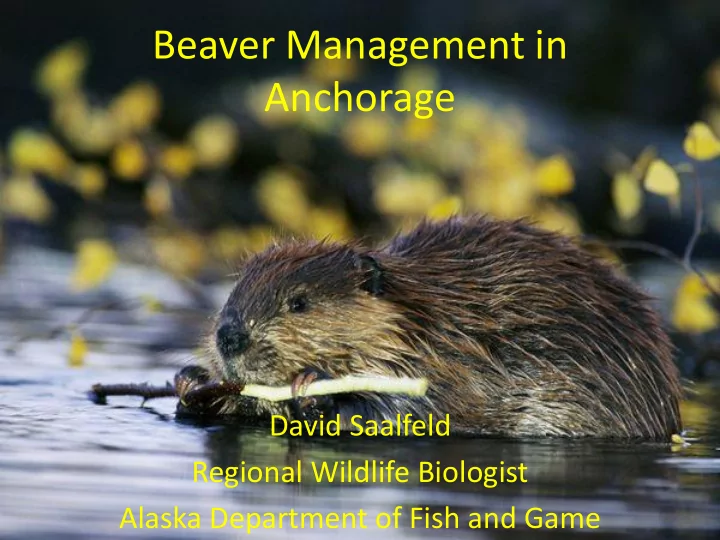
Beaver Management in Anchorage David Saalfeld Regional Wildlife Biologist Alaska Department of Fish and Game General Biology Largest rodent in North America Continue to grow in body size throughout their lives Average 40-70 lbs,
Beaver Management in Anchorage David Saalfeld Regional Wildlife Biologist Alaska Department of Fish and Game
General Biology • Largest rodent in North America • Continue to grow in body size throughout their lives • Average 40-70 lbs, but have been known to grow to 100 lbs • Primarily nocturnal, but sometimes active during day
North American Range
Reproduction • Monogamous — mated pair will live together for many years, sometimes for life • Breeding season in January/February • Gestation 107-110 days • 2-4 kits born April-June • Kits eyes are open at birth, and they are covered with soft fur • Nurse for 2-3 months • Can swim at 4 days
Longevity • When foraging away from water, vulnerable to wolves, coyotes, bears, lynx • Other causes of mortality include winter starvation, disease…and falling trees • Generally live 5-10 years in wild
Colonies • Beavers live in family units: Mom, Dad, and the kits • Kits stay with parents until 2 years old • Most beavers will reproduce at 3 years of age • Beavers are very territorial, and will defend their area from any other beavers
Designed for Underwater Operations • Nictitating membranes protect eyes • Nose and ear valves close • Draws lips tightly behind teeth when carrying wood • Can hold breath for 10-15 minutes
Coat • Short, fine hairs for warmth • Longer hairs for waterproofing • Beavers frequently groom their fur and waterproof it with castor
Castoreum • Found in “glands” near the base of the tail • Both male and females have castor sacs • Used for marking territory • Protect and waterproof fur • Human uses for castor include lure for trapping beavers, perfume, food additive, and historically it was used in some medicines
Tail • Used as a rudder • Slaps as a warning • Used for balance when standing on hind legs
Feet • Webbed hind feet for swimming • Front paws skillful at manipulating objects
Teeth • Never stop growing • Self-sharpening — the inner surface is softer than the outer enamel, so wears away faster to create a sharp edge
Diet • Vegetarians • Fresh leaves, stems, twigs, bark, aquatic plants, roots, grasses • Preferred tree species include alder, aspen, birch, cottonwood, poplar and willow • If preferred species unavailable, will eat most woody plants • Often travel >100 yds from water • Food for winter use stored in underwater caches
Structures • Dams • Lodges • Bank Dens
Dams • Flood areas for protection from predators, access to food supply, and to provide underwater entrances to dens. • Beavers living on water bodies that maintain a constant level (e.g., lakes, large rivers) do not build dams.
Dams • Dams are constructed and maintained with whatever materials are available — wood, stones, mud, and plant parts. They vary in size from a small accumulation of woody material to structures 10 ft high and over 165 ft wide • The average tree used in construction of a dam is 4- 12” at the stump…but use of trees 150’ tall and 5’ across have been recorded
Lodges and Bank Dens • The beaver’s home • Both have one chamber and at least one exit to deep water • Freestanding lodges usually built in lakes/ponds, or areas where the bank or water levels aren’t sufficient for a safe bank den • Bank dens are often in large, swift streams • Lodges consist of mound of branches and logs, plastered with mud • One or more underwater openings lead to tunnels that meet at the center of the mound • Bank dens are dug into the banks of streams and large ponds, and beavers may or may not build a lodge over them • Bank dens may also be located under stumps, logs, or docks
Lodges
The Challenges of Beaver Management • Anywhere there are beavers, we two opposing viewpoints among local residents • Benefit/Cost
Environmental Benefits • Water quality • Creation of habitat for other species • Creation of open space • Reduction of erosion
Water Quality • Beaver ponds help remove sediment and pollutants from waterways, including suspended solids, total nitrogen, phosphates, carbon, and silicates
Creation of Habitat • As trees are drowned by rising water, they become ideal for woodpeckers — whose cavities in turn draw other cavity nesting birds • Canada Geese and Trumpeter Swans have been known to depend on beaver lodges for nest sites
Creation of Habitat • Beaver ponds have been shown to have a beneficial effect on trout and salmon populations • Beaver ponds may be especially important wintering habitat for salmonids • Beaver dams develop new wetlands, benefitting a variety of other species, including waterfowl, bears, moose, gulls, etc. • Removal of some pond-side trees increases the grass/forb/shrub layer, creating more waterfowl nesting habitat adjacent to water
Creation of Open Space • When beaver ponds eventually silt in, fertile “beaver meadows” are gradually formed, creating open space that benefits a variety of other species
Reduction of Erosion • Beaver dams deepen and reduce flow, decreasing bank erosion
Beaver/Human Conflicts • Flooding • Issues with water facilities such as stormwater systems • Damage to forests and landscaping • Undermine roads • Dams can sometimes be an impediment to fish — but not as often as commonly thought • University Lake — aggressive beavers
“Beaver Fever” • Debilitating (to humans) gastrointestinal distress caused by the parasite Giardia lamblia • You get it from drinking water containing the parasite • Beavers are not the only animals that carry it
Anchorage
SHIP CREEK Glenn Pond below Alderwood Park 5th K FISH CREEK E a E L r R g C n Eastchester Lagoon D S Fork Chester Cr I O University Lake International Airport T u d o r Elmore Reflection Lake k e e r C l l e b p L R a s p b e r r y m i t t l e a C C a m p b e l l C r e e k Taku Lake Seward CAMPBELL LAKE CRAIG CREEK O ' M a l l e y Hillside FURROW CREEK RABBIT CREEK E K E C R T B I A B R E T L T L I Little Survival Creek POTTER CREEK
Management Options • Education • Exclusion • Dam Removal • Water Flow Devices • Trapping/Removal • Combination
Education • Speak to community groups • Educate personnel from other agencies; work with Municipality to draft policies guiding beaver management in Anchorage • Educate landowners: often used when there is not a real problem — beavers are simply present
Exclusion • Sturdy fencing is the primary means of exclusion. • Individual trees are best wrapped with hardware cloth forming a cylinder standing at least six inches away from the trunk. • Property is best fenced with welded wire fencing.
Dam Removal (hand removal) • Used in certain situations, if volunteers are willing to put forth effort
Water Flow Devices (Flooding Prevention) • Pond Levelers (Beaver Dam Pipes) • Culvert Protectors • Combinations
Pond Levelers • Beavers plug leaks in their dams quickly to maintain water levels • The sound of running water stimulates them to plug holes • Pond Levelers eliminate the sound and feel of flowing water
Pond Levelers
Culvert Protectors • Beavers often plug culvert pipes under roads, resulting in flooding • To be effective, a culvert fence needs to be wide, forcing the beavers to dam a long section of fence
Water Flow Devices • Appropriate for certain situations, but not all • Generally most successful if the water level does not have to be dropped very far • Must be installed correctly and maintained • If some degree of elevated water is acceptable, water flow devices should be considered • Sometimes trapping is necessary before installation
Common Reasons for Failure of Water Flow Devices • Beavers construct a new dam • Improper design (e.g., insufficient pipe capacity) • Lack of maintenance • Beavers dam the fencing • Vandalism
Relocation • Very rarely an option • Most habitat suitable for beavers…already has beavers • Beavers are territorial, so newcomers will likely be chased away
Trapping/Removal • Last resort — but is often the most practical solution • If trapping or shooting is to be done to remove beavers in the event of conflicts with humans, it is ONLY to be done under a permit issued by ADF&G • Any beavers removed by lethal means become the property of the state and hides/skulls are used for educational purposes • Not a long term solution
Evaluation of a Conflict • Can beavers and humans coexist in this area? • Are nonlethal means likely to be successful? • Is the landowner interested in trying nonlethal means…at their own expense? • Is there likely to be damage to a structure or other property? • What is the landowner willing to do to prevent future problems?
If you become aware of a conflict between humans and beavers • Do not take action on your own • ADF&G needs to evaluate the situation to decide upon the appropriate management response • Call ADF&G at 267-2344
Recommend
More recommend
Explore More Topics
Stay informed with curated content and fresh updates.