Anna Medvedovsky ICERM institute postdoc (ph.d. Brandeis University - PowerPoint PPT Presentation
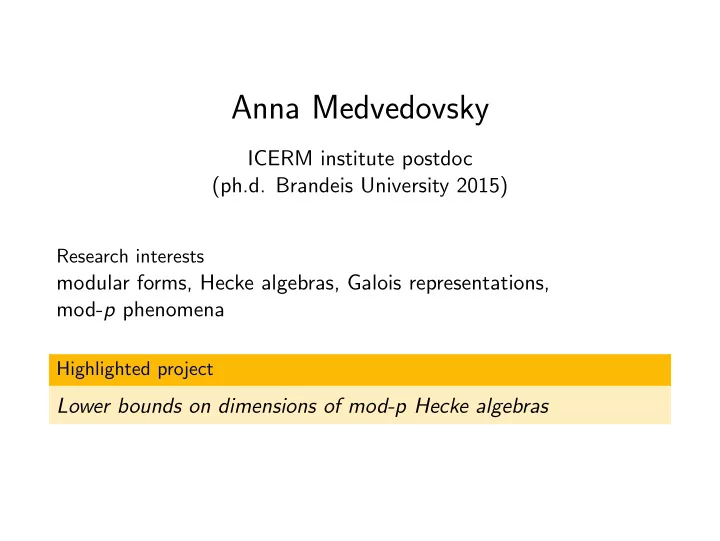
Anna Medvedovsky ICERM institute postdoc (ph.d. Brandeis University 2015) Research interests modular forms, Hecke algebras, Galois representations, mod- p phenomena Highlighted project Lower bounds on dimensions of mod-p Hecke algebras
Definitions p prime M ⊂ F p � q � space of modular forms modulo p (span of q -expansions mod p of modular forms of level one and any weight) A ⊂ End F p ( M ) Hecke algebra on M generated by all the T n with ( n , p ) = 1 (and completed: an inverse limit of Hecke algebras on finite subs of M ) We want to show that A is big (lots of modular forms).
How big? Theorem (Nicolas-Serre, 2012) If p = 2 , then A = F 2 � T 3 , T 5 � . Method: computation in characteristic 2. (Quite technical, completely elementary, combinatorial in flavor. Does not generalize.) Theorem (Bella¨ ıche-Khare, 2014) For p ≥ 5 , each local piece of A has Krull dimension ≥ 2 . Method: deduction from characteristic-zero results. (Gouvˆ ea-Mazur infinite fern implies that local pieces of char-zero Hecke algebra have dim ≥ 4.)
The nilpotence method Let m be a maximal ideal of A . To prove that dim A m ≥ 2, it is enough to see that the Hilbert-Samuel function k �→ dim F p A / m k grows faster than linearly . By duality, this is the same as finding lots of generalized eigenforms killed by m k .
Example: p = 3 Here M = F 3 [∆] and A is local with T 2 ∈ m . We look for many powers of ∆ killed by T k 2 . Key input (after Nicolas-Serre): The sequence { T 2 (∆ n ) } n of forms in M satisfies a linear recursion T 2 (∆ n ) = ∆ T 2 (∆ n − 2 ) − ∆ 3 T 2 (∆ n − 3 ) , n ≥ 3 . Theory of recursion operators in characteristic p (cf. my thesis) ⇒ the power of T 2 that kills ∆ n grows slower than linearly in n = ⇒ number of forms killed by T k = 2 grows faster than linearly in k . Corollary: dim A ≥ 2. More precisely, A = F 3 � T 2 , 1 + T 7 � .
Conclusion ◮ This method currently works for p = 2 , 3 , 5 , 7 , 13, recovering Nicolas-Serre and Bella¨ ıche-Khare (case p = 3 is new). ◮ Generalizations: any p , any level? ◮ Higher-rank groups: can this method say anything? How do you compute with these objects? Hence this semester at ICERM.
Recommend
More recommend
Explore More Topics
Stay informed with curated content and fresh updates.