Anneal induced transforms of radiation defects in hadron and - - PowerPoint PPT Presentation

anneal induced transforms of radiation defects in
SMART_READER_LITE
LIVE PREVIEW

Anneal induced transforms of radiation defects in hadron and - - PowerPoint PPT Presentation

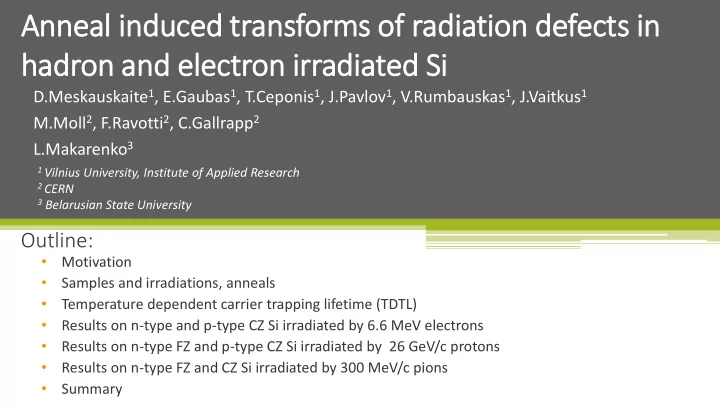
Anneal induced transforms of radiation defects in hadron and electron irradiated Si D.Meskauskaite 1 , E.Gaubas 1 , T.Ceponis 1 , J.Pavlov 1 , V.Rumbauskas 1 , J.Vaitkus 1 M.Moll 2 , F.Ravotti 2 , C.Gallrapp 2 L.Makarenko 3 1 Vilnius University,


slide-1
SLIDE 1

1 Vilnius University, Institute of Applied Research 2 CERN 3 Belarusian State University

D.Meskauskaite1, E.Gaubas1, T.Ceponis1, J.Pavlov1, V.Rumbauskas1, J.Vaitkus1 M.Moll2, F.Ravotti2, C.Gallrapp2 L.Makarenko3

Anneal induced transforms of radiation defects in hadron and electron irradiated Si

  • Motivation
  • Samples and irradiations, anneals
  • Temperature dependent carrier trapping lifetime (TDTL)
  • Results on n-type and p-type CZ Si irradiated by 6.6 MeV electrons
  • Results on n-type FZ and p-type CZ Si irradiated by 26 GeV/c protons
  • Results on n-type FZ and CZ Si irradiated by 300 MeV/c pions
  • Summary

Outline:

slide-2
SLIDE 2

Motivation

  • The better understanding of radiation damage of particle detectors is important

in order either to extend sensor lifetime and their radiation hardness or to restore their functionality after degradation caused by irradiations.

  • One of the ways to recover detector operational features is heat treatment at

technically acceptable temperatures.

  • Knowledge of evolution of the most harmful radiation defects under heat-

treatment procedures is inevitable for development of the anneal technologies.

  • The radiation defects identification by applying the contact-less MW-PC

measurements and TDTL analysis, when the standard contact methods (C-DLTS) become unsuitable due to the disordered structures and internal electric fields existing within heavily radiation damaged materials.

slide-3
SLIDE 3

Samples and irradiations

Type of irradiation Electrons Protons Pions Energy 6.6 MeV 24 GeV/c 300 MeV/c Fluence range 1016-5×10¹⁶ e/cm2 1012-1016 p/cm2 1011-3×10¹⁵ π+/cm2 Si material CZ n-Si CZ p-Si FZ n-Si CZ p-Si CZ n-Si FZ n-Si Dopant concentration 1015 cm-3 31015cm3 1012 cm-3 1012 cm-3 1012 cm-3 1012 cm-3 Resistivity 4.5 cm 4.5 cm >3 kcm 10 kcm >3 kcm >3 kcm

slide-4
SLIDE 4

Samples and irradiations

Type of irradiation Electrons Protons Pions Energy 6.6 MeV 24 GeV/c 300 MeV/c Fluence range 1016-5×10¹⁶ e/cm2 1012-1016 p/cm2 1011-3×10¹⁵ π+/cm2 Si material CZ n-Si CZ p-Si FZ n-Si CZ p-Si CZ n-Si FZ n-Si Dopant concentration 1015 cm-3 31015cm3 1012 cm-3 1012 cm-3 1012 cm-3 1012 cm-3 Resistivity 4.5 cm 4.5 cm >3 kcm 10 kcm >3 kcm >3 kcm

Anneals

  • The isochronal anneals for 24 hours have been performed at the temperatures in the

range of 80˚-280˚C.

  • The hadron irradiated samples were isothermally (at 80 ˚C) annealed up to 5 hours

before isochronal (24 h) anneals.

slide-5
SLIDE 5

Temperature dependent carrier trapping lifetime (TDTL)

Simulated trapping coefficients (Ktr) as a function of temperature for trapping level with activation energy

  • f

0.4eV and 0.23eV in Si. NC,e,Ntr(T) - the effective density of band states for trapped carriers, ∆n(T) - the excess carrier density. The as-recorded MW-PC transients in CZ Si sample irradiated with fluence 41016 e/cm2 after heat treatment 280˚C at different scan temperatures.

  • E. Gaubas, E. Simoen and J. Vanhellemont, Review-Carrier lifetime spectroscopy for defect characterization in semiconductor materials and devices, ECS J. Solid

State Sci. Technol. 5, (2016) P3108.

) ( for ) 33 34 exp( fixed for ) 3 2 exp(

33 34 3 / 2

T n , kT E B T const n , kT E A T

peak tr peak C peak tr peak

    

0.0 0.1 0.2 0.3 0.4 0.5 100 200 300

Tpeak (K) Etr (eV)

nC A=10-1 A=10-4 n(T) B=10-1 B=10-4

(d)

100 200 300 400 500 10 10

1

10

2

10

3

10

1

10

4

10

7

10

10

10

13

10

16

10

19

n(T) Ktr1 NC,e,Ntr1(T) Ktr2 NC,e,Ntr2(T) Ksum Etr1=0.4 eV Etr2=0.23 eV

n, NC,e,Ntr (cm

  • 3)

Ktr T (K) (b)

A=nC/K K=NC,VT-3/2 B=(300300-4.25F/K)

Peak temperature (within TDTL spectrum) dependence

  • n trapping centre activation

energy (Etr) simulated for the fixed ∆nC=const and temperature varied ∆n(T) excess carrier density

Tpeak for which the largest Ktr, ascribed to a single type trapping centres, is obtained, can be found by solving the transcendental equations:

slide-6
SLIDE 6

Results on n-type and p-type CZ Si irradiated by 6.6 MeV electrons

40 80 120 160 200 240 280 2 4 6 8

H related V2O V2

+

VOC TD

+

BiCs CiOi V3O V2O VP VO V2

  • C-DLTS signal (pF)

T (K)

Cz Si irradiated by electrons: n-type: =110

16 cm

  • 2

=510

16 cm

  • 2

Annealed Tan=280

  • C:

=110

16 cm

  • 2

=510

16 cm

  • 2

p-type: =110

16 cm

  • 2

=510

16 cm

  • 2

Annealed Tan=280

  • C:

=110

16 cm

  • 2

=510

16 cm

  • 2

TD

  • No peaks in low temperature wing were
  • bserved in heavily irradiated n- and p-type

CZ samples. This result can be explained by the low effective doping concentration in heavily irradiated material.

  • The radiation induced defects, ascribed

to VO, V2O. V3O and VP complexes, TD and to H related defects have been

  • bserved in the electron irradiated n-

type Cz-Si samples.

  • The hydrogen, oxygen and carbon related

complexes of V2O, VOC, V3O, BiCs , CiOi, divacancy V2

+ and TD defects have been

  • bserved in the electron irradiated p-

type Cz-Si samples.

slide-7
SLIDE 7

Results on n-type and p-type CZ Si irradiated by 6.6 MeV electrons

40 80 120 160 200 240 280 2 4 6 8

H related V2O V2

+

VOC TD

+

BiCs CiOi V3O V2O VP VO V2

  • C-DLTS signal (pF)

T (K)

Cz Si irradiated by electrons: n-type: =110

16 cm

  • 2

=510

16 cm

  • 2

Annealed Tan=280

  • C:

=110

16 cm

  • 2

=510

16 cm

  • 2

p-type: =110

16 cm

  • 2

=510

16 cm

  • 2

Annealed Tan=280

  • C:

=110

16 cm

  • 2

=510

16 cm

  • 2

TD

  • No peaks in low temperature wing were
  • bserved in heavily irradiated n- and p-type

CZ samples. This result can be explained by the low effective doping concentration in heavily irradiated material.

  • Application of the TDTL technique allowed to

identify the trapping centres appeared after heat treatment at Tan≥80˚C even in heavily irradiated samples.

120 160 200 240 280 20 40 60 80 V2 V3O

  • V2

=

E=0.3 eV H related V3O

Tan=180C Tan=280C Experiment, Simulations Experiment, Simulations R, tr,i single trap R, tr,i single trap tr, tr (traps) tr, tr (traps)

R, tr (s)

T (K)

CZ n-Si

=410

16 e/cm 2

VO

slide-8
SLIDE 8

Results on n-type FZ and p-type CZ Si irradiated by 26 GeV/c protons

  • The predominant peaks for the n-type FZ Si

samples are attributed to V- and H-related defects.

  • The application of DLTS technique for the p-type

CZ Si samples is limited due to low effective doping concentration.

50 100 150 200 250 0.0 0.1 0.2 0.3 V related V related H related H related V2

=

VO V2

  • TD

DLTS signal (arb. units) T (K)

=110

13 p/cm 2

=110

14 p/cm 2

FZ n-Si Tan=250

  • C 24h
  • DLTS

measurement are not suitable for p-type CZ Si samples irradiated by 26 GeV/c protons, due to the low concentration of the effective doping.

slide-9
SLIDE 9

Results on n-type FZ and p-type CZ Si irradiated by 26 GeV/c protons

  • The predominant peaks for the n-type FZ Si

samples are attributed to V- and H-related defects.

  • The application of DLTS technique for the p-type

CZ Si samples is limited due to low effective doping concentration.

  • As deduced using TDTL, the V2

= , H-related

and VO complexes are predominant radiation defects in the p-type CZ Si.

  • The TDTL spectroscopy is a reliable tool for

tracing of the radiation defect evolution for the range of elevated fluences.

50 100 150 200 250 0.0 0.1 0.2 0.3 V related V related H related H related V2

=

VO V2

  • TD

DLTS signal (arb. units) T (K)

=110

13 p/cm 2

=110

14 p/cm 2

FZ n-Si Tan=250

  • C 24h

120 160 200 240 280 4 8 12

=110

13 p/cm 2 =510 13 p/cm 2

Experiment, Simulations Experiment, Simulations R, tr,i single trap R, tr,i single trap tr, tr (traps) tr, tr (traps)

VO V

= 2

H related

R, tr (s) T (K)

CZ p-Si Tan= 200C 24h

slide-10
SLIDE 10

Results on n-type FZ and CZ Si irradiated by 300 MeV/c pions

  • VO, double charged di-vacancy (V2

=), H-related

and V-related defects are dominant defects in CZ n-Si samples after heat treatment at 250˚C.

  • TD and V2
  • defects are dominant defects in the

FZ n-Si samples after heat treatment at 250˚C.

50 100 150 200 250 0.0 0.5 1.0 1.5 V related H related H related V2

  • V2

=

VO TD

FZ n-Si: =110

13 /cm 2

CZ n-Si: =110

14 /cm 2

Tan=250

  • C 24h

DLTS signal (arb. units) T (K)

  • The

similarity between DLTS spectra,

  • btained for rather low fluence irradiations

by protons and pions, indicate that the irradiation with various type penetrative hadrons induce the same defects.

slide-11
SLIDE 11

Results on n-type FZ and CZ Si irradiated by 300 MeV/c pions

  • VO, double charged di-vacancy (V2

=), H-related

and V-related defects are dominant defects in CZ n-Si samples after heat treatment at 250˚C.

  • TD and V2
  • defects are dominant defects in the

FZ n-Si samples after heat treatment at 250˚C.

  • TDTL results are in qualitative agreement with

DLTS results: after subsequent heat treatment using 250˚C temperature anneals, the V2

= and VO

defects become predominant in FZ and CZ Si.

  • The unidentified defect with activation energy

E=0.3 eV might be the H-related defect.

50 100 150 200 250 0.0 0.5 1.0 1.5 V related H related H related V2

  • V2

=

VO TD

FZ n-Si: =110

13 /cm 2

CZ n-Si: =110

14 /cm 2

Tan=250

  • C 24h

DLTS signal (arb. units) T (K)

120 160 200 240 280 1 2 3 4 5 6 7

FZ n-Si CZ n-Si Experiment, Simulations Experiment, Simulations R, tr,i single trap R, tr,i single trap tr, tr (traps) tr, tr (traps)

V2

VO E=0.3 eV V=

2

R, tr (s) T (K)

=110

14 /cm 2

Tan= 250C 24h

slide-12
SLIDE 12
  • The non-monotonous variations of trap densities after different anneal steps have been

identified in heavily electrons and hadrons irradiated silicon by combining the DLTS and TDTL spectroscopy.

  • TDTL technique allowed to identify the trapping centres after heat treatment at Tan≥80°C in

electron irradiated Si (CiOi, VO, V3O and non-identified defects, also observed in DLTS spectra).

  • The similarity between DLTS spectra, obtained for rather low fluence irradiations by protons

and pions, indicate that the irradiation with various type penetrative hadrons induce the same defects (the oxygen, vacancy and hydrogen related complexes and TD).

  • The TDTL spectra showed the spectral changes dependent on irradiation type (either protons
  • r pions). The peaks related to the dominant traps have there been ascribed to V related
  • complexes. The additional peak obtained for samples irradiated by pions is attributed to the

non-identified defect with activation energy E=0.3 eV. This defect is also observed for electron irradiated CZ Si.

  • Contactless TDTL technique allows simultaneous control of interactions among several

radiation defects within large fluences irradiated Si structures.

Summary

slide-13
SLIDE 13

This research was implemented according to AIDA-2020 grant. This study was partially supported by Lithuanian Academy of Sciences, grants LMA-CERN-2016/2017. The work was partly performed in the framework of the CERN RD50 collaboration. Authors are also indebted for pion irradiations performed at the proton accelerator, Paul Scherrer Institute, Villigen, Switzerland.