AP BIOLOGY Progressive Science Initiative Origins and Molecules - - PDF document

ap biology
SMART_READER_LITE
LIVE PREVIEW

AP BIOLOGY Progressive Science Initiative Origins and Molecules - - PDF document

Slide 1 / 248 Slide 2 / 248 New Jersey Center for Teaching and Learning AP BIOLOGY Progressive Science Initiative Origins and Molecules This material is made freely available at www.njctl.org of Life and is intended for the non-commercial


slide-1
SLIDE 1

Slide 1 / 248

This material is made freely available at www.njctl.org and is intended for the non-commercial use of students and teachers. These materials may not be used for any commercial purpose without the written permission of the owners. NJCTL maintains its website for the convenience of teachers who wish to make their work available to other teachers, participate in a virtual professional learning community, and/or provide access to course materials to parents, students and others.

Click to go to website: www.njctl.org New Jersey Center for Teaching and Learning Progressive Science Initiative

Slide 2 / 248

AP BIOLOGY Origins and Molecules

  • f Life

www.njctl.org September 2011

Slide 3 / 248 Origins and Molecules of Life Unit Topics

· Early Universe, LUCA · Article Discussion Day · Polymers, Proteins

Click on the topic to go to that section

· Carbohydrates, DNA / RNA, Lipids · Water, Carbon, Nitrogen, Phosphorus Cycles · Properties of Water · Membranes, Diffusion, Osmosis · Enzymes, Non-Competitive Inhibition · Electrochemical Gradients · Optimal Environments · Facilitated Diffusion, Sodium Potassium Pump · Article Discussion Day

Slide 4 / 248

Early Universe, LUCA

Return to Table of Contents

Slide 5 / 248

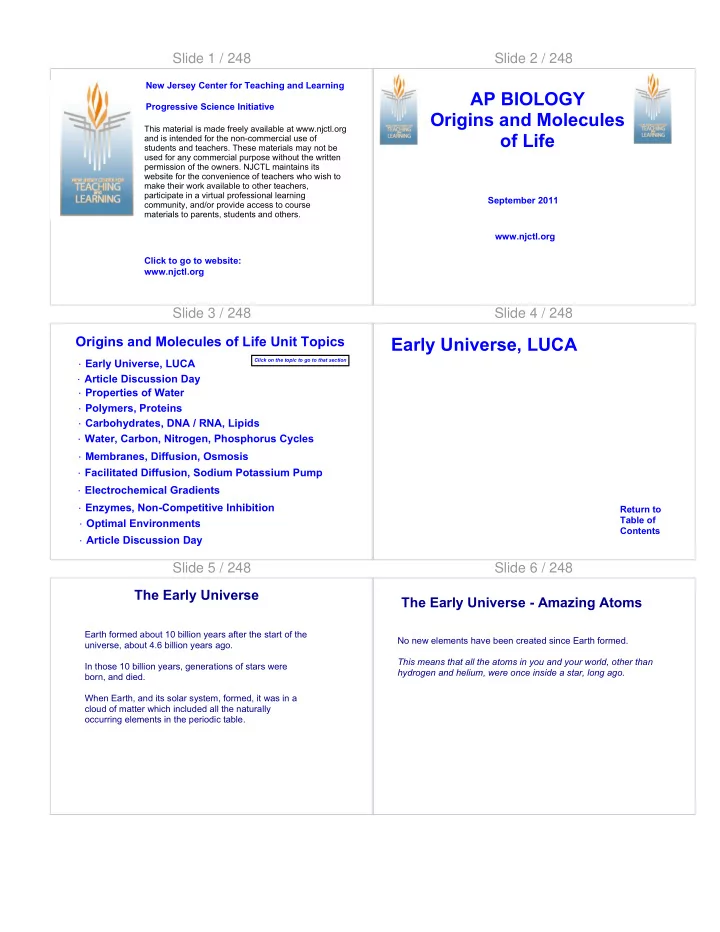
Earth formed about 10 billion years after the start of the universe, about 4.6 billion years ago. In those 10 billion years, generations of stars were born, and died. When Earth, and its solar system, formed, it was in a cloud of matter which included all the naturally

  • ccurring elements in the periodic table.

The Early Universe Slide 6 / 248

No new elements have been created since Earth formed. This means that all the atoms in you and your world, other than hydrogen and helium, were once inside a star, long ago.

The Early Universe - Amazing Atoms

slide-2
SLIDE 2

Slide 7 / 248

The most prevelant were: water vapor (H2O) carbon dioxide (CO2) nitrogen (N2) hydrogen sulfide (H2S) methane (CH4) ammonia (NH3)

Early Earth

Studies of volcanos suggest the early atmosphere of Earth was composed of a mix of chemical compounds.

Slide 8 / 248

As Earth's crust cooled and solidified, water vapor condensed to create oceans. The atmosphere was likely dominated by hot hydrogen gas, but that gas escaped quickly. Earth was also subject to intense lightning and ultraviolet radiation. Up until 3.9 BYA, the environment on Earth was too hostile for life. The earliest fossil evidence for life dates to 3.5 BYA.

Early Earth Slide 9 / 248

1 Scientists hypothesize that Earth's early atmosphere contained substances such as: A

  • xygen, carbon dioxide and hydrogen gas

B nitrogen,oxygen, and water vapor

C water vapor, methane, and oxygen D ammonia, water vapor, and hydrogen gas

Slide 10 / 248

Three-quarters of Earth’s surface is submerged in water. The abundance of water is the main reason the Earth is habitable.

The Blue Planet

image courtesy NASA

Slide 11 / 248

A water molecule consists of two hydrogen atoms covalently bonded to one oxygen atom. The more electronegative oxygen atom pulls the electrons from the hydrogen atoms toward it, resulting in an uneven distribution of charge.

Water Molecules

Slight Positive Charge Slight Negative Charge

Slide 12 / 248 Water Molecules

Since a water molecule has a positive end and a negative end it is called a polar molecule. This property of water causes it to act like a magnet, attracting

  • ther molecules that have positive and negative poles.
slide-3
SLIDE 3

Slide 13 / 248 Liquid Water

The polarity of water molecules causes them to be attracted to each other. Weak hydrogen bonds form between the hydrogens on one water molecule and the oxygen atoms on another to form liquid water.

Hydrogen Bonds

It was in this chemical medium that life first emerged.

Slide 14 / 248

2 In a water molecule hydrogen and oxygen are bonded together by

A

Ionic bonds

B

Covalent bonds

C

Hydrogen bonds

D

Van der waals forces

Slide 15 / 248

3 Which of the following best describes a hydrogen bond?

A

bond formed through an electrostatic attraction between two oppositely charged ions

B

bond formed by the equal sharing of electrons between two atoms

C

the attractive force between neutral molecules

D

the attractive force between the hydrogen attached to an electronegative atom of one molecule and an electronegative atom of a different molecule

Slide 16 / 248 How life may have emerged

Organic monomers formed and combined to form polymers. Phospholipids formed, creating membranes, and created isolated chemical environments. Simple metabolism and self-replication within these environments led to increasingly complex compounds and micromolecules, and eventually macromolecules. The development of RNA marks the transition to life, as metabolism, self-replication and catalysis became more advanced.

Slide 17 / 248

Organic Monomers Formed

There are two theories for the source of organic monomers · Arrival on Earth from space · Creation on Earth through chemical reaction

Slide 18 / 248

Theory 1: Organic Monomers from Space

The dust in the solar system, from which Earth formed, was rich in organic chemicals. Meteorites striking Earth would have hit with lower velocity since the atmosphere was thicker; the monomers would have survived.

slide-4
SLIDE 4

Slide 19 / 248

Two scientists (Oparin and Haldane), in the 1920's, proposed that

  • rganic chemistry could have evolved in the early Earth's

atmosphere because it contained no oxygen. The oxygen-rich atmosphere of today is corrosive and breaks molecular bonds.

Theory 2: Organic Monomers from Reactions

Slide 20 / 248

In 1953, Stanley Miller used Oparin and Haldane's original idea and tested a hypothesis involving an artificial mixture of inorganic molecules while simulating the conditions thought to be found on primitive Earth. Within days, the experiment produced some of the 20 amino acids presently found in organisms, as well as other organic molecules.

Organic Monomers from Reactions

Slide 21 / 248

Stanley Miller's Experiment

Slide 22 / 248

4 Miller and other scientists have shown that A simple cells can be produced in a laboratory B amino acids and sugars could be produced from inorganic molecules C cells survived in the primitive atomosphere D life on early earth required material from space

Slide 23 / 248

5 Organic compounds are found in which section of Miller's apparatus? A B C D A B C D

Slide 24 / 248

H

OH

removal of water molecule

OH

+

molecule 1 molecule 2

OH

new molecule is formed

H H20 H

From these organic molecules, polymers were then formed through a process called dehydration synthesis

Dehydration Synthesis

slide-5
SLIDE 5

Slide 25 / 248

Part of the process of chemical evolution was that molecules had to react together and then form new molecules.

Hydrolysis

H

OH

addition of water molecule

OH

splits into 2 new molecules

OH

  • riginal molecule

H H20 H

and

Reacting together also involved breaking molecules apart. This process is called Hydrolysis.

Slide 26 / 248

6 Which is true about dehydration synthesis?

A

  • ne monomer loses a hydrogen atom, the other loses a

hydroxyl group B electrons are shared between the joined monomers C water is formed when monomers join D covalent bonds are formed between monomers E all of the above are true

Slide 27 / 248

Phospholipids are molecules whose opposite ends are very different: · One end is polar and can form hydrogen bonds with water · The other end is non-polar and cannot form hydrogen bonds

Phospholipids

Dehydration Synthesis allowed phospholipids to form and naturally created membranes which led to primitive cells, which isolated separate chemical environments. When phospholipids are placed in water, they move so that their hydrophilic ends are in contact with water and their hydrophobic ends are isolated from the water.

Slide 28 / 248

The result is that phospholipids naturally form membrane surfaces that enclose a volume of space. Membranes are an arrangement of phospholipids that gather together and make a closed shape. Membranes act as a wall or a barrier separating the outside and the inside of the closed shape.

Primitive Cells: Isolated chemical environments Slide 29 / 248

Within the enclosed environment, the processes of chemistry would create even more complex molecules, specifically: · Proteins · Carbohydrates · Lipids · Nucleic Acids

Simple compounds and micromolecules accumulated and formed macromolecules. Slide 30 / 248

7 The creation of membranes from phospholipids __________________. A allowed for a more complex chemistry B allowed bacteria to flourish C allowed lipids to make glycoproteins D allowed more amino acids to form

slide-6
SLIDE 6

Slide 31 / 248

The chemical reactions in these cells would eventually create sugars, and then Ribonucleic Acid. RNA has now been shown to be capable

  • f some of the key functions enabling life, and in more advanced

biological systems, specific chemical processes have taken over these activities: replication: making identical copies of itself. (Today, DNA is more effective at storage of genetic information) metabolism: storing energy for chemical reactions. (ATP now stores energy in our cells) catalyzation: dramatically speeding up favored chemical reactions (Proteins handle these reactions in our cells)

Simple compounds and micromolecules accumulated and formed macromolecules. Slide 32 / 248 Last Universal Common Ancestor (LUCA)

These cells became ever more complex until they included all the large biological molecules, including both RNA and DNA and the enzymes needed to maintain and use them. This led to what is called Last Universal Common Ancestor (LUCA). The common features of life on Earth are so profound that all life must have evolved from a single ancestor.

Slide 33 / 248

LUCA (3.5 - 3.8 BYA)

Life on Earth

The only reasonable explanation that ALL LIFE uses the exact same molecular features is that those features were in place before life branched out. They would not have been shared if they were developed independently at a later time.

Slide 34 / 248

8 Evidence for a last universal common ancestor among life

  • n Earth is:

A they all have the same synthesis pattern B they share the same underlying molecular biology C they all look the same D they are all aerobic

Slide 35 / 248

Article Discussion Day

Return to Table of Contents

Slide 36 / 248

DNA Building Blocks Found in Meteorites It's Alive! It's Alive! Maybe Right Here On Earth Evidence of Earth's Earliest Life

Click on the link to go to the article

slide-7
SLIDE 7

Slide 37 / 248

Properties of Water

Return to Table of Contents

Slide 38 / 248

Water is the Molecule That Supports All Life

All living organisms require water more than any other substance Most cells are surrounded by water, and cells consist of about 70-95% water

brain 73% heart 73% kidneys 79 % lungs 83% skin 64% blood 79 % bones 31% musles 79%

Slide 39 / 248

Three-quarters of Earth’s surface is submerged in water. The abundance of water is the main reason the Earth is habitable.

Water and Earth

image courtesy NASA

Slide 40 / 248 Four properties of water contribute to Earth’s fitness for life

Cohesive behavior Ability to moderate temperature Expansion upon freezing Versatility as a solvent

Slide 41 / 248

Cohesion and Adhesion

Cohesion is the bonding of a high percentage of the water molecules to neighboring water molecules. Cohesion is due to hydrogen bonding. Adhesion is similar to cohesion except that adhesion involves the attraction of a water molecule to a non-water molecule. Cohesion is a special case of adhesion.

Click Here to see an animation of hydrogen bonding

Slide 42 / 248

Hydrogen bonds allows for cohesion between water molecules in the microscopic vessels of plants. Adhesion of water to plant cell walls also helps counteract the force of gravity.

Cohesion and Adhesion in Plants

O H H O H H O H H O H H O H H O H H O H H O H H O H H O H H O H H

XYLEM

evaporation

  • ut the

leaf roots pull water into the plant

O H H

slide-8
SLIDE 8

Slide 43 / 248

Surface tension is related to cohesion. It is a measure of how hard it is to break the surface of a liquid

Cohesion and Surface Tension

Click Here to see a video about cohesion, adhesion, and surface tension

Slide 44 / 248

9 What do cohesion, surface tension, and adhesion have in common with reference to water?

A

All increase when temperature increases.

B

All are produced by ionic bonding. C All are properties related to hydrogen bonding. D All have to do with nonpolar covalent bonds.

Slide 45 / 248

10 Which of the following is possible due to the high surface tension of water?

A Lakes don't freeze solid in winter, despite low temperatures. B A water strider can walk across the surface of a small pond. C Organisms resist temperature changes, although they give off heat due to chemical reactions.

D Water can act as a solvent.

Slide 46 / 248

Evaporative Cooling

Evaporation is the transformation of a substance from a liquid to a gas. Heat of vaporization is the quantity of heat a liquid must absorb for 1 gram of liquid to be converted to a gas.

Slide 47 / 248

As liquid evaporates, its remaining surface cools. Evaporative cooling is due to water’s high heat of

  • vaporization. Evaporative

cooling of water helps stabilize temperatures in living things and in bodies

  • f water

Evaporative Cooling Slide 48 / 248

The hydrogen bonds in ice are more “ordered” than in liquid water, making ice less dense.

Insulation of Bodies of Water by Floating Ice

slide-9
SLIDE 9

Slide 49 / 248

11 Which property of water best explains why humans sweat to maintain a normal body temperatue?

A

Expansion upon freezing

B

Evaporative cooling

C

Specific gravity

D

Cohesion

Slide 50 / 248

12 Lettuce that has been frozen turns into green mush when thawed. What causes this to happen?

Discuss at your table and come up with an answer to share.

Slide 51 / 248 The Solvent of Life

A solution is a homogeneous mixture of substances. An aqueous solution has water as the

  • solvent. Water is a versatile solvent due

to its polarity.

Solute Solvent Solvent dissolves solute in solution

Slide 52 / 248

The different regions of the polar water molecule can interact with ionic compounds called solutes and dissolve them. Water can also interact with large polar molecules such as proteins. Certain enzymes, like those in saliva, can only act in the presence

  • f water.

Water Biochemistry

Click Here to see water dissolving a solute.

Most biochemical reactions occur in water.

Slide 53 / 248 Dissociation of Water Molecules

In liquid water, hydrogen bonds are constantly breaking and re- forming, causing water to dissociate into hydronium (H3 +) ions and hydroxide (OH-) ions. In biological systems, chemical compounds flow through and dissolve in liquid water. When chemicals dissolve in biological solutions they add ions to liquid water, changing the concentrations of H3O+ and OH-

  • ions. These changes in ionic concentration have a great effect
  • n biochemical reactions in living organisms.

O H H O H H O H H O H

+ +

  • H

Hydronium ion (H3O+) Hydroxide ion (OH-)

Slide 54 / 248 Acids and Bases

Acids are ionic compounds that break apart in water to form H+ ions.

  • Ex. HCl

Bases are ionic compounds that break apart in water to form OH- ions.

  • Ex. NaOH
slide-10
SLIDE 10

Slide 55 / 248 Acidic and Basic Solutions

Neutral Solution Acidic Solution Basic Solution

[H+] = [OH–] [H+] > [OH–] [H+] < [OH–]

Slide 56 / 248

Most biological solutions have pH values between 6-8.

Increasingly Acidic [H+] > [OH–] Neutral [H+] = [OH–] Increasingly Basic [H+] < [OH–]

The pH Scale

The pH of a solution is determined by the relative concentration of hydrogen ions.

Click Here to see a pH Simulation

Slide 57 / 248

13 The unequal sharing of electrons makes water a molecule.

A

hypdrophobic

B

ionic

C

nonpolar

D

polar

Slide 58 / 248

14 Why is water a good solvent?

A

It expands upon freezing

B

It has a high specific heat

C

Water molecules are polar

D

Water molecules are ionic

Slide 59 / 248

15 Which of the following substances would have the highest concentration of H+ ions?

A

Soap

B

Human Blood

C

Coffee

D

Gastric Acid

Slide 60 / 248

Polymers, Proteins

Return to Table of Contents

slide-11
SLIDE 11

Slide 61 / 248

Although organisms share the same limited number of monomer types, each organism is unique based on the arrangement of monomers into polymers. An immense variety of polymers can be built from a small set of monomers.

Polymers

Polymer Made of these monomers Proteins Amino acids Carbohydrates Simple sugars (monosaccharides) Nucleic acids Nucleotides

Slide 62 / 248

16

____________ are to carbohydrates as ______________ are to proteins. A nucleic acids; amino acids B monosaccharides; amino acids C amino acids; nucleic acids D monosaccharides; nucleic acids

Slide 63 / 248

To create these biological molecules, Carbon moves from the environment to the organisms, where it is used to build the backbones of macromolecules. Carbon is used primarily in storage compounds and cell formation. Nitrogen also moves from the environment to organisms where it is used to build proteins and nucleic acids.

Elements and Large Biological Molecules Slide 64 / 248

The monomers that comprise proteins are amino acids. There are 20 amino acids used to construct the vast majority of proteins; while there are a few others that are sometimes used, these 20 are the "standard" amino acids All life on Earth uses virtually the same set of amino acid to construct its proteins

Proteins and Amino Acids

Slide 65 / 248

amine group (NH3) carboxyl group (COOH) side chain Amino Acids always include an amine group (NH3), a carboxyl group (COOH) and a side chain that is unique to each amino acid.

Amino Acids

Slide 66 / 248

And here are the H (hydrogen) and the OH (hydroxyl) that form peptide bonds on either side of the amino acid.

Amino Acids

H (either H could be used) OH

slide-12
SLIDE 12

Slide 67 / 248

17

Which of the following is not a component of amino acids? A R-group B Amine Group C Hydroxyl Group D Carboxyl Group

Slide 68 / 248 Protein Shape and Structure

Shape is critical to the function of a protein A protein's shape depends on four levels of structure: Primary Secondary Tertiary Quaternary

Slide 69 / 248 Primary Structure

The primary structure of a protein is the sequence of amino acids that comprise it. Changes in the primary structure of a protein are changes in its amino acid sequence Changing an amino acid in a protein changes its primary structure, and can affect its overall structure and ability to function Sickle Cell disease is an example of a single amino acid defect

Slide 70 / 248 Primary Structure - Sickle Cell Disease

In Sickle Cell Disease - the amino acid valine is substituted for the amino acid glutamic acid.

Glutamic Acid Valine

Slide 71 / 248

Amino Acid Sequence Protein Chain Gene Sequence Amino Acid Sequence Protein Chain Gene Sequence Single Base Mutation

Normal Cell Sickle Cell Slide 72 / 248 Secondary Structure

Secondary Structure is a result of hydrogen bond formation between amino and carboxyl groups of amino acids in sequence along each polypeptide chain. Depending on where the groups are relative to one another, the secondary structure takes the shape

  • f an alpha helix or a

pleated sheet. R-groups on the amino acid do not play a role in secondary structure.

alpha helix pleated sheets

slide-13
SLIDE 13

Slide 73 / 248 Tertiary Structure

Tertiary Structure, the overall three dimensional shape of the polypeptide, results from the clustering of hydrophobic and hydrophilic R-groups and bonds between them along the helices and pleats.

Slide 74 / 248 Protein Folding

Protein folding occurs because of the properties of the individual amino acids and the way they interact with each other and their environment. Some amino acids are hydrophilic, some are hydrophobic, some are acidic, and some are basic.

Slide 75 / 248 How Protein and Water Interact

Hydrophobic amino acids are buried inside to avoid water Hydrophilic amino acids move to surface to interact with water

CLICK HERE TO SEE A PROTEIN FOLDING VIDEO

Oppositely charged acidic (-) and basic (+) amino acids pair up. Sulfides pair up to form a covalent bond.

Slide 76 / 248 Quaternary Structure

Quaternary Structure consists of more than one polypeptide chain. The quaternary structure for each protein is different, based on how the amino acids assemble and their bonds interact. Note: Not every protein has a quarternary structure!

Slide 77 / 248 Protein Function

The shape of the protein - as determined by its tertiary structure - determines the function of the protein. Its shape is driven by chemistry, but it is the shape, not the chemistry, that dictates function.

Slide 78 / 248 Normal vs. Sickle Cell

Quarternary Structure Normal Protein Quarternary Structure

  • f two abnormal

proteins clumped together

slide-14
SLIDE 14

Slide 79 / 248 Denaturation

Each sequence of amino acids folds in a different way as each amino acid in the chain interacts with water, and the

  • ther amino acids in the protein, uniquely.

Changes in heat, ionic strength, and salinity can cause proteins to unfold and lose their functionality, known as denaturation.

CLICK HERE TO SEE AN ANIMATED EXPLANATION OF PROTEIN DENATURATION

Slide 80 / 248 7 Classes of Proteins

Structural: hair, cell cytoskeleton Contractile: as part of muscle and other motile cells Storage: sources of amino acids Defense: antibodies, membrane proteins Transport: hemoglobin, membrane proteins Signaling: hormones, membrane proteins Enzymatic: regulate speeds of chemical reactions

Slide 81 / 248

18 The tertiary structure of a protein refers to: A its size

B the presence of pleated sheets

C its over all 3D structure D the number of R-groups it contains

Slide 82 / 248

19 The __________ structure of a protein consists of a chain of amino acids assembled in a specific order. A primary

B secondary

C tertiary D quaternary

Slide 83 / 248

20

At which structural level does a protein get its function? A primary B secondary C tertiary D quaternary

Slide 84 / 248

Carbohydrates, DNA / RNA, Lipids

Return to Table of Contents

slide-15
SLIDE 15

Slide 85 / 248

Monosaccharides are the simplest carbohydrates. They are the monomers that are used to build more complex carbohydrates.The most common of these are glucose and fructose. Disaccharides are formed by combining two

  • monosaccharides. Table sugar, (sucrose) is made up of

glucose and fructose. Polysaccharides are formed by combining chains of many monosaccharides.

Carbohydrates

The general formula for a carbohydrate is Cx H2x Ox

Slide 86 / 248

The simplest sugars. Examples include glucose and fructose In solution, they form ring-shaped molecules The basic roles of monosaccharides are:

  • fuel to do work,
  • raw materials for carbon backbones
  • monomers from which larger carbohydrates are synthesized.

Monosaccharides Slide 87 / 248

Cells link 2 simple sugars together to form disaccharides Disaccharide formation is another example of a dehydration reaction, the same reaction used to create proteins

Disaccharides

The most common disaccharide is sucrose (composed of glucose and fructose)

Slide 88 / 248

Different organisms link monosaccharides together, using dehydration reactions, to form several different polysaccharides. The most important 3 are starch, glycogen, and cellulose. Polysaccharides are polymers of glucose: glucose serves the same role in polysaccharides as amino acids do in proteins In order for cells to obtain energy from polysaccharides, they must be first broken down, hydrolyzed, into monosaccharides, usually glucose, which can be absorbed and used by cells.

Polysaccharides Slide 89 / 248

21 Which of the following could be a molecular formula for a carbohydrate?

A

C6H12O6

B

C23H25O18

C

C12H22O11

D

CO2

E

None of the above

Slide 90 / 248

22 The fundamental unit of polysaccharides is A fructose B glucose C sucrose D fructose and glucose

slide-16
SLIDE 16

Slide 91 / 248 Nucleic Acids

Nucleic acids are made up of a sugar and a base (a nitrogen compound). Ribonucleic Acid (RNA) uses a sugar backbone of ribose, while Deoxyribonucleic Acid (DNA) uses a sugar backbone of deoxyribose. Here's the difference. Ribose Deoxyribose

Slide 92 / 248

A nucleotide is made up of 3 components: a 5-carbon sugar (ribose or deoxyribose) a nitrogenous base a phosphate group

Nucleotides Slide 93 / 248

Nucleotides attach to one another to make long strands through dehydration reactions involving their phosphate groups. The bond that holds nucleotide monomers together is the phosphodiester bond.

Nucleotides Slide 94 / 248 Nucleic Acids

RNA uses the bases adenine, guanine, cytosine, and uracil (AGCU). DNA uses the bases adenine, guanine, cytosine, and thymine (AGCT). thymine cytosine guanine adenine uracil

Slide 95 / 248 RNA

RNA is usually single stranded. As a result, it can take on many different shapes. It's shape, depends on the hydrogen bonding between its bases and between each base and the surrounding water.

Slide 96 / 248

DNA, does not form different shapes; it's nucleotides hydrogen bond to form the familiar double- helix form of DNA. Also, instead of nucleotides being attracted to other bases in the same strand, creating shapes, they bond to matching nucleotides in a second strand, to create the double stranded helix.

DNA

This makes DNA a better archive for genetic information since the bases are on the inside of the helix, protected. But it also means that DNA can't directly work in the cell. It is a library of information, but the only way that information can be used is via RNA. RNA is chemically active in the cell, DNA is not.

slide-17
SLIDE 17

Slide 97 / 248 RNA v. DNA Slide 98 / 248 RNA versus DNA

The stability of the DNA molecule stops DNA from taking on different shapes to catalyze reactions, but that role has been taken over by proteins. So DNA is more useful and stable as an archive, while RNA is more useful working in the cells. RNA carries genetic information from DNA to where it can be used.

Slide 99 / 248 RNA versus DNA

DNA is maintained in a safe environment to maintain the integrity of the genetic code. RNA is used throughout the cell to implement the genetic code that's stored within DNA. RNA strands are shorter and less durable than DNA strands, but they are critical to communicate the instructions of the DNA code to the cell where they can be executed. Without RNA, the information stored in DNA could not be used. And without DNA, the information would not be as stable.

Slide 100 / 248

double-stranded double helix ribose sugar single stranded phosphate group found inside and

  • utside the nucleus

guanine base multiple shapes uracil base thymine base remains in nucleus cytosine base

DNA RNA DNA RNA

and deoxyribose sugar adenine bse made up of nucleotides

Slide 101 / 248

23 DNA is more stable than RNA because A it can form a double helix B it contains the base uracil C it can form a double helix and contains the base uracil D it can form a double helix and contains the base thymine

Slide 102 / 248

Lipids are the one class of large biological molecules that do not consist of polymers. Lipids are either hydrophobic or amphiphilic (like phospholipids). Main functions include energy storage, cell membranes, and metabolic activities.

Lipids

slide-18
SLIDE 18

Slide 103 / 248

Triglycerides are hydrophobic. Constructed from two types of smaller molecules: a single glycerol and usually three fatty acids. Fatty acids are carboxylic acids with a very long chain of carbon

  • atoms. They vary in the length and the number and locations of

double bonds they contain.

Lipids: Triglycerides

a fatty acid

CH2OH CH2OH CH2OH

glycerol

Slide 104 / 248

Saturated fatty acids

Fatty Acid Bonding Structure

Unsaturated fatty acids double bond

Slide 105 / 248

Have the maximum number of hydrogen atoms possible Have no double bonds in their carbon chain Solid fats

Saturated Lipids Unsaturated Lipids

Have one or more double bonds Oils are liquids at room temperature When hydrogenated (by adding more hydrogen) they become solid and saturated

Slide 106 / 248 Trans Fats

The chemical process that's used to saturate unsaturated fatty acids can lead to transfats. These have a double bond that is rotated, resulting in a linear chain. These do not function well in biological systems and are a health hazard. double bond

Slide 107 / 248

Waxes are effective hydrophobic coatings formed by many organisms (insects, plants, humans) to ward off

  • water. They consist of 1 fatty acid attached to an

alcohol. Steroids are lipids with backbones which form rings. Cholesterol is an important steroid as are the male and female sex hormones, testosterone and estrogen.

Waxes and Steroids Slide 108 / 248

24 Estrogen and Testosterone are examples of which type

  • f lipid?

A

fatty acids

B

hormones

C

steroids

D

triglycerides

slide-19
SLIDE 19

Slide 109 / 248

25 ______ and _______ have double bonds in their structures.

A

trans fats, saturated fats

B

saturated fats, unsaturated fats

C

unsaturated fats, trans fats

Slide 110 / 248

26 This term describes a molecule whose individual ends can attract and repel water.

A

hydrophobic

B

hydrophilic

C

amphiphilic

Slide 111 / 248

27 ______ is the class of biological molecules which do not consist of polymers

A

lipids

B

nucleic acids

C

proteins

D

carbohydrates

Slide 112 / 248

Water, Carbon, Nitrogen, and Phosphorus Cycles

Return to Table of Contents

Slide 113 / 248 Cycles of Matter

Energy from the sun can enter Earth, constantly adding new energy to the biosphere. However, when it comes to matter, the Earth is a closed system. The law of conservation of matter informs that in closed systems, matter can neither be created or destroyed. Atoms of elements, chemical compounds, and other forms of matter that exist on Earth cycle through the biosphere as they are passed from one organism to the next. Matter is recycled within and between ecosystems. Living organisms are composed primarily of the elements carbon, hydrogen, oxygen, phosphorous, and nitrogen in various combinations.

Slide 114 / 248

28 Since the same matter is continuously cycled through the biosphere and cannot be created or destroyed, which of the following may be true? A You inhale oxygen atoms that may have been breathed by dinosaurs millions of years ago. B You are made out of elements that were

  • nce part of a star.

C The carbon dioxide you exhale will still be here in 1000 years. D All of the above

slide-20
SLIDE 20

Slide 115 / 248 Cycles of Matter

Biogeochemical cycles refer to to the pathways through which a chemical moves through the biosphere. The primary biogeochemical cycles studied in biology are: Water Cycle Carbon Cycle Nitrogen Cycle Phosphorous Cycle

Slide 116 / 248 The Water Cycle

Water is essential to living

  • rganisms.

Water moves between the

  • cean,

atmosphere, and land.

Slide 117 / 248 Movement of Water

Most water molecules are taken up into the clouds by evaporation and transpiration. The water returns to the

  • ceans, lands, and lakes by precipitation. Water that enters the

soil returns to the oceans through runoff.

Slide 118 / 248

29 What is transpiration? A The precipitation of water from clouds. B The movement of water from the ocean to the atmosphere. C The movement of water through plants to the atmosphere. D The movement of water from the ground to the ocean.

Slide 119 / 248

30 How does water that enters the soil eventually return to the

  • cean?

A Precipitation B Transpiration

C Condensation D Runoff

Slide 120 / 248 The Carbon Cycle

Carbon is the basic building block of all

  • rganic material.

Most carbon is found as carbon dioxide in the atmosphere.

slide-21
SLIDE 21

Slide 121 / 248

(1) Photosynthesis, cellular respiration, and decomposition in living organisms take up and release carbon. (2) Geochemical processes like erosion and volcanic activity release carbon dioxide into the atmosphere and ocean. (3) Burial and decomposition under pressure converts dead

  • rganisms into fossil fuels like coal and petroleum, storing carbon

underground. (4)Human activities like mining, slashing and burning forests, and burning fossil fuels release carbon dioxide into the atmosphere. Carbon is moved through the biosphere in four main ways:

4 Ways to Move Carbon Slide 122 / 248

(1) Photosynthesis, cellular respiration, and decomposition in living organisms take up and release carbon. (2) Geochemical processes like erosion and volcanic activity release carbon dioxide into the atmosphere and ocean. (3) Burial and decomposition under pressure converts dead

  • rganisms into fossil fuels like coal and petroleum, storing carbon

underground. (4)Human activities like mining, slashing and burning forests, and burning fossil fuels release carbon dioxide into the atmosphere. Carbon is moved through the biosphere in four main ways:

4 Ways to Move Carbon Slide 123 / 248

(1) Photosynthesis, cellular respiration, and decomposition in living organisms take up and release carbon. (2) Geochemical processes like erosion and volcanic activity release carbon dioxide into the atmosphere and ocean. (3) Burial and decomposition under pressure converts dead

  • rganisms into fossil fuels like coal and petroleum, storing carbon

underground. (4)Human activities like mining, slashing and burning forests, and burning fossil fuels release carbon dioxide into the atmosphere. Carbon is moved through the biosphere in four main ways:

4 Ways to Move Carbon Slide 124 / 248

(1) Photosynthesis, cellular respiration, and decomposition in living organisms take up and release carbon. (2) Geochemical processes like erosion and volcanic activity release carbon dioxide into the atmosphere and ocean. (3) Burial and decomposition under pressure converts dead

  • rganisms into fossil fuels like coal and petroleum, storing carbon

underground. (4)Human activities like mining, slashing and burning forests, and burning fossil fuels release carbon dioxide into the atmosphere. Carbon is moved through the biosphere in four main ways:

4 Ways to Move Carbon Slide 125 / 248

(1) Photosynthesis, cellular respiration, and decomposition in living organisms take up and release carbon. (2) Geochemical processes like erosion and volcanic activity release carbon dioxide into the atmosphere and ocean. (3) Burial and decomposition under pressure converts dead

  • rganisms into fossil fuels like coal and petroleum, storing carbon

underground. (4)Human activities like mining, slashing and burning forests, and burning fossil fuels release carbon dioxide into the atmosphere. Carbon is moved through the biosphere in four main ways:

4 Ways to Move Carbon

Click here to watch a video on The Carbon Cycle

Slide 126 / 248

31 Most carbon is found A as carbon dioxide B in plants C in fossil fuels D as glucose

slide-22
SLIDE 22

Slide 127 / 248

32 How does carbon return to the atmosphere? A It is released by organisms during cellular respiration B It is released by the burning of fossil fuels C It can be released by volcanic activity D All of the above

Slide 128 / 248 Nitrogen Cycle

Nitrogen is the an important nutrient found in all amino acids. All organisms from bacteria to humans require nitrogen to make proteins. Most nitrogen is found as a gas in the atmosphere, but this form is unavailable for protein synthesis. Bacteria in soil fix nitrogen so that it can be used by plants and animals.

Slide 129 / 248 Nitrogen Cycle

Bacteria in soil and in symbiotic relationships with plants convert atmosphere nitrogen (N2) into ammonia (NH3) or ammonium (NH4) in a process called nitrogen fixation. Other bacteria in soil convert ammonia into nitrates (NO3

  • ) and

nitrites (NO2

  • ).

Producers use ammonium, nitrates, and nitrites to make proteins. Consumers eat producers and reuse the nitrogen to make their

  • wn proteins.

When organisms die, decomposers release the nitrogen in their bodies back into the soil or convert the nitrates back into nitrogen gas in a process called denitrification.

Slide 130 / 248

33 All nitrogen obtained by animals can be traced back to A The eating of bacteria at some stage in the food chain B The eating of plants at some stage in the food chain C The absorption of atmospheric nitrogen D None of the above

Slide 131 / 248

34 Nitrogen fixation is the process by which A Bacteria convert atmospheric nitrogen into ammonium B Bacteria convert nitrates and nitrites into atmospheric nitrogen C Decomposers release nitrates and nitrites from decaying

  • rganisms

D Plants release atmospheric nitrogen into the atmosphere

Slide 132 / 248 The Phosphorous Cycle

slide-23
SLIDE 23

Slide 133 / 248 Phosphorus

Phosphorous is an essential nutrient because it is a building block for RNA, DNA, and ATP. Unlike carbon and nitrogen, phosphorous is not abundant in the atmosphere and is mostly found on land in rocks, soil, and ocean sediment.

Slide 134 / 248 Storage of Phosphorus

Most phosphorous is stored in the form

  • f inorganic phosphate within rocks

and sediment until they eventually wear down and release the phosphate. Phosphate molecules may be washed into rivers, streams, and eventually the

  • cean where they are used by marine
  • rganisms.

Phosphate may remain in soil on land and be absorbed into plants that convert them into organic compounds to be useful to living organisms.

Slide 135 / 248

35 Most phosphorous is found A In the atmosphere B In plants and animals C In rocks and sediment beneath the ocean D In bacteria

Slide 136 / 248

Membranes, Diffusion, Osmosis

Return to Table of Contents

Slide 137 / 248

Membranes are an arrangement of phospholipids that gather together to enclose a volume. Membranes act as a wall or a barrier separating the

  • utside and the inside of that enclosed volume.

Membranes allow for the intake of nutrients and the elimination of waste because they are selectively permeable.

Membranes

Slide 138 / 248

36 Plasma membranes allow all types of molecules to pass through. True False

slide-24
SLIDE 24

Slide 139 / 248

37 Phospholipids arrange themselves so that their

A hydrophilic ends contact each other B hydrophobic ends ends contact each other

C hydrophilic end of one layer meets the hydrophobic end of the other layer D hydrophobic ends contact the enclosed volume of fluid

Slide 140 / 248 Plasma Membrane of Cells

Plasma membranes consist of many components including: phospholipids, cholesterol, proteins, glycoproteins, and glycolipids.

Slide 141 / 248 Lipids and the Membrane

Phospholipids form two parallel lines with their hydrophobic ends in between. The hydrophobic ends are protected from the water by the hydrophilic ends, creating a bilayer. Cholesterol inserts itself into the membrane in the same orientation as the phospholipid. Cholesterol immobilizes the first few hydrocarbons in the phospholipid, making the bilayer more stable, and impenetrable to water molecules. Cholesterol is only found in animal cell membranes.

Slide 142 / 248 Types of Membrane Proteins

Peripheral proteins stay on only one side of the membrane. Integral proteins pass through the hydrophobic core and often span the membrane from one end to the other. Proteins in the plasma membrane can drift within the bilayer. They are much larger than lipids and move more slowly throughout the fluid mosaic.

Slide 143 / 248 Carbohydrates and the Membrane

Glycoproteins have a carbohydrate attached to a protein and serve as points

  • f attachment for other

cells, bacteria, hormones, and many other molecules. Glycolipids are lipids with a carbohydrate attached. Their purpose is to provide energy and to act in cellular recognition.

protein

Slide 144 / 248

38 Which of the following statements about the role of phospholipids in forming membranes is correct?

A They are completely insoluble in water. B They form a single sheet in water. C They form a structure in which the hydrophobic portion faces

  • utward.

D They form a selectively permeable structure.

slide-25
SLIDE 25

Slide 145 / 248

39 Which best describes the structure of a cell's plasma membrane?

A proteins sandwiched betweeen two layers of phospholipids B proteins embedded in two layers of phospholipids C phospholipids sandwiched between two layers of proteins D a layer of protein coating two layers of phospholipids

Slide 146 / 248 Passive Transport

Some molecules pass through the membrane without the use

  • f energy, this is called passive transport.

Two types of Passive Transport: Diffusion Osmosis

Slide 147 / 248

Diffusion is the process where solute molecules move down a gradient until an equilibrium is reached.

Diffusion

This gradient is specific to each type of molecule meaning each type of molecule can diffuse in a different direction and at a different rate.

semipermeable

Slide 148 / 248

40 When diffusion has occurred until there is no longer a concentration gradient, then _______________ has been reached. A equilibrium B selective permeability C phospholipid bilayer D homeostasis

Slide 149 / 248 Osmosis

Osmosis is the diffusion of free water molecules across a selectively permeable membrane. Water moves down its concentration gradient from an area with lots of free water molecules to an area with fewer free water molecules. Two ways to describe osmosis: Water moves from areas of low solute concentration to areas of high solute concentration until the solute concentrations are in equilibrium.

Slide 150 / 248 Osmosis

If the solution on the outside of the membrane has a higher solute concentration than the solution inside, we say that the outside solution is hypertonic. If the solution on the outside of the membrane has an equal solute concentration to the solution inside the membrane we say that the

  • utside solution is isotonic to the inside solution.

If the solution on the inside of the membrane has a higher solute concentration than the solution outside, we say that the outside solution is hypotonic.

slide-26
SLIDE 26

Slide 151 / 248

If too much water leaves the cell, due to its being in a hypertonic solution, it can shrink or shrivel up. If too much water enters a cell, due to its being in a hypotonic solution it can swell, and potentially lyse.

Slide 152 / 248

41

In Osmosis, water molecules diffuse from A inside the plasma membrane to outside only B outside the plasma membrane to inside only C from areas of high solute concentration to areas of low solute concentration D from areas of low solute concentration to areas of high solute concentration

Slide 153 / 248

42

What type of environment has a higher concentration of solutes

  • utside the plasma membrane than inside the plasma membrane?

A hypertonic B isotonic

C normal D hypotonic

Slide 154 / 248

43 What type of solution has a greater flow of water to the inside of the plasma membrane? A hypertonic B isotonic

C normal D hypotonic

Slide 155 / 248

44 A red blood cell will lyse when placed in which of the following kinds of solution?

A

hypertonic

B

hypotonic

C

isotonic

D

any of these

Slide 156 / 248

45 Which solute(s) will exhibit a net diffusion out of the cell? A sucrose B glucose C fructose D sucrose, glucose, and fructose E sucrose and glucose

Cell: 0.05M sucrose 0.02M glucose environment 0.01M sucrose 0.01M glucose 0.01M fructose

slide-27
SLIDE 27

Slide 157 / 248

46 Is the solution outside the cell isotonic, hypotonic, or hypertonic? A Hypertonic B Hypotonic C Isotonic

Cell: 0.05M sucrose 0.02M glucose environment 0.01M sucrose 0.01M glucose 0.01M fructose

Slide 158 / 248

Facilitated Diffusion, Sodium Potassium Pump

Return to Table of Contents

Slide 159 / 248

Selective permeability is based on the types of transport proteins embedded in a cell's lipid bilayer. Small molecules like O2 and CO2 readily diffuse through all plasma membranes because they are small and non-polar; they can squeeze between the phospholipids. Larger molecules and ions, charged particles, cannot squeeze between the phospholipids, they need the help of a transport protein. This process is called Facilitated Diffusion.

Facilitated Diffusion Slide 160 / 248

In Facilitated Diffusion, particles move from an area of high to low concentration with the help of a transport protein. Transport proteins speed the passive transport of molecules and also allow passage of hydrophilic substances across the membrane.

Transport Proteins Slide 161 / 248 Examples of Transport Proteins

Channel proteins, are one type of transport proteins that provide corridors that allow a specific molecule or ion to cross the membrane. Carrier proteins, are another type of transport proteins that change shape slightly when a specific molecule binds to it in order to help move that molecule across the membrane. Aquaporins are channel proteins embedded in the bilayer which regulate the flow of water. These are also known as water

  • channels. These aquaporins allow water molecules to move

across the membrane more efficiently than just passing through the phospholipid bilayer by osmosis.

Slide 162 / 248 Active Transport

Active Transport uses ATP to move solutes through a transport or carrier protein against their gradients.

slide-28
SLIDE 28

Slide 163 / 248

47 Active transport moves molecules _____. A against their concentration gradients using energy B against their concentration gradients without the use of energy

C with their concentration gradients using energy D with their concentration gradients without the use of energy

Slide 164 / 248

48 Which protein can be used for both active and passive transport? A carrier protein B channel protein C any integral protein D any transmembrane protein

Slide 165 / 248 Sodium Potassium Pump

The sodium potassium pump is an active transport mechanism that requires energy and works through a series of conformational changes in an integral protein.

Slide 166 / 248 Steps of the Sodium Potassium Pump

The pump, binds ATP, and then binds 3 intracellular Na+ ions. Step 1

Slide 167 / 248 Steps of the Sodium Potassium Pump

ATP is hydrolyzed, leading to phosphorylation of the pump and subsequent release of ADP. Step 2

Slide 168 / 248 Steps of the Sodium Potassium Pump

A conformational change in the pump exposes the Na+ ions to the

  • utside. The phosphorylated form of the pump has a low affinity for

Na+ ions, so they are released. Step 3

slide-29
SLIDE 29

Slide 169 / 248 Steps of the Sodium Potassium Pump

The pump binds 2 extracellular K+ ions. This causes the dephosphorylation of the pump, reverting it to its previous conformational state, transporting the K+ ions into the cell. Step 4

Slide 170 / 248 Steps of the Sodium Potassium Pump

back to step 1

The unphosphorylated form of the pump has a higher affinity for Na + ions than K+ ions, so the two bound K+ ions are released. ATP binds, and the process starts again. Step 5

Slide 171 / 248 Sodium Potassium Pump Animations

click here to see an animation of the Sodium Potassium Pump click here to watch students demonstrating the Sodium Potassium Pump

Slide 172 / 248

49 The sodium-potassium pump is a major contributor in establishing the ________ of a cell.

A

pump direction

B

ion concentrations

C

ATP

D

membrane potential

Slide 173 / 248

50 In the sodium potassium pump, ___ sodium ions initially bind to the transport protein.

A

1

B

2

C

3

D

4

Slide 174 / 248

51 The binding of the sodium ions does not change the shape of the protein until the potassium ions bind.

True False

slide-30
SLIDE 30

Slide 175 / 248

52 The sodium potassium pump passes:

A

more Na+ out than K+ in

B

K+ out and Na+ in on a one-for-one basis

C

Na+ out and K+ in on a one-for-one basis

D

K+ and Na+ in the same direction

Slide 176 / 248

Electrochemical Gradients

Return to Table of Contents

Slide 177 / 248 Electrochemical Gradient

An electrochemical gradient is a variation across a membrane of both electrical potential and chemical concentration. Electrical potential represents one of the interchangeable forms

  • f potential energy through which energy may be conserved.

The direction an ion moves either by diffusion or active transport across a membrane is determined by the electrochemical gradient.

Slide 178 / 248 Electrochemical Gradient

An electrochemical gradient has 2 parts. The electrical part is caused by a charge difference across the phospholipid bilayer. The second part is the difference in concentration of ions across the membrane. These two parts determine the thermodynamically favorable direction for the ions movement across the membrane.

Slide 179 / 248 Electrochemical Gradient Slide 180 / 248 Ion Gradients

The tendency of an electrically charged solute (such as the sodium ion in our last example) to move across the membrane is decided by the difference in electrochemical potential on the inside and outside of the membrane. This comes from 3 factors: · [solute] on the 2 sides of the membrane · the charge on the solute molecule · the difference in voltage across the membrane

slide-31
SLIDE 31

Slide 181 / 248 Membrane Potential

Membrane Potential is the difference in voltage across the membrane. Most eukaryotic cells maintain a non-zero membrane potential with the negative voltage on the interior and the positive voltage on the cell exterior. In electrically excitable cells (neurons and muscle cells), the membrane potential is used in signal transmission between different parts of a cell.

Slide 182 / 248 Membrane Potential

The largest contributions usually come from sodium (Na+) and chloride (Cl–) ions which have high concentrations in the extracellular region. The potassium (K+) ions, which along with large protein anions have high concentrations in the intracellular region.

Slide 183 / 248

53 Which of the following molecules is most likely to diffuse freely across the lipid bilayer without a transport protein? A carbon dioxide B glucose C sodium ion D DNA E all of the above

Slide 184 / 248

54 Membrane potential involves the difference in _________ between the interior and exterior of a cell.

A

voltage

B

sodium ions

C

type of membrane

D

ATP

Slide 185 / 248

55 The transmembrane potential is typically _____ in eukaryotic cells.

A

positive

B

negative

C

non-zero

D

zero

Slide 186 / 248

56 Which of the following processes includes all others? A

  • smosis

B diffusion of a solute across a membrane C facilitated diffusion D passive transport

slide-32
SLIDE 32

Slide 187 / 248

Enzymatic activity: Some proteins are used to catalyze reactions. Signal transduction: Some proteins are used to gather information about the cell's surrounding environment. Cell-cell recognition: Some proteins are used to recognize viruses, bacteria, or other cells.

Additional Membrane Protein Functions Slide 188 / 248

If a substance or molecule is too large to use transport proteins to get through the membrane, it must enter or exit by fusing with the plasma membrane.

Large Molecules and the Plasma Membrane

Slide 189 / 248

The vesicles that enclose the products a cell makes will fuse with the plasma membrane and then open up and spill their contents

  • utside of the cell.

Exocytosis

Exocytosis

This process is known as exocytosis. The vesicle will become part of the cell membrane

Slide 190 / 248

The opposite of exocytosis is endocytosis. The cell takes in macromolecules

  • r other particles by forming

vesicles from its plasma membrane.

Endocytosis Slide 191 / 248

Phagocytosis involves taking in solid particles. Pinocytosis involves taking in substances dissolved in liquids. Receptor-mediated endocytosis requires the help of a protein coat and receptor on the membrane for the vesicle to get through.

3 Types of Endocytosis Slide 192 / 248 3 Types of Endocytosis

slide-33
SLIDE 33

Slide 193 / 248

57 The process by which a cell ingests large solid particles, therefore it is known as "cell eating". A Pinocytosis B Phagocytosis

C Exocytosis D Osmoregulation

Slide 194 / 248

58 Protein coated vesicles move through the plasma membrane via this process: A Phagocytosis B Active Transport

C Receptor-Mediated Endocytosis D Pinocytosis

Slide 195 / 248

59 Which of the following is not a function of proteins in the plasma membrane? A produce lipid molecules B assist in the passage of materials into the cell C gather information from the surrounding environment D interact and recognize other cells

Slide 196 / 248

60 Four of the five answers below are related by energy

  • requirements. Pick the exception.

A

active transport

B

endocytosis

C

facilitated diffusion

D

exocytosis

E

sodium-potassium pump

Slide 197 / 248

Enzymes, Non-Competitive Inhibition

Return to Table of Contents

Slide 198 / 248

Enzymes are catalysts in biological systems. Life processes are all regulated by enzymes that determine which reactions proceed and which do not. Enzymes, in early cells, were comprised of RNA. Today, in advanced cells, enzymes are a special type of protein.

Enzymes

slide-34
SLIDE 34

Slide 199 / 248 The Flow of Energy

Chemical and physical changes are usually accompanied by changes in energy. Recall the following terms: When energy is put into the system, the process is called

  • endothermic. When energy is released by the system, the process

is called exothermic.

Slide 200 / 248 Potential Energy Diagrams

A potential energy diagram shows how potential energy changes as a reaction proceeds, i.e. over time. In this example, the potential energy of the products is LOWER than the potential energy of the reactants; the reaction is exothermic.

Slide 201 / 248 Potential Energy Diagrams

In order for a reaction to

  • ccur, a minimum amount of

energy must first be applied to the reactants. This Activation Energy, or Ea input is needed to break bonds, usually.

Slide 202 / 248

61 Activation energy is _____. A the heat released in a reaction

B the energy given off when reactants collide

C generally very high for a reaction that takes place rapidly D an energy barrier between reactans and products

Slide 203 / 248 Catalysts

Catalysts increase the rate of a reaction by decreasing the activation energy of the reaction. This graph shows the decomposition of a sugar both with and without a

  • catalyst. Notice that the

energies of reactants and products are unchanged by the catalyst. The presence of a catalyst speeds up reactions by changing the mechanism of the reaction. Catalysts are not consumed during the course of the reaction.

Slide 204 / 248

62 If a catalyst is used in a reaction _____. A the energy of activation increases B different reaction products are obtained C the reaction rate increases D it evaporates away

slide-35
SLIDE 35

Slide 205 / 248 Enzyme Substrate Complex

Enzymes work by providing an active site for the reactants, or substrates, of a reaction to bind to and undergo a chemical reaction.

Substrate entering active site of enzyme Enzyme/substrate complex Enzyme/products complex Products leaving active site of enzyme

Active site

substrate

Slide 206 / 248 Induced Fit

As the substrates enter the active site, the enzyme's shape changes just a little in order to create a better fit, called an induced fit.

Slide 207 / 248 Enzyme Inhibitors

An enzyme is capable of being used again and again to allow more of the same reactions to occur. Certain chemicals work to stop or inhibit the enzymes. These chemicals are called enzyme inhibitors. In most natural processes it is necessary to regulate enzyme

  • activity. This regulation can either be to inhibit or to stimulate

activity.

Slide 208 / 248 Competitive Inhibitors

Competitive inhibitors are similar in shape to the substrates. They are able to block the substrates from binding to the active site by binding to the active site themselves. In virtually every case, competitive inhibitors bind in the same binding site as the substrate, but same-site binding is not a

  • requirement. A competitive inhibitor could bind to an allosteric

site of the free enzyme and prevent substrate binding, as long as it cannot bind to the allosteric site when the substrate is bound.

Slide 209 / 248 Competitive Inhibitors Slide 210 / 248 Allosteric Competitive Inhibitors

slide-36
SLIDE 36

Slide 211 / 248 Slide 212 / 248

Noncompetitive Inhibitors

Noncompetitive inhibitors bind to a separate part of the enzyme and cause the enzyme to change shape and the substrate is no longer able to bind to the active

  • site. This type of inhibition is sometimes irreversible.

Slide 213 / 248

Non-Competitive Inhibition

Click here to watch a video

  • n enzyme function and

inhibition

Slide 214 / 248

63

Organic molecules that aid in the action of the enzyme are called _____. A products B coenzymes C substrates D helpers

Slide 215 / 248

64 Which of the following graphs of enzyme-mediated reactions represents an allosteric enzyme? A B C

rxn rate [substrate] rxn rate [substrate] rxn rate [substrate] rxn rate [substrate]

D

Slide 216 / 248

65

Which type of inhibitor binds at the active site? A Competitive Inhibitor B Noncompetitive Inhibitor

slide-37
SLIDE 37

Slide 217 / 248

66 Enzymatic reactions can be controlled by: A amount of substrate available B concentration of the products C temperature D modifications of reactive sites by substances that fit into the enzyme, and later, their reactive site E all of these

Slide 218 / 248

67

Noncompetitive inhibitors are similar in shape to the substrates that bind at the active site of an enzyme. True False

Slide 219 / 248

68 Allosteric inhibition is generally a result of: A excess substrates B binding of regulatory molecules at another site C temperature change D pH inhibition of the enzyme

Slide 220 / 248

69

In allosteric regulation the sites where the inhibitors and activators are able to bind are called _____. A Active Site B Substrates C Allosteric Site D Cofactors

Slide 221 / 248

70

An allosteric site on an enzyme is A not made of protein B involved in feedback inhibition C the same as the active site D where the products leave the enzyme

Slide 222 / 248

Optimal Environments

Return to Table of Contents

slide-38
SLIDE 38

Slide 223 / 248 Enzymes Have Optimal Environments

Since enzymes are proteins and proteins are sensitive to their environments, enzymes are also sensitive to their environments.

Factors Affecting Enzyme Activity Temperature pH

Slide 224 / 248 Effect of Temperature on Enzymes

In general, increasing the temperature of a system increases the reaction rate because the substrates are able to move faster and have more collisions with the active sites of the enzymes. The optimal temperature is different for each type of enzyme.

Slide 225 / 248

Past the optimal temperature, the enzyme begins to denature or lose its shape, which changes the shape of the active site.

Effect of Temperature on Enzymes Slide 226 / 248 Optimal Temperature and Fever

The optimal temperature for most bacterial enzymes is less than 98o F, so by raising body temperature above that, the immune system attempts to denature the bacteria's enzymes and stop the infection.

Slide 227 / 248

(optimal pH = 4.2)

Effect of pH on Enzymes

pH level can also cause a denaturing of the enzyme. The optimal pH for most enzymes is between 6-8, but again the optimal pH is different for each type of enzyme.

Click Here to see an enzyme activity simulation.

Slide 228 / 248

71

What is the optimal temperature for this enzyme?

slide-39
SLIDE 39

Slide 229 / 248

72 You are studying a species never before studied. It lives in acidic pools in volcanic craters where the temperatures reach 100oC. You determine it has a surface enzyme that catalyzes a reaction leading to its protective coating. Under what conditions in the lab would you most likely find optimum activity of the enzyme? A 0oC B 37oC C 55oC D 95oC

Slide 230 / 248

73

Based on this information which environment can you conclude as being more basic? A Stomach B Liver Liver Enzyme Stomach Enzyme

Slide 231 / 248

74

Which enzyme would you use in a acidic environment? A B C

Slide 232 / 248

75 The active site of an enzyme

  • I. is the part of the enzyme where a substrate can fit
  • II. can be used again and again
  • III. is not affected by environmental factors

A I only B II only C III only D I and II E

I and III

Slide 233 / 248

76 Four of the five answers below affect the rate of enzymatic

  • activity. Select the exception.

A pH B temperature C concentration D built-up product E hormones

Slide 234 / 248

77 If you want to slow the speed, but not stop an enzymatic reaction, you should:

A

use less substrate

B

use less enzyme

C

use less reactant

D

use less product

slide-40
SLIDE 40

Slide 235 / 248

78 An enzyme is mixed with its substrate and the amount

  • f product formed is calculated at 10-second intervals.

Looking at the data table, the initial rate for this experiment is:

A

0.025

B

0.175

C

2.50

D

time (sec)

10 20 30

40

50 60

product formed (mg)

0.25 0.50 0.75 0.80 0.85 0.85

Slide 236 / 248

79 Looking at the same data, the rate after 30 seconds is:

A

0.25

time (sec)

10 20 30

40

50 60

product formed (mg)

0.25 0.50 0.75 0.80 0.85 0.85

B

0.025

C

0.75

D

2.25

Slide 237 / 248

80 Looking at the same data again, the rate after 60 seconds is:

A

0.025

B

0.75

C

0.14

D

0.014

time (sec)

10 20 30

40

50 60

product formed (mg)

0.25 0.50 0.75 0.80 0.85 0.85

Slide 238 / 248

81 The reason for the decrease in reaction rate is likely due to the fact that

A

the enzyme got degraded

B

the product was not needed any longer

C

the concentration of substrate decreased

D

the temperature was too high

Slide 239 / 248

82 In the last example, if the scientist was to change the experiment by increasing the amount of substrate initially, the rate of reaction would likely:

A

increase

B

decrease

C

stay the same

D

cannot answer without more information

Slide 240 / 248 Cofactors

Cofactors are helper molecules which bind at the active site to make the enzyme active. If the cofactors are

  • rganic molecules, then they are called coenzymes.

Vitamins are a type of coenzyme. Enzyme coenzyme substrate

slide-41
SLIDE 41

Slide 241 / 248 Feedback Inhibition

In certain processes the products from one enzyme act as the substrates for a second enzyme and and the second enzyme's products are a substrate for a third enzyme etc. When this happens, the products from the last enzyme in the path can allosterically inhibit the first enzyme in the path until it is necessary for more of the products to be made again, and then the inhibitor leaves. This is called feedback inhibition.

Slide 242 / 248 Feedback Inhibition Slide 243 / 248

83 Which of the following may show enzymatic activity? A I only B II only C III only D II and III E I and II I : Lipids II: Proteins III: RNA

Slide 244 / 248

84

Feedback inhibition is a type of _____. A competitive inhibition B product C allosteric regulation D enzyme

Slide 245 / 248

85 Coenzymes and cofactors assist enzyme function by: A stabilizing the 3D shape and maintaining active sites B assisting with the binding of enzyme and substrate C both A and B D neither A nor B

Slide 246 / 248

86 An excess of end-product alters the shape of the first enzyme in the pathway and shuts off that metabolic pathway. This describes an example of a/an _______. A catalyst B feedback inhibition C active site D allosteric enzyme

slide-42
SLIDE 42

Slide 247 / 248

Article Discussion Day

Return to Table of Contents

Slide 248 / 248

The Best Solution to World Thirst May Be Desalination Biofuel Enzymes in Hot Water

Click on the link to go to the article