
SLIDE 1
1 IMAPS/ACerS 8th CICMT, Erfurt, 16-19.4.2012
Thomas Maeder, Bo Jiang, Fabrizio Vecchio, Caroline Jacq, Peter Ryser and Paul Muralt
École Polytechnique Fédérale de Lausanne (EPFL), Switzerland
Lamination with hot-melt adhesives
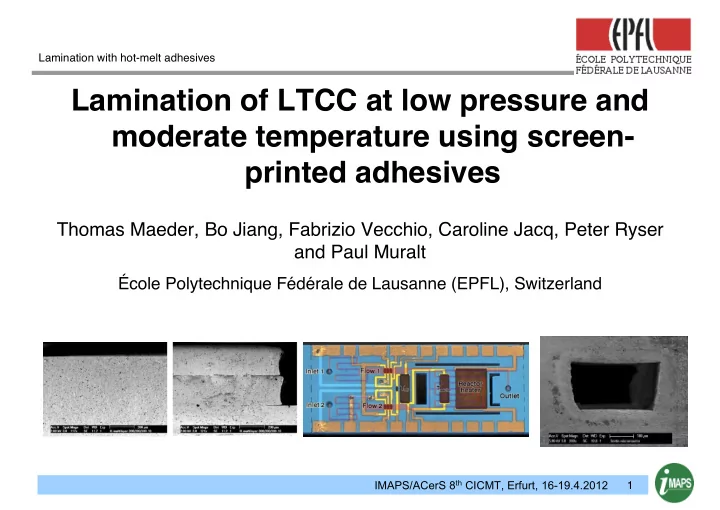
Lamination of LTCC at low pressure and moderate temperature using - - PowerPoint PPT Presentation
Lamination with hot-melt adhesives Lamination of LTCC at low pressure and moderate temperature using screen- printed adhesives Thomas Maeder, Bo Jiang, Fabrizio Vecchio, Caroline Jacq, Peter Ryser and Paul Muralt cole Polytechnique
1 IMAPS/ACerS 8th CICMT, Erfurt, 16-19.4.2012
Lamination with hot-melt adhesives
2 IMAPS/ACerS 8th CICMT, Erfurt, 16-19.4.2012
Outline
3 IMAPS/ACerS 8th CICMT, Erfurt, 16-19.4.2012
Outline
4 IMAPS/ACerS 8th CICMT, Erfurt, 16-19.4.2012
Complete device ! Complex fluidic circuit (2
! Flow sensors ! Heaters ! Channels in support
! …
LTCC module + fluidic circuit 1 - Introduction - structuration of LTCC
5 IMAPS/ACerS 8th CICMT, Erfurt, 16-19.4.2012
! Very complex:
! Reformer (GPU) ! Post-combustor (PCU) ! Heat exchangers? ! + all transfer piping
! Active filler material
! Many layers LTCC µ-SOFC module PCU = post-combustor GPU = reformer
1 - Introduction - structuration of LTCC
6 IMAPS/ACerS 8th CICMT, Erfurt, 16-19.4.2012
! Complex circuits ! Multisensors
! Pressure ! Flow ! Temperature
Process gas channels & integrated modules Gas multisensor (p, Q, T)
1 - Introduction - structuration of LTCC
7 IMAPS/ACerS 8th CICMT, Erfurt, 16-19.4.2012
Multilayer above & below cavity ! Standard: ≈70°C 20 MPa ! Deformation of intricate structures ! Lower pressure at edges ! Bonding above & below cavities
Bonding besides a cut-out zone
1 - Introduction - structuration of LTCC
8 IMAPS/ACerS 8th CICMT, Erfurt, 16-19.4.2012
! Sacrificial fillers
! Prevent crushing / deformation ! Allow standard high-pressure/-
! Somewhat cumbersome (fill complex
! Ensure pressure transfer - good
! Low-pressure lamination
! Careful determination of minimal
! "Glues": solvents / thinners / honey /
! Adhesive tapes
1 - Introduction - structuration of LTCC
9 IMAPS/ACerS 8th CICMT, Erfurt, 16-19.4.2012
Outline
10 IMAPS/ACerS 8th CICMT, Erfurt, 16-19.4.2012
! Screen-printable (infrastructure) ! High-solids (low solvent) ! Nonagressive towards LTCC tape ! Print over whole raw tape (generic)
2 - Hot-melt adhesive formulation
! Low/no tack
! No dust from laser, punching, … ! Normal handling & storage possible
! Overprintable (?) ! Corrections possible during
11 IMAPS/ACerS 8th CICMT, Erfurt, 16-19.4.2012
! Allow lamination at moderate
! Melt at moderate temperature ! Large decrease of viscosity / increase
! Hold / "fuse" tapes together by
! Debind cleanly
! Not too much organics ! Binder burnout assorted with LTCC
2 - Hot-melt adhesive formulation
12 IMAPS/ACerS 8th CICMT, Erfurt, 16-19.4.2012
! Tape binders (typ.):
! Acrylics: PMMA, PEMA, PBMA, … ! Polyvinylbutyral (PVB)
! Screen emulsions (typ.):
! Polyvinylalcohol (PVA, PVOH)
! Avoid tape dissolution:
! Low solvent amount: high-solids ! Solubility parameter mismatch ! Balance volatility: screenability vs. persistence - attack
! In this respect, methods compatible with volatile solvent better (spray,
2 - Hot-melt adhesive formulation
13 IMAPS/ACerS 8th CICMT, Erfurt, 16-19.4.2012
! Solvent-binder-plasticiser
! Formulate to dry "just non-tacky" ! Upon reheating, plasticiser serves as
! Somewhat progressive solid-liquid
! Solvent-binder-[plasticiser]-wax
! Wax crystallises out @RT: non-tacky ! Upon reheating, wax acts as a solvent ! More abrupt solid-liquid transition
2 - Hot-melt adhesive formulation
14 IMAPS/ACerS 8th CICMT, Erfurt, 16-19.4.2012
! "Common" binders selected ! PVB, PxMA or EC: used in tapes & pastes ! Hansen solubility parameters (give an idea…) ! Other binders possible (HPC, PVP, …)
[MPa0.5]
[MPa0.5]
[MPa0.5]
(20% OH)
[MPa0.5]
2 - Hot-melt adhesive formulation
15 IMAPS/ACerS 8th CICMT, Erfurt, 16-19.4.2012
! Classical - terpineol, texanol
! Excessive dissolution of tapes
! Glycols - PG, BG, …
! Low attack ! Not suitable for PVB / EC ! Suitable for other binders
! Fatty alcohols
! (Cyclo)hexanol: good compromise ! + tailing solvent: lower volatility ! Suitable for PVB / EC (esp. with co-solvents / plasticiser)
2 - Hot-melt adhesive formulation
16 IMAPS/ACerS 8th CICMT, Erfurt, 16-19.4.2012
† TBAC = tributylacetylcitrate - tested with EC only TEG-EH = triethylene glycol bis(2-ethylhexanoate) - tested with both EC & PVB So-16 = sorbitan monopalmitate C18E2 = steareth-2 (diethylene glycol stearyl ether) ! Mixing possible to tune properties
! Plasticiser-wax: plasticiser stays in resin, wax precipitates out ! Wax-wax: increase total solubility in ink & tune consistency
2 - Hot-melt adhesive formulation
17 IMAPS/ACerS 8th CICMT, Erfurt, 16-19.4.2012
#363-2
#364-2
#362-4
! Optimise cold-warm contrast
! Use low-MW resin & high amount of additives ("fragile glass") ! Use wax with strong cold-warm solubility dependence
2 - Hot-melt adhesive formulation
18 IMAPS/ACerS 8th CICMT, Erfurt, 16-19.4.2012
Outline
19 IMAPS/ACerS 8th CICMT, Erfurt, 16-19.4.2012
! Simple ø5 mm membranes ! Tapes: DP 951 or Her HL2000 ! Good bonding & low distorsion @60°C
4 - Application to structures
Profilometer results 1.94 MPa 3.88 MPa 7.75 MPa Glue LTCC fired quality fired quality fired quality #346-6 1st layer 8 dense 10
dense
15
dense
#362-4 1st layer 9 dense 5
little crack
13
dense
#363-2 1st layer 10 little crack 13
dense
12
dense
Membrane (!m) 1.94 MPa 3.88 MPa 7.75 MPa Glue LTCC fired quality fired quality fired quality #344-5 1st layer 7 dense 7 dense 4 dense #346-6 1st layer 12 dense 6 dense 10 dense #362-4 1st layer 6 dense 11 dense 7 dense #363-2 1st layer 11 dense 6 dense 3 dense
20 IMAPS/ACerS 8th CICMT, Erfurt, 16-19.4.2012
! Body mostly OK ! Double membrane layer difficult (no
! More glue: lamination OK, but deforms
4 - Application to structures
21 IMAPS/ACerS 8th CICMT, Erfurt, 16-19.4.2012
Outline
22 IMAPS/ACerS 8th CICMT, Erfurt, 16-19.4.2012
! Simple low-pressure lamination technique
! Generic prior application onto tape ! Use of existing infrastructure (screen-printing), or
! Easy, predictable processing & handling ! Low-pressure lamination at moderate temperature ! Formulations using safe chemicals, low toxicity
! Outlook
! Accurate study of what is going on…
! Rheology ! Phase transitions (waxes)
! Further optimise formulations ! Study "difficult" cases (layers atop cavities, …)
5 - Conclusions & outlook
T ≈ 50-60°C P ≈ 2 MPa 1 2 3 4
23 IMAPS/ACerS 8th CICMT, Erfurt, 16-19.4.2012
! Swiss National Science Foundation
! 'Sinergia' grant CRSI22-126830/1
! ONEBAT project partners
!
5 - Conclusions & outlook