Archaeological investigation works HS2 provides an unprecedented - - PowerPoint PPT Presentation

archaeological investigation works
SMART_READER_LITE
LIVE PREVIEW

Archaeological investigation works HS2 provides an unprecedented - - PowerPoint PPT Presentation

Archaeological investigation works HS2 provides an unprecedented opportunity to reveal a new understanding of our past through Britain's biggest ever programme of archaeological investigations. What we might find? Artefacts objects made or


slide-1
SLIDE 1

Archaeological investigation works

HS2 provides an unprecedented opportunity to reveal a new understanding of our past through Britain's biggest ever programme of archaeological investigations. What we might find?

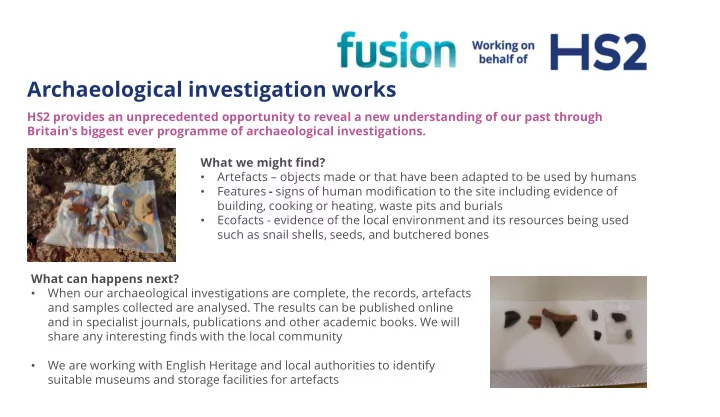
  • Artefacts – objects made or that have been adapted to be used by humans
  • Features - signs of human modification to the site including evidence of

building, cooking or heating, waste pits and burials

  • Ecofacts - evidence of the local environment and its resources being used

such as snail shells, seeds, and butchered bones What can happens next?

  • When our archaeological investigations are complete, the records, artefacts

and samples collected are analysed. The results can be published online and in specialist journals, publications and other academic books. We will share any interesting finds with the local community

  • We are working with English Heritage and local authorities to identify

suitable museums and storage facilities for artefacts

slide-2
SLIDE 2

Archaeological investigation works

These investigations help enable a greater understanding of significant archaeology in the area Desk Based Research is the study of documentary evidence, records, maps and photographs to determine whether remains of possible archaeological interest are present in the land that would benefit from further study. Geophysical Surveys uses modern sensor equipment to understand what is below the ground, but without the need to dig. Every kind of material has unique magnetic properties, even if we do not think of it as something ‘magnetic’. The buried evidence of past human activity can cause the Earth’s magnetic field to be altered and this is detectable using sensitive magnetometers that detect these changes. The results of these surveys can help archaeologists to identify area that may need further investigation. Trial Trenches we have been digging a number of trenches in Chetwode and Newton Purcell area. These shallow trenches let our experienced archaeologists understand if there are archaeological remains in the area.

slide-3
SLIDE 3

Archaeological works in Chetwode and Newton Purcell

What are we doing in the area? We have begun archaeological investigations in the area shown on the map below. These works enable us to gain a greater understanding of significant archaeology in the area. The work requires the digging of 25 trial trenches which let our experienced archaeologists understand if there are archaeological remains in the area.

The photo shows a trial trench

slide-4
SLIDE 4

Fencing works

The land which has been acquired either temporarily or permanently for the construction and future running

  • f the railway, Fusion have started a programme of fencing. The boundary fencing will be mainly be post and

wire construction.

slide-5
SLIDE 5

Barton Hartshorn – woodland creation planting

Planting area Access route HS2 route

  • Currently at design stage. Tree species

chosen will be reflective of those native to the area

  • 0.76 hectares of planting
  • Expected to include Alder, Birch, Hazel,

and Hawthorn, amongst more than a dozen species totalling over 4000 trees

  • Variable spacing from 0.5m to 3m
  • Planting scheduled for November 2020

to March 2021 planting season

  • Post planting maintenance plan