SLIDE 1
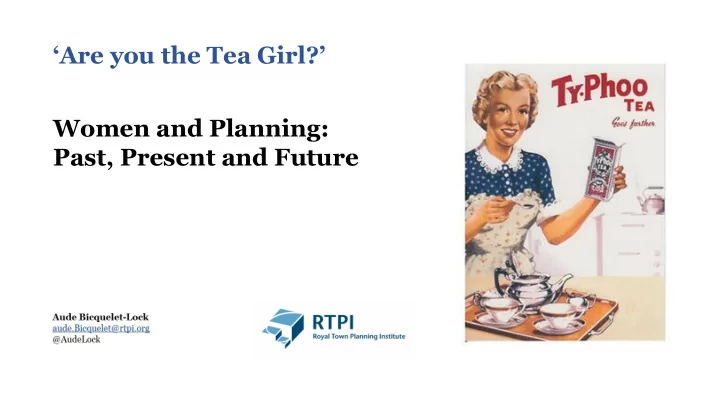
‘Are you the Tea Girl?’ Women and Planning: Past, Present and Future
SLIDE 2
Background 2017 RTPI membership survey Relatively important % of female planners have faced barriers to their professional advancement. ▪ Gender – 24% of female respondents and 2% of male respondents. ▪ Lack of family-friendly employer policies –14% of female respondents and 2% of male respondents
SLIDE 3 Background
“Regarding career progression, I do find it quite disheartening that with a BA and MA with Distinction, RTPI membership and having almost 12 years experience I am still essentially no nearer achieving the career I would like. I am sure that I would have had more chance of progression were I not female. Even in this job (…) I have been asked directly if I am the 'tea girl'.”
Female planner, 2017 RTPI membership survey
SLIDE 4
Women and Planning: Past Present and Future (2019)
Part 1: Professional journey of female planners. Part 2: Impact of gender mainstreaming on planning policies. Part 3: Future challenges facing the next generation of planners.
SLIDE 5
Women and Planning: Past Present and Future (2019)
52 Cases 41 Questionnaires 11 Interviews 50Women 2 Men 6 Countries
SLIDE 6
SLIDE 7
Women and Planning: Past Present and Future (2019)
SLIDE 8
Women and Planning: Past Present and Future (2019) ▪ Exploratory rather than confirmatory ▪ Springboard towards developing hypotheses ▪ Experiences vs. numbers ▪ Pilot Project - Equality Diversity & Inclusivity Action Plan
SLIDE 9
The Good The Bad The Ugly
SLIDE 10 ‘The Good’ “[Where I work…] female colleagues are promoted just as frequently as the few male colleagues I have. I believe that the male dominated leadership is a hangover from previous, less enlightened times.”
Female planner, 25-34 years old, New Zealand, Public Sector
SLIDE 11 ‘The Good’ “I do not consider that gender has acted as a barrier to my professional advancement to date. My current employers are family-friendly which has made working whilst caring for two young children manageable”.
Female planner, 25-34 years old, England, Public Sector
SLIDE 12 ‘The Good’ ? “I think my gender has worked in my favour because the majority of agencies I have worked for have been dominated by mature males – within their executive. I have no doubt they hire on the basis of someone they can relate to”.
Male planner, 55-64 years old, New Zealand, Public Sector
SLIDE 13
‘The bad’
SLIDE 14 ‘The bad’ “I have been told outright in the past that I would not be selected for a promotion because I would “probably just have a baby anyway”.
Female planner, 35-44 years old, Canada, Private Sector
SLIDE 15
‘The bad’
SLIDE 16 ‘The bad’ “I don’t feel that gender had any effect on my career until I had children, but the impact of two maternity leaves was significant (…). In both instances, the manager (a woman) had decided that I wouldn’t be able to cope with my own job following my return to work”.
Female planner, 35-44 years old, Scotland, Public Sector background
SLIDE 17
‘The bad’
SLIDE 18 ‘The ugly’ “I’ve had people pat me on the head, shush me and assume they know what I am going to say (…). I’ve had colleagues give inappropriate hugs or get too close and you’ve just had to suck it up and deal with it.”
Female planner, 45-54 years old, England, Public Sector
SLIDE 19
‘The very ugly’…
SLIDE 20
Preliminary Findings Summary
SLIDE 21 Preliminary Findings: Summary “Yes, discrimination, sexism, racism persists.”
Female planner, 45-54 years old, Canada, mixed background
SLIDE 22
Preliminary Findings: Summary
SLIDE 23 Preliminary Findings: Summary
I still feel that as women we take the lion’s share of childcare etc. and this conflicts with corporate life. I believe there is very much a ‘boys club’ culture which I view as being a potential barrier (…). Things like golf days, rugby events etc. have made me feel like I cannot partake in certain things (…). I have often had the experience of being talked over (…). Men don’t realise what they are doing it, and sometimes women are scared to point it out for fear of being seen as an ‘angry woman’. Unfortunately, a lot of women who made it suffer from the ‘queen bee syndrome’. They are more critical of other women to keep them
- ut, they also manipulate issues around gender
equality to suit their own purposes. Children rather than gender per se are probably the issue today in terms of career progression (…) Overall, I think that class is now a more significant barrier to entry to planning or similar professions than gender (Male respondent).
SLIDE 24
Respondents’ Recommendations
SLIDE 25
Respondents’ recommendations
“Understanding first and foremost that there is an issue” ▪ Equal pay ▪ Testing unconscious bias during interviews ▪ Monitoring the ‘office culture’ ▪ Setting up safe, confidential, and professional system for reporting sexist behaviours ▪ Encouraging mentorship and networking activities
SLIDE 26
Respondents’ recommendations
“Serious, practical and above all genuine actions to change things” ▪ Offering career development & leadership trainings to women ▪ Implementing family and carer-friendly policies ▪ Implementing flexible working hours ▪ Improving support before, during, upon return from ML ▪ Carefully monitoring managers’ behaviours when women are most at risk (e.g. upon return from ML; when promotion opportunities arise; at events…)
SLIDE 27
Respondents’ recommendations
▪ Publishing examples of good practices in the workplace ▪ Appointing dedicated senior members of staff to monitor Ethics, Equality and Diversity issues ▪ Taking transparency and accountability seriously (e.g. defining KPI; tracking and publishing progress across organisations) ▪ Encouraging women to take leadership roles (and ‘defining’ leadership) ▪ Encouraging macro and micro behavioural shifts (challenging language and ‘masculine norms’)
SLIDE 28 Respondents’ Recommendations
“I am a proponent of the importance of micro-level social interactions to undermine implicit gender barriers. For example, I refuse to make tea in a meeting, so as to not take up a traditional serving female role.”
Female planner, 35-44 years old, England, Private Sector
SLIDE 29
Thank you
And a very warm thank you to all the participants in this study!