As a prelude to the back-analysis intended for the full MAE Center - - PDF document

as a prelude to the back analysis intended for the full
SMART_READER_LITE
LIVE PREVIEW

As a prelude to the back-analysis intended for the full MAE Center - - PDF document

2 2 1.5 1.5 1 1 0.5 0.5 PGA(g) PGA(g) Stiff Soil, Mean 0.1 Stiff Soil, Mean +/- 0.1 Soft Soil, Mean Stiff Soil, Mean Soft, Mean +/- Stiff Soil, Mean +/- Abbottabad (+/-10 km) Soft Soil, Mean Murree (+/-10 km)


slide-1
SLIDE 1

20

Mid-America Earthquake Center Mid-America Earthquake Center

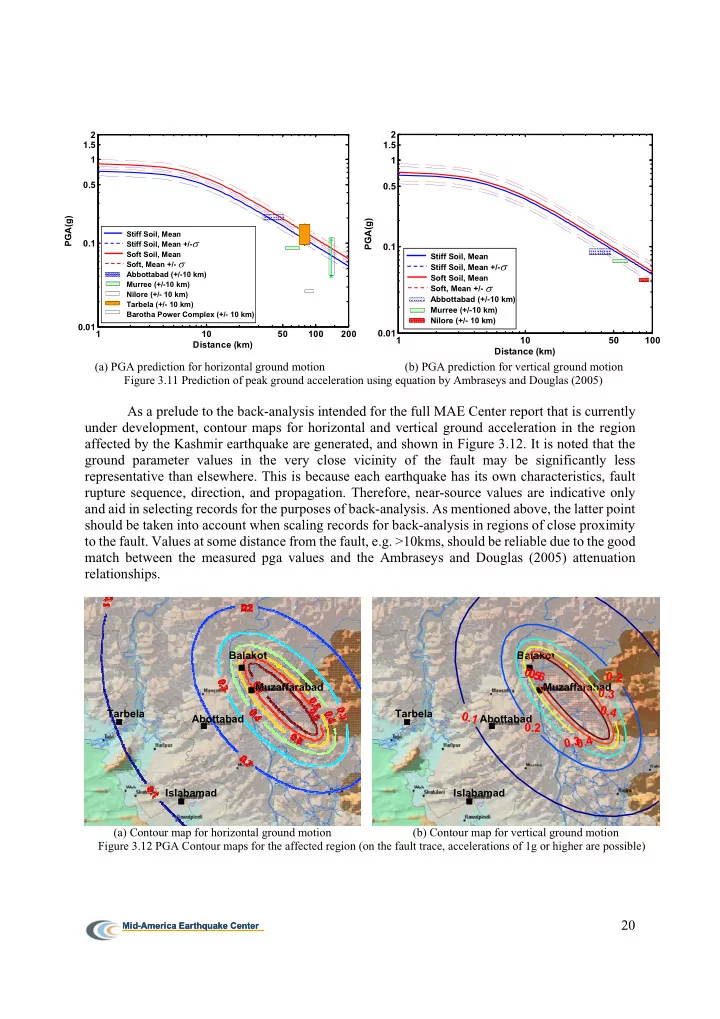
(a) PGA prediction for horizontal ground motion (b) PGA prediction for vertical ground motion Figure 3.11 Prediction of peak ground acceleration using equation by Ambraseys and Douglas (2005)

As a prelude to the back-analysis intended for the full MAE Center report that is currently under development, contour maps for horizontal and vertical ground acceleration in the region affected by the Kashmir earthquake are generated, and shown in Figure 3.12. It is noted that the ground parameter values in the very close vicinity of the fault may be significantly less representative than elsewhere. This is because each earthquake has its own characteristics, fault rupture sequence, direction, and propagation. Therefore, near-source values are indicative only and aid in selecting records for the purposes of back-analysis. As mentioned above, the latter point should be taken into account when scaling records for back-analysis in regions of close proximity to the fault. Values at some distance from the fault, e.g. >10kms, should be reliable due to the good match between the measured pga values and the Ambraseys and Douglas (2005) attenuation relationships.

(a) Contour map for horizontal ground motion (b) Contour map for vertical ground motion Figure 3.12 PGA Contour maps for the affected region (on the fault trace, accelerations of 1g or higher are possible)

1 10 50 100 0.01 0.1 0.5 1 1.5 2 Distance (km) PGA(g)

Stiff Soil, Mean Stiff Soil, Mean +/- Soft Soil, Mean Soft, Mean +/- Abbottabad (+/-10 km) Murree (+/-10 km) Nilore (+/- 10 km)

  • 1

10 50 100 200 0.01 0.1 0.5 1 1.5 2 Distance (km) PGA(g)

Stiff Soil, Mean Stiff Soil, Mean +/- Soft Soil, Mean Soft, Mean +/- Abbottabad (+/-10 km) Murree (+/-10 km) Nilore (+/- 10 km) Tarbela (+/- 10 km) Barotha Power Complex (+/- 10 km)

  • Tarbela

Abottabad Islabamad Balakot Muzaffarabad

. 6 0.1 0.2 0.2 . 3 0.3 0.4 0.4 0.5

Tarbela Abottabad Islabamad Balakot Muzaffarabad

slide-2
SLIDE 2

21

Mid-America Earthquake Center Mid-America Earthquake Center

Table 3.4: Selected records for back-analysis, two for each side, based on available information PGA (g) Location Earthquake Name Station Name Mw Fault Distance Soil Type Long. Trans. Verti. Gazli Gazli 6.7 4 km soft soil 0.616 0.721 1.288 Muzaffarabad (4 km) Tabas Tabas 7.4 3 km stiff soil 0.927 1.103 0.840 Tabas Dayhook 7.4 11 km Rock 0.338 0.386 0.174 Montenegro Bar-Skupstina O. 7.05 12 km stiff soil 0.376 0.363 0.254 Balakot (10 km) Montenegro Pertovac-Hotel O. 7.05 12 km stiff soil 0.455 0.306 0.213 Tabas Boshroyeh 7.4 34 km soft soil 0.102 0.087 0.079 Abbottabad (39 km) Montenegro Ulcinj-Hotel O. 7.05 24 km stiff soil 0.294 0.241 0.458 Tabas Ferdoos 7.4 94 km stiff soil 0.092 0.102 0.053 Islabamad (98 km) Montenegro Veliki S. S. 7.05 105 km alluvium 0.268 0.181 0.046 Gazli (1976, Uzbekistan), Tabas (1978, Iran), and Montenegro (1979, Yugoslavia)

The source mechanism, magnitude and peak ground accelerations obtained thus far were employed to select earthquake records for sites where extensive damage was observed. Table 3.4 lists the selected earthquakes, two for each side with the exception of Balakot, where three records are selected. These records are recommended for use in loss assessment studies for the region, alongside the actual acceleration recordings from Nilore, Abbottabad and Murree. It is stressed that the Nilore record should be used with caution in view of the location of the instrument. 3.4 IMPLICATIONS ON FUTURE EARTHQUAKE HAZARD AND NEEDS The Kashmir earthquake, in a regional setting, is considered to be a moderate earthquake. The region is susceptible to great earthquakes of magnitudes > 8.0. Estimates of slip rates vary considerably, and it is not the objective of this Quicklook report to resolve the differences or re-interpret their underlying assumptions. The most reliable estimates from the authors viewpoint suggest an average slip of ~ 18 mm/year (Bilham and Ambraseys, 2005), averaged over the entire India-Tibet collision zone. The average slip observed in earthquakes in the past 5 centuries amounts to less than 3 mm/year. Whereas other interpretations exist, the most likely outcome of the above is that there are massive earthquakes awaited, nucleating in the Himalayan arc. In the latter publication, it is estimated that four earthquakes of magnitude > 8.4 are required to make up for the slip deficit between GPS-calculated strains, and slip during earthquakes observed from year 1500 to 2000. With the Kashmir earthquake releasing less than 10% of the energy stored in the collision region, many large population centers throughout northern Pakistan and India are exposed to serious seismic risk. The dearth of strong ground motion records point to the need for a well developed seismic monitoring network of not only the area affected by the recent earthquake, but for all of Pakistan. Moreover, a clearing house should be established to disseminate such data, and other information

  • n the earthquake, to encourage the earthquake engineering community to undertake analysis and

assessments, thus enriching the knowledge base and aiding in the better understanding of Himalayan earthquakes and their effects.

  • 4. BUILT ENVIRONMENT LOSSES

Performance of the built environment and the damage sustained by various types of structures in Abbottabad and Balakot in NWFP, and Muzaffarabad in AJK are discussed in this

  • section. The assessment of structural performance in other locations visited by the team will be

presented in the detailed reconnaissance report to be issued from the MAE Center, alongside

slide-3
SLIDE 3

22

Mid-America Earthquake Center Mid-America Earthquake Center

back-analysis of buildings and bridges in the affected region. The systems considered in this section are primarily, (a) residential buildings, (b) hospital and school buildings, (c) road networks, and (d) bridges. Attention is primarily focused on the construction practice prevalent in the area in each of the categories above, and the common causes of failures observed. It is emphasized that the general observations given below are based on visual inspection with no detailed analysis or formal assessment. They should therefore be taken as preliminary and awaiting further studies and

  • confirmation. A detailed structural damage commentary is also given by the University of

Engineering and Technology, Peshawar (UET, 2005). 4.1 RESIDENTIAL BUILDINGS The October 8, 2005 earthquake left an estimated 2.8 million people in need of shelter. The Government of Pakistan census data indicates that about 439,880 housing units were in the affected area of which 261,990 housing units were completely destroyed, while 177,890 were damaged to various degrees. A distribution of these units in the various districts of the earthquake affected areas, broadly categorized as AJK and NWFP is presented in Table 2.4. Losses to the housing sector represent 84 percent of the total housing stock in the affected districts of AJK, and 36 percent of housing stock in the five affected districts of NWFP. A typical residential house in the affected rural areas has a relatively small footprint of about 400 sq. ft. of living space, and consists of one or two main rooms, a veranda and a bath and a kitchen which may not be attached. A Katcha (non-permanent) house (Figure 4.1) has mud or stone rubble walls with a flat thatch/mud roof supported on timber beams to support heavy mud insulation and snow load. A Pucca (permanent) house (Figure 4.2) typically has stone rubble or fired brick masonry walls with cement-sand mortar and a low-pitched sheet metal or reinforced concrete (RC) flat slab roof. The main cause of collapse of both types is the heavy weight of the roof which attracts large inertia forces. The slender unreinforced walls without adequate connectivity to the roof could hardly withstand these inertial forces, often experiencing out of plane failure and collapsing under the weight of the roof. Since a thick roof is essential for insulation in the hostile winter season, any alteration in local construction practice should take into account needs other than seismic design. In relatively more accessible small towns, the use of masonry blocks with a reinforced concrete slab has become increasingly popular. One could also notice reinforced concrete frames with infill walls in mid to large size towns such as Balakot and

  • Muzaffarabd. While many of such semi-engineered buildings completely collapsed or suffered

serious damage, the others survived the earthquake with relatively small damage. The nature of the damage points to the usual culprits of poor quality construction, deficient detailing, and lack of seismic consideration.

Figure 4.1 Collapsed Kacha house Figure 4.2 Destroyed Pucca house

slide-4
SLIDE 4

23

Mid-America Earthquake Center Mid-America Earthquake Center

According to AJK Government, 115,211 buildings in Muzaffarabad completely collapsed which constitutes 63% of the collapsed buildings in AJK. Figure 4.3 shows an interior street in the Medina Market which was the main shopping area in Muzaffarabad, the capital city of AJK. As shown in Figure 4.4, poor construction practices, use of smooth reinforcing bars, lack of continuity and proper detailing, and insufficient stirrups for confinement resulted in severe structural damage. Figure 4.5 shows an example of housing units that were made of plastered brick walls and concrete

  • slabs. Old construction mixed with the new and the use of different materials in the same building

was commonly observable. Pounding of the adjacent buildings, water tanks at the roof,

  • ut-of-plane failure of unreinforced masonry infills, and drastic stiffness discontinuities all

contributed to failures of a large number of inner-town buildings in Muzaffarabad.

Figure 4.3 An interior street in Madina Market, Muzaffarabad. (a) Overview of Madina Market (b) Interior street (c) Failure of Beam-column joint Figure 4.4 Damage in Madina Market, Muzaffarabad

slide-5
SLIDE 5

24

Mid-America Earthquake Center Mid-America Earthquake Center

Figure 4.5 Typical old urban and rural housing units made of brick walls and concrete slabs, Muzaffarabad.

In Balakot several hotels and an entire string of shopping plazas along the main road collapsed or suffered severe damage. Figure 4.6 shows collapsed first story of these two-story

  • plazas. It is clear from the failure mechanisms that these buildings were designed primarily for

gravity loads with little consideration for lateral forces. As in Muzaffarabad, poor construction practices manifested in cold joints, lack of structural continuity, poor quality concrete, and first soft story appear to be the most common causes of these building failures. Figure 4.7 shows the total destruction of an entire community on a small hill just behind the main road in Balakot, where several hundred RC and masonry buildings collapsed. Pending further investigation, the damage is likely to be associated with intense shaking due to ridge effect. Depending on the ridge geometry, ridges amplify the periods corresponding to their own vibration modes, as well as their energy focusing effects.

Figure 4.6 Structural failures due to soft story along main street in Balakot (a) overview of the collapse area on the hill in Balakot