
SLIDE 1
ATLAS ttH measurements in H at s = 13 TeV Jennet Dickinson USLUA - - PowerPoint PPT Presentation
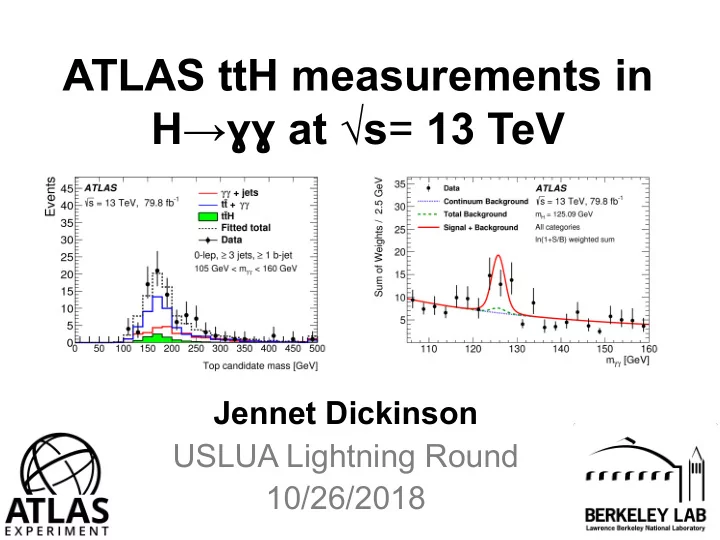
ATLAS ttH measurements in H at s = 13 TeV Jennet Dickinson USLUA Lightning Round 10/26/2018 Higgs production in pp collisions ttH production is a direct probe of the Higgs-top coupling Indirect probes include gluon-gluon
– Indirect probes include gluon-gluon fusion production and H →ɣɣ decay loops
2
– Low rates of photons compared to jets – Smoothly falling background mɣɣ spectrum
– Photons from Higgs, all other objects from tops
3
4
Multiple variables (four-vectors) Single discriminant (BDT score) Multiple categories with different S/B BDT training using XGBoost Categorization Sensitivity evaluation mɣɣ spectrum of data in all categories Signal: ttH(ɣɣ) MC Bkg: continuum diphoton
– Tight BDT categories have lower statistics in data, but higher ttH purity and better S/B ratio
5
All-hadronic 1+ lepton
6
7
mtop = 173 GeV
8
9
−100 (syst) fb
11
Higgs production in association with top quarks (ttH) is predicted by the Standard Model at a rate of about 1% of the total Higgs cross section. This process directly probes the Higgs- top coupling, a critical parameter for isolating Beyond the Standard Model contributions to Higgs physics. The ATLAS search for ttH events in conjunction with the decay H → γγ takes advantage of the high photon detection efficiency and energy resolution of the ATLAS electro-magnetic calorimeter, as well as the relatively low rate of diphoton background processes. The application of sophisticated multivariate techniques to identify ttH → γγ events improves the sensitivity to ttH compared to past analyses. In combination with other Higgs decay channels, ttH → γγ contributed to the recent discovery of the ttH production mode.
12
– ATLAS ttH discovery (June 2018): https://arxiv.org/pdf/1806.00425.pdf
– http://pdg.lbl.gov/2016/reviews/rpp2016-rev- higgs-boson.pdf – https://twiki.cern.ch/twiki/bin/view/%20LHCPhysic s/LHCHXSWG#SM_Higgs – ATLAS CONF H→ɣɣ (July 2018): http://cdsweb.cern.ch/record/2628771
13
14
15
– Four momentum and b-tag score of up to six jets – Four momentum of the two photons, scaled by mɣɣ to prevent biasing the mɣɣ distribution – Missing ET and angle of missing ET
16
– Reject events with BDT score < 0.91
17
– These are the most powerful categories
Expected ttH yield: 3.00 S/B: 0.05 ttH purity (nttH/nHiggs): 48% Background shape: Power law Mass resolution: 1.63 GeV
18
S/B and purity calculated in the smallest window containing 90% of ttH
Expected ttH yield: 4.7 S/B: 0.13 ttH purity (nttH/nHiggs): 70% Background shape: Power law Mass resolution: 1.59 GeV
19
S/B and purity calculated in the smallest window containing 90% of ttH
Expected ttH yield: 3.41 S/B: 0.42 ttH purity (nttH/nHiggs): 83% Background shape: Exponential Mass resolution: 1.46 GeV
20
S/B and purity calculated in the smallest window containing 90% of ttH
Expected ttH yield: 4.20 S/B: 1.87 ttH purity (nttH/nHiggs): 90% Background shape: Power law Mass resolution: 1.32 GeV
21
S/B and purity calculated in the smallest window containing 90% of ttH
– Four momentum and b-tag score of up to six jets – Four momentum of the two photons, scaled by mɣɣ to prevent biasing the mɣɣ distribution – Four momentum of up to two leptons – Missing ET and angle of missing ET
23
– Reject events with BDT score < 0.70
24
– Branching ratio of W to eν
Expected ttH yield: 0.82 S/B: 0.17 ttH purity (nttH/nHiggs): 73% Background shape: Exponential Mass resolution: 1.73 GeV
25
S/B and purity calculated in the smallest window containing 90% of ttH
Expected ttH yield: 2.23 S/B: 0.46 ttH purity (nttH/nHiggs): 89% Background shape: Power law Mass resolution: 1.68 GeV
26
S/B and purity calculated in the smallest window containing 90% of ttH
Expected ttH yield: 4.50 S/B: 1.84 ttH purity (nttH/nHiggs): 95% Background shape: Power law Mass resolution: 1.45 GeV
27
S/B and purity calculated in the smallest window containing 90% of ttH
28