
SLIDE 1
Factor Analysis and Beyond
Chris Williams, School of Informatics University of Edinburgh
Overview
- Principal Components Analysis
- Factor Analysis
- Independent Components Analysis
- Non-linear Factor Analysis
- Reading: Handout on “Factor Analysis and Beyond”, Jordan §14.1
Covariance matrix
- Let denote an average
- Suppose we have a random vector X = (X1, X2, . . . , Xd)T
- X denotes the mean of X, (µ1, µ2, . . . µd)T
- σii = (Xi − µi)2 is the variance of component i (gives a measure of
the “spread” of component i)
. . . . . . . . . . . . . . . . . . . . . . . . . .
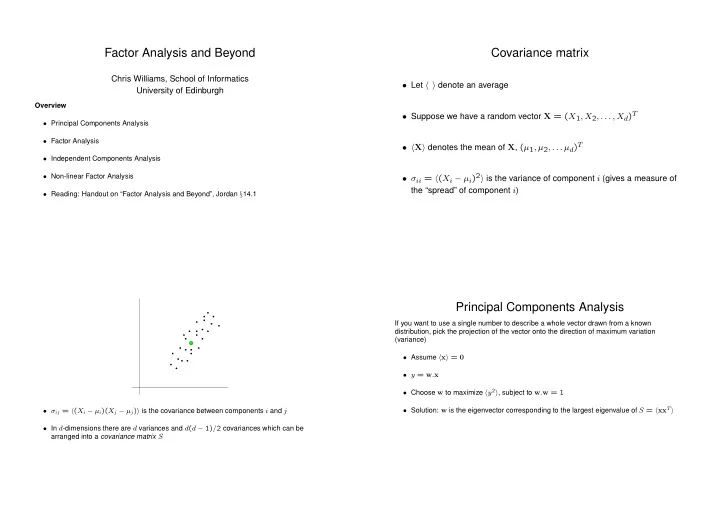
- σij = (Xi − µi)(Xj − µj) is the covariance between components i and j
- In d-dimensions there are d variances and d(d − 1)/2 covariances which can be
arranged into a covariance matrix S
Principal Components Analysis
If you want to use a single number to describe a whole vector drawn from a known distribution, pick the projection of the vector onto the direction of maximum variation (variance)
- Assume x = 0
- y = w.x
- Choose w to maximize y2, subject to w.w = 1
- Solution: w is the eigenvector corresponding to the largest eigenvalue of S = xxT