Attaining Privilege to operate in the Arctic; Understanding the - - PowerPoint PPT Presentation

attaining privilege to operate in the arctic
SMART_READER_LITE
LIVE PREVIEW

Attaining Privilege to operate in the Arctic; Understanding the - - PowerPoint PPT Presentation

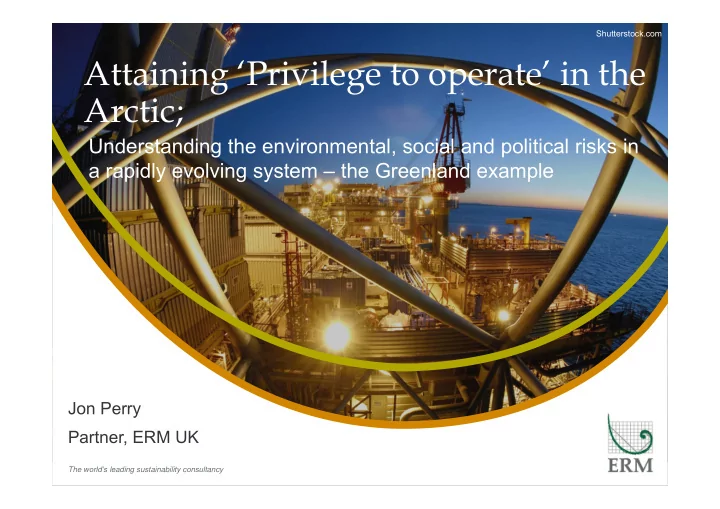
Shutterstock.com Attaining Privilege to operate in the Arctic; Understanding the environmental, social and political risks in a rapidly evolving system the Greenland example Insert then choose Picture select your


slide-1
SLIDE 1

“Insert” then choose “Picture” – select your picture. Right click your picture and “Send to back”.

The world’s leading sustainability consultancy

Attaining ‘Privilege to operate’ in the Arctic;

The world’s leading sustainability consultancy

Understanding the environmental, social and political risks in a rapidly evolving system – the Greenland example

Jon Perry Partner, ERM UK

Shutterstock.com

slide-2
SLIDE 2

The world’s leading sustainability consultancy

Contents

Part 1

■ Greenland 101 ■ Exploration in Greenland ■ It’s not all about the permitting ■ Q&A

Part 2

■ What is Privilege to Operate? ■ Why is all this important? ■ What are the lessons? ■ Q&A

Shutterstock.com

slide-3
SLIDE 3

Part 1 – context

The world’s leading sustainability consultancy

■ Greenland 101 ■ Exploration in Greenland ■ It’s not all about the permitting

Shutterstock.com

slide-4
SLIDE 4

The world’s leading sustainability consultancy

Greenland 101 – The basics (this is important later on)

4

■ 2,166,086 km²

(about the same size as Algeria, slightly more than three times the size of Texas)

■ Population 57,000

(about the same as Kettering)

■ 85% is covered by icecap with only 15% along the coast inhabitable ■ There are no roads between the towns

  • n the coast

■ Greenlanders are an indigenous Inuit people, which make up 85% of the population ■ Kalaallisut, a traditional Inuit dialect, is the country’s official language, although Danish is also heavily used. Language and translation is an important issue.

Europe is 4.7 times as big as Greenland, with

  • ver 12,000 times

as many people

Source: www.MapFight.com

slide-5
SLIDE 5

The world’s leading sustainability consultancy

Greenland 101 – Greenland Economy

5

■ 85% of exports are from fish and shellfish ■ As well as fishing, around 10 % of the workforce is directly or indirectly involved in the hunting industry ■ Greenland receives an annual block grant of around € 470 M from the Danish State ■ Identifying alternative sources of income and foreign investment is considered vital for the economy ■ Social problems include high levels of unemployment and lack of suitable skills within the workforce

Source: J Perry

slide-6
SLIDE 6

The world’s leading sustainability consultancy

Greenland 101 - Political Framework

6

■ Greenland was a colony of Denmark until 1953, when it became a constituency in the Danish Kingdom alongside the Faroe Islands ■ On May 1st, 1979, Greenland Home Rule was established. ■ In November 2008 Greenland voted that Self Rule should be introduced and this was accepted by the Danish parliament. ■ On the National day, June 21st 2009, the Greenland Self-Government replaced the Home Rule Government (now just “the Greenland Government”) ■ Greater jurisdiction including natural resources (but not the whole offshore area) – still a tricky balance

slide-7
SLIDE 7

The world’s leading sustainability consultancy

Greenland Exploration History (in pictures)

7 1970s 1980s 1990s 2000s 2010s

slide-8
SLIDE 8

The world’s leading sustainability consultancy

Greenland Exploration –Permitting backdrop

8

■ Frontier area, highly challenging ■ Emerging legislative regime ■ Lack of local resources (eg Govt) ■ Single authority (BMP), with broad powers ■ Considerable stakeholder scrutiny ■ Setting a high bar for the oil and gas industry, without constraining growth or discouraging E&P activity Which means… ■ Frequent amendments to the legislation and guidance ■ Vociferous and often conflicting stakeholder views; ■ Cherry-picking of standards to quickly build up a suitable legislative framework

Source: www.bmp.gl

slide-9
SLIDE 9

Questions

The world’s leading sustainability consultancy

Shutterstock.com

slide-10
SLIDE 10

The world’s leading sustainability consultancy

2009

Greenland E&S Permitting –A moving target

10

2009 (Jun) Guidelines for preparing an EIA Report for Activities Related to Exploration, Development, Production and Transport of Hydrocarbons Offshore Greenland 2010 (Jun) Guidelines to Environmental Impact Assessment of Seismic Activities in Greenland Waters (NERI / BMP) 2011 (December) BMP Guidelines for application, execution and reporting of

  • ffshore hydrocarbon exploration activities (excluding drilling) in Greenland (BMP)

2011 (Dec) Guidelines to environmental mitigation assessment of seismic activities in Greenland waters (DCE) 2011 (Jan) BMP Guidelines – for preparing an EIA report for activities related to hydrocarbon exploration and exploitation off shore Greenland 2011 (Apr) Guidelines for preparing an EIA report related to stratigraphic drilling offshore Greenland (BMP) 2011 (Apr) Guidelines for application, execution and reporting of offshore hydrocarbon exploration activities (excluding drilling) in Greenland (BMP) 2011 (Dec) Supplementary guidelines for EIAs concerning seismic surveys in Greenland 2012 (DCE) 2009 (Nov) Guidelines for Social Impact Assessments for mining projects in Greenland (BMP) 2011 (May) Greenland Bureau of Minerals and Petroleum Exploration Drilling Guidelines

Present

2013 onwards ‐ ?

slide-11
SLIDE 11

The world’s leading sustainability consultancy

Greenland – It’s not all about the permitting

11

Licence Permitting Spud well Seismic Permitting Site/Env Survey Permitting

Project description - then:

  • Environmental Mitigation

Assessment OR

  • Environmental Impact

Assessment Plus

  • Consider Cumulative

Project description - then:

  • Environmental Mitigation

Assessment OR

  • Environmental Impact

Assessment Plus

  • Consider Cumulative
  • Environmental Impact

Assessment

  • Discharge modelling
  • Oil Spill Contingency Plan
  • Social Impact Assessment
  • Impact Benefit Agreement
  • Strategic Environmental

Assessment (NERI/DCE)

slide-12
SLIDE 12

The world’s leading sustainability consultancy

Greenland – It’s not all about the permitting

12

Given the unique environment and regulatory structure, it can be difficult enough fulfilling E&S permitting requirements in Greenland; however focussing only on an approvals based approach is likely to generate significant project risks – both immediate and longer term. Identifying and addressing the Non-Technical Risks is an essential part of attaining Privilege to Operate

slide-13
SLIDE 13

The world’s leading sustainability consultancy

Greenland – Stakeholder Regime

13

Despite its low population, there are numerous stakeholder groups within Greenland that need to be considered… As well as the people themselves… And a broad range of external stakeholders…

Greenlandt

  • day.com
slide-14
SLIDE 14

Questions

The world’s leading sustainability consultancy

Shutterstock.com

slide-15
SLIDE 15

Part 2 - Meaning

The world’s leading sustainability consultancy

■ What is Privilege to Operate? ■ Why is all this important? ■ What are the lessons

Shutterstock.com

slide-16
SLIDE 16

The world’s leading sustainability consultancy

What is Privilege to Operate?

16

■ a term that reflects going beyond simply acquiring regulatory approval by taking full account of the views and concerns of stakeholders; ■ it is about involving people, but it also involves minimising major project risks due to delays, protests, legal disputes and media action; ■ the benefits of privilege to operate, as well as the potential risks of ignoring it, are increasing reflected in oil company rhetoric;

and not just from the supermajors; “Salyan oil & gas Limited (Azerbaijan), as a responsible corporate citizen, seeks

  • pportunities to strengthen the communities and countries in which it has the

privilege to operate, through sustainable practices and initiatives” (www.salyanoilgas.com) “Being a safe, compliant and reliable operator is our highest priority at BP, and we understand that the privilege to operate depends on our ability to operate responsibly.” (bp.com)
slide-17
SLIDE 17

The world’s leading sustainability consultancy

What is Privilege to Operate?

17

■ For all the reasons given previously, the Arctic, and in particular Greenland, is an area where industry needs to focus on more than just approvals ■ The unique social, political and environmental factors in this area combine to focus stakeholder attention and put pressure on all participants: Industry, Government, communities and NGOs ■ The technical, logistical and scheduling challenges in this area leave little room for manoeuvre ■ The permitting framework is complex, it is also evolving and the bar keeps getting moved – generally upwards

Shutterstock.com

slide-18
SLIDE 18

The world’s leading sustainability consultancy

Why is all this important? Headlines

18

slide-19
SLIDE 19

The world’s leading sustainability consultancy

Why is all this important?

19

■ Long project delays are attributed to sustainability issues (e.g. stakeholder, community, environment) far more than to either Commercial (eg cost or contract) or Technical issues

Goldman Sachs study

■ Non-technical risks have the potential to hold up a project for years, unlike many technical problems ■ Once it becomes a public issue, the required solution may be completely disproportionate to the actual harm to health, safety and the environment – it becomes an issue of perception more than of science ■ Failure to attain privilege to operate also shapes future legislation and the expectations of regulators

Shell boss defends Alaska project as ice halts drilling Shell has spent more than $4.5bn over four years preparing for work in the Chukchi and Beaufort seas, off the state's west and north coasts, but has faced legal action, post- Deepwater Horizon drilling bans and a very short summer weather window.

slide-20
SLIDE 20

The world’s leading sustainability consultancy

What are the lessons?

20

“The businesses which will succeed will be those which take their responsibilities to the region’s communities and environment seriously, working with other stakeholders to manage the wide range of Arctic risks and ensuring that future development is sustainable.”

Richard Ward, CEO Lloyd’s Arctic Opening: Opportunity and Risk in the High North (2012)

Key Lessons: ■ Understanding Risks ■ Engagement and Disclosure ■ Environmental ■ The Corporate View

Shutterstock.com

slide-21
SLIDE 21

The world’s leading sustainability consultancy

What are the lessons? Understanding Risks

21

Get an early understanding of the Non-Technical Risks and local context

■ Identify the critical path items; bring together Technical and Non-Technical perspectives ■ What is the local understanding of the project? ■ What are the key stakeholder concerns? ■ What information needs to be acquired as early as possible (baseline, seasonal data, weather windows) ■ How do the views of local people compare with those of authorities, consultees, NGOs and pressure groups? ■ What are the potential conflicts and concerns and what project impacts could these have? ■ How will risk management be maintained across project phases?

Source: mnn.com

slide-22
SLIDE 22

The world’s leading sustainability consultancy

What are the lessons? Engagement / Disclosure

22

Stakeholder Engagement in Greenland

■ Account for local practices when scheduling engagement (hunting, fishing, confirmation parties) ■ Always assume there will be delays and have a contingency ■ Use different methods for gathering social baseline data (eg self) ■ Understand the cultural differences (eg raising concerns in public) ■ Tailor disclosure methods to the audience (eg radio, graphics) ■ Avoid technical descriptions – it doesn’t translate (stakeholder feedback) ■ Be honest about the options and timelines; balance open disclosure against the risk of raising expectations ■ Understand the local dynamics, there will always be politics ■ Start early to build trust; lack of communication creates suspicion ■ Plan and engage collaboratively (as an industry) to avoid mixed messages and stakeholder fatigue

slide-23
SLIDE 23

The world’s leading sustainability consultancy

What are the lessons? Environmental

23

Environmental Considerations

■ Consider the potential for Cumulative Effects – this is being built into the legislation and will only become more prominent ■ Consider the potential for Transboundary Effects; can this be modelled and assessed? How does it alter the relevant stakeholder groups? ■ Recognise uncertainty and be open about data gaps ■ The baseline is not static – this needs to be accounted for ■ Link the EIA with the SIA – they are interdependent (eg through Ecosystem Services) ■ Use local knowledge, make the engagement programme work for you

slide-24
SLIDE 24

The world’s leading sustainability consultancy

What are the lessons? The corporate view

24

Non-technical risks are not only external

■ Consider up-front the full cost of potential delays, local opposition, reputational damage, legal challenges and try to balance preventative costs against remedial actions (monetising risk) ■ Identify ‘internal blockers’ (between teams, departments, businesses etc) and any embedded barriers to the necessary flow of information ■ Look at internal stage gates, what are the drivers and incentives at handover – are they based on securing approvals or the overall ‘health’

  • f the project?

■ Proactively use the EIA / SIA / ESHIA as a process of internal engagement and alignment; these documents should not be the sole preserve of the EHS team

slide-25
SLIDE 25

The world’s leading sustainability consultancy

In Summary

25

“In 2011, they started to make decisions to drill. This year, they started to assess the real costs.” WWF Arctic Programme.

Shutterstock.com

slide-26
SLIDE 26

Part 3

The world’s leading sustainability consultancy

■ Final Questions

Shutterstock.com