
SLIDE 1
1
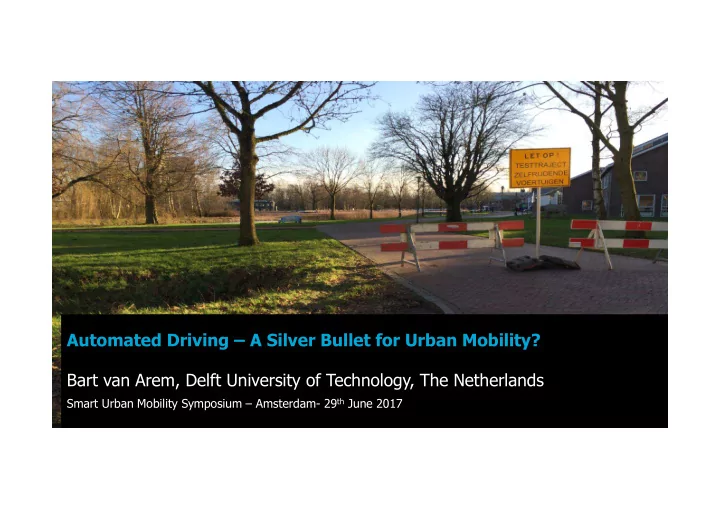
Automated Driving – A Silver Bullet for Urban Mobility? Bart van Arem, Delft University of Technology, The Netherlands
Smart Urban Mobility Symposium – Amsterdam- 29th June 2017
Automated Driving A Silver Bullet for Urban Mobility? Bart van - - PowerPoint PPT Presentation
Automated Driving A Silver Bullet for Urban Mobility? Bart van Arem, Delft University of Technology, The Netherlands Smart Urban Mobility Symposium Amsterdam- 29 th June 2017 1 A first drive with fully automated vehicle 2 Rivium
1
Smart Urban Mobility Symposium – Amsterdam- 29th June 2017
2
3
Separated track Road based transponders Supervisory control Since 1999…
4
5
Automated vehicles can improve traffic efficiency and safety Netherlands to facilitate large scale testing of automated vehicles
6
7
Comfort, efficiency, safety, costs Mode choice, location choice, urban and transport planning
8
Will there be more or less congestion? Will we drive longer or shorter distances? Are we going to own or share cars? Will we need more or less road infrastructures? How much on-street and off-street parking spaces will still be needed? Will we travel safer? How will cities evolve? Will we still need buses? Will we consume more or less energy to travel? When fully automated vehicles will hit the market?
9
Much progress short term and small scale impacts on driver behaviour and traffic flow. Research on longer term, indirect, wider scale impacts on mobility, logistics, residential patterns and spatial-economic structure in its infancy.
Milakis et al (2017), Policy and society related implications of automated driving, Journal of ITS.
10
2016-2020 M€ 2,4
11
Automated Driving Travel and location choice behaviour Freight and Logistics applications Infrastructure service networks Urban design and traffic safety Spatial structure and economy Accessibility Economy Traffic Safety Urban quality
Regional spatial and transport system
12
Regional case studies: passenger cars, freight, public transport, parking
Metropoolregio Rotterdam-The Hague Province Zuid-Holland Province North-Holland Municipality of Amsterdam Rotterdam The Hague Airport Municipality of The Hague Municipality of Rotterdam AMS Advanced Metropoliton Solutions SmartPort SWOV Institute for Road Safety Research RET NV Mobycon Province Gelderland DTV Consultants Connekt ITS Netherlands Municipality of Delft Rijkswaterstaat KiM CROW Transdev-Connexxion RDW TNO Goudappel Coffeng
Spatial impacts, urban design, agglomeration Business cases Modelling tools, impacts, risks, benefits
13
14
with a dedicated camera
Nunez Velasco et al (in prep)
15
16
Vehicle Automation & Vehicle Sharing can increase efficiency of urban land use and the urban vehicle fleet Modeling the interrelation between car sharing, car
Image: Somerset County Council
Mobility Policy Mobility Choices Mobility Services
17
840 respondents Amsterdam, Utrecht, The Hague Rotterdam Attributes were varied
18 Current Commuting Mode Estimated Modal Split
22,5% 41,6 % 17,7% 9,0% 9,2%
840 respondents Amsterdam, Utrecht, The Hague Rotterdam
Winter et al (2017), Mode Preferences in Times of Free-Floating Carsharing and Shared Automated Vehicles - a Stated Choice Experiment, submitted.
Next step: Activity based modelling
19
Performance Expectancy Effort Expectancy Social Influence Perceived Enjoyment Age Gender Income Trust Locus of Control Sensation Seeking Motion Sickness Household Structure Education Level of Control Technical Innovativeness Mobility-related Innovativeness Speed Design Acceptance Region Ban Manual Driving Personal Distance Legal Liability Provision of Sustainable Infrastructure Service Quality Psychological Attributes Labor Status Pull-Factors
Mobility Mobility
Travel –related Attributes Access to Car Distance PT stop Difficulty parking Transport Means Attitude Car Ecological Norms Mobility Flatrate Environment Culture Impairment Satisfaction travel Access to PT Access PT Push-Factors Unemployment Data Privacy Technology Socio-Democraphics Hacking System failure Interactions CVs
Nordhoff et al (2016), A Conceptual Model to Explain, Predict, and Improve User Acceptance of Driverless Podlike Vehicles, Transportation Research Record Unified Theory of Acceptance and Use of Technology (UTAUT) + Pleasure Arousal Dominance (PAD)
20
Nordhoff et al (2017), User Acceptance of Driverless Shuttles Running in an Open and Mixed Traffic Environment, Proc 12th ITS in Europe Conference EUREF Campus, Berlin, 8 km/h; 326 respondents, after driving December 2016-April 2017
AV considered useful, especially in relation to public transport Attitude positive, Willingness to share with others AV considered less useful by car users AV easy to use High level of trust in AV
21
Winter et al (2016), Designing an Automated Demand-Responsive Transport System, Transportation Research Record
Vehicle capacity (2-40) Dwell time (1-6 min) Initial Vehicle Location Demand level and randomness
System cost per trip Vehicle fixed and variable costs Passenger generalized cost
22
ProRail (2014)
23
24
Trip segment Mode Willingness-to-pay per 10 minutes Main Private car €1.80 - €1.90 Egress Bus/tram/metro €0.55 - €0.65 Egress Bicycle €1.45 - €1.55 Egress Automatic vehicle: manually driven €0.85 - €0.95 Egress Automatic vehicle: automatically driven €2.25 - €2.35
Yap et al (2015). Preferences of travellers for using automated vehicles as last mile Public Transport of Multimodal train trips. Transportation Research Part A.
1st class passengers prefer AV Dual mode AV first step Trust and reliability important
25 Scheltes & Correia (2017. Exploring the use of automated vehicles as last mile connection of train trips through an agent-based simulation model: an application to Delft, Netherlands. International Journal of Transportation Science and Technology
26
27
Fleet size: 20 Service zones: 21 Fleet size: 40 Service zones: 35
City area Train station Reserved requests
Liang et al, (2016), Optimizing the service area and trip selection of an electric automated taxi system used for the last mile of train trips, Transportation Research E
28
Moral philosophy Traffic engineering Cognitive psychology
Responsible Innovation
29
Courtesy Martijn Bruil, Province of Gelderland
30
Children with Multiple Complex Disabilities Need for flexible and safe transport 400 m between home and day care Steward and helper present
Automate wheelchair ready vehicle? Make automate vehicle wheelchair ready?
Light traffic, moderate infrastructure adaptations Light traffic, moderate infrastructure adaptations
31
32
33
34
Smart urban mobility: automated driving, walking, cycling, parking, sharing ,… Automated driving can strengthen public transport Automated driving in passenger cars, freight transport, parcel and pizza delivery… Moving into increasingly complex situations User acceptance growing