Automated Reasoning Decision procedures for various small theories, - - PowerPoint PPT Presentation

▶
automated reasoning
SMART_READER_LITE
LIVE PREVIEW

Automated Reasoning Decision procedures for various small theories, - - PowerPoint PPT Presentation

Decision Procedures in Theorem Proving Automated Reasoning Decision procedures for various small theories, e.g., - propositional


slide-1
SLIDE 1

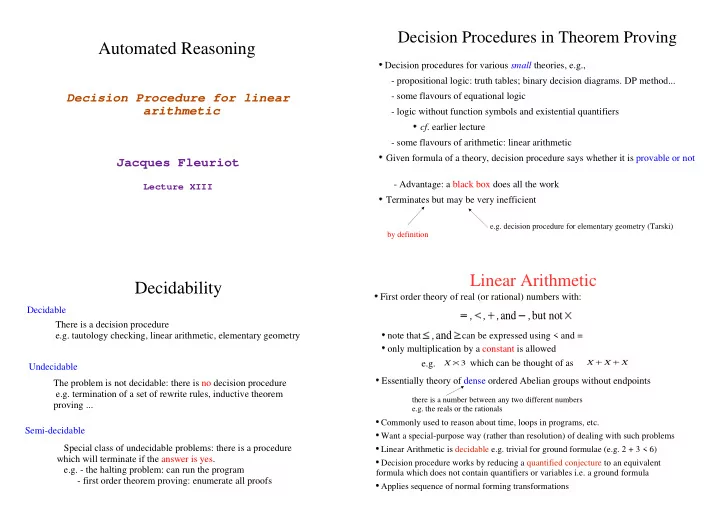
Decision Procedures in Theorem Proving

  • Decision procedures for various small theories, e.g.,
  • propositional logic: truth tables; binary decision diagrams. DP method...
  • some flavours of equational logic
  • logic without function symbols and existential quantifiers
  • cf. earlier lecture
  • some flavours of arithmetic: linear arithmetic
  • Given formula of a theory, decision procedure says whether it is provable or not
  • Advantage: a black box does all the work
  • Terminates but may be very inefficient

e.g. decision procedure for elementary geometry (Tarski) by definition

Linear Arithmetic

✁

First order theory of real (or rational) numbers with:

✂

,

✄

,

☎

,and

✆

,but not

✝ ✞

,and

✟ ✁

note that can be expressed using < and =

✁
  • nly multiplication by a constant is allowed

e.g.

X

✠

3 X

✡

X

✡

X

which can be thought of as

✁

Essentially theory of dense ordered Abelian groups without endpoints

there is a number between any two different numbers e.g. the reals or the rationals

☛

Commonly used to reason about time, loops in programs, etc.

☛

Want a special-purpose way (rather than resolution) of dealing with such problems

☛

Linear Arithmetic is decidable e.g. trivial for ground formulae (e.g. 2 + 3 < 6)

☛

Decision procedure works by reducing a quantified conjecture to an equivalent formula which does not contain quantifiers or variables i.e. a ground formula

☛

Applies sequence of normal forming transformations

Automated Reasoning

Decision Procedure for linear arithmetic Jacques Fleuriot

Lecture XIII

Decidability

Decidable There is a decision procedure e.g. tautology checking, linear arithmetic, elementary geometry Undecidable The problem is not decidable: there is no decision procedure e.g. termination of a set of rewrite rules, inductive theorem proving ... Semi-decidable Special class of undecidable problems: there is a procedure which will terminate if the answer is yes. e.g. - the halting problem: can run the program

  • first order theorem proving: enumerate all proofs
slide-2
SLIDE 2

Step II: Disjunctive Normal Form (DNF)

DNF: disjunction of conjunction of literals A formula of the form D1

  • ✁
  • Dn where

each Di is of the form Ci1

✂ ✁ ✂

Cim How to achieve DNF:

✄

Remove all logical connectives except ¬,

☎

and

✆

use def.of

✝

and .

✄

Move ¬ inwards

✄

Move

✆

inside

☎ ✄

Move

✞

inside

☎

View this process as

✟

reorganisation within levels so that existential variable can be easily solved and eliminated

✟

an exhaustive application of rewrite rules

Stratification

A

✠

B

✡

D

✠

E

✠

F

Example:

Step II: Removing and

☛

Removal of P Q

☞

P

✌

Q

✍

Q

✌

P P Q

✎

¬P

✏

Q

✑

¬Q

✏

P alternatively:

no need to unfold

✒

Note: formula doubles in size P

✓

Q

✎

¬P

✏

Q

☛

Removal of

✔

Exercise: Are these rules terminating? clearly size is not decreasing!

Example of Decision Procedure Application

✕

Choose to eliminate Y in the conjecture:

✖

X.

✖
  • Y. ¬

2

✗

X

✘

1

✙

Y

✚

¬ Y

✘

X

✙

1

✕

Put in disjunctive normal form:

✛

X.

✛

Y. 2

✜

X

✢

1

✣

Y

✤

Y

✢

X

✣

1

✕

Solve for Y:

✕

Eliminate Y: ( no longer appears)

✥
  • X. 2
✦

X

✧

1

★

1

✩

X

✖

X.

✖

Y. Y

✙

2

✗

X

✘

1

✪

Y

✙

1

✫

X

✬

Y

✕
  • Simplify. Repeat process, eliminate X:
✭
  • X. X
✮

2

✕

Solve for X, and we are done. The conjecture is true

Each step preserves truth

Step I: Choosing a Variable to Eliminate

✯

universally quantify any free variables appearing in conjecture (closure)

✰
  • Y. 2
✱

Y

✲

1

✳

X

For example, becomes

✴

X.

✰
  • Y. 2
✱

Y

✲

1

✳

X

✯

choose with no quantifiers in its scope: the innermost

✵ ✵ ✶

X.

✷
  • Y. 2
✸

Y

✹

1

✺

X

e.g. choose Y in:

✯

if no then create one:

✵ ✻
  • X. P
✼

¬

✽
  • X. ¬P
✯

stop if there are no variables or quantifiers left

✯

eliminate this variable then recurse

✵

recall: is a rewrite rule

lhs

✼

rhs

slide-3
SLIDE 3

Example of Disjunctive Normal Form

Conjecture:

  • X.

P

✁

Q

✂

¬R

✄

S Removal of

✄

:

  • X.

¬ P

✁

Q

✂

¬ R

✁

S Stratification of ¬:

  • X.

¬P

✂

¬Q

✁

¬¬ R

✁

S Stratification of

✂

:

  • X.

¬P

✂

¬Q

✁

¬P

✂

¬¬ R

✁

S Stratification of

  • :
  • X. ¬P
✂

¬Q

✁
  • X. ¬P
✂

¬¬ R

✁
  • X. S

Reorganisation:

  • X. ¬P
✂

¬Q

✁
  • X. ¬P
✂

R

✁
  • X. S

note: use of associativity rule

Note: transformation into DNF is potentially inefficient

Elimination of Quantifiers

☎

Make each argument of ∧ into an equation or inequality need to remove defined predicate symbols (e.g. ≤ in terms

  • f < and =)
☎

Solve each equation and inequality for chosen existential variable

☎

Thereby eliminate variable from conjunction

☎

Existential quantifier becomes redundant since that variable no longer appears in the formula

Stratification

✆✞✝✠✟

¬ atomic formulae We have a formula in which

✡

and have to be removed Need to stratify: arrange remaining connectives into layers

Having exhaustively applied these stratification rules, we are in DNF But, it is worth doing a little more normalization (tidying up)

Stratify ¬: De Morgan's laws ¬ P

☛

Q

☞

¬P

✌

¬Q ¬ P

✌

Q

☞

¬P

☛

¬Q Stratify

✌

: P

✌

Q

☛

R

☞

P

✌

Q

☛

P

✌

R Q

☛

R

✌

P

☞

Q

✌

P

☛

R

✌

P Stratify

✍

:

✍

X. P

☛

Q

☞ ✍
  • X. P
☛ ✍
  • X. Q

Rewrite rules

top bottom

Reorganisation

✎

Right associativity

P

✏

Q

✏

R

✑

P

✏

Q

✏

R P

✒

Q

✒

R

✑

P

✒

Q

✒

R

✎

Thinning

¬¬P

✓

P

Reorganisation makes subsequent steps a little easier

Note: this is sometimes done as negation is pushed in during stratification

slide-4
SLIDE 4

Eliminating Variables

Now we can exploit the solutions for the chosen variable

  • Substitution of solutions: use an equality X = T to replace all the other
  • ccurrences of X with the term T

X

✁

T

✂

P X

✄

P T

Si

☎

X

✆

X

✝

T j

✞ ✟

i

✟

j

✠

i j

Si

✡

T j

  • Un-interpolation:

all possible combinations

S

☛

X

☞

X

☛

T

✌

S

☛

T

special case:

  • Drop redundant quantifier
✍
  • X. P
✎

P where P does not contain X a

✏

b

✑

k

✏

b

✑

b

✏

c

✑

b

✏

d

Exercise:

Eliminating Variables

Now we can exploit the solutions for the chosen variable

  • Substitution of solutions: use an equality X = T to replace all the other
  • ccurrences of X with the term T

Si

☎

X

✆

X

✝

T j

✞

Si

✡

T j

  • Un-interpolation:

all possible combinations

S

☛

X

☞

X

☛

T

✌

S

☛

T

special case:

  • Drop redundant quantifier
✍
  • X. P
✎

P where P does not contain X a

✏

b

✑

k

✏

b

✑

b

✏

c

✑

b

✏

d

Exercise:

Example of Elimination of Quantifiers

Conjecture:

✒

Y

✒

Z

✒

X. Z

✓

X

✔

1

✕

Y

✖

X

✔

Z

✕

2

✗

X

✓

Y Removal of

✖

:

✒

Y

✒

Z

✒

X. Z

✓

X

✔

1

✕

X

✔

Z

✓

Y

✕

2

✗

X

✓

Y Inequality solving:

✒

Y

✒

Z

✒

X. Z

✘

1

✓

X

✕

X

✓

Y

✘

Z

✕

X

✓

1

✙

2

✗

Y Un-interpolation

✒

Y

✒

Z

✒

X. Z

✘

1

✓

Y

✘

Z

✕

Z

✘

1

✓

1

✙

2

✗

Y Drop redundant

✒

:

✒

Y

✒
  • Z. Z
✘

1

✓

Y

✘

Z

✕

Z

✘

1

✓

1

✙

2

✗

Y Solve for Y and Z ...

X has been chosen and formula is in DNF Next:

Removal of Defined Symbols

✚

Removal of >, ≤ , ≥ X

✛

Y

✜

Y

✢

X X

✣

Y

✜

¬ X

✢

Y X

✤

Y

✜

¬ Y

✢

X ¬ X

✥

Y

✜

X

✢

Y

✦

Y

✢

X ¬ X

✢

Y

✜

X

✥

Y

✦

Y

✢

X

✚

Removal of ¬ relies on linearity: X < Y or X = Y or X > Y for any X and Y Note: this must be done within the DNF procedure, since the presence of ¬ makes a difference A

✧

¬ X

★

Y

✩

A

✧

X

✪

Y

✫

X

✬

Y e.g. if not then need to redo DNF Note: unnegated equalities are untouched

Equation and Inequality Solving

bring together occurrences of variables being solved

X

✭

Y

✮

X

✯

Y

✭

X

✰

Y

✮

X

✯

Y

✰

X

✱

Z

✱

Y

✮

X

✱

Y

✱

Z

✲

Attraction

A

✳

X

✴

B

✳

X

✵

A

✴

B

✳

X A

✳

X

✶

B

✳

X

✵

A

✶

B

✳

X

✲

Collection

e.g. 3

✷

X

✸

Y

✸

X

✹

?

Note: A and B must be constants for linear arithmetic, so A + B and A

✺

B must evaluate to a number

X

✻

Y

✼

Z

✽

X

✼

Z

✾

Y X

✻

Y

✿

Z

✽

X

✿

Z

✾

Y X

✾

Y

✼

Z

✽

X

✼

Z

✻

Y X

✾

Y

✿

Z

✽

X

✿

Z

✻

Y A

❀ ❁

A

❂

X

✼

Z

✽

X

✼

1

❃

A

❂

Z

✿

A

❁

A

❂

X

✿

Z

✽

X

✿

1

❃

A

❂

Z A

✿ ❁

A

❂

X

✿

Z

✽

1

❃

A

❂

Z

✿

X

✲

Isolation: isolate the chosen (quantified) variable onto one side of every equality or inequality

conditional rules that make coefficient

  • f the chosen variable +1

X is chosen variable in each case A is constant (since linear arith)

slide-5
SLIDE 5

Interleaving of Normal Form and Elimination

  • 1. Remove ↔,→ , >, ≥ , and ≤
  • 2. For each quantifier, starting with innermost:

a) turn ∀ into ∃ b) stratify ¬ , thin multiple occurrences and remove c) continue and complete disjunctive normal form process d) For each disjunct:

  • i. solve equations/inequalities
  • ii. substitute and un-interpolate to eliminate variable
  • iii. remove redundant ∃
  • 3. Use arithmetic and propositional decision procedure to decide

Final Algorithm: There are other more efficient algorithms

¬ X

  • Y
✁

X

✂

Y

✄

Y

  • X

e.g.

Summary

☎

Some theories are decidable

☎

Decision procedures can provide practical theorem provers

☎

Common decision procedure uses normal forming and quantifier elimination

☎

Procedure steps can be realised as rewriting

☎

Removal, stratification and reorganisation are common patterns

☎

Recommended Reading: Paper by Bundy available from AR pages