
SLIDE 1
AUTOMATED REASONING SLIDES 4: SOME USEFUL NOTIONS Structures and Models Herbrand Interpretations and Models Soundness and Completeness Properties Soundness of Resolution Completeness of Resolution (Outline)
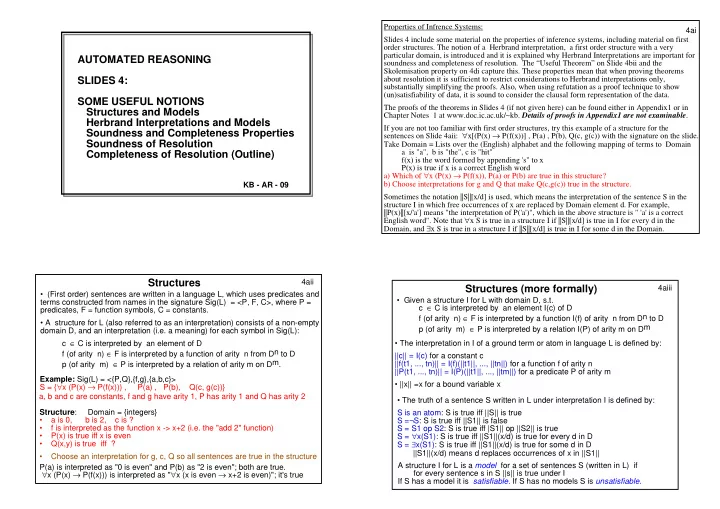
KB - AR - 09 4ai Properties of Infrence Systems: Slides 4 include some material on the properties of inference systems, including material on first
- rder structures. The notion of a Herbrand interpretation, a first order structure with a very
particular domain, is introduced and it is explained why Herbrand Interpretations are important for soundness and completeness of resolution. The “Useful Theorem” on Slide 4bii and the Skolemisation property on 4di capture this. These properties mean that when proving theorems about resolution it is sufficient to restrict considerations to Herbrand interpretations only, substantially simplifying the proofs. Also, when using refutation as a proof technique to show (un)satisfiability of data, it is sound to consider the clausal form representation of the data. The proofs of the theorems in Slides 4 (if not given here) can be found either in Appendix1 or in Chapter Notes 1 at www.doc.ic.ac.uk/~kb. Details of proofs in Appendix1 are not examinable. If you are not too familiar with first order structures, try this example of a structure for the sentences on Slide 4aii: ∀x[(P(x) → P(f(x))] , P(a) , P(b), Q(c, g(c)) with the signature on the slide. Take Domain = Lists over the (English) alphabet and the following mapping of terms to Domain a is "a", b is "the", c is "hit" f(x) is the word formed by appending 's" to x P(x) is true if x is a correct English word a) Which of ∀x (P(x) → P(f(x)), P(a) or P(b) are true in this structure? b) Choose interpretations for g and Q that make Q(c,g(c)) true in the structure. Sometimes the notation ||S||[x/d] is used, which means the interpretation of the sentence S in the structure I in which free occurrences of x are replaced by Domain element d. For example, ||P(x)||[x/'a'] means "the interpretation of P('a')", which in the above structure is " 'a' is a correct English word". Note that ∀x S is true in a structure I if ||S||[x/d] is true in I for every d in the Domain, and ∃x S is true in a structure I if ||S||[x/d] is true in I for some d in the Domain.
- (First order) sentences are written in a language L, which uses predicates and
terms constructed from names in the signature Sig(L) = <P, F, C>, where P = predicates, F = function symbols, C = constants.
- A structure for L (also referred to as an interpretation) consists of a non-empty
domain D, and an interpretation (i.e. a meaning) for each symbol in Sig(L): c ∈ C is interpreted by an element of D f (of arity n) ∈ F is interpreted by a function of arity n from Dn to D p (of arity m) ∈ P is interpreted by a relation of arity m on Dm. 4aii
Structures
Example: Sig(L) = <{P,Q},{f,g},{a,b,c}> S = {∀x (P(x) → P(f(x))) , P(a) , P(b), Q(c, g(c))} Structure: Domain = {integers}
- a is 0, b is 2, c is ?
- f is interpreted as the function x -> x+2 (i.e. the "add 2" function)
- P(x) is true iff x is even
- Q(x,y) is true iff ?
- Choose an interpretation for g, c, Q so all sentences are true in the structure
a, b and c are constants, f and g have arity 1, P has arity 1 and Q has arity 2 P(a) is interpreted as "0 is even" and P(b) as "2 is even"; both are true. ∀x (P(x) → P(f(x))) is interpreted as "∀x (x is even → x+2 is even)"; it's true
- Given a structure I for L with domain D, s.t.
c ∈ C is interpreted by an element I(c) of D f (of arity n) ∈ F is interpreted by a function I(f) of arity n from Dn to D p (of arity m) ∈ P is interpreted by a relation I(P) of arity m on Dm 4aiii
Structures (more formally)
A structure I for L is a model for a set of sentences S (written in L) if for every sentence s in S ||s|| is true under I If S has a model it is satisfiable. If S has no models S is unsatisfiable.
- The interpretation in I of a ground term or atom in language L is defined by:
||c|| = I(c) for a constant c ||f(t1, ..., tn)|| = I(f)(||t1||, ..., ||tn||) for a function f of arity n ||P(t1, ..., tn)|| = I(P)(||t1||, ..., ||tm||) for a predicate P of arity m
- ||x|| =x for a bound variable x
- The truth of a sentence S written in L under interpretation I is defined by: