Autonomic and Vascular Assessments : q A new tool to differentiating - - PowerPoint PPT Presentation

autonomic and vascular assessments
SMART_READER_LITE
LIVE PREVIEW

Autonomic and Vascular Assessments : q A new tool to differentiating - - PowerPoint PPT Presentation

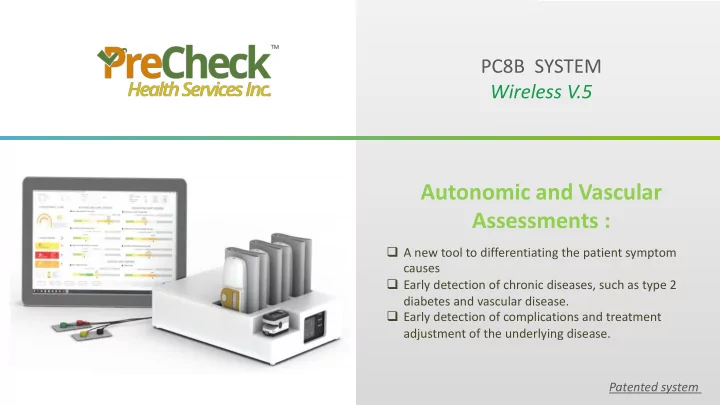
PC8B SYSTEM Wireless V.5 Autonomic and Vascular Assessments : q A new tool to differentiating the patient symptom causes q Early detection of chronic diseases, such as type 2 diabetes and vascular disease. q Early detection of complications


slide-1
SLIDE 1

Autonomic and Vascular Assessments :

PC8B SYSTEM Wireless V.5

q A new tool to differentiating the patient symptom causes q Early detection of chronic diseases, such as type 2 diabetes and vascular disease. q Early detection of complications and treatment adjustment of the underlying disease. Patented system

slide-2
SLIDE 2

PC8B SYSTEM

WHAT IS PC8B ?

slide-3
SLIDE 3

*PC8B System Product Code OUG ** SweatC 510K# 152216Product Code GZO *** ES-BC 510k #113264

LD TECHNOLOGY IS ISO 13485

BRACHIAL AND ANKLES’ VOLUME PLETHYSMOGRAPHY *****

GALVANIC SKIN RESPONSE**

PHOTOPLETHYSMOGRAPHY (PTG) ****

**** LD-Oxy 510k # 160956 Product Code MWI, DQA ***** TBL-ABI 510k # 179636 Product Code JOM Europe : EC Mark Class IIa

INTEGRATED TECHNOLOGIES AND INTENDED USES

SWEATC LD-0XY TBL-ABI BIOIMPEDANCE ANALYSIS*** ES-BC

SUDOMOTOR FUNCTION PC8B ASSESSMENTS TECHNOLOGIES BODY COMPOSITION HEART RATE VARIABILITY AT REST AND CARTs PTG ANALYSIS TIME DOMAIN PATENTED PTG SPECTRAL ANALYSIS ANKLE BRACHIAL INDICES VOLUME PLETHYSMOGRAPHY ANALYSIS

slide-4
SLIDE 4

q HRV ANALYSIS q BODY COMPOSITION q SUDOMOTOR TEST q CARDIAC AUTONOMIC REFLEX TESTS q ANKLE BRACHIAL INDEX MEASUREMENTS q PULSE VOLUME PLETHYSMOGRAPHY ANALYSIS q PHOTOPLETHYSMOGRAPHY ANALYSIS

PC8B TESTS ANALYSIS

NON INVASIVE MEASUREMENTS IN 7-10 MINUTES v CARDIOMETABOLIC RISK MARKERS AND SCORE v MICROVASCULAR MARKERS (ANS) AND SCORE v MACROVASCULAR MARKERS AND SCORE LIFESTYLE SCORE NON INVASIVE MEASUREMENTS IN 7-10 MINUTES ANS , VASCULAR AND LIFESTYLE ASSESSMENTS

slide-5
SLIDE 5

Patient is lying down and relax (at least for 5 min)

  • 1. Enter patient info
  • 2. Set up patient . Place the disposable electrodes on

the soles of the feet, then place cuffs on the arm and ankles, and finally place pulse oximeter on the finger.

  • 3. Checking device connections
  • 4. Start the exam at baseline and sudomotor test
  • 5. ABI measurements at the left arm and dorsalis

pedis , and then, right arm and posterior tibial artery

  • 6. Start the exam during the Cardiac Autonomic Reflex

Tests (CARTs)

PC8B INPUT DATA: MEASUREMENT PROCEDURE AND RECORDS

1- SETUP PATIENT 2- BASELINE RECORDS 3- CART RECORDS

Sudomotor response

Arm PVR Left Ankle PVR Right Ankle PVR

Photoplethysmography analysis Volume Plethysmography

PROCEDURE

slide-6
SLIDE 6

PC8B OUTPUT DATA

slide-7
SLIDE 7
  • 1. No human error. Clear Labeling and

software connection control and user guidance messages.

  • 2. Fast measurements: Simultaneous

Tests ( HRV, PTG , sudomotor and ABI measurements)

  • 3. Patented cardiometabolic risk

markers and Accurate results validated by several published studies.

  • 4. Clear report with different options.
  • 5. Increased patient and technician

comfort: Our most recent innovation includes wireless transmission. ANS and Vascular function overview helps physicians differentiate vascular from neuropathic symptoms.

HOW DOES PC8B MAKE A DIFFERENCE?

Our vision is to provide physicians with new tools that simplify complex procedures, such as Ankle Brachial Index (ABI) and Autonomic Nervous Systems Assessments, recommended by US and International Medical Associations. BENEFITS

slide-8
SLIDE 8

PC8B SYSTEM

WHO SHOULD BE MEASURED WITH PC8B ?

slide-9
SLIDE 9

WHICH PATIENTS REQUIRE TESTING?

Patients having symptoms suggesting either Autonomic Neuropathy Peripheral Arterial Disease (PAD).

Pain, numbness, ss, tingling

  • r
  • r bur

burning ning in in the he feet eet Dizzi zziness, ss, Syn ynco cope Leg pain after effort , cl claudica cation

ANS

30 million WHO SHOULD BE MEASURED WITH PC8B ?

15 to 25% of people

  • ver 50 have ANS

and/or VASCULAR damage

US DIABETES American Diabetes association (ADA): Autonomic testing is recommended for all patients with type 2 diabetes at the time

  • f the diagnosis, and 5 years after diagnosis in individuals

with type 1 diabetes. American Heart association (aha) : ABI testing is recommended for all patients over 50 with high Cardiovascular risk and everyone over 70. US PREDIABETES

84.1 million ABI Testing recommendations From AHA ANS Testing recommendations From ADA

USA DIABETES Over than 30 million USA PREDIABETES Over than 84 million Individuals with diabetes that have autonomic neuropathy have a significantly higher mortality, and higher hypoglycemia risk.
slide-10
SLIDE 10

PC8B TECHNOLOGIES

SWEATC : GALVANIC SKIN RESPONSE TECHNOLOGY

slide-11
SLIDE 11

SWEATC : SUDOMOTOR TESTING PROCESS OF MEASUREMENT

Inversion of current flow Inversion of current flow Pad - Pad + Current generate by the hardware Phase 1 SSR at the Pad + Pad + PAD - Phase 2 SSR at the Pad - NO Sweat Peak Marker of microvascular disorders Phase 3 SSR at the Pad + Pad - Phase 4 SSR at the Pad - iSweat Peak marker of cholinergic fiber (C-fiber) neuropathy PAD + + +

  • Pads positioning
slide-12
SLIDE 12

SWEATC: MEASUREMENT RECORDS AND CLINICAL OUTCOMES

Sudomotor testing is used in the clinical setting to evaluate and document neuropathic disturbances that may be associated with pain. Sudomotor testing is also the only way to detect isolated damage to sudomotor nerves in a number of different disease states such as Ross Syndrome, Harlequin Syndrome, diabetes, multiple system atrophy, Parkinson’s disease, autoimmune autonomic ganglionopathy, and pure autonomic failure.

slide-13
SLIDE 13

SWEATC: RESULTS AND SUDOMOTOR READING GUIDELINES

slide-14
SLIDE 14

PC8B SYSTEM

ANKLE BRACHIAL PRESSURE MEASUREMENT

slide-15
SLIDE 15

The Ankle Brachial Index (ABI) is the highest systolic pressure at the right or left ankle, divided by the highest systolic pressure at the arms. It has been shown to be a specific and sensitive metric for the diagnosis of Peripheral Arterial Disease (PAD). Additionally, the ABI has been shown to predict mortality and adverse cardiovascular events independent of traditional CV risk factors.

TBL-ABI SYTEM GENERAL FEATURES

The TBL-ABI System uses 3 Bluetooth blood pressure with a patented Pulse wave measurement to measure the Ankle Brachial Indices. The measurement of the blood pressure is performed by Pulse wave which displays a volume Plethysmography equivalent to the bi-direction Doppler

slide-16
SLIDE 16

TBL-ABI PATIENT SETUP STEP 1

slide-17
SLIDE 17

TBL-ABI PATIENT SETUP STEP 2

slide-18
SLIDE 18

TM-ABI : SYMPLIFYING THE ASSESSMENT OF PERIPHERAL ARTERY

Compared to the handheld Doppler probe, TBL-ABI performs an automated ABI measurement in less than 2 minutes without tubes on the body and therefore increase the comfort of the patient. Innovative technology enables the device to provide accurate and objective results, based on which the physicians can detect Peripheral Arterial Disease with great confidence.

slide-19
SLIDE 19

The ankle-brachial index test is a quick, noninvasive way to check your risk of peripheral artery disease (PAD). . The ankle-brachial index test is recommended by AHA as part

  • f a series of three tests, including the carotid ultrasound

and abdominal ultrasound, to check for blocked or diseased arteries ANKLE BRACHIAL INDEX AS DIAGNOSTIC OF PERIPHERAL ARTERY DISEASE

A low ankle-brachial index number can indicate narrowing or blockage of the legs arteries which increasing the risk of circulatory problems causing heart disease or stroke A high ankle-brachial index number can indicate calcification of the legs arteries which increasing of mortality

slide-20
SLIDE 20

TBL-ABI : VOLUME PLETHYSMOGRAPHY ANALYSIS

TBL-ABI VOLUME PLETHYSMOGRAPHY CASP= Systolic Pressure –AP CENTRAL AORTIC BLOOD PRESSURE (CASP) AND PERIPHERAL AUGMENTATION INDEX (Aix) Emerging evidence now suggests that central pressure is better related to future cardiovascular events than is brachial

  • pressure. Moreover, anti-hypertensive drugs can exert differential effects on brachial and central pressure.

Therefore, basing treatment decisions on central, rather than brachial pressure, is likely to have important implications for the future diagnosis and management of hypertension.

slide-21
SLIDE 21

TBL-ABI ABI RESULTS AND REPORT

slide-22
SLIDE 22

TBL-ABI ARTERIAL STIFFNESS AND CENTRAL AORTIC PRESSURE RESULTS

slide-23
SLIDE 23

PC8B SYSTEM

LD-OXY: PHOTOPLETHYSMOGRAPHY TECHNOLOGY

slide-24
SLIDE 24

PTG :Arterial vessel and changes in blood volume with cardiac cycle Venous vessel not affected Incident Light (Red/IR)

PHOTOPLETHYSMOGRAPHY

slide-25
SLIDE 25

PHOTOPLETHYSMOGRAPHY (PTG) RECORDS AND ANALYSIS

Original PTG Analysis Second derivative PTG Analysis for vascular tone assessment First derivative PTG Analysis for accurate heart rate detection. EKG correlation 99.9%

slide-26
SLIDE 26

Peripheral vascular tone related to age

slide-27
SLIDE 27

PC8B SYSTEM

LD-OXY: CARDIAC AUTONOMIC NERVOUS SYSTEM ASSESSMENT

slide-28
SLIDE 28

RR INTERVALS ANALYSIS AND BEAT TO BEAT BLOOD PRESSURE ANALYSIS

Self body Regulation Assessment related to the level of fitness

RR INTERVALS SPECTRAL ANALYSIS AUTONOMIC NERVOUS BALANCE

VLF(%) LF(%) HF(%)

Standing SP

HEART RATE VARIABILITY ANALYSIS AT REST/STANDING CARDIAC AUTONOMIC REFLEX TESTS ( CARTs) ANALYSIS

Diagnostic of Cardiac Autonomic Neuropathy (CAN)

slide-29
SLIDE 29

LD-OXY: CARDIAC AUTONOMIC NEUROPATHY ASSESSMENT RESULTS AND READING GUIDELINES

In the CAN Subcommittee of the Toronto Consensus Panel statement and Ewing peer reviews are defined criteria for CAN definition and

  • severity. The diagnosis is based on 7 tests: 5 CARTs ( Valsalva, deep breathing, K30/15 , SPRS and DPRS) and HRV tests in time (SDANN) and

frequency-domains (Total Power). The protocol has a sensitivity of 97.5% for detection of ANS dysfunction.

slide-30
SLIDE 30

PC8B SYSTEM

LD-OXY: ENDOTHELIAL FUNCTION ASSESSMENT

slide-31
SLIDE 31

SECOND DERIVATIVE PTG ANALYSIS

VLF(%) LF(%)

SDPTG RATIO MARKER SECOND DERIVATIVE ANALYSIS

SDPTG Ratio is related to the vascular tone. It could be used to monitor the effectiveness of vasodilation agents

NORMAL VASCULAR TONE ABNORMAL VASCULAR TONE

slide-32
SLIDE 32

PTG TOTAL POWER (PTG-TP) It is the area covering the 3 frequencies of the PTG spectral Analysis PTG INDEX (PTGI) It is the sum of amplitude between the Peaks of the Spectral analysis.

PATENTED PTG SPECTRAL ANALYSIS AND MARKERS

AMPLITUDE PTG VLF PTG LF PTG HF

HZ

100- 90- 80- 70- 60- 50- 40- 30- 20- 10- 0- V/S ms2

STRESS INDEX It is the amplitude of PTG VLF PTG VLF INDEX (PTGVLFI) It is the amplitude of VLF divided by the NO Peak of the GSR measurement

slide-33
SLIDE 33

LD-OXY: ENDOTHELIAL FUNCTION ASSESSMENT The available evidence suggests that these alterations in endothelial phenotype contribute to the formation, progression, and rupture of atherosclerotic lesions. There currently is great interest in understanding the mechanisms and clinical relevance of these changes in endothelial cell biology, because they could lead to new approaches for the management of patients with atherosclerosis. PC8B is the only device to provide different markers of the endothelial function. Under pro-atherosclerotic conditions, endothelial cells lose the ability to produce bioactive nitric

  • xide and demonstrate increased expression of :

ü Vasoconstrictor ( PTG Second Derivative Index), ü pro-inflammatory (Stress Index), ü Heart blood flow (PTG Index) and ü pro-thrombotic factors (PTG VLF Index). ü Insulin resistance

slide-34
SLIDE 34

LD-OXY: ENDOTHELIAL ASSESSMENT AND READING GUIDELINES

slide-35
SLIDE 35

PC8B SYSTEM

STUDIES AND CLINICAL OUTCOMES

slide-36
SLIDE 36

DIABETES CLINICAL STUDIES – 2013

UM, Lewis et al.

A CROSS-SECTIONAL ASSESSMENT TO DETECT TYPE 2 DIABETES WITH ENDOTHELIAL AND AUTONOMIC NERVOUS SYSTEM MARKERS USING A NOVEL SYSTEM.

  • RESULTS. At 120 minutes, the correlations between the OGTT and CMRS were:

r = 0.56 (p = 0.004) for glucose, r = 0.53 (p = 0.006) for insulin, and r = 0.58 (p = 0.002) for insulin C-peptide. he mean CMRS of the healthy subjects was 2.2 and of the type 2 diabetes mellitus patients was 9.4), and that difference was statistically significant (t = 7.6 (47), p < 0.001). The CMRS had a sensitivity

  • f 92% and specificity of 83%

Specificity Sensitivity Specificity Diabetes detection using different tests * Coefficient of correlation r test versus OGTT (Glucose at 120’) *

83 92

0.56

* Lab test statistics come from WHO

slide-37
SLIDE 37

ENDOTHELIAL FUNCTION CLINICAL STUDY-2014

Gandhi PG, Rao GHR.

THE SPECTRAL ANALYSIS OF THE PHOTOPLETHYSMOGRAPHY TO EVALUATE AN INDEPENDENT CARDIOVASCULAR RISK.INT J GEN MED. RESULTS PTGi and PTGVLFi have respectively the same sensitivity of 86.1% and specificity of 87.3% and 93.6% (P=0.0001) and area under the receiver

  • perating characteristic curve =0.967) to detect endothelial dysfunction in

CAD population. CONCLUSION The spectral analysis techniques used on the photoplethysmogram, as

  • utlined in this study, could be useful when used alongside conventional

known cardiovascular disease risk markers.

Specificity Sensitivity RI PTGi

PTGi PTGVLFi PTGr CVD

RECEIVER OPERATING CHARACTERISTIC CURVES

slide-38
SLIDE 38

Aglecio Luiz De Souza, Gisele Almeida Batista, Sarah Monte Alegre Journal of Diabetes and its complications.

ASSESSMENT OF INSULIN SENSITIVITY BY THE HYPERINSULINEMIC EUGLYCEMIC CLAMP: COMPARISON WITH THE SPECTRAL ANALYSIS OF PHOTOPLETHYSMOGRAPHY RESULTS Correlation between insulin sensitivity (M-value) and PTG-TP (r= −0.64, p < 0.0001). PTG-TP had a sensitivity = 95.7%, specificity =84,4% and the area under the ROC curve (AUC) = 0.929 for identifying insulin resistance. (p < 0.0001). CONCLUSION The use of the PTG-TP marker measured from the PTG spectral analysis is a useful tool in screening and follow up of Insulin Resistance (IR)

INSULIN RESISTANCE CLINICAL STUDIES – 2016

M - value ( mg/kg ffm - min) PTG - TP (m/s2) 100 - Specificity Sensitivity

Sensitivity: 95,7% Especificity: 84,4% Criterion: >406,2 AUC: 0,929 p-value < 0,0001

slide-39
SLIDE 39

DE SOUZA ET AL. Assessment of insulin sensitivity by the hyperinsulinemic euglycemic clamp: Comparison with the spectral analysis of Photoplethysmography. Journal of Diabetes and its complications. Volume 31, (2017) 128–133

Insulin resistance detection marker (PTG-TP) vs. Gold standard and

  • ther alternative blood tests and algorithms

INSULIN RESISTANCE DETECTION PERFORMANCE

slide-40
SLIDE 40

SWEATC CLINICAL EVALUATION-2017

ROC Curve FOR NO Sweat Peak

1-SPECIFICITY SENSITIVITY

NO SWEAT PEAK MARKER OF MICROVASCULAR DISORDERS : NO Sweat Peak inversely correlated with : Lab tests: BUN (Spearman ρ=-0.41, p<0.0001) Homocysteine (Spearman ρ=-0.44, p<0.0001) Fibrinogen (Spearman ρ=-0.41, p<0.0001) Neuropathy (vascular disease) CAN score (Spearman ρ=-0.68, p<0.0001) HRV Total Power (Spearman ρ=-0.57, p<0.0001) Marker of endothelial function: PTGi (Spearman ρ=0.53 p<0.0001) NO Sweat Peak had a sensitivity of 88% and specificity of 68% to detect retinopathy ( microvascular disease) ISWEAT PEAK MARKER OF PERIPHERAL NEUROPATHY iSweat Peak inversely correlated with the severity of symptoms on the peripheral neuropathy scale (Spearman ρ=- 0.56, p<0.0001). University of Miami study . J. Lewis et al. 2017

slide-41
SLIDE 41

SWEATC CLINICAL STUDIES – 2017

UM, Lewis et al. 2017

A NEW METHOD OF SUDOMOTOR FUNCTION MEASUREMENT TO DETECT MICROVASCULAR DISEASE AND SWEAT GLAND NERVE OR UNMYELINATED C FIBER DYSFUNCTION IN ADULTS WITH RETINOPATHY. RESULTS The marker Stress Index correlated with C-Reactive Protein (Spearman ρ=0.40, p<0.0001) The marker PTGVLFi correlated with Fibrinogen lab test (Spearman ρ=0.40, p<0.0001)

Specificity Specificity

CRP - Stress I Mean of CRP and Stress I +1.96 SD Mean

  • 1.96 SD
slide-42
SLIDE 42

TM-ABI VS. DOPPLER PROBE CLINICAL EVALUATION TM-ABI CLINICAL STUDY RESULTS: When comparing ABI measurements

  • btained

by Volume Plethysmography (VP) and Doppler (D) methods it was evident that VP measurements were more precise than Doppler probe measurements; 17% vs.19% respectively. Bland Altman plot showed bias of +0.06 and scatter diagram showed good correlation (slope: 0.75). In VP method analysis percentage error was 0.26. Furthermore, assessment of the concordance index revealed a very good agreement between both methods in terms of clinical relevance: concordance index of 0.88 (95% CI: from 0.76 to 0.97). VP measurements were completed three times faster than Doppler probe measurements. FIG2: Scatter diagram, correlation (green line) and 95 % confidence interval for ABI obtained by both methods FIG1: Agreement of ABIVP and ABID in respect to clinical for level of PAD.

BRACHIAL AND ANKLES’ VOLUME PLETHYSMOGRAPHY PERFORMANCE

Doppler Volume Plethysmography No of measurements PAD Borderline Normal ABlVP ABlD

27 35 12 9 233 226

Fig.1 Fig.2

slide-43
SLIDE 43

TBL-ABI CLINICAL STUDY RESULTS VS TM-ABI:

TBL-ABI PERFORMANCE

Doppler Volume Plethysmography No of measurements

0.9 1.0 1.1 1.2 1.3 1.4 0.9 1.0 1.1 1.2 1.3 1.4 1.5 TM TBL

Pearson coefficient of correlation Left and right ABI comparing TBL-ABI and TM-ABI

Variable Y TBLABI Variable X TMABI Sample size 40 Correlation coefficient r 0.9382 Significance level P<0.0001 95% Confidence interval for r 0.8855 to 0.9671

slide-44
SLIDE 44

PC8B SYSTEM

GENERAL GUIDANCE

slide-45
SLIDE 45

Scenario 1: The patient has symptom (s) of neuropathy or vascular disorders ( i.e. Pain, numbness, tingling or burning in the feet, Leg pain after effort , claudication, Dizziness, Syncope…) and diagnosis for chronic disease has not yet been established by lab tests or

  • ther conventional exams.

The results help the physician for: ü Differentiating vascular from neuropathic disorders which can be difficult. It is imperative to distinguish between autonomic neuropathy and vascular disease because the treatments are quite different. ü Early detection of insulin resistance and impaired glucose tolerance help the physician to:

  • 1. Prescribe a metabolic panel lab test
  • 2. Start a wellness program or treatment option as soon as possible in order to

delay or reverse the metabolic syndrome risk.

GENERAL GUIDANCE: SCENARIO 1

slide-46
SLIDE 46

Scenario 2: The patient has symptom (s) of neuropathy or vascular disorders and diagnosed as diabetic. He is undergoing a treatment. The cardiometabolic risk markers will help improve the efficiency of the physician’s treatment:

  • 1. by motivating the patient to adjust & improve their diet and fitness level.
  • 2. to adjust and improve the patient’s treatment plan.
  • The PTG TP marker has a high specificity and sensitivity to detect insulin resistance

Therefore, the physician can follow the effectiveness of treatment acting on insulin resistance (i.e. metformin)

  • Adjust the Hb1AC result according to the cardiometabolic score or PTGi ( correlated to

IGT) or Sympathetic score ( risk of hypoglycemia)

  • 3. Early detection of macrovascular and ANS complications which would allow the physician

to quickly refer a patient to a specialist who could rapidly respond and delay the symptoms and severity related to those complications.

GENERAL GUIDANCE: SCENARIO 2

slide-47
SLIDE 47

PC8B SYSTEM

SUGGESTED CPT CODE AND DISCLAIMERS

slide-48
SLIDE 48

PTG-TP: Increased Insulin resistance detected

  • If fasting glucose < 126 mg/dL (7 mmol/L) and Hb1Ac < 6.5: Diet with low carbs

diet, progressive increased of the level activity and supplements such as Chromium or Cinnamon are suggested.

  • If Fasting glucose > 126 mg/dL (7 mmol/L) and Hb1Ac > 6.5: Metformin is suggested.

PTG INDEX: Decreased Impaired Heart blood flow. Omega-3 supplements are suggested PTG VLFi: Increased Increased Fibrinogen detected. Daily low dose aspirin is suggested STRESS INDEX: Decreased Inflammation response detected. High docosahexaenoic acid fish oil, grape seed oil extract and pycnogenol are suggested. Reducing the ratio Omega 6/ Omega 3 will be helpful.

ENDOTHELIAL MARKERS AND SUGGESTED TREATMENT

PTG SD RATIO : Increased. Vascular tone disorder. Supplements such as Niacin, Fish Oil and Policosanol are suggested.

slide-49
SLIDE 49

SUDOMOTOR MARKERS AND SUGGESTED TREATMENTS

SWEAT PEAK . Increased. C-Fiber inflammation detected. if symptoms : Anti-inflammatory cream is suggested If no symptoms: Preliminary research suggests alpha-lipoic acid may be helpful in slowing or even reversing neuropathy. NO PEAK . Decreased. Microcirculatory disorders detected If no contraindications, B12 is suggested and/or Pycnogenol. Supplementary exams for Kidney and Eyes are suggested. SWEAT PEAK. Mildly to moderately Decreased value for Sweat Peak Marker (>= 512 mV): C-Fiber density decreased. Treatment of any underlying causative etiology is likely to be the most effective treatment when possible. If symptoms: Capsaicin cream may be helpful. SWEAT PEAK. No sudomotor response (< 512 mV): C-Fiber damage detected. Treatment of any underlying causative etiology of a small fiber neuropathy is likely to be the most effective treatment when possible. Symptomatic medications : Refer to Neurologist. Gabapentin frequently is utilized as a first-line treatment of neuropathic pain.

slide-50
SLIDE 50

CARDIAC AUTONOMIC NEUROPATHY SUGGESTED TREATMENTS NON PHARMACOLOGICAL TREATMENTS PHARMACOLOGICAL TREATMENTS

Total Power can be improve by Vitamin D supplement and increased activity level. Reduce or discontinue drugs that potentially induce

  • rthostatic hypotension ( i.e. Beta-Blockers)

Avoid hot environment, carbohydrates- rich meals, alcohol. Avoid prolonged recumbence during the daytime. Sit on the edge of the bed for some minutes after recumbence. Take at least 8g of salt daily Drink water from 2 to 2.5 l/day Sleep with elevated bed head ( 20-30 cm) At the onset of the pre-synpocal symptoms Make the following maneuver: leg crossing with tension to the thigh, buttock and calf muscle-party position- bending over forward, squatting. Drink water. Drugs that increase intravascular volume: Fludrocortisone acetate 0.1-0.2 mg/day Erythropoleitin 25-75U per kilo 3 times a week Desmopressin acetate nasal spray ( 10-40 µg/day) or per os ( 100-800 µg/day) Pressor agents: Milodrine 2.5-10 mg t.i.d Yohimbine 5.4 mg/day Pseudoephedrine 30mg t.i.d Ergotamine/ caffeine 1 mg/100 mg/day Before a meal Droxidopa 600 mg t.i.d Blood glucose optimization is the essential treatment for CAN. However, sympathetic failure increases the risk of unawareness hypoglycemia

slide-51
SLIDE 51

The appropriate code for galvanic skin response is 95923 (Testing of autonomic nervous system function; sudomotor, including one or more

  • f the following: quantitative sudomotor axon reflex test [QSART], silastic sweat imprint, thermoregulatory sweat test, and changes in

sympathetic skin potential).Only a single unit of 95923 regardless of the number of limbs the doctor tests should be billed. Cardiovagal innervation – a test that provides a standardized quantitative evaluation of vagal innervation to parasympathetic function of the heart. Responses are based on the interpretation of changes in continuous heart recordings in response to standardized maneuvers and include heart rate response to deep breathing, Valsalva ratio, and 30:15 ratio heart rate responses to standing. Limited bilateral noninvasive physiologic studies of upper or lower extremity arteries, (eg, for lower extremity: ankle/brachial indices at distal posterior tibial and anterior tibial/dorsalis pedis arteries plus bidirectional, doppler waveform recording and analysis at 1-2 levels, or ankle/brachial indices at distal posterior tibial and anterior tibial/dorsalis pedis arteries plus volume plethysmography at 1-2 levels, or ankle/brachial indices at distal posterior tibial and anterior tibial/dorsalis pedis arteries with, transcutaneous oxygen tension measurement at 1-2 levels)

*The above check list of CPT Codes and corresponding ICD-10's are only suggested according to the intended use of each LD Technology product. The practitioner is solely responsible for compliance in the use of CPT codes and ICD-10's according to the guidelines established by the AMA (American Medical Association) and CMS (Center for Medicare and Medicaid Services) Central Office. LD TECHNOLOGY shall not be liable for any damages or injury resulting from the suggested CPT and ICD-10 codes in case of practitioner's Audit. It is the Physicians sole responsibility to ensure that they have the knowledge, training, expertise, and accreditation to perform these tests. The accreditation requirements are provided by CMS.

SUGGESTED CPT CODES

slide-52
SLIDE 52

PC8B ANS RESULTS AND DISCLAIMERS

ANS testing is considered medically necessary when used as a diagnostic tool to evaluate symptoms indicative of vasomotor instability and the ANS testing is directed at establishing a more accurate or definitive diagnosis or contributing to clinically useful and relevant medical decision making for one of the following indications:

  • To diagnose the presence of autonomic neuropathy in a patient with signs or symptoms suggesting a progressive

autonomic neuropathy.

  • To evaluate the severity and distribution of a diagnosed progressive autonomic neuropathy.
  • To differentiate the diagnosis between certain complicated variants of syncope from other causes of loss of
  • consciousness. • To evaluate inadequate response to beta blockade in vasodepressor syncope.
  • To evaluate distressing symptoms in a patient with a clinical picture suspicious for distal small fiber neuropathy in
  • rder to diagnose the condition.
  • To differentiate the cause of postural tachycardia syndrome. • To evaluate change in type, distribution or severity of

autonomic deficits in patients with autonomic failure.

  • To evaluate the response to treatment in patients with autonomic failure who demonstrate a change in clinical

exam.

  • To diagnose axonal neuropathy or suspected autonomic neuropathy in the symptomatic patient.
  • To evaluate and treat patients with recurrent unexplained syncope or demonstrate autonomic failure, after more

common causes have been excluded by other standard testing. Interpretation of the ANS results should be performed by an individual with expertise and training in ANS testing. PC8B is NOT an automated device with interpretation. The PC8B provides the results of the battery of tests with a scoring system for helping the reading of the report.