Axion Detection with Resonant Cavities Kelsey Oliver-Mallory 1 - PowerPoint PPT Presentation
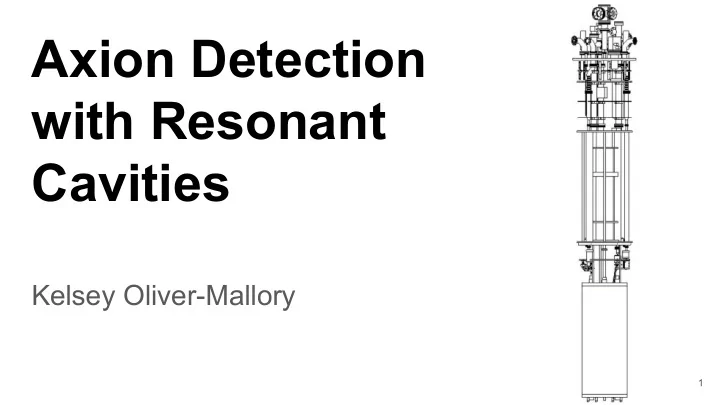
Axion Detection with Resonant Cavities Kelsey Oliver-Mallory 1 Content Axions (why resonant cavities are an effective way to detect them) Resonant Cavities (how they work) ADMX (limits that cut into region of plausible axion
Axion Detection with Resonant Cavities Kelsey Oliver-Mallory 1
Content ● Axions (why resonant cavities are an effective way to detect them) ● Resonant Cavities (how they work) ● ADMX (limits that cut into region of plausible axion theories) 2
Axions ● pseudoscalar dark matter candidate ● probably light ● probably cold 3
Peccei-Quinn Theory ● Strong force only breaks charge parity ● Strong CP problem ● Breaks hidden global U[1] symmetry ● pseudo-Nambu-Goldstone boson ● meets dark matter requirements: cold, non-baryonic, weak coupling to normal matter ● Forms a Bose_Einstein condensate 4
Mass ● fA is the decay constant ● constrained cosmic observation and particle physics experiments ● SN1987A: lower bound f A ● cosmic energy density: upper bound on f A ● Axion mass in range: ueV-meV ● Lifetime much greater than age of universe 5
Coupling to photon (KSVZ and DFSZ models) ● � is the fine structure constant ● g � is a model dependent coupling constant 6
Inverse Primakoff Effect ● Use B 0 as a virtual photon ● Increase decay rate by increasing external magnetic field 7
Resonant Cavities for Axion Detection ● Use a long cylindrical resonant cavity ● Apply uniform magnetic field throughout cavity ● Can detect photons at resonant frequencies 8
Resonant Cavities for Axion Detection ● Maxwell’s equations and boundary conditions result in standing waves ● Only certain resonant modes allowed ● Energy of axion must align with frequency of resonant mode ● Usually looking for TM010 mode. 9
Resonant Cavities for Axion Detection ● Want tunable resonant cavities ● Position of rods changes the resonant frequency 10
Tuning Resonant Modes ● Magnitude electric field 11
Tuning Resonant Modes ● Power produced in cavity from axion ● � a : local energy density of axion field ● V: volume of the cavity ● Q L : loaded quality factor ● Cmnp: coupling form factor of the axion to a specific mode 12
Comparison Resonant Cavity Experiments ● Projected limits for ADMX move into band of viable theories. 13
ADMX Detector ● Superconducting solenoid ● 7.6 Tesla magnetic field ● Cylindrical resonant cavity: r=21cm and z= 100cm ● Black body and axion photons picked up by antenna at top of cavity ● Cryogenically cooled 14
ADMX Detector 15
Receiver and Electronics ● SQUID noise temperature: 100mk at 500MHz and 200mK ● KSVZ axions: 3.3-3.53 ueV ● HFET noise temperature: 2K ● Newest version: cooling with ● KSVZ axions: 1.9-3.3 ueV 3He/4He dilution refrigerator 16
SQUIDs 17
Signal ● Warm power spectrum with cavity resonance ● Monte Carlo with axions 18
ADMX Sensitivity 19
End of Presentation 20
SQUIDs 21
Recommend
More recommend
Explore More Topics
Stay informed with curated content and fresh updates.