b.What do we want to be able to do? (South) 6. Summary of tech/data - - PowerPoint PPT Presentation

b what do we want to be able to do south
SMART_READER_LITE
LIVE PREVIEW

b.What do we want to be able to do? (South) 6. Summary of tech/data - - PowerPoint PPT Presentation

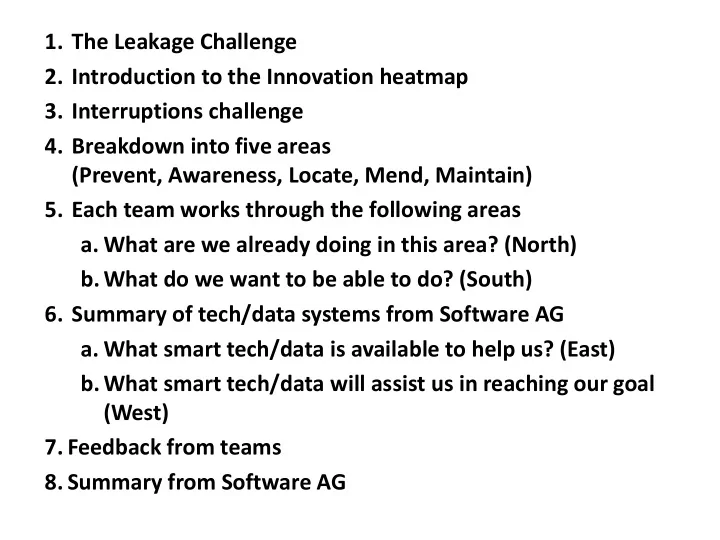
1. The Leakage Challenge 2. Introduction to the Innovation heatmap 3. Interruptions challenge 4. Breakdown into five areas (Prevent, Awareness, Locate, Mend, Maintain) 5. Each team works through the following areas a. What are we already doing


slide-1
SLIDE 1
  • 1. The Leakage Challenge
  • 2. Introduction to the Innovation heatmap
  • 3. Interruptions challenge
  • 4. Breakdown into five areas

(Prevent, Awareness, Locate, Mend, Maintain)

  • 5. Each team works through the following areas
  • a. What are we already doing in this area? (North)

b.What do we want to be able to do? (South)

  • 6. Summary of tech/data systems from Software AG
  • a. What smart tech/data is available to help us? (East)

b.What smart tech/data will assist us in reaching our goal (West)

  • 7. Feedback from teams
  • 8. Summary from Software AG
slide-2
SLIDE 2
  • All water Companies are now required to achieve

a 15%-25% leakage reduction over the next 5 years

  • This will not be achievable using existing solutions
  • The 15+ leakage reduction requires a change in

approach

  • As a result, there is a shared interest in both new

technologies and collaboration.

  • Using the UKWIR leakage reduction big question,

we have developed a routemap for our current research

slide-3
SLIDE 3

How do we achieve zero leakage in a sustainable way by 2050?

Vision Outcomes Key Benefits New leaks on existing networks are minimised All new leaks are found quickly after they break out Background leakage is eliminated How does deterioration of pipes evolve into leakage Impact of network

  • peration on

leakage Use of optical fibres for detection How to pinpoint leaks very accurately from the surface Development of techniques for tracing non- metallic pipes Where does background leakage occur? How great is it? Deterioration processes in joints of various types Incidence and causes of repeat bursts at old repairs Comparison of cured-in-place and sprayed structural linings We can develop strategies to prevent or minimise new leaks We have improved knowledge of how and why leaks break out and grow We have sensors and indicators for new leaks We can receive real-time alarms on new leaks We have remote leak detection tools We have effective acoustic & non acoustic detection methods We have effective detection method for plastic pipes We know how to make correlators more effective We know how/where to use permanent instrumentation for detection We have improved zero/ minimum excavation techniques We have developed non metallic pipe tracing tools We understand how to prevent repeat bursts We understand the nature and magnitude of background leakage We have improved techniques to seal pipes Prediction of future leakage and burst rates for different types

  • f pipes

How to prevent or minimise leaks on existing pipes Causes of transients in distribution networks Use of remote imagery for leak detection Development of platelet-type techniques (by suppliers) Combination of transient v steady state detection methods Repairs are quick, economic with

  • min. disruption

Optimisation of sensor location : "Hydrant dynamics for acoustic leak detection" 3,4,5 6, 7 8 11 12 Critical UG Pipe Sensing 17 Acoustic sensing for leak detection

  • n trunk mains

16 20 21 22 23 24 25 26 Impact of customer-side leakage approaches 28 Active leakage control efficiency 29 Idea Planned Live Completed Pipe wave modelling for Acoustic Leak Detection 9 33 18 10 13 Establish high

  • spec. DMAs to

demonstrate zero leakage is achievable Identify and quantify leakage in new DMAs and relate to installation Making new pipework leak- free with existing techniques Cost benefit of high spec networks in terms

  • f maint. savings

We can

  • ptimise

current methods We can specify new leak-free methods All new pipework is leak-free Development of self-healing pipes (by suppliers) 15 14 27 31 32

Prevent Aware Locate Mend

We can confidently quantify leakage and demonstrate when it is zero Understand the balance between use, supply pipe leakage, plumbing losses and meter under-registration Use of smart networks for leakage management 1 Best Practice For Trunk Main Flow Monitoring Areas 19 The impact of reductions in leakage levels on reported and detected leak repair frequencies 30 2 We have accurate knowledge of where water is going within DMAs We can make accurate local water balances We have near universal customer metering

slide-4
SLIDE 4

Company Project Name Project Description Project Type Project Cost Project Status Project timescales to results Willingness to share SES Water LoRa Smart meters Trial of smart meters using LoRa base station and configurable LoRa water meters

  • 1. Quantify property

leakage / allowances Less than £100K4. Project abandoned Completed Share project findings SES Water NB-IoT Smart meters Trial of smart meters using NB-IoT water meters

  • 1. Quantify property

leakage / allowances Less than £100K3. Project commencement By April 2020 Share selected project data SES Water WiFi smart meters Trial of smart meter using WiFi with high frequency data capture

  • 1. Quantify property

leakage / allowances Less than £100K3. Project commencement By April 2020 Share selected project data SES Water Intelligent networks Demonstration of advanced water networks to reduce leakage by 15% and consumption by 7%. 6000 Properties

  • 2. Dynamic/Optimised

networks Between £100K and £500K

  • 3. Project

commencement By April 2021 Share selected project data SES Water Leak localisation using pressure Up to 10 pressure points within a DMA to localise leak breakout

  • 3. Network leakage

location (non acoustic) Less than £100K3. Project commencement By April 2020 Share selected project data SES Water Mains condition surveying Trial to determine mains condition using acoustic methods

  • 2. Mains condition

surveying Not disclosed

  • 3. Project

commencement By April 2020 Share selected project data SES Water Variable pumping pressure management Control pressure within a DMA using multiple pressure points

  • 2. Network pressure
  • ptimisation

Less than £100K1. Active Investigation By April 2022 Share selected project data SES Water PRV controllers powered by turbine Use of small inline turbines to generate power at the PRV so that loggers etc. can be powered

  • 2. Network pressure
  • ptimisation

Not disclosed

  • 3. Project

commencement By April 2020 Share selected project data SES Water NB-IoT logging Use of NB-IoT loggers to increase either the range, battery life or data frequency

  • f traditional GPRS loggers
  • 3. Network leakage

awareness Not disclosed

  • 3. Project

commencement By April 2020 Share selected project data SES Water Micro excavation Development of techniques to both acceralte the repair process and minimise the size of excavation

  • 4. Micro excavation

Not disclosed

  • 1. Active

Investigation By April 2022 Share selected project data YW Fibre Optics (Within Pipe) Trial of fibre optics within trunk mains for leak detection

  • 3. Trunk Main leakage

location Greater than £500K

  • 3. Project

commencement By April 2021 Share selected project data YW Trunk Main Hydrophones Trial to understand the BC for wider roll

  • ut of hydrophones on trunk mains
  • 3. Trunk Main leakage

location Between £100K and £500K

  • 3. Project

commencement By April 2021 Share selected project data YW Internal Repair Clamp Development of an internal repair clamp for repairing smaller leaks through a hydrant without excavation

  • 4. Internal repair

methods Between £100K and £500K

  • 2. Business CaseBy April 2021 Share selected

project data

Leakage innovation heatmap