Background ArDeZ - Overview Communication Sensor Networks period - - PDF document

background
SMART_READER_LITE
LIVE PREVIEW

Background ArDeZ - Overview Communication Sensor Networks period - - PDF document

Outline Background ArDeZ: An Asymmetric Rendezvous ArDeZ Based MAC for Sensor Networks Overview Channel Setup Kwan-Wu Chin and Raad Raad Generating Pseudo-random Rendezvous Periods Telecommunications and Information


slide-1
SLIDE 1

1

ArDeZ: An Asymmetric Rendezvous Based MAC for Sensor Networks

Kwan-Wu Chin and Raad Raad

Telecommunications and Information Technology Research Institute University of Wollongong Australia

2

Outline

  • Background
  • ArDeZ

– Overview – Channel Setup – Generating Pseudo-random Rendezvous Periods – Transmissions: broadcast and unicast

  • Results
  • Conclusion and on-going work

3

Background

  • Sensor Networks

– Low cost nodes equipped with a processor, a low data rate transceiver, modest memory, and one or more sensors – Precision agriculture, bush fire monitoring, etc. – Energy constrained

  • Medium Access Control (MAC)

– Coordinating channel access in an energy efficient manner. – Issues:

  • collisions, idle-listening, overhearing, synchronization, and

control overheads.

4

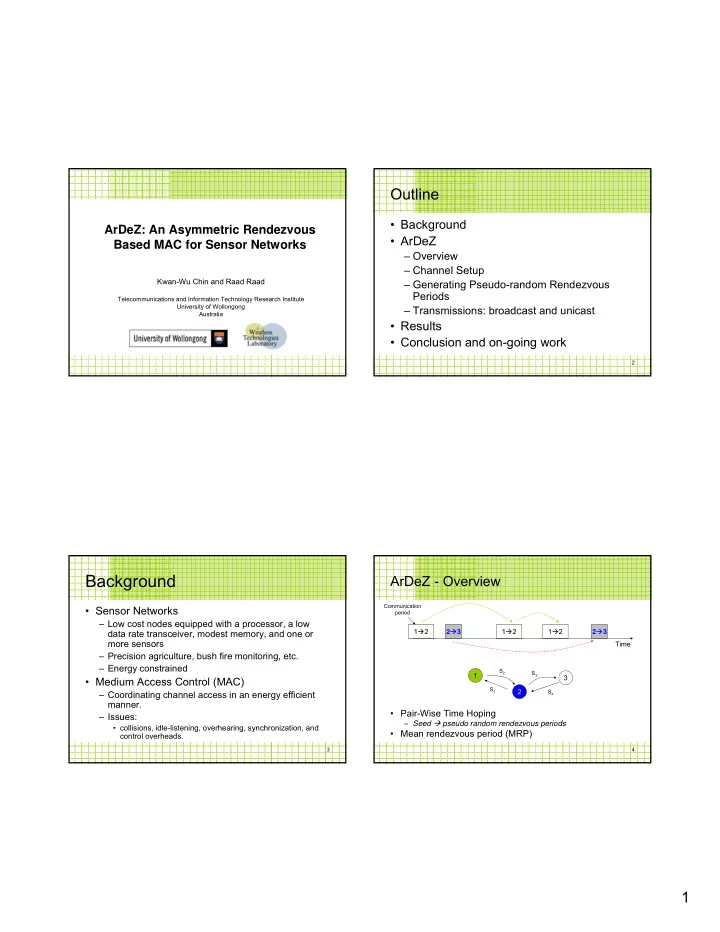
ArDeZ - Overview

  • Pair-Wise Time Hoping

– Seed pseudo random rendezvous periods

  • Mean rendezvous period (MRP)

12 12 12 23 23 Time 1 2 3

S1 S2 S3 S4 Communication period

slide-2
SLIDE 2

2

5

ArDeZ – Channel Setup

  • Invite message

– Frequency dictated by Invite’s Mean Rendezvous Period (MRP)

  • Scan for a maximum WaitNeighbor time
  • Upon receiving an Invite message, a

sensor selects an invite slot randomly.

Invite Message Sleep

Time

Invite Slots

Part 1

6

ArDeZ – Channel Setup

Sleep Time

Node-A’s Invite Message

  • Node address
  • Sensor capabilities
  • Uplink and Downlink seeds

Us and Ds

  • Constants Ca and Cb

Neighbors == N? Channel exist with node-A? Node-A meets criteria?

Channel Request Message

(Su, Sd, Duration)

Node-A

Channel ACK Message (CAM)

Node-B (Invitee) (Inviter)

Part II

7

ArDeZ – Generation Rendezvous Periods

255 )% ( 255 )% (

b i seed a i d b i seed a i u

C D C S C U C S + = + =

MRP S D MRP S U

i d wake i i u wake i

× = × = 255 255

d i seed u i seed

S D S U = =

Advertise in Invite Messages, and selected by an invitee Ca and Cb are constants Jump offset MRP controls how “far” we jump into the future

8

ArDeZ – Generation Rendezvous Periods

) ( ) (

wake i rx i wake i rx i

D IM Downlink U IM Uplink + = + =

i d i seed i u i seed

S D S U = =

+ + 1 1 IMrx is the timestamp

  • f the Invite Message

Update the seed for next iteration

  • First rendezvous period is relative to the reception time of the Invite
  • Message. Subsequent periods are relative to the last rendezvous

period’s end time.

slide-3
SLIDE 3

3

9

ArDeZ – Supporting Broadcast

1 2 3 4 S1 S2 S3 S4 S5 S6 1 2 3 4 B2 B2 B2 B2 – Broadcast seed. Node-2 transmits, all other neighbors listen.

10

ArDeZ – Transmitting and Receiving

DATA/ACK Time

Frame Hdr

Time DATA/ACK

Frame Hdr

Wakeup Wakeup MaxWait

Sender Receiver

  • MaxWait – minimize idle listening
  • Send a packet every z rendezvous periods to avoid losing

synchronization

11

Analysis – Overlapping periods

8-bit 16-bit

12

Analysis – Channel Setup

slide-4
SLIDE 4

4

13

Simulation

  • ns-2 (ns-allinone-2.1b9)
  • CBR – 100 packets, 50 bytes
  • Only establish channels to a neighbor that has a

path to the sink

  • Data rate – 20 Kb/s
  • Rendezvous period length, 30ms
  • Random number range, 0 … 255
  • Energy

– Tx (12 mAh), Rx (1.8 mAh), asleep (5 μAh)

14

Results – Channel Setup

15

Results – Network Setup Time (36 nodes)

16

Results – Node Density vs. Packet

Delivery Ratio

slide-5
SLIDE 5

5

17

Results – Throughput vs. Network Sizes

18

Results – Energy Drain vs MRP

8-months

19

Conclusion

  • ArDeZ – An asymmetric MAC that uses

pseudo-random sleep/wake periods.

– Uplink and downlink channels with different duty cycles

  • Simple setup procedure

– Low signaling overheads

  • No global synchronization or superframe
  • Duty Cycle controlled by adjusting each

link’s Mean Rendezvous Period (MRP)

20

Current Work

  • Comparisons with other MACs

– SMAC, TRAMA, WiseMAC, etc…

  • Design and implementation of routing and

transport protocols that make use of MRP

  • Collision free extensions

– Listening to neighbors’ seeds

slide-6
SLIDE 6

6

21

Questions? kwanwu@uow.edu.au