Background Meet the Participants Special school based research - - PDF document

background
SMART_READER_LITE
LIVE PREVIEW

Background Meet the Participants Special school based research - - PDF document

Paper presented at WFOT 2014, Yokohama, Japan 19 June, 2014 Carolyn Mills Literature Review Extensive reporting presence of sensory difficulties in ASD (Iarocci & McDonald, 2006; Ben-Sasson, Hen, Fluss, Cermak et al, 2009, Ashburner,


slide-1
SLIDE 1

Paper presented at WFOT 2014, Yokohama, Japan Carolyn Mills 19 June, 2014 1

Autism Spectrum Australia (Aspect) 1

Classroom based sensory intervention for children with autism spectrum disorders (ASD): A pilot study using single system design Caroline Mills Chris Chapparo

Autism Spectrum Australia (Aspect) 2

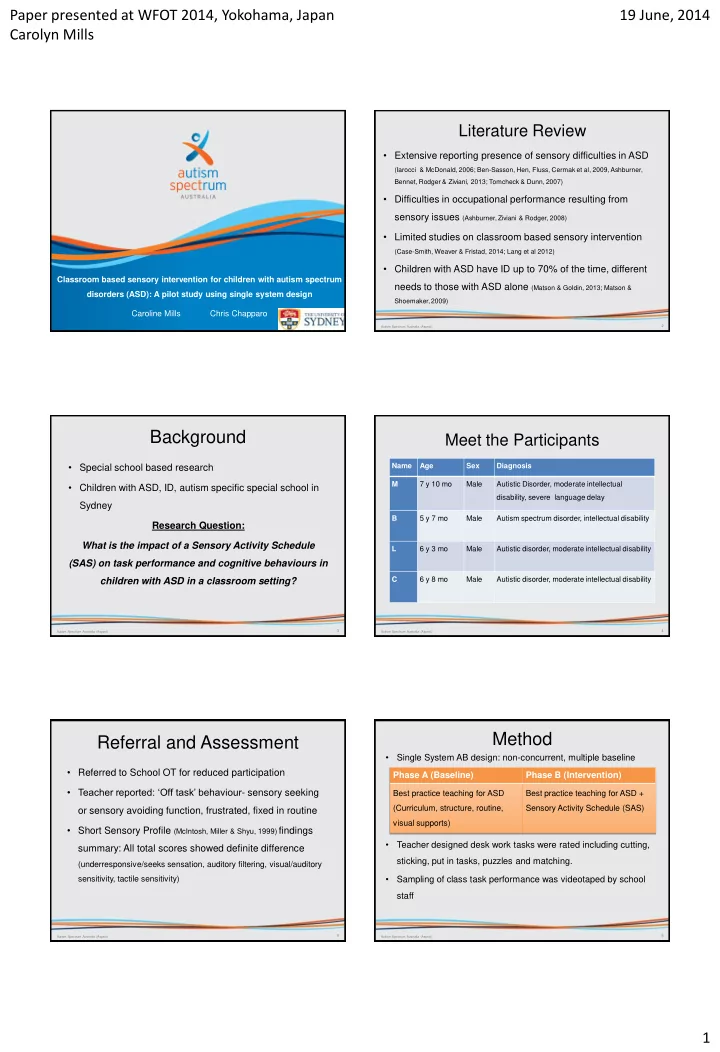
Literature Review

  • Extensive reporting presence of sensory difficulties in ASD

(Iarocci & McDonald, 2006; Ben-Sasson, Hen, Fluss, Cermak et al, 2009, Ashburner, Bennet, Rodger & Ziviani, 2013; Tomcheck & Dunn, 2007)

  • Difficulties in occupational performance resulting from

sensory issues (Ashburner, Ziviani & Rodger, 2008)

  • Limited studies on classroom based sensory intervention

(Case-Smith, Weaver & Fristad, 2014; Lang et al 2012)

  • Children with ASD have ID up to 70% of the time, different

needs to those with ASD alone (Matson & Goldin, 2013; Matson &

Shoemaker, 2009)

Autism Spectrum Australia (Aspect) 3

Background

  • Special school based research
  • Children with ASD, ID, autism specific special school in

Sydney Research Question: What is the impact of a Sensory Activity Schedule (SAS) on task performance and cognitive behaviours in children with ASD in a classroom setting?

Autism Spectrum Australia (Aspect) 4

Name Age Sex Diagnosis M 7 y 10 mo Male Autistic Disorder, moderate intellectual disability, severe language delay B 5 y 7 mo Male Autism spectrum disorder, intellectual disability L 6 y 3 mo Male Autistic disorder, moderate intellectual disability C 6 y 8 mo Male Autistic disorder, moderate intellectual disability

Meet the Participants

Autism Spectrum Australia (Aspect) 5

Referral and Assessment

  • Referred to School OT for reduced participation
  • Teacher reported: ‘Off task’ behaviour- sensory seeking
  • r sensory avoiding function, frustrated, fixed in routine
  • Short Sensory Profile (McIntosh, Miller & Shyu, 1999) findings

summary: All total scores showed definite difference

(underresponsive/seeks sensation, auditory filtering, visual/auditory sensitivity, tactile sensitivity)

Autism Spectrum Australia (Aspect) 6

Method

  • Single System AB design: non-concurrent, multiple baseline
  • Teacher designed desk work tasks were rated including cutting,

sticking, put in tasks, puzzles and matching.

  • Sampling of class task performance was videotaped by school

staff Phase A (Baseline) Phase B (Intervention)

Best practice teaching for ASD (Curriculum, structure, routine, visual supports) Best practice teaching for ASD + Sensory Activity Schedule (SAS)

slide-2
SLIDE 2

Paper presented at WFOT 2014, Yokohama, Japan Carolyn Mills 19 June, 2014 2

Autism Spectrum Australia (Aspect) 7

Method

  • Between 11 and 18 videos were rated using Perceive,

Recall, Plan and Perform (PRPP) Stage One and Two Analysis for each student (Chapparo & Ranka, 2005)

  • Videos were randomly ordered and scored by researchers
  • For each student, Phase A (Baseline) and Phase B

(Intervention) performances were compared.

  • Students were not compared to each other.

Autism Spectrum Australia (Aspect) 8

  • Administered by teacher’s

aide and teacher.

  • Morning session- after

morning circle, before desk work.

  • Used classroom based

equipment

  • 10-15 mins

Intervention- Sensory Activity Schedule (SAS)

Intervention

Bouncing on a therapy ball, tight lycra, deep touch pressure Jumping on a mini-tramp, deep touch pressure Squashing with a bean bag Rolled over a therapy ball, Jumping on a mini tramp and crashing into cushions, shoulder squeezing, tight lycra

Autism Spectrum Australia (Aspect) 9

Intervention- Sensory Activity Schedule (SAS)

Queensland DET Guidelines (QLD DET, 2011):

  • Based on the ‘sensory diet’ (Wilbarger & Wilbarger, 1991)
  • Activities are encouraged at specific times
  • Enable occupational performance
  • Terminology should be clarified
  • Brushing (Deep Pressure Proprioceptive Technique) was

not used (Wilbarger & Wilbarger, 1991)

  • Participants were not targeted for sensory

defensiveness

Autism Spectrum Australia (Aspect) 10

(Chapparo & Ranka, 2005)

Perceive, Recall, Plan, Perform (PRPP)

  • Two stage standardised

criterion referenced assessment

  • Stage One uses

procedural task analysis to determine level of expected skill

  • Stage Two uses

cognitive task analysis and measures cognitive strategy application in the context of task performance

Autism Spectrum Australia (Aspect) 11

Data Analysis- PRPP Stage One

  • Outcome Measure- PRPP

Stage One: Procedural task analysis for teacher designated desk work tasks in the classroom.

  • Steps containing errors were

recorded

  • Percentage of error free

performance was calculated

PRPP Stage One Put in Task

Errors

Sit down Take plastic bottle Take bottle cap Place in bottle Take bottle cap Place in bottle Put bottle in finish tray

ERROR FREE- 5/7 71.4% X X

Autism Spectrum Australia (Aspect) 12

Results

M Performance Mastery

50.00 55.00 60.00 65.00 70.00 75.00 80.00 85.00 90.00 95.00 100.00 1 2 3 4 5 6 7 8 9 10 11

Percentage Score Task Performances

Phase A- Baseline Phase B- SAS Intervention

p=0.038, p<0.05

Two band standard deviation method (Ottenbacher, 1986)

slide-3
SLIDE 3

Paper presented at WFOT 2014, Yokohama, Japan Carolyn Mills 19 June, 2014 3

Autism Spectrum Australia (Aspect) 13

50.00 55.00 60.00 65.00 70.00 75.00 80.00 85.00 90.00 95.00 100.00 1 2 3 4 5 6 7 8 9 10 11 12 13 14 Percentage Score

Task Performances

Phase A Baseline Phase B SAS Intervention

p=0.01, p<0.05 B Performance Mastery

Autism Spectrum Australia (Aspect) 14

50.00% 55.00% 60.00% 65.00% 70.00% 75.00% 80.00% 85.00% 90.00% 95.00% 100.00% 1 2 3 4 5 6 7 8 9 10 11 12

Percentage Score Task Performance

Phase A Baseline Phase B SAS Intervention

p=0.502, p>0.05 L Performance Mastery

Autism Spectrum Australia (Aspect) 15

50.00% 55.00% 60.00% 65.00% 70.00% 75.00% 80.00% 85.00% 90.00% 95.00% 100.00% 1 2 3 4 5 6 7 8 9 10 11 12 13 14

Percentage Scores Task Performances

Phase A Phase B

p<0.001 C Performance Mastery

Autism Spectrum Australia (Aspect) 16

Child Stage One Task Mastery Result Statistics*

Phase A (Baseline) Phase B (Intervention)

M

69.5% 82.64% p=0.038**

B

86.67% 95.88% p=0.01***

L

81.32% 84.39% p=0.502

C

85.2% 98.18% p<0.001***

Results Summary PRPP Stage One

*Two tailed, Independent Samples T test (confirmed by Mann Whitney U statistic) ** Significance at the 0.05 level, *** Significance at the 0.01 level

Autism Spectrum Australia (Aspect) 17

Discussion

  • 3 out of 4 showed improved task mastery following a

classroom based SAS as measured by Stage One PRPP

  • Why was intervention effective for 3 out of 4 children?
  • A targeted opportunity to meet a child’s sensory needs

contributed to better self regulation prior to completion

  • f work tasks in the classroom.
  • L’s results were not significant- baseline not stable,

trend lines showed improvements

  • L needed a longer baseline

Autism Spectrum Australia (Aspect) 18

Discussion

  • Teachers can be trained to do the intervention
  • Intervention designed with teachers
  • Qualitative feedback from teachers confirmed

statistical results

  • PRPP is a suitable tool to use to measure task

mastery in context

  • Ecologically suitable- teacher set tasks
  • Small pilot study, many limitations
  • Real life research
slide-4
SLIDE 4

Paper presented at WFOT 2014, Yokohama, Japan Carolyn Mills 19 June, 2014 4

Autism Spectrum Australia (Aspect) 19

Where to from here?

  • Results support further research
  • Randomised Control Trial (RCT)
  • At least 50 children
  • Sensory Activity Schedule intervention for least
  • ne school term (9 weeks)
  • Quantitative and qualitative measures of task

mastery and occupational performance in the classroom

Autism Spectrum Australia (Aspect) 20

Questions

Acknowledgements Lara Cheney, Allyce Cunningham, Lydia Griffiths, Jamie Togle, Rebecca Fitzroy, Nala Simmons, Yasmina Adamson, Ashwini Reddy, Dr Debra Costley, Dr Trevor Clark, Dr Susan Bruck, Dr Joanne Hinitt Participating students and families Contact: Caroline Mills cmills@autismspectrum.org.au Dr Chris Chapparo chris.chapparo@sydney.edu.au

Autism Spectrum Australia (Aspect) 21

References

Ashburner, J., Ziviani, J., & Rodger, S. (2008). Sensory processing and classroom emotional, behavioral, and educational outcomes in children with autism spectrum disorder. American Journal of Occupational Therapy, 62, p.564–573. Ashburner, J., Bennett, L., Rodger, S. & Ziviani, J. (2013) 'Understanding the sensory experiences of young people with autism spectrum disorder: A preliminary investigation.' Australian Journal of Occupational Therapy 60, pp. 171-180. Ben-Sasson, A., Hen, L., Fluss, R. Cermak, S.A., Engel-Yeger, B. & Gal, E. (2009) 'A Meta-Analysis of Sensory Modulation Symptoms in Individuals with Autism Spectrum Disorders' Journal of autism and developmental disorders, 39, p.1–11 Case-Smith, J., Weaver, L.L. & Fristad, M.A. (2014) 'A systematic review of sensory processing interventions for children with autism spectrum disorders‘ Autism pp. 1 –16 Chapparo C. & Ranka, J. (2005) ‘PRPP Task Analysis Research User’s Training Manual- Research Edition’. Sydney: The University of Sydney. DET QLD (2011) Best Practice Guidelines for Department of Education and Training Occupational Therapists: Supporting Students with Sensory Processing Challenges. Department of Education and Training, Queensland, Australia. Iarocci G. & McDonald, J. (2006) 'Sensory integration and the perceptual experiences of persons with autism.' Journal of Autism and Developmental Disorders, 36 (1) p. 77-90

Autism Spectrum Australia (Aspect) 22

References

Lang, R., O'Reilly, M., Healy, O., Rispoli, M., Lydon, H. et al (2012) 'Sensory integration therapy for autism spectrum disorders: A systematic review' Research in Autism Spectrum Disorders 6, pp.1004-1018. Matson, J.L. & Goldin, R.L. (2013) Review: Comorbidity and autism: Trends, Topics and future

  • directions. Research in Autism Spectrum Disorders 7 pp.1228-1233

Matson, J.L. & Shoemaker, M. (2009) 'Review: Intellectual disability and its relationship to autism spectrum disorders.' Research in Developmental Disabilities 30, pp.1107–1114. McIntosh DN, Miller LJ, Shyu V (1999) Development and validation of the Short Sensory Profile. In: W Dunn, ed. The Sensory Profile examiner’s manual. San Antonio, TX: Psychological Corporation, p.59-73. Ottenbacher, K. (1986) 'Evaluating Clinical Change: Strategies for occupational and physical therapists' USA: Williams & Wilkins. Tomchek, S.D. & Dunn, W. (2007) Sensory processing in children with and without autism: A comparitive study using the short sensory profile. American Journal of Occupational Therapy, 61, p.190-200. Wilbarger, P. & Wilbarger, J. (1991) ‘Sensory Defensiveness in Children ages 1-12: an intervention guide for parents and other caretakers.’ Santa Barbara California: Avanti Educational Programs.