Background Electronic Monitoring in the DOCs MCS works to examine - - PDF document

background
SMART_READER_LITE
LIVE PREVIEW

Background Electronic Monitoring in the DOCs MCS works to examine - - PDF document

Background Electronic Monitoring in the DOCs MCS works to examine PS interactions and mitigation measures New Zealand Inshore Trawl Fishery: A Pilot Study Observers are current monitoring method, but with limitations Can


slide-1
SLIDE 1

1

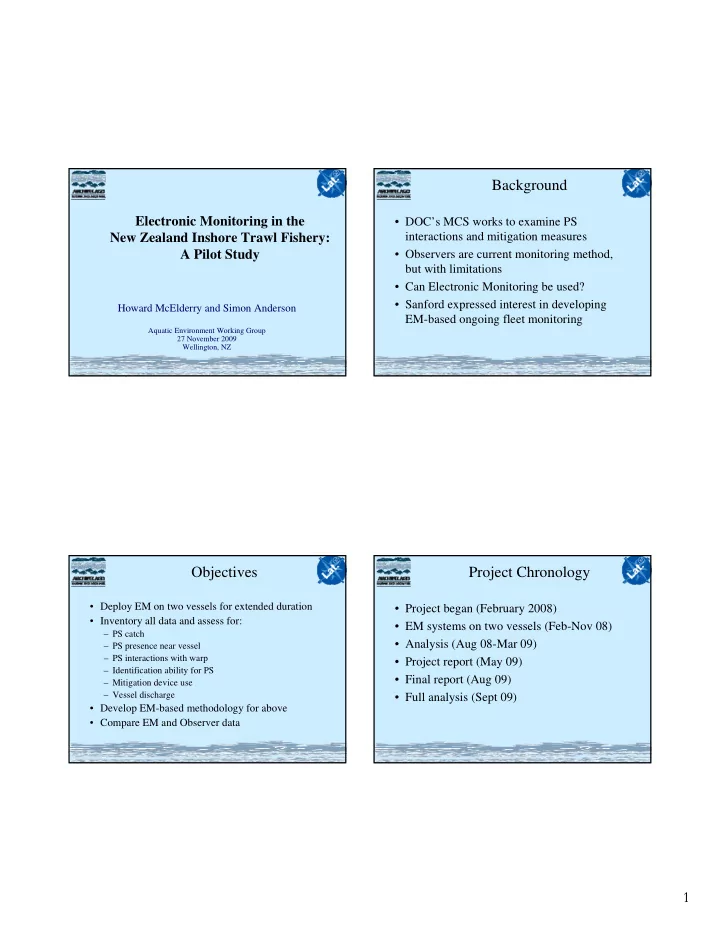
Electronic Monitoring in the New Zealand Inshore Trawl Fishery: A Pilot Study

Howard McElderry and Simon Anderson

Aquatic Environment Working Group 27 November 2009 Wellington, NZ

Background

  • DOC’s MCS works to examine PS

interactions and mitigation measures

  • Observers are current monitoring method,

but with limitations

  • Can Electronic Monitoring be used?
  • Sanford expressed interest in developing

EM-based ongoing fleet monitoring

Objectives

  • Deploy EM on two vessels for extended duration
  • Inventory all data and assess for:

– PS catch – PS presence near vessel – PS interactions with warp – Identification ability for PS – Mitigation device use – Vessel discharge

  • Develop EM-based methodology for above
  • Compare EM and Observer data

Project Chronology

  • Project began (February 2008)
  • EM systems on two vessels (Feb-Nov 08)
  • Analysis (Aug 08-Mar 09)
  • Project report (May 09)
  • Final report (Aug 09)
  • Full analysis (Sept 09)
slide-2
SLIDE 2

2 Roles

  • Project design – DOC, Sanford,

Archipelago and Lat37

  • Field services (Lat 37)
  • EM data interpretation (Archipelago)
  • Analysis and report (Archipelago)

Electronic Monitoring Inshore Trawl Vessels

V2 V2 V1 V1

Example Camera Views – V1

slide-3
SLIDE 3

3 Example Camera Views – V2 Data Capture Specifications

  • EM system powered 100% while vessel at

sea

  • Sensor data recorded continuously

– 10 second update

  • Image data triggered by winch/hydraulics

– 1-6 fps per camera – All cameras activated – 30 min run-on

EM Data Inventory

slide-4
SLIDE 4

4 EM Data Quality Assessment

  • GPS – 100% complete
  • Winch rotation – 85% complete
  • Hydraulic – 50% complete (V2 reversed)
  • Imagery – 85% complete

– High – 58% – Medium – 41% – Low – 1%

Image Data Inventory

  • Total fishing events – 1,022
  • Fishing events w/ observer – 60
  • Fishing events w/o observer – 962

– Complete imagery – 822 (84%) – Partial imagery (power) – 15 – Partial imagery (system error) – 150

  • Events sampled – 210 (~20%)

– 60 observer present – 150 no observer present (random, time strata)

  • Post report – 612 events analyzed

Image Data Inventory cont.

  • PS catch – 184 events (88% )
  • PS presence near vessel – 171 events (86%)
  • PS interactions with warp – 0 events (0%)
  • Identification ability for PS – 169 events (86%)
  • Mitigation device use – 200 events (95%)
  • Vessel discharge - 165 events (79%)

PS Catch

  • Def’n: Presence of protected species in fishing

gear during net retrieval and catch stowage

  • Events:

– Dolphin #1 – observer and EM detected – Dolphin #2 – vessel reported, EM not detected (outside camera view) – Gannet – vessel reported, EM detected

  • Issues

– 100% deck area needs to be covered – Small PS in catch likely hard to detect

slide-5
SLIDE 5

5 PS Presence Near Vessel

  • Def’n: Abundance estimates of PS (mostly seabirds) during

shooting and/or hauling of fishing gear (daylight operations).

  • EM seabird estimates based on abundance categories
  • EM and Observer seabird estimates were correlated.
  • EM PS estimates limited in range and resolution.
  • PS estimates vary by camera position.

PS Interactions With Warp

  • Def’n: Counts of seabird strikes with warp

(and mitigation device) during daylight tows.

  • No suitable camera placements for this
  • bjective.
  • Not successful with this objective

PS Identification Ability

  • Def’n: Identify PS to lowest taxa possible
  • PS catch

– W/ large PS, ID to species likely

  • PS in proximity to vessel

– W/ large PS, calm seas, close to vessel – ID possible – Most seabird classifications were to general groups

Mitigation Device Use

  • Def’n: documentation of the type and

effectiveness of mitigation gear deployed during fishing operations

  • High agreement with observer (93%)
  • Night tows more problematic
slide-6
SLIDE 6

6 Vessel Discharge

  • Def’n: Estimations of fish discharge (offal
  • r whole fish) during fishing operations (for

this fleet essentially fish discards during catch stowage operations).

  • Quantification – both species and quantities
  • Observer and EM weight estimates w/in

16%.

  • EM poorly resolved species (~50%

unidentified catch)

  • EM system performed very well overall
  • EM power should be continuous (data loss

16%)

  • Image recording run on too short
  • EM installation opportunistic
  • 4 cameras not enough for all monitoring
  • bjectives

Rec/Concl’s: EM Performance Rec/Concl’s: Monitoring Objectives

  • PS Catch

– Need full view of net and fish handling areas. – Need control point for all catch not retained – Likelihood of success: High

Rec/Concl’s: Monitoring Objectives

  • PS Presence Near Vessel

– Consider rank indices of abundance. – Place cameras at deck level – Likelihood of success: Medium

slide-7
SLIDE 7

7 Rec/Concl’s: Monitoring Objectives

  • Trawl Warp Monitoring

– Requires dedicated cameras – Seabird strikes difficult to detect – Perhaps focus on mitigation instead of warp? – Likelihood of success: Low

Rec/Concl’s: Monitoring Objectives

  • PS Identification

– Catch

  • Need full view of net and fish handling areas.
  • Need control point for all catch not retained
  • Likelihood of success: Medium to High

– Near Vessel

  • General species groupings
  • Likelihood of success: Low

Rec/Concl’s: Monitoring Objectives

  • Mitigation Device Deployment

– Include in deck camera views – Easily monitored – Likelihood of Success - High

Rec/Concl’s: Monitoring Objectives

  • Assessment of Discharge Patterns (Discarded

whole fish)

– Need full view of net and fish handling areas. – Need control point for all catch not retained – Likelihood of Success - High

slide-8
SLIDE 8

8 Rec/Concl’s: Operational

  • Narrow communication gaps between

vessel, company, field services (Lat37) and analysis (Archipelago)

  • EM analysis should be NZ based
  • Need larger scale for NZ based

infrastructure

  • Real time EM ‘health status’ would be

beneficial.

Conclusions - General

  • EM cost $383/day, or ~38% of equivalent
  • bserver program
  • EM could work with industry involvement.
  • Benefits of industry engagement huge
  • EM would address monitoring needs but

different data than observer

  • Best option - combined EM and observer

monitoring

  • EM program takes time and infrastructure

Thanks!