Background to Research Back pain is a debilitating condition Costs - - PDF document

background to research
SMART_READER_LITE
LIVE PREVIEW

Background to Research Back pain is a debilitating condition Costs - - PDF document

18/12/2014 The Wear of Ceramic Total Disc Replacements Naomi Green, Athena Swan Event 12 th November 2014 Background to Research Back pain is a debilitating condition Costs UK economy billions of pounds a year in treatment and lost


slide-1
SLIDE 1

18/12/2014 1 The Wear of Ceramic Total Disc Replacements

Naomi Green, Athena Swan Event 12th November 2014

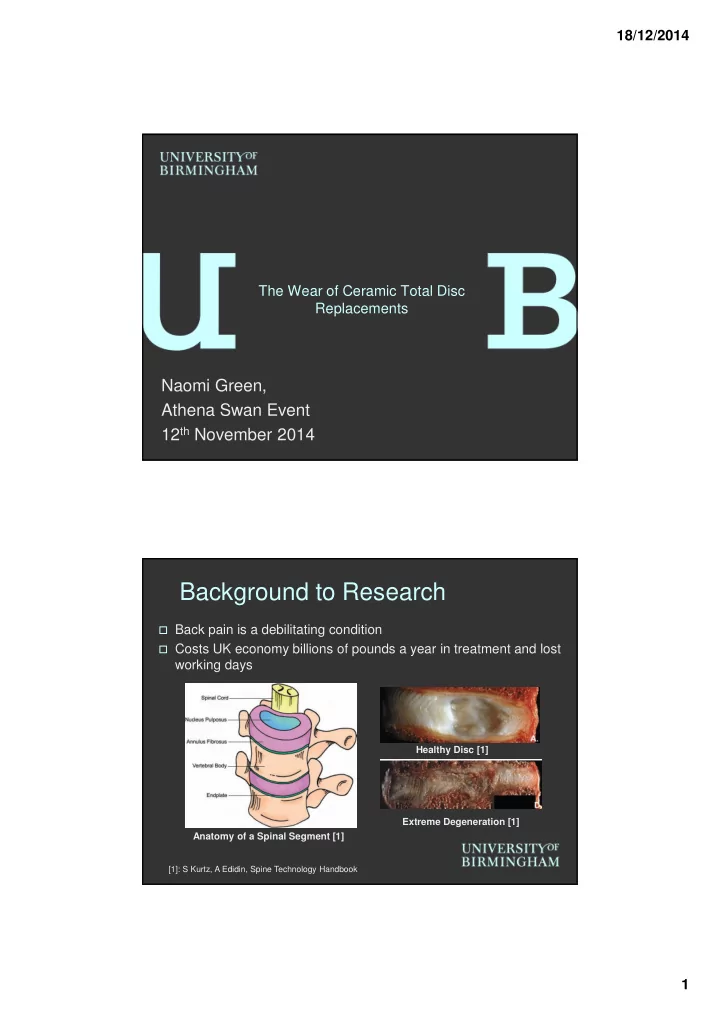
Background to Research

Back pain is a debilitating condition Costs UK economy billions of pounds a year in treatment and lost

working days

[1]: S Kurtz, A Edidin, Spine Technology Handbook

Healthy Disc [1] Extreme Degeneration [1] Anatomy of a Spinal Segment [1]

slide-2
SLIDE 2

18/12/2014 2

Total Disc Replacements

Total Disc Replacement (TDR) possible treatment Intervertebral disc is removed and replaced with TDR Issues with devices and debate over clinical outcomes Ceramic materials may improve devices

Scient’x Discocerv: Ceramic

  • n Ceramic TDR [2]

Synthes Spine ProDisc II: Total Disc Replacement [1] Medtronic MAVERICK: Metal

  • n Metal TDR [1]

[1]: S Kurtz, A Edidin, Spine Technology Handbook, [2] http://www.scientx.com/product_nonfusion_discocerv.php 2006

Aims

Overall aims:

– Investigate the use of ceramics in cervical Total Disc Replacements and their wear behaviour – Manufacture ceramic implants using novel grinding methods – Develop a new method for measuring low wear rates for implants

slide-3
SLIDE 3

18/12/2014 3

Implant Manufacture

Universitas 21 Scholarship to study at University College Dublin,

Ireland

Collaborative study of the grinding of ceramic TDRs using novel

diamond tool to achieve desired surface finish

Upper and Lower Alumina Implants in Fixtures Manufacture of Implant

Wear and Friction Testing

Major mode of failure for an implant is wear TDRs are tested on spinal simulators to the international

standard ISO 18192-1 [3] to determine wear rates

Bose SDWS-1 Spine Simulator

[3] ISO 18192-1:2011 Implants for surgery — Wear of total intervertebral spinal disc prostheses Part 1

slide-4
SLIDE 4

18/12/2014 4

Measuring Wear Rates

Normal method for measuring wear rates of implants is the

gravimetric method

Change in mass is used to determine volume loss When wear rates are low it is difficult to measure the change in

mass of the sample accurately

Alumina cervical implants are expected to have low wear rates Alternative method is required Use non-contacting optical method, Alicona Infinite Focus, to

scan surface of the implant

Can measure form and surface roughness parameters in one

scan

Implant Wear Measurement

Form and roughness measurements taken before start of

wear test and at every 0.5 million cycles

Matlab code has been developed which finds volume

difference between the unworn and worn surfaces

Images of the Functional Surfaces Before and After Testing
slide-5
SLIDE 5

18/12/2014 5

Friction Measurements

Short 100 cycle tests Measure frictional torque against frequency Produce Stribeck Curves Gradient of the line gives information about lubrication

regime

Example Stribeck Curve

Future Work

Complete final scans of implant Analyse data

  • Calculate wear rates
  • Compare gravimetric method with optical method
  • Surface roughness changes with wear

Publish journal papers Write thesis Graduate ?!?