
SLIDE 1
18TH INTERNATIONAL CONFERENCE ON COMPOSITE MATERIALS
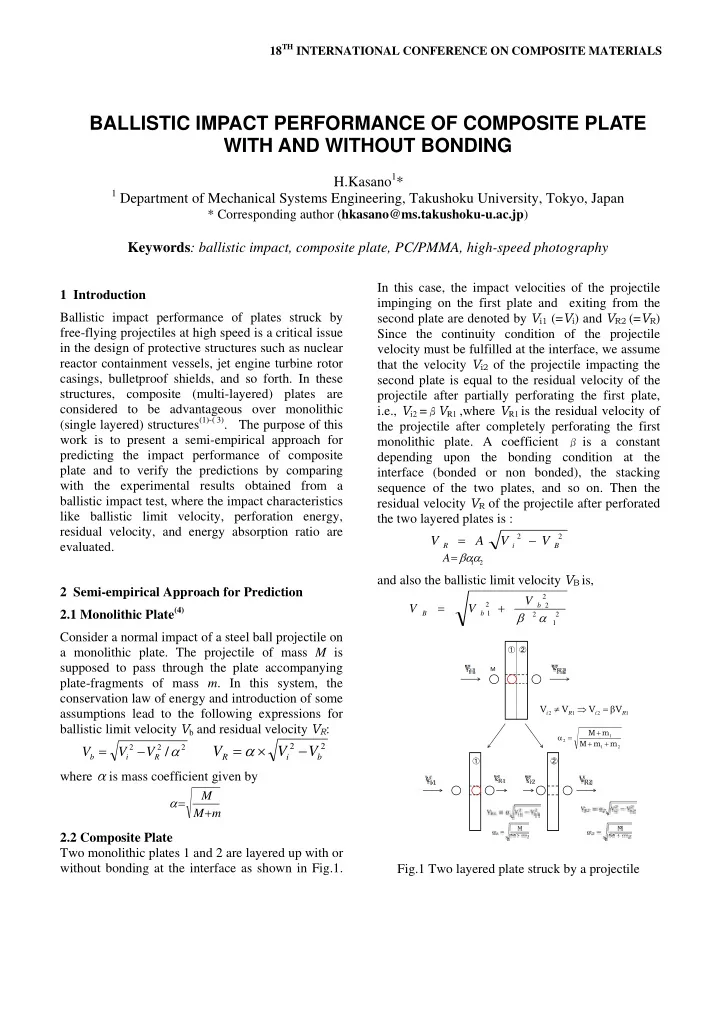
1 Introduction Ballistic impact performance of plates struck by free-flying projectiles at high speed is a critical issue in the design of protective structures such as nuclear reactor containment vessels, jet engine turbine rotor casings, bulletproof shields, and so forth. In these structures, composite (multi-layered) plates are considered to be advantageous over monolithic (single layered) structures(1)-( 3). The purpose of this work is to present a semi-empirical approach for predicting the impact performance of composite plate and to verify the predictions by comparing with the experimental results obtained from a ballistic impact test, where the impact characteristics like ballistic limit velocity, perforation energy, residual velocity, and energy absorption ratio are evaluated. 2 Semi-empirical Approach for Prediction 2.1 Monolithic Plate(4) Consider a normal impact of a steel ball projectile on a monolithic plate. The projectile of mass M is supposed to pass through the plate accompanying plate-fragments of mass m. In this system, the conservation law of energy and introduction of some assumptions lead to the following expressions for ballistic limit velocity Vb and residual velocity VR: where αis mass coefficient given by 2.2 Composite Plate Two monolithic plates 1 and 2 are layered up with or without bonding at the interface as shown in Fig.1. In this case, the impact velocities of the projectile impinging on the first plate and exiting from the second plate are denoted by Vi1 (=Vi) and VR2 (=VR) Since the continuity condition of the projectile velocity must be fulfilled at the interface, we assume that the velocity Vi2 of the projectile impacting the second plate is equal to the residual velocity of the projectile after partially perforating the first plate, i.e., Vi2 =βVR1 ,where VR1 is the residual velocity of the projectile after completely perforating the first monolithic plate. A coefficient β is a constant depending upon the bonding condition at the interface (bonded or non bonded), the stacking sequence of the two plates, and so on. Then the residual velocity VR of the projectile after perforated the two layered plates is : and also the ballistic limit velocity VB is,
① ② ① ②
M
1 2 1 2 R i R i
V V V V β = ⇒ ≠
2 1 1 2
m m M m M + + + = α
Fig.1 Two layered plate struck by a projectile
BALLISTIC IMPACT PERFORMANCE OF COMPOSITE PLATE WITH AND WITHOUT BONDING
H.Kasano1*
1 Department of Mechanical Systems Engineering, Takushoku University, Tokyo, Japan
* Corresponding author (hkasano@ms.takushoku-u.ac.jp)
Keywords: ballistic impact, composite plate, PC/PMMA, high-speed photography
2 2 2
/α
R i b
V V V − =
2 2 b i R
V V V − × = α
m M M + = α
2 2 B i R
V V A V − =
2 1 2 2 2 2 1
α β
b b B
V V V + =
2 1α