1
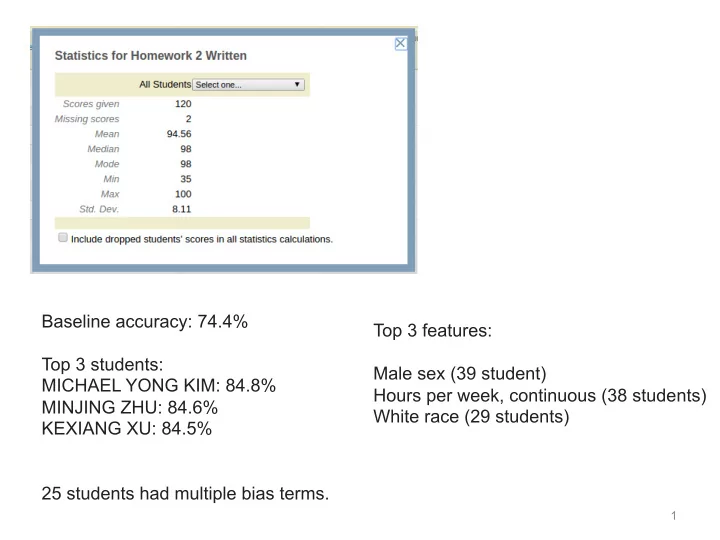
Baseline accuracy: 74.4% Top 3 students: MICHAEL YONG KIM: 84.8% MINJING ZHU: 84.6% KEXIANG XU: 84.5% 25 students had multiple bias terms. Top 3 features: Male sex (39 student) Hours per week, continuous (38 students) White race (29 students)
Baseline accuracy: 74.4% Top 3 features: Top 3 students: Male sex - - PowerPoint PPT Presentation
Baseline accuracy: 74.4% Top 3 features: Top 3 students: Male sex (39 student) MICHAEL YONG KIM: 84.8% Hours per week, continuous (38 students) MINJING ZHU: 84.6% White race (29 students) KEXIANG XU: 84.5% 25 students had multiple bias
1
Baseline accuracy: 74.4% Top 3 students: MICHAEL YONG KIM: 84.8% MINJING ZHU: 84.6% KEXIANG XU: 84.5% 25 students had multiple bias terms. Top 3 features: Male sex (39 student) Hours per week, continuous (38 students) White race (29 students)
3
4
7
8
decision tree learning algorithm; very similar to version in earlier slides
shades of blue/red indicate strength of vote for particular classification
13
time = 0 blue/red = class size of dot = weight weak learner = Decision stub: horizontal or vertical l
14
time = 1
this hypothesis has 15% error and so does this ensemble, since the ensemble contains just this one hypothesis
15
time = 2
16
time = 3
17
time = 13
18
time = 100
19
time = 300
“heavier” ¡data ¡points ¡
– e.g., ¡MLE ¡for ¡Naïve ¡Bayes, ¡redefine ¡Count(Y=y) ¡to ¡be ¡weighted ¡count: ¡ – sebng ¡D(j)=1 ¡(or ¡any ¡constant ¡value!), ¡for ¡all ¡j, ¡will ¡recreates ¡ unweighted ¡case ¡
n j=1
How? Many possibilities. Will see one shortly!
Why? Reweight the data: examples i that are misclassified will have higher weights!
Dt+1(i) < Dt(i) ¡
Dt+1(i) > Dt(i)
Final Result: linear sum of “base” or “weak” classifier
D1(i) = 1/m, for i = 1, . . . , m
m
X
i=1
Dt(i) exp(−αtyiht(xi))
H(x) = sign T X
i=1
αtht(x) !
D1(i) = 1/m, for i = 1, . . . , m
0.2 0.4 0.6 0.8 1.0 3 2 1 1 2
m)
m
i=1
¡ ¡ ¡ Where ¡ ¡ ¡ ¡ ¡ [Schapire, 1989]
m
i=1
m
i=1
¡ ¡ ¡ Where ¡ ¡ ¡ And ¡ ¡
¡ ¡ ¡
[Schapire, 1989] This equality isn’t
shown with algebra (telescoping sums)!
t
m
i=1
1 m
m
X
i=1
δ(H(xi) 6= yi) 1 m
m
X
i=1
Dt(i) exp(yif(xi))
¡ ¡ ¡ ¡ ¡ ¡ [Schapire, 1989]
m
i=1
m
i=1
✏t =
m
X
i=1
Dt(i)(ht(xi) 6= yi)
x1
Use ¡decision ¡stubs ¡as ¡base ¡classifier ¡ Ini7al: ¡
t=1: ¡
¡= ¡0.33×1+0.33×0+0.33×0=0.33 ¡
= ¡0.33×exp(-‑0.35×1×-‑1) ¡= ¡0.33×exp(0.35) ¡= ¡0.46 ¡
= ¡0.33×exp(-‑0.35×-‑1×-‑1) ¡= ¡0.33×exp(-‑0.35) ¡= ¡0.23 ¡
= ¡0.33×exp(-‑0.35×1×1) ¡= ¡0.33×exp(-‑0.35) ¡=0.23 ¡
t=2 ¡
¡ ¡ Ini7alize: ¡ For ¡t=1…T: ¡
¡
¡ Output ¡final ¡classifier: ¡ D1(i) = 1/m, for i = 1, . . . , m
Dt+1(i) ∝ Dt(i) exp(−αtyiht(xi))
H(x) = sign(0.35×h1(x))
H(x) = sign T X
i=1
αtht(x) !
✏t =
m
X
i=1
Dt(i)(ht(xi) 6= yi)
x1
t=2: ¡
new ¡data ¡weights ¡D; ¡breaking ¡7es ¡opportunis7cally ¡ (will ¡discuss ¡at ¡end)] ¡
¡= ¡0.5×0+0.25×1+0.25×0=0.25 ¡
= ¡0.5×exp(-‑0.55×1×1) ¡= ¡0.5×exp(-‑0.55) ¡= ¡0.29 ¡
= ¡0.25×exp(-‑0.55×-‑1×1) ¡= ¡0.25×exp(0.55) ¡= ¡0.43 ¡
= ¡0.25×exp(-‑0.55×1×1) ¡= ¡0.25×exp(-‑0.55) ¡= ¡0.14 ¡
t=3
¡ ¡
Ini7alize: ¡ For ¡t=1…T: ¡
¡
¡ Output ¡final ¡classifier: ¡ D1(i) = 1/m, for i = 1, . . . , m
Dt+1(i) ∝ Dt(i) exp(−αtyiht(xi))
H(x) = sign(0.35×h1(x)+0.55×h2(x))
H(x) = sign T X
i=1
αtht(x) !
✏t =
m
X
i=1
Dt(i)(ht(xi) 6= yi)
x1
t=3: ¡
because ¡of ¡new ¡data ¡weights ¡D; ¡breaking ¡7es ¡
¡= ¡0.33×0+0.5×0+0.17×1=0.17 ¡
¡ ¡ Ini7alize: ¡ For ¡t=1…T: ¡
¡
¡ Output ¡final ¡classifier: ¡ D1(i) = 1/m, for i = 1, . . . , m
H(x) = sign T X
i=1
αtht(x) !
Dt+1(i) ∝ Dt(i) exp(−αtyiht(xi))
H(x) = sign(0.35×h1(x)+0.55×h2(x)+0.79×h3(x))
m
i=1
t
T
t=1
[Schapire, 1989]
Test error Training error
[Freund & Schapire, 1996]
[Freund & Schapire, 1996]
[Freund & Schapire, 1996] error error error
w0, ¡w1, ¡… ¡wn ¡via ¡gradient ¡
m
X
i=1
ln(1 + exp(−yif(xi)))
m
i=1