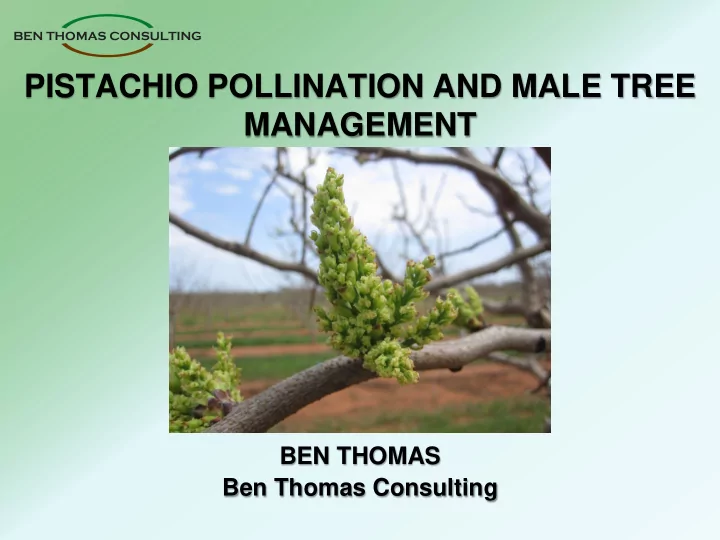
PISTACHIO POLLINATION AND MALE TREE MANAGEMENT BEN THOMAS Ben - - PowerPoint PPT Presentation
PISTACHIO POLLINATION AND MALE TREE MANAGEMENT BEN THOMAS Ben Thomas Consulting PISTACHIO FLOWERS FEMALE MALE Slide 2 PISTACHIO FLOWERS The pistachio tree is dioecious Means two houses Male (staminate) flowers are borne
PISTACHIO FLOWERS
FEMALE MALE
Slide 2
PISTACHIO FLOWERS
- The pistachio tree is dioecious
– Means ‘two houses’ – Male (staminate) flowers are borne on
- ne tree and female (pistillate) flowers
- n another
- A group of flowers is called a
panicle and flowers are formed on a rachis
- There can be hundreds of flowers
per panicle but set is very low
- Capable of parthenocarpy where the
fruit grows but there is no viable embryo
Slide 3
POLLINATION & FRUIT SET
- STAGE 1 : Pollination
- Pollen released from staminate flowers on male trees.
- Carried by wind to stigmas of pistillate flowers on female trees
- STAGE 2 : Pollen tube growth
- Pollen grain on stigma germinates to form a pollen tube.
- Pollen tube carrying male germ cells grows through stigma and style
tissue to the ovule.
- STAGE 3 : Fertilisation
- Fusion of male and female germ cells in the ovule.
Slide 4
PISTILLATE FLOWER ANATOMY - WALNUT
Slide 5
PISTACHIO POLLINATION & ORCHARD DESIGN
- Pistachio is wind pollinated
– Male trees are interspersed through the orchard, usually in a regular pattern. – Initial plantings in Australia had 7-11% male trees but given the amount of pollen produced, more recent plantings use 4% male trees – Additional male trees can be planted in border rows but solid male tree rows are usually not needed. – Pistachio pollen can travel long distances
Erdogan et al. (1998)
Slide 6
PLANTING DESIGNS
- Traditional planting designs
M F F M F F F F F F F F F F F F F F M F F M F F F F F F F F F F F F F F
Male tree every 3rd tree, every 3rd row 1 male tree for 8 female trees 11.1% male trees
M F F M F F F F F F F F F F F F F F F F F F F F F F F F F F M F F M F F F F F F F F F F F F F F F F F F F F F F F F F F
Male tree every 5th tree, every 3rd row 1 male tree for 14 female trees 6.7% male trees
Slide 7
PLANTING DESIGNS
- Modern planting design
Male tree every 5th tree, every 5th row 1 male tree for 24 female trees 4% male trees
M F F F F M F F F F F F F F F F F F F F F F F F F F F F F F F F F F F F F F F F F F F F F F F F F F M F F F F M F F F F F F F F F F F F F F F F F F F F F F F F F F F F F F F F F F F F F F F F F F F F
Slide 8
PISTACHIO POLLINATION & ORCHARD DESIGN
- Pistachio is wind pollinated
– Male trees are interspersed through the orchard, usually in a regular pattern. – Initial plantings in Australia had 7-11% male trees but given the amount of pollen produced, more recent plantings use 4% male trees – Additional male trees can be planted in border rows but solid male tree rows are usually not needed.
- Sirora can have different stages of female flowers on the same
branch
– Bloom overlap is critical – Males with different flowering times are used to ensure there is pollen being released to cover the flowering times of Sirora – 3 males commonly used in Australia – ‘Green’ flowers early season – ‘Blue’ flowers mid season – ‘Red’ flowers late season
Slide 9
SIRORA FLOWERING
Slide 10
BLANKS
- Blank nuts result when there is fruit set and ovary growth but the
embryo fails to grow
- Blanking during nut set – PARTHENOCARPY
– Pollination occurs but fertilisation fails – Stimulus of pollination and/or pollen tube growth induces fruit set but the lack of fertilisation means that no embryo is formed so there is no kernel to fill the shell resulting in a blank – Boron nutrition. Low boron limits pollen germination and pollen tube growth
- Blanking during nut fill
– Blanks can develop during nut fill when the fertilised embryos fail to grow – Cause unknown but tree carbohydrate reserves suspected – Blanking is also sensitive to insufficient irrigation
Slide 11
BLANKS
Slide 12
MALE TREE MANAGEMENT
- Male trees can be big!
Slide 13
MALE TREE MANAGEMENT
- Shading and crowding neighbouring female trees
Slide 14
MALE TREE MANAGEMENT
- Pruning male trees
Slide 15