
SLIDE 1
Geoff Gordon—10-701 Machine Learning—Fall 2013
Bayes rule
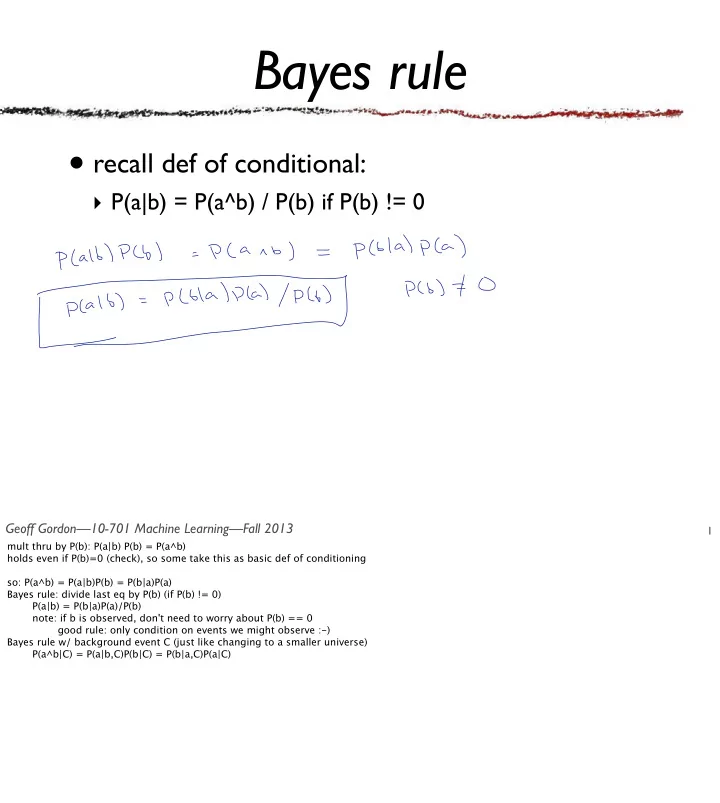
- recall def of conditional:
- P(a|b) = P(a^b) / P(b) if P(b) != 0
1
- mult thru by P(b): P(a|b) P(b) = P(a^b)
holds even if P(b)=0 (check), so some take this as basic def of conditioning so: P(a^b) = P(a|b)P(b) = P(b|a)P(a) Bayes rule: divide last eq by P(b) (if P(b) != 0) P(a|b) = P(b|a)P(a)/P(b) note: if b is observed, don't need to worry about P(b) == 0 good rule: only condition on events we might observe :-) Bayes rule w/ background event C (just like changing to a smaller universe) P(a^b|C) = P(a|b,C)P(b|C) = P(b|a,C)P(a|C)