Behavior: A Neurodevelopmental Perspective A video presentation from - - PDF document

behavior a neurodevelopmental perspective a video
SMART_READER_LITE
LIVE PREVIEW

Behavior: A Neurodevelopmental Perspective A video presentation from - - PDF document

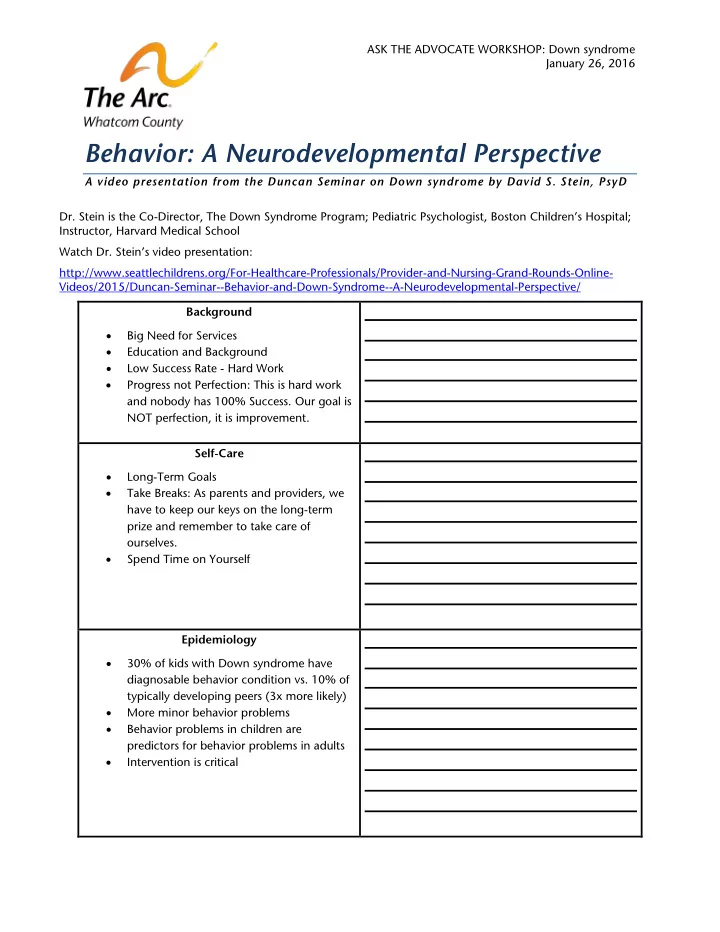
ASK THE ADVOCATE WORKSHOP: Down syndrome January 26, 2016 Behavior: A Neurodevelopmental Perspective A video presentation from the Duncan Seminar on Down syndrome by David S. Stein, PsyD Dr. Stein is the Co-Director, The Down Syndrome Program;


slide-1
SLIDE 1

ASK THE ADVOCATE WORKSHOP: Down syndrome January 26, 2016

Behavior: A Neurodevelopmental Perspective

A video presentation from the Duncan Seminar on Down syndrome by David S. Stein, PsyD

  • Dr. Stein is the Co-Director, The Down Syndrome Program; Pediatric Psychologist, Boston Children’s Hospital;

Instructor, Harvard Medical School Watch Dr. Stein’s video presentation: http://www.seattlechildrens.org/For-Healthcare-Professionals/Provider-and-Nursing-Grand-Rounds-Online- Videos/2015/Duncan-Seminar--Behavior-and-Down-Syndrome--A-Neurodevelopmental-Perspective/ Background

  • Big Need for Services
  • Education and Background
  • Low Success Rate - Hard Work
  • Progress not Perfection: This is hard work

and nobody has 100% Success. Our goal is NOT perfection, it is improvement. Self-Care

  • Long-Term Goals
  • Take Breaks: As parents and providers, we

have to keep our keys on the long-term prize and remember to take care of

  • urselves.
  • Spend Time on Yourself

Epidemiology

  • 30% of kids with Down syndrome have

diagnosable behavior condition vs. 10% of typically developing peers (3x more likely)

  • More minor behavior problems
  • Behavior problems in children are

predictors for behavior problems in adults

  • Intervention is critical
slide-2
SLIDE 2

ASK THE ADVOCATE WORKSHOP: Down syndrome January 26, 2016

Behavior: A Neurodevelopmental Perspective

A video presentation from the Duncan Seminar on Down syndrome by David S. Stein, PsyD Etiology: Why do children with Ds have behavior problems?

  • Brain Differences
  • Reduced Growth in Frontal Lobe
  • Smaller Brain Stem & Cerebellum
  • Problems in Temporal Lobe &

Hippocampus Brain Differences Consequences of Brain Differences in Ds

  • Social
  • Hyper-aware & hyper-engaged
  • Hyper-aware can also mean

hypersensitive

  • Language
  • Receptive vs. Expressive
  • Resulting Frustration
  • Information Processing & Memory
  • Strong Visual Learning
  • Storing and Understanding

Information

  • The world has expectations about

understanding/comprehension = scary!

  • Motivation
  • Lower Desire for Mastery
  • Gas in the Tank model
  • Great frustration can lead to avoidance
  • Executive Functioning
  • Impulsivity: may not see the stop signs
  • May struggle with planning behavior

and considering consequences Big Picture

  • Complex world = Perfect Storm for

Frustration and Behavior

  • If not well supported and understood
slide-3
SLIDE 3

ASK THE ADVOCATE WORKSHOP: Down syndrome January 26, 2016

Behavior: A Neurodevelopmental Perspective

A video presentation from the Duncan Seminar on Down syndrome by David S. Stein, PsyD What can we do about behavior problems? Relationship is key: When you don’t know what to do, consider what is best for your relationship Behavior Basics

  • Reinforce what you want to see more
  • Don’t reinforce what you want to go away.

Reinforcing Good Behavior

  • Use Attention
  • Notice Good Behavior and React
  • Praise Good Behavior
  • Simple Token Economy
  • Visuals, Repetition, Motivators,

Attention for Positive Behavior Functions of Behavior Purpose

  • ABCs of Behavior
  • Antecedent: What’s the situation?
  • Behavior: What are they doing?
  • Consequences: What happens

afterwards?

  • 2 Most Common Functions are Attention

and Avoidance/Escape

  • Lower Intrinsic Motivation = Escape
  • Hyper-Social + Reduced Impulse

Control = Attention Positive Behavior Support Strategies

  • Choices = control
  • Redirection
  • Providing positive feedback
  • Incentives or Providing the Carrot
  • First ____, then _____
  • Boost motivation throughout the day
slide-4
SLIDE 4

ASK THE ADVOCATE WORKSHOP: Down syndrome January 26, 2016

Behavior: A Neurodevelopmental Perspective

A video presentation from the Duncan Seminar on Down syndrome by David S. Stein, PsyD Attention Seeking Example

  • What is the Situation?
  • What is the Function of this behavior?
  • What is reinforcing this behavior?
  • What could be done differently?

Have you experienced a similar example? Planned Ignoring

  • 3 Basket Model
  • Basket 1 is safety concerns, something

must change

  • Basket 2 is frustrating for everyone,

something should change

  • Basket 3 is minor frustrations,

something could change, mostly ignore the behavior How do we remember these principles?

  • Mindfulness in stressful situations
  • Shut down your reactions
  • Reverting to old habits can be easy;

remember reaction influence immediate and future path

slide-5
SLIDE 5

ASK THE ADVOCATE WORKSHOP: Down syndrome January 26, 2016

Behavior: A Neurodevelopmental Perspective

A video presentation from the Duncan Seminar on Down syndrome by David S. Stein, PsyD Environment Strengths and Weaknesses Visual vs. Verbal Social vs. Impulse Control Routine and predictability vs. inconsistency

  • Routines, especially visual, promote

repetition and predictability

  • Visual takes pressure off of relationship
  • Visual Timers
  • Social Motivators
  • Social Stories
  • What to do in a given situation

Negatives include wordiness, inconsistency, and responses to negative behavior Discipline

  • Positive Behavior Supports > Punishment
  • Positive strategies are more effective!
  • Discipline may be Reinforcing negative

behavior

  • Reinforcement = adding
  • Discipline = taking things away

Adjust Situation by Removing Reinforcers

  • Vocal Communication (i.e. yelling)
  • Reasoning/language
  • Eye Contact
  • Facial Expression
  • “Social-Emotional Radar”

Respond but don’t react

  • Look at the Whole Picture (condition,

environment, etc.)

  • What can you remove?
  • Seek Help when Needed
  • Is there another condition that needs

treatment?

  • Is the environment causing problems?
slide-6
SLIDE 6

ASK THE ADVOCATE WORKSHOP: Down syndrome January 26, 2016

Behavior: A Neurodevelopmental Perspective

A video presentation from the Duncan Seminar on Down syndrome by David S. Stein, PsyD Support/Resources

  • Professionals
  • Schools
  • Community
  • Books

Review/Closing Thoughts

  • Think about Situation from Child’s point of

view

  • Focus on positives - and their strengths!
  • The goal is not perfection, it is

improvement: Remember Where you Started “The “endpoint” is not tomorrow or next

  • month. It is the individual with Ds having a

fulfilling adulthood and not being limited by behavior problems.” Q&A

  • Extinction Burst
  • Ignoring and Siblings
  • Peer Modeling/Influence
  • Insurance Coverage
  • Toddlers
  • Dual Diagnosis