Best treatment of Type 1A Endoleaks Prevention! Incidence varies in - - PDF document

best treatment of type 1a endoleaks
SMART_READER_LITE
LIVE PREVIEW

Best treatment of Type 1A Endoleaks Prevention! Incidence varies in - - PDF document

4/4/2019 Treatment of Type 1 Endoleaks: Open Conversion is the Best Option for Average Risk Patients Michael S. Conte MD Professor and Chief UCSF Division of Vascular and Endovascular Surgery UCSF Vascular Symposium April 4-5, 2019 1 Best


slide-1
SLIDE 1

4/4/2019 1 UCSF Vascular Symposium April 4-5, 2019

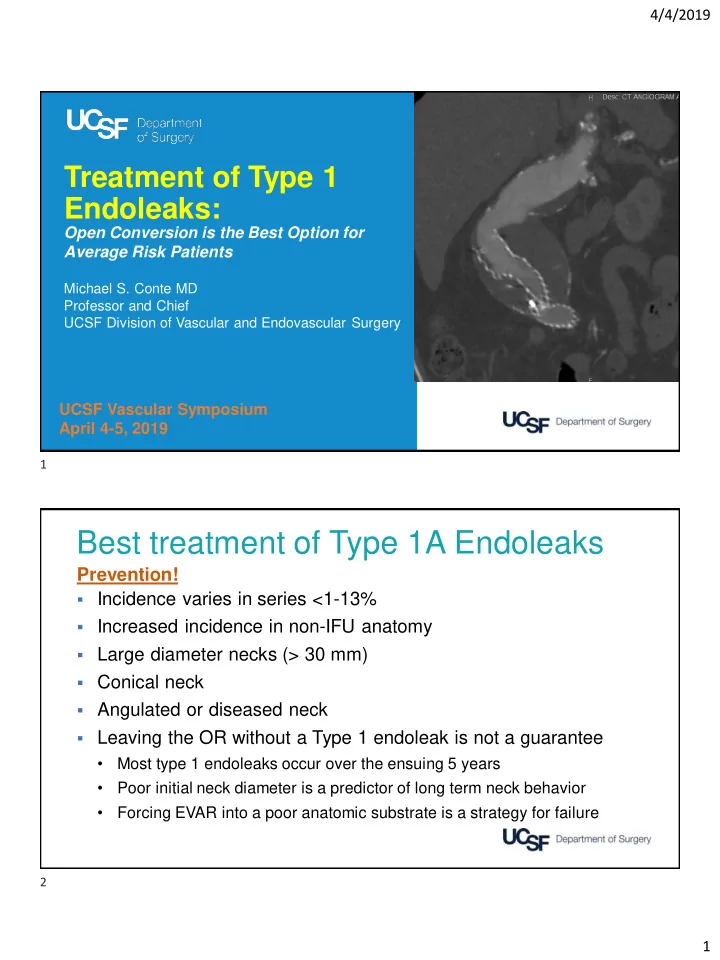
Treatment of Type 1 Endoleaks:

Open Conversion is the Best Option for Average Risk Patients

Michael S. Conte MD Professor and Chief UCSF Division of Vascular and Endovascular Surgery

Best treatment of Type 1A Endoleaks

Prevention!

▪ Incidence varies in series <1-13% ▪ Increased incidence in non-IFU anatomy ▪ Large diameter necks (> 30 mm) ▪ Conical neck ▪ Angulated or diseased neck ▪ Leaving the OR without a Type 1 endoleak is not a guarantee

  • Most type 1 endoleaks occur over the ensuing 5 years
  • Poor initial neck diameter is a predictor of long term neck behavior
  • Forcing EVAR into a poor anatomic substrate is a strategy for failure

1 2

slide-2
SLIDE 2

4/4/2019 2

J Vasc Surg 2019; 69(414-22) VQI >14,000 EVAR with 1-year imaging data Overall: 25% Sac Expansion JVIR 2018; 29:1011-16

3 4

slide-3
SLIDE 3

4/4/2019 3

Type 1A Endoleak Treatment Options

Endovascular

▪ Extension cuff/stent with or

without snorkels etc

▪ Endoanchors ▪ ZFEN conversion ▪ MBEG conversion

Open Repair

▪ Supra-renal or supra-celiac

clamping

▪ Trans-abdominal vs RP

approach

▪ Higher risk than initial

elective repair (4-27% 30 day mortality)

UCSF Center for Aortic Disease

  • 86 yo M, s/p EVAR 2010 for

5.6 cm AAA

  • Medtronic Talent 32 mm

main body

  • Enlarged to 8.2 cm 2016
  • Type 1A endoleak
  • Juxtarenal AAA
  • Former smoker, mild COPD
  • Active, high functioning

5 6

slide-4
SLIDE 4

4/4/2019 4

Open Conversion

UCSF Center for Aortic Disease

  • Transperitoneal exposure.
  • Proximal control supra-celiac, distal control of bilateral iliac limbs.
  • Explant main body, transect iliac limbs.
  • Proximal anastomosis at level of renals.
  • Distal anastomoses to bilateral iliac limbs.

Follow-up CTA

UCSF Center for Aortic Disease

Pre-conversion 2 years post-conversion

7 8

slide-5
SLIDE 5

4/4/2019 5 UCSF Center for Aortic Disease

  • 77 yo F, s/p EVAR 2013 for

5.7 cm AAA

  • Medtronic Talent 28 mm

main body

  • Enlarged to 8.2 cm 2016
  • Type 1A endoleak
  • Juxtarenal AAA
  • Former smoker, no CAD
  • Stage 3 CKD
  • Active, high functioning
  • Reintervention 10/2016 for

Type 1b leak (R iliac)

  • Coil Type 2 leak 6/2017

Open Conversion

UCSF Center for Aortic Disease

  • Retroperitoneal exposure with partial 11th rib resection.
  • Left kidney down due to retro-aortic left renal vein.
  • Proximal control between celiac and SMA, distal control b/l iliac limbs.
  • Explant main body, transect iliac limbs.
  • Proximal anastomosis at orifice of left renal (w/ limited endarterectomy).
  • Distal anastomoses to right graft limb and left external iliac.

9 10

slide-6
SLIDE 6

4/4/2019 6 UCSF Center for Aortic Disease

  • 71 yo M, s/p FEVAR 2015
  • 32 mm main body, SMA

scallop + 2 fenestrations

  • Type 1A endoleak in OR-

cuff

  • Coil placement adjacent to

LRA

  • Former smoker, no CAD
  • Active, high functioning
  • Sac increased to 6.1 cm

Open Conversion

UCSF Center for Aortic Disease

  • Transperitoneal exposure.
  • Proximal control supraceliac, distal control of bilateral common iliacs.
  • Transect stentgraft below left renal, transect iliac limbs.
  • 24 x 12 mm Dacron graft selected, 7 mm side branch created (for RRA)
  • Proximal anastomosis to level of left renal, incorporating prior stentgraft.
  • Bypass to right renal with pre-fashioned 7 mm limb.
  • Distal anastomoses to bilateral iliac limbs (left CIA, right EIA).

11 12

slide-7
SLIDE 7

4/4/2019 7

6 mo post-conversion CTA (video)

UCSF Center for Aortic Disease

30-day Mortality: 8.1% with graft explant; 3.6% no explant One year survival 87% 53% Type 1A endoleaks J Vasc Surg 2018 (ePub)

13 14

slide-8
SLIDE 8

4/4/2019 8

30 day mortality: 6.3% (3.8% for elective conversions) Increased iliac degeneration when limbs were removed J Vasc Surg 2019; 69(80-85) J Vasc Surg 2016; 63(873-81)

15 16

slide-9
SLIDE 9

4/4/2019 9

J Vasc Surg 2018; 68(1676-87) J Vasc Surg 2018; 68(1676-87)

17 18

slide-10
SLIDE 10

4/4/2019 10

Best treatment of Type 1A Endoleaks

Take Home Points

▪ Elective re-intervention is far safer ▪ Both open conversion and endovascular interventions needed

  • Average risk patients may be better served by open conversion earlier,

unless there is a high probability of success endo option in play

  • Open conversion, done electively, has marginally higher morbidity and

mortality compared to primary open repair in experienced hands

  • A poor quality neck is best repaired open
  • Multiple failed endovascular interventions increases surgical complexity,

and should be avoided in a surgical candidate- avoid the slippery slope

19 20