Type 1 Diabetes Type 1 Diabetes Environmental Insult in Children - - PDF document

type 1 diabetes type 1 diabetes
SMART_READER_LITE
LIVE PREVIEW

Type 1 Diabetes Type 1 Diabetes Environmental Insult in Children - - PDF document

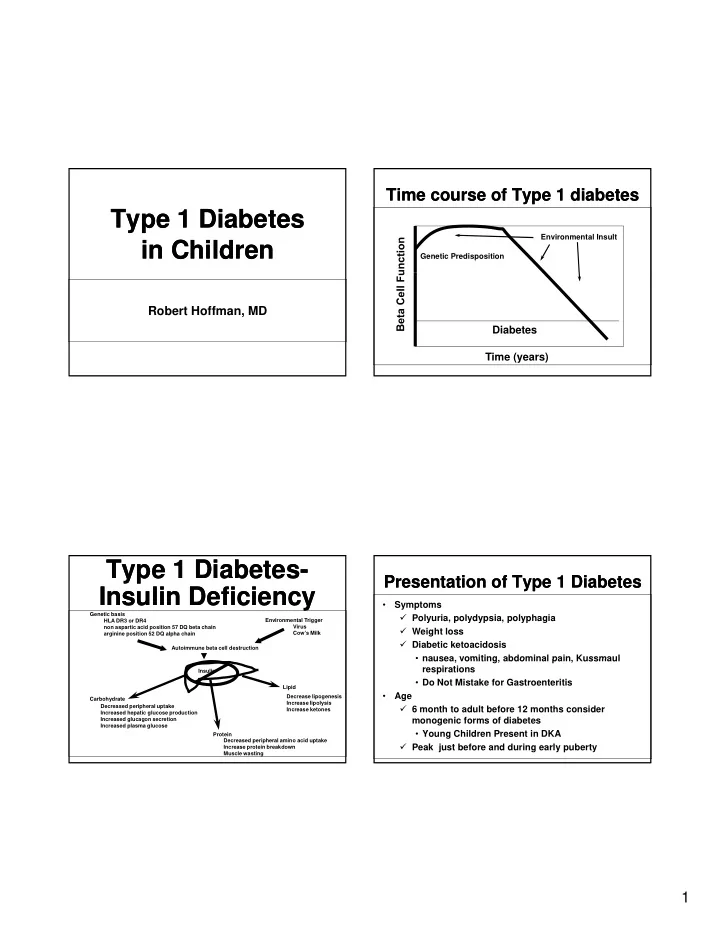
Time course of Type 1 diabetes Time course of Type 1 diabetes Type 1 Diabetes Type 1 Diabetes Environmental Insult in Children in Children Genetic Predisposition Robert Hoffman, MD Diabetes Time (years) Type 1 Diabetes- Type 1 Diabetes-


slide-1
SLIDE 1

1

Type 1 Diabetes in Children Type 1 Diabetes in Children

Robert Hoffman, MD

Type 1 Diabetes- Insulin Deficiency Type 1 Diabetes- Insulin Deficiency

Genetic basis HLA DR3 or DR4 non aspartic acid position 57 DQ beta chain arginine position 52 DQ alpha chain Environmental Trigger Virus Cow’s Milk Autoimmune beta cell destruction Insulin Carbohydrate Decreased peripheral uptake Increased hepatic glucose production Increased glucagon secretion Increased plasma glucose Protein Decreased peripheral amino acid uptake Increase protein breakdown Muscle wasting Lipid Decrease lipogenesis Increase lipolysis Increase ketones

Time course of Type 1 diabetes Time course of Type 1 diabetes

Genetic Predisposition Environmental Insult

Diabetes Time (years)

Presentation of Type 1 Diabetes Presentation of Type 1 Diabetes

  • Symptoms

Polyuria, polydypsia, polyphagia Weight loss Diabetic ketoacidosis

  • nausea vomiting abdominal pain Kussmaul

nausea, vomiting, abdominal pain, Kussmaul respirations

  • Do Not Mistake for Gastroenteritis
  • Age

6 month to adult before 12 months consider monogenic forms of diabetes

  • Young Children Present in DKA

Peak just before and during early puberty

slide-2
SLIDE 2

2

Diagnosis Diagnosis

  • Urine dipstick positive for glucose and

ketones

  • Plasma glucose >200 mg/dl at any time and

ketones

  • Fasting plasma glucose >126 mg/dl
  • Stress induced hyperglycemia is a rare

confounder

Usually no history of polyuria, polydypsia Usually no ketones

Goals of Diabetes Therapy Goals of Diabetes Therapy

  • Prevent Diabetic Ketoacidosis
  • Prevent Severe Hypoglycemia

yp g y

  • Maintain Normal Growth and Development
  • Prevent Long-Term Complications

How Does the DCCT Relate to Children? How Does the DCCT Relate to Children?

  • Are the risks of intensive diabetes therapy

t ? greater?

  • Will intensive diabetes therapy in childhood

reduce the risks of long term complications?

DCCT: Adolescents (13 to 18 years) versus Adults DCCT: Adolescents (13 to 18 years) versus Adults

Adolescent Adults Mean HbA1c(%) Intensive Conventional 8.06±0.13 9.76±0.12 7.12±0.03 9.02±0.05 Conventional Severe Hypoglycemia Rate (/100 pt-years) Relative Risk 85.7 2.93 56.9 3.30

slide-3
SLIDE 3

3

DCCT Retinopathy in Adolescents DCCT Retinopathy in Adolescents

DCCT Microalbuminuria in Adolescents DCCT Microalbuminuria in Adolescents

50 60 70 80 buminuria 10 20 30 40 50 2 4 6 8 10 Years Percent Microalb Conventional Intensive

Summary Summary

  • Adolescents in the DCCT had poorer glycemic

control than did adults regardless of treatment group

  • Intensive therapy was associated with improved

glycemic control in adolescents

  • Good glycemic control still prevents or delays the
  • nset of diabetic complications
  • Good glycemic control prolongs beta cell

function

Children less than 13 Children less than 13

  • Children with diabetes onset before age 5

have reduced neurocognitive test scores as adolescents.

  • This may be due to recurring

hypoglycemia.

  • The prepubertal years have less impact on

the development of diabetes complications.

slide-4
SLIDE 4

4

  • Adolescents

ADA target range 70-120 mg/dl before meals 100-150 at bedtime Raise target range if patient has hypoglycemic unawareness

Glucose Target Range Glucose Target Range

unawareness

  • Preschool children

Target range 100-180 mg/dl before meals and bedtime snack Highs preferable to lows

  • School-age children

Adjust goals downward as recognition of lows develops

Diet Diet

  • Goal Is Consistency, Not Calorie

Restriction

  • 60% Carbohydrate, 20%Fat, 20% Protein
  • Insulin to Carbohydrate Ratios
  • Insulin to Carbohydrate Ratios
  • Lispro, aspart, glulysine 1 unit per number of carbs
  • Insulin should be taken before meals if patient can predict how

much they are going to eat

  • Toddlers and sick days after meals

Exercise Exercise

  • HbA1c improves and insulin sensitivity

increase with improved physical fitness Competitive athletes with IDDM have

  • Competitive athletes with IDDM have

poorer control than sedentary patients

Fear of hypoglycemia and abnormal eating schedules

Arslanian et al. Diabetes Care 1990;13:9 Huttunen et al. Diabetes Care 1989;12:737 Marrero et al. Pediatr 1988:81:519 Eberling et al. Diabetes 1995;44:477

Monitoring Complications Monitoring Complications

  • Overt complications rare in children and

adolescents

  • Retinopathy
  • Dilated eye exam yearly after 5 years and puberty
  • Dilated eye exam yearly after 5 years and puberty
  • Nephropathy
  • Blood pressure second most important predictor
  • Microalbumin measurement same schedule as eye exam
  • Smoking worsens every complication
slide-5
SLIDE 5

5

What Goes Wrong? What Goes Wrong? What Goes Wrong? What Goes Wrong? Hypoglycemia Hypoglycemia

  • Why do low blood sugars happen

Inaccurate carbohydrate counting Failure to plan appropriately for exercise Failure to plan appropriately for exercise Inadequate glucose testing Alcohol Unexplained

Treatment of Hypoglycemia in IDDM Treatment of Hypoglycemia in IDDM

  • Test blood sugar
  • If low 15 - 20 grams of simple carbohydrate

wait 15 min

1/2 cup juice or pop ,3 glucose tabs, 4 sugar cubes

  • Incoherent at home use glucagon

<30 kg 0.5 mg >30 kg 1.0 mg

  • Hospital

25 % dextrose 2 ml/kg

Dawn and Somogyi Phenomena Dawn and Somogyi Phenomena

  • Dawn Phenomena

Increasing insulin resistance from 3 AM to 8AM N t l th h ti Nocturnal growth hormone secretion Normal sugar at 3 AM, high at 8 AM

  • Somogyi Phenomena

Rebound hyperglycemia following hypoglycemia Low sugar at 3 AM, high at 8 am Doesn’t exist Most Somogyi is overtreatment of lows or waning insulin

slide-6
SLIDE 6

6

Prevention of DKA Prevention of DKA

  • Test urine ketones

If glucose >250 mg/dl With vomiting or illness

  • Extra short acting insulin

Small or moderate ketones 10% of total daily insulin dose Large ketones 20% of total daily dose

Prevention of DKA Prevention of DKA

  • Sick days with ketones

Glucose > 200 mg/dl: sugar free clear liquids Glucose < 200 mg/dl: sugar containing Glucose < 200 mg/dl: sugar containing clear liquids Monitor glucose and ketones frequently

  • 3-4 emesis in a row without any retention

trip to ER

  • Have parent give injections

Type 1 Diabetes Type 1 Diabetes

  • Management requires a multidisciplinary team approach,

including a nurse educator, dietitian, social worker and/or psychologist, and a physician

  • The keys to good control are assuring adherence to

testing and insulin usage. This is usually best accomplished through assuring ongoing parental involvement

  • There is no magic insulin regimen but use of the newer

insulins lispro, aspart, and glargine are associated with better postprandial glucose control and less hypoglycemia

  • Insulin pumps are one tool that can be used in the

appropriate individual

Type 1 Diabetes in the Adult Type 1 Diabetes in the Adult

Kathleen Dungan MD

slide-7
SLIDE 7

7

Classification of Diabetes Classification of Diabetes

  • Type 1 diabetes

Autoimmune/Non-autoimmune Latent autoimmune diabetes of the adult (LADA) (LADA)

  • Type 2 diabetes

Ketosis prone type 2 diabetes

  • MODY (monogenic forms)
  • Secondary forms

ADA; Diabetes Care. 2010;33:S62-9.

Retinopathy

Metabolic Memory Metabolic Memory

Long Long-

  • term follow

term follow-

  • up of the DCCT

up of the DCCT

Diabetes Control and Complications Trial/Epidemiology of Diabetes Interventions and Complications (DCCT/EDIC) Research Group, Arch Intern Med 2009;169:1307-1316.

Nephropathy CV Disease

Post-Trial F/u of DCCT: Metabolic Memory Post-Trial F/u of DCCT: Metabolic Memory

  • Despite early loss of glycemic differences, a

continued reduction in microvascular risk and emergent risk reductions for myocardial infarction and all-cause mortality were y

  • bserved during 10 years post-trial follow-up.

“The Persistence of Memory”, Dali, 1931

Target Blood Glucose Ranges Target Blood Glucose Ranges

  • 1. American Diabetes Association (2009) Clinical Practice Recommendations
  • 2. American Association of Clinical Endocrinologists (2002)
slide-8
SLIDE 8

8

Insulin Preparations Onset of Action Peak Action Duration of Action BOLUS INSULIN Regular 30 minutes 2-4 hours 6-10 hours Lispro (Humalog) 5-15 minutes 1-2 hours 4-6 hours

Insulin Profiles Insulin Profiles

Lispro (Humalog) Aspart (Novolog) Glulisine (Apidra) 5 15 minutes 1 2 hours 4 6 hours BASAL INSULIN NPH 1-2 hours 4-8 hours 10-20 hours Glargine (Lantus) 1-2 hours Flat ~ 24 hours Detemir (Levemir) ? Flat ~ 24 hours

Mooradian, A. D. et. al. Ann Intern Med 2006;145:125-134

If all else fails… Think Like a Pancreas! If all else fails… Think Like a Pancreas!

Basal-Bolus Insulin: 3 Components

1) Basal: 50% of total daily needs

2) Prandial/nutritional: 50% of total daily needs 3) Supplemental (Correction)

Clement S et al. Diabetes Care. 2004;27:553-591.

Bolus

Basal Prandial Insulin Basal Prandial Insulin

  • Education is important!

Consistent carbohydrate diet Carb counting (particularly for erratic eating patterns)

  • Target pre-meal BG 90-130 mg/dL

Pattern Management Pattern Management

1) First ask about missed doses, extra carbs 2) Look for lows 3) Evaluate FBG 4) Pre-meal readings 5) If no pattern, get more data

slide-9
SLIDE 9

9 Indications for Advanced Therapies:

Pumps, Sensors, Pramlintide

Indications for Advanced Therapies:

Pumps, Sensors, Pramlintide

  • Motivated individuals
  • Realistic expectations
  • Using carbohydrate counting effectively
  • Willingness to check BG 4+ times per day

MN B MN B L L D HS D HS MN MN Normal Normal

How Does a Pump Mimic a Pancreas? How Does a Pump Mimic a Pancreas?

MN B MN B L L D HS D HS MN MN CSII CSII

Short Short-

  • acting

acting Analog Analog

Continuous Subcutaneous Insulin Infusion (CSII)

Advantages of Insulin Pumps Advantages of Insulin Pumps

  • Accuracy

Delivery of fractions of a unit Bolus calculator

  • Customization: throughout the day and

from day to day

  • Adaptability: suspend or set temporary

basal rates

  • Protections from insulin stacking

Steil Diabetologia 48:1833, 2005

slide-10
SLIDE 10

10

Cumulative Distribution of Glycated Hemoglobin Levels, According to Age

Real-time Continuous Glucose Monitoring Real-time Continuous Glucose Monitoring

The Juvenile Diabetes Research Foundation Continuous Glucose Monitoring Study Group. N Engl J Med 2008;359:1464-1476

  • Meter replacement—NO!!
  • Infusion controller—NO!!
  • Alarms
  • Retrospective Use
  • Concurrent Use: dynamic adjustment

y j

  • Prospective Use: trend arrows

Stomach Brain

Food Intake Gastric Emptying

Liver

Multihormonal Regulation of Glucose Multihormonal Regulation of Glucose

  • Insulin helps

regulate glucose disappearance

  • Plasma Glucose

Tissues Glucose Appearance Glucose disappearance GLP-1 Gut Glucagon Pancreas Insulin Amylin

  • Amylin helps

regulate glucose appearance

Model derived from animal studies Adapted from Edelman S, et al. Diabetes Technol Ther 2002; 4:175-189

  • Pramlintide

(Symlin)

Pramlintide

(Symlin)

  • Synthetic form of amylin
  • Reduces PPG (A1C reduction is modest)
  • Weight loss (increased satiety)
  • Administration
  • Before major meals (>30 grams of carbohydrate)
  • Start low dose and titrate to minimize nausea
  • Reduce mealtime insulin by 30-50%

Whitehouse et al. Diabetes Care 2002; 25:724. Ratner et al. Diabet Med 2004; 21:1204. Hollander et al. Diabetes Care 2003; 26:784. Ratner et al. Diabetes Technol Ther 2002; 4:51.

slide-11
SLIDE 11

11

Treatment of Hyperglycemia

Diabetes Diagnosis

T1DM: Treatment Throughout the T1DM: Treatment Throughout the Course of Disease Course of Disease

Prevention Prediction Slowing beta cell loss Prevention of complications Treatment of complications Beta cell replacement

Conclusions Conclusions

  • Therapy should be individualized to each

patient

  • If it doesn’t work think like a pancreas!
  • If it doesn t work, think like a pancreas!
  • Glucose monitoring is crucial for

adjustment of therapy