Type 1 Diabetes Cause and Effects of Type 1 Autoimmune destruction - - PowerPoint PPT Presentation

type 1 diabetes
SMART_READER_LITE
LIVE PREVIEW

Type 1 Diabetes Cause and Effects of Type 1 Autoimmune destruction - - PowerPoint PPT Presentation

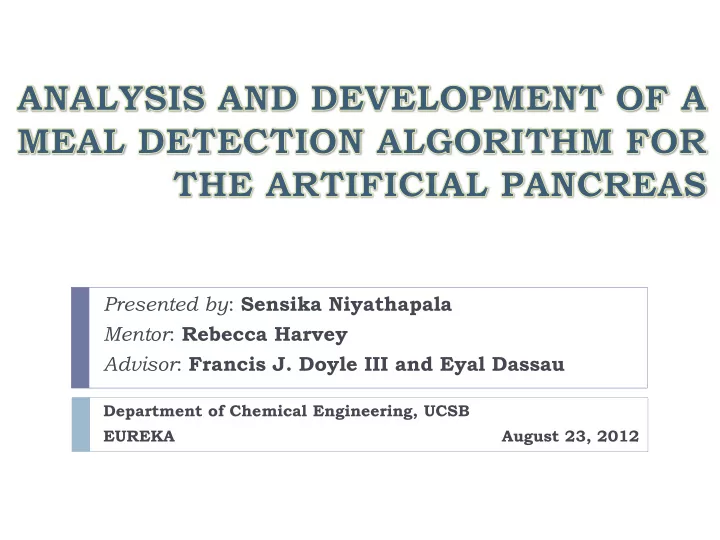
Presented by : Sensika Niyathapala Mentor : Rebecca Harvey Advisor : Francis J. Doyle III and Eyal Dassau Department of Chemical Engineering, UCSB EUREKA August 23, 2012 Type 1 Diabetes Cause and Effects of Type 1 Autoimmune destruction

slide-1
SLIDE 1

Presented by: Sensika Niyathapala Mentor: Rebecca Harvey Advisor: Francis J. Doyle III and Eyal Dassau

Department of Chemical Engineering, UCSB EUREKA August 23, 2012

slide-2
SLIDE 2

Type 1 Diabetes

 Cause and Effects of Type 1

 Autoimmune destruction of

pancreatic beta cells

 No control of blood glucose  Exogenous insulin required

2

http://www.southboromedical.com/images/fingerstick.jpg

 Current disease therapy

 Self monitoring  Multiple daily insulin injections

http://www.cumc.columbia.edu/news-room/wp- content/uploads/2012/04/image001.jpg

slide-3
SLIDE 3

Future of Disease Therapy: Artificial Pancreas

3

slide-4
SLIDE 4

Effect of a Meal on Glucose

4

slide-5
SLIDE 5

Project Goals

5

 Implementing basic meal detection algorithm  Establish metrics that represent desired qualities

 Alarms faster than current controller response  Very few false alarms  True positive alarms

slide-6
SLIDE 6

Data from Clinical Trials (12 subjects)

6

 Breakfast and dinner given with NO meal

announcement

slide-7
SLIDE 7

Algorithm and System Alarming

7

 Slope predicted at each point

 Threshold  Max and min slope

 Algorithm Parameters

 Subsequent Alarms Required

(SAR)

Start of Insulin Response

slide-8
SLIDE 8

Hypotheses

8

 Hypothesis 1: with SAR 1, the reaction time for

detecting a meal will be the fastest, however there will be more false positive alarms

 Hypothesis 2: by using SAR 3, we anticipate a

longer reaction time with a greater number of false negative alarms, but less false positive alarms present

slide-9
SLIDE 9

10 20 30 40 50 60 70 80 90 100 1 2 3 4 5 6 7 8 9 10 11 12 13 14 15 16 17 18 19 20 21 22 23 24 Time From Meal To Alarm (min) Meal Number From meal To alarm 1 From meal To alarm 2

From meal to alarm 3

Undetected Meals

Faster Response

Determining the Best Parameter Settings: SAR

9

slide-10
SLIDE 10

Results: The Better Detector

10

Number of Alarms Required 1 2 3 True Positive Ratio 21/24 21/24 19/24 # of False Positives 1/24 1/24 1/24

Average Time Difference from Alarm to Insulin Delivery

  • 11 ± 1 min
  • 6 ±17 min

3 ± 14 min

slide-11
SLIDE 11

Conclusions & Future Work

11

 Hypothesis 1 unconfirmed: SAR 1 should have

had more false positive alarms

 Hypothesis 2 confirmed: SAR 3 had more false

negative alarms

 Future Work: Using the basic algorithm as a

benchmark for an advanced system

slide-12
SLIDE 12

Acknowledgements

12

slide-13
SLIDE 13

Questions?

13