SLIDE 1
Biofuels, Ancestral Time, and the Destruction of Borneo Michael Northcott University of Edinburgh
SLIDE 2 European Commission Renewable Energy Directive (ECRED) says 10%
- f liquid fuels in EU must be composed of plant-derived fuels by 2020.
This is to meet EU’s treaty obligations under Kyoto Protocol and Paris Accord to reduce EU nations’ domestic greenhouse gas emissions
SLIDE 3
ECRED claims that biofuels and bioliquids ‘help guarantee real carbon savings and protect biodiversity.’ But biofuels market leads directly and indirectly to land use conversion, including from tropical forests to oil palm, soya, corn.
SLIDE 4
Madhu Khanna1, Christine L. Crago and Mairi Black (2011) Can biofuels be a solution to climate change? The implications of land use change-related emissions for policy, Interface Focus 1, 233-47.
SLIDE 5
SLIDE 6
SLIDE 7
SLIDE 8
SLIDE 9
SLIDE 10
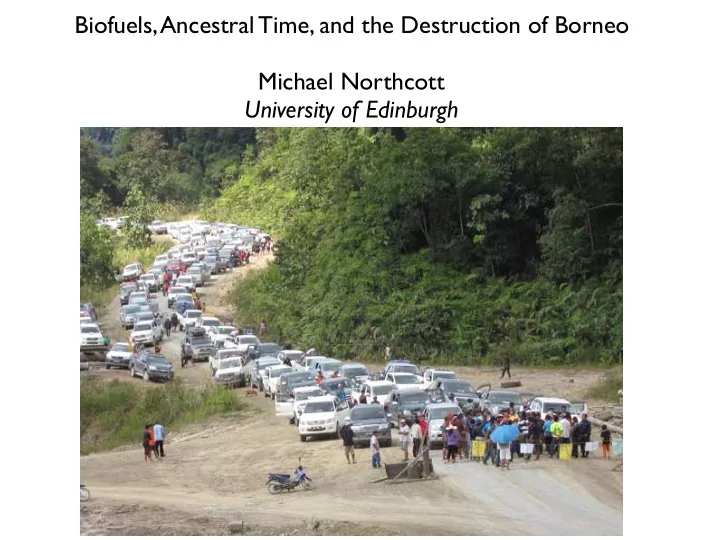
The forests of Borneo are being destroyed, their rich biodiversity and human cultures eroded, and the stored greenhouse gases in their biomass and soils released to atmosphere, for short term profit from global, including EU, primary resource markets for tropical timber & tropical plantation products including EC mandated biofuels.
SLIDE 11 Bill Kayong, assistant to a Sarawak MP , defending a longhouse community from an oil palm company, was killed in Miri by three men
- inc. an oil palm employee June 21 2016.
“he was defending the rights of Sungai Bekelit, rather than nature. But after his death, Sarawak’s environmentalists joined land-rights campaigners to voice their outrage. Environmentalists see longhouse communities and their defenders as the last hope for the state’s dwindling forests, as loggers complete their destruction and trees are replaced by oil palm, one of the world’s most ubiquitous – and profitable – plantation crops.” “In the last few years, we have seen a spate of killings [of activists] throughout Sarawak, with the same modus operandi: drive-by shooting by criminals,” a group of local environmental activists headed by Peter Kallang of the Save Sarawak Rivers Network said in a joint statement. The group blamed the deaths on “companies that employ thugs in the guise of security personnel to look after the plantation estates.” (F Pearce, Guardian, 14 March 2017)
SLIDE 12 In the long houses many traditional practices continue including cooking and eating communally, fishing, swidden farming of wild rice, fruit trees etc as supplement to gathering, hunting and fishing. Evelyn Hong (1987), Natives of Sarawak
But land rights of longhouses not recognised by State government
Minister Moham’d Taib grew a property empire
timber and oil palm plantation concessions and licenses and from family and crony timber and oil palm businesses
SLIDE 13
On a field visit I made in 1987 a flying doctor told me she was visiting tribal communities in the highland interior, many miles from river-banks, who were suffering from malnutrition because the fish, mammals and plants they used to live off were no longer available to their parents to hunt and gather. The fish in the rivers had died as the quantity of soil displaced by logging activities had filled the rivers with silt, depriving the fish of oxygen. The mammals and plants the communities had once hunted and gathered, as had their ancestors for thousands of years, were either killed or destroyed by the clear-cutting practices of the logging companies, and the terracing and draining of land for oil palm.
SLIDE 14
SLIDE 15
The EU Directive (2009/30/EC) mandates the use of biofuels in order to help the European Community ‘meet its greenhouse gas reduction goals through the decarbonisation of transport fuel’ and to reduce ‘lifecycle cycle greenhouse gas emissions’ from the fuel and energy supply of European vehicles. It acknowledges that ‘the incentives provided for in this Directive will encourage increased production of biofuels worldwide’, but it argues that ‘increasing worldwide demand for biofuels, and the incentives for their use provided for in this Directive should not have the effect of encouraging the destruction of biodiverse lands’. Biofuel provision must be subject to ‘sustainability criteria’ and biofuels must ‘not originate in biodiverse areas’ or ‘threatened or endangered ecosystems or species’ and ‘primary forest’ should not be used to grow biofuels.
SLIDE 16
ECRED (2009) led to a fivefold increase in the marketing of palm oil as biodiesel according to trade data (Transport and the Environment, 2016). Palm oil is the largest single plant source of European biodiesel ECRED incentivises companies and national agencies to grow more biofuel, and to continue to convert land areas to more production of crops with the potential to feed demand for biofuels, including forests and grasslands. The Commission argue that since primary forests are gazetted worldwide by government agencies that it will be possible to prevent the marketing of biofuels from land converted from primary forests. There is no mechanism or certification scheme to ensure that biofuels, which are liquids refined mostly in the country of origin and shipped thousands of miles to European ports in oil tankers, do not originate from lands that were formerly primary forests.
SLIDE 17
The origins of so much biodiesel from former primary tropical forests and the claim plants in biodiesel make it cleaner is a scandalous form of greenwash promulgated by the EC / EU It is made even more egregious when added to the vast amount of evidence that Volkswagen, and EU vehicle regulators, worked together to reduce the laboratory emissions of diesel engines reported in vehicle technical reports and VW went even further and installed software to fool real world vehicles when being tested for annual vehicle inspection and emissions compliance Diesel kills 10,000s of Europeans prematurely and it kills forests and forests peoples and forests creatures And yet it is still being promoted by the EC, and by European vehicle manufactures who can still legally sell diesel cars to consumers despite the evidence diesel kills As a cyclist I frequently have to hold my breath when I am among vehicles pouring this toxic stuff into my air
SLIDE 18
SLIDE 19
Singapore Government forest fires monitoring map July 2013 Singapore is however a tax haven and many Indonesian and Malaysian oil palm and timber companies site their HQs in Singapore The Singapore stock exchange therefore trades in substantial stocks in timber and oil palm companies implicated in the fires
SLIDE 20
The European Commission published a revision in 2015 requiring that companies wanting their biofuels to become part of the EU liquid fuels mix should sign up to ‘legal or voluntary schemes’ to ensure their products are not from recently cleared forests (EC 2015). In the case of oil palm the only internationally recognised scheme for ensuring oil palm is not produced from land converted from primary forests is the Roundtable on Sustainable Palm Oil (RSPO) In the 2013 burning season scientists used satellite data which traced many of the fires in the region to areas of land contiguous to oil palm plantations producing RSPO certified oil palm The worst starter of fires was Sime Derby, the largest and mainly government owned oil palm company in Malaysia https://www.rspo.org/file/haze/MAP%20ANALYSIS- KLK,GAR,SIMEDARBY_FINAL10july.pdf
SLIDE 21
There is growing recognition that the European Biofuels Directive, far from reducing greenhouse gas emissions in Europe’s vehicular fleet, has increased them because it has promoted tropical forest clearing and replacement with oil palm plantations. Advocacy from NGOs such as Oxfam and Greenpeace, and related scientific studies (Pesqueira and Glasbergen 2013), led to a debate in the European Parliament in which MEPs passed a motion in 2017 calling on the European Commission to remove all vegetable oils including palm oil from European biofuels by 2020, but the Commission has not responded (EU Parliament 2017). If it does Malaysia and Indonesia said that they would raise a trade dispute with the European Union through the WTO
SLIDE 22 The conversion of so much of Borneo from primary forest to oil palm has
- ccasioned an ecological disaster on an unprecedented scale.
Behind this disaster there is systemic political corruption, extensive criminal activity, and destruction of the habitats of native peoples and wildlife. In Sarawak the people most affected by the destruction of their forests are the nomadic Penan people. Though under Malaysian adat they ought to be considered owners of the forests of Sarawak, since they have lived in them for generations, this customary ownership has not been recognised by the Sarawakian government. Instead the Sarawak State Government, under its Chief Minister Abdul Taib Muhamad, appointed itself the ‘trustee' of the forests of native peoples for sixty years Taib has grown a $15 billion US property empire from timber concessions and
- il palm plantation investments as traced by Straumann, (2014) Money Logging
SLIDE 23
SLIDE 24
The destruction of the forests led to extensive protests and resistance by Penan and other native groups including logging blockades, and claims launched in Malaysian courts to recognise native land rights based upon extensive mapping projects undertaken by the Iban and Penan with help from the Swiss Art for Rainforests Foundation and the Bruno Manser Fund. Manser was a Swiss adventurer who lived extensively with the Penan in the 1990s and campaigned on their behalf internationally though the Sarawakian government then outlawed land surveying and mapping other than by government surveyors (Straumann 2014 167). Manser, as well as Penan, Iban and Dayak headmen who have taken up land claims in the courts or led logging road blockades have been threatened and some killed by oil palm plantation employees.
SLIDE 25
SLIDE 26 The Chief Minister of Sarawak, Taib Mahmud, appointed his own Land Custody and Development Authority (LCDA) to act as the so-called ‘Trustee’ on behalf
- f the native land owners when negotiating with concession holders.
SLIDE 27
The interaction between criminality and corruption, primary forest exploitation and wealth accumulation is facilitated through international financial agencies and technologies (Tsing 2005). Deutsche Bank, Goldman Sachs and other international agencies provide Taib and his family enterprises with international investment capital to grow their businesses further, and the financial means to move funds around. Deutsche Bank raised Taib and his businesses over $700 million in investment capital in the form of bond issues and loans to fund the continued expansion of his family’s, and cronies’, tropical logging and land conversion activities (Straumann 2014 192-3). International capital also provides the means to launder the ill gotten gains of crony capitalism into internationally recognised wealth of the kind that means the FBI rents a building in Seattle from the Chief Minister’s family company.
SLIDE 28 In addition to finance legitimating biofuels on deforested land, science is used to promote biofuels as response to climate change, and hence provides capital opportunities for primary forest conversion to biofuels Under the UNFCCC nations agree to produce inventories of national greenhouse gas emissions from their territories. These inventories are sites of mediation and manoeuvring by national governments in pursuit of their national interests. So the Malaysian government in its inventory considers oil palm plantations as ‘forest’, thus reducing the emissions attributable to the drying out
- f soils which the drainage of tropical forest land requires for the
production of palm oil. In Sarawak official statistics in 2010 indicated that 64% of the land area was forest but this is a significant over-estimate. (Hon and Shibata 2013).
SLIDE 29
Conventional scientific narrative of climate change causes focuses on emissions from coal, gas and oil use as prinicipal climate forcer. European Commission uses greenhouse accounting modes of representation which make it seem as though ‘youthful’ biofuel from photosynthesis on present-day plants, , though grown on ancestral forest lands, has a lower climate impact than the ‘old’ photosynthesis on ancient plants and shell fish represented by fossil fuels. EC assumes national inventories of primary forests are diligently kept by governments to prevent their destruction, whereas in Sarawak, Kalimantan and Sumatra inventories are viewed as a license to exploit and a sources of capital.
SLIDE 30
Science justifies the new uses to which the land is put as ‘climate friendly’ and in particular the production of biofuels. Governments of Malaysia and Indonesia, and plantation companies, use science in their modes of representation of the ghgs embedded in their biodiesel which omit emissions from land use change, fires, and drainage The mode of representation of ghgs in biofuels use science in their accounting but significantly under-estimate the climate forcing impact of biofuels because they leave out greenhouse gas emissions from land use change. Climate forcing from biofuels is 50-100% higher than Saudi crude oil But when the customer buys diesel at a European gas station, she is assured, because it contains plants, it is more ‘climate friendly’
SLIDE 31
Juxtaposed against crony and international capital, and science- informed accounts of biofuels ghgs and climate science are the traditions, customs and beliefs of scientifically uninformed native peoples whose ancestral forests are being destroyed to grow the young plants needed for increased global production of biofuels. The shared assumption among Malaysian politicians and scientific forestry is that indigenous people are not good guardians or managers of forests. However in Sarawak the only areas that have been saved from the destruction outside of the gazetted boundaries of National Parks, which constitute only 6.6% of the forested area of Sarawak (Hon and Shibato 2013), are areas protected from deforestation by the non- violent logging and oil palm resistance activities of the Penan.
SLIDE 32
SLIDE 33
SLIDE 34
SLIDE 35
SLIDE 36
SLIDE 37 Baram villagers looking forward to start conservation project
July 13, 2016, Wednesday
‘Ulu Baram is proposed for conservation as primary jungle covering an area of 1,633 sq km and the area will be jointly maintained and managed by communities living in the area with the support of the state government.’ ‘The area involved is one of the very few primary forests left in the interior of Baram. It is located adjacent or close to a number of national parks – the Pulung Tau National Park, Batu Lawi National Park in Sarawak, and Kayan Mentarang National Park in Kalimantan, Indonesia.’ Borneo Post, July 13 2016
SLIDE 38 The example of the Penan highlights a broader problem with what Agrawal calls ‘environmentality’ which is the tendency of environmental, atmospheric and species conservation science and agreements to be used to impose governance regimes on peoples, creatures and habitats in which agency is denied to the ancestral dwellers of such habitats both human and nonhuman (Agrawal 2005). The limited success of the Penan in resisting their ancestral forests being logged and then turned into biofuel plantations is an example
- f why Courtney Jung calls the ‘moral force of indigenous
politics’ (Jung 2008). By resisting a postcolonial regime the Penan became subjects against the consensus in West and East Malaysia that nomadic indigenous peoples, are primitives who only acquire rights when they come out
- f the forests and live like normal modern ‘citizens’ in permanent
long houses, or government cinder block and tin huts on town edges
SLIDE 39
Bruno Latour argues that the modern environmental science lacks sufficient purchase on the public sphere because it has not found ways to include creatures voices in public assemblies and courts (Latour 2004). But the Penan are not ‘environmentalists’, or agents of environmental science. They resist environmental science because it colludes with crony capitalism in displacing them from their ancestral lands for the growing of biofuels to act as a fig leaf for Europeans. The Penan’s is an ‘environmentalism of the poor (Martinez-Alier 2003) In The Environment and Christian Ethics (Northcott 1996) I argued on basis of my experiences in Borneo that recognition of land as divine gift to humans in Hebrew Bible involves the idea of ‘environmental justice’ In Laudato SI’ Pope Francis argues the environmental crisis is a crisis first and foremost for indigenous people, as well as creatures, and legal recognition of their role as guardians of habitats and creatures is a stronger basis for change than traditional environmental focus on trees, orang utans or pandas
SLIDE 40 In his study of the Tsembaga people
Rappaport argued that indigenous peoples, their customs and religious rituals, are the best guardians and keepers of ecosystems, forests, savannah and water catchments (Rappaport 1968). Rappaport gathered data from his field study of an annual pig sacrificial ceremony which he found demonstrated that the annual ritual sacrifice functioned in such a way as to limit the number of pigs kept by the group of 200 people whom he studied within the carrying capacity
SLIDE 41
The role of religion is to mediate between what is made and what is not made so as to facilitate adaptation of human making, including the making of meaning, and natural laws and the ‘unmade’ (Rappaport 1999). When religion fails, or becomes pathological, and where ecosystems collapse because of overuse or misuse, this is because of a failure of adaptation. In Rappaport’s terms the adoption of biofuels as a response to climate change is a post-religious pathology to support the religion of consumerism. It is part of the larger tendency of science and technologies in late modernity to fashion meanings and symbol systems which come to displace the prehistoric and historic role of religions in mediating between the known and the unknown, the made and the mysterious (Noble 1999).
SLIDE 42 Alfred Russell Wallace formulated what has become known as ‘the Sarawak Law’ since it was his first published formulation of a theory of the long evolution of life on earth, and of the means of variation and distribution which drew a great deal from his observations in Sarawak. He summarises his theory as follows: ‘Every species has come into existence coincident both in space and time with a pre–existing closely allied species.’ (Wallace 1855) Wallace’s law however left out the influence of Homo sapiens on the process
- f the evolution and distribution of species.
Like John Muir when he went to Yosemite, and the Amazon, Wallace preferred explanations of what he saw in the field that did not include persons, particularly when those other persons are non-Europeans lacking scientific education. Homo sapiens dwelt in Borneo for14,000 years before Wallace got there and the shape of the rainforest and the distribution of species within it was in part due to human influence. Analogously when indigenous peoples lose influence over Borneo’s forests and ecosystems it is unsurprising that their loss of influence coincides with the threat of extinction of many of Borneo’s species and their replacement with one alien species - Elaeis guineensis - from the forests of West Africa.
SLIDE 43
Robin Hanbury-Tenison led the 1977-8 Royal Geographical Society Expedition into Mulu in North Sarawak and was the first European to find the cathedral like cave, and cave system, in the Mulu upland forest. That discovery, along with the many endemic species the expedition identified, led to the gazetting of the area as Gunung Mulu National Park. Robin was befriend by a Penan family and he came to realise on his expedition and with his deep engagement with the Penan that ‘the key reason there is so much biodiversity’ in Sarawak and it is this ‘which makes the forests so valuable and worth turning into a park is the there have bene people looking after it in a symbiotic relationship for ages. And what is more, as we were increasingly to learn on our expedition, their knowledge and understanding of it far exceeded our own superficial scientific analysis’ (Hanbury-Tenison 2017, 64).
SLIDE 44
ECRED reveals an ontological misunderstanding of persons and other beings in time which puts short-term accumulation of economic value above longer-term values such as ecosystem resilience, biodiversity, and long-evolved human traditions including the ancestral guardianship of creatures and ecosystems. The short- and medium-term temporalities of global climate governance, combined with the short-term utilitarian cost benefit calculus of financialised capitalism, have combined in the recent past and present to supplant longer- term temporalities which have evolved over thousands of years, and which traditionally governed the viability of tropical ecosystems and the ways of life that humans and other animals have developed to dwell in them sustainably. The Penan and other indigenous peoples live by a temporality that I call ‘ancestral time’. They govern their lands and raise their children and guard their fellow creatures as their ancestors have done for millennia. They do this from present-day photosynthesis since the materials they use to build their homes, to clothe, entertain and nourish themselves are derived from their local forests. Hence paradoxically their 'ancestral time’ also promotes a ‘presentist temporality’ in relation to energy production and use (Northcott 2018).
SLIDE 45
At the heart of the climate change conundrum is the way in which science and technology have enabled coal, gas and oil engineers to take the earth’s carbon cycle to a deep time state of parts per million of CO2 in the atmosphere that it has not been in the 200,000 year history of Homo sapiens by burning buried sunlight in the present-day atmosphere. But attempts to fix this error with biofuels reveal a misunderstanding of the temporal nature of the climate problem and of energy production, marketing and use, and a disconnection between present uses of energy and future planetary states (Shirani, Butler et al 2013). That misunderstanding is resulting in the ongoing destruction of tropical forests to fit UNFCCC mandated national terrain-based net- present greenhouse gas emission accounting mechanisms. Governments which turn to biofuels as means to reduce their net- greenhouse gas emissions need urgently to end the biofuels error and instead invest in ways to reduce per capita energy use in the present and near future with present-day energy from the sun, wind, water flow, and hot rocks generated justly and ethically from within their own domains (Northcott 2007).
SLIDE 46