SLIDE 1
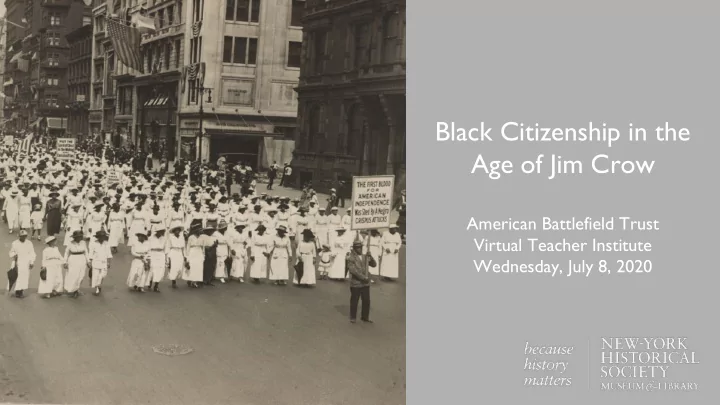
Black Citizenship in the Age of Jim Crow
American Battlefield Trust Virtual Teacher Institute Wednesday, July 8, 2020
SLIDE 2
SLIDE 3
◼ The New-York Historical Society organizes and presents an extensive range of school
programs, teacher resources, and adult and child workshops.
Education @ the New-York Historical Society
SLIDE 4 HISTORY @ HOME
In order to continue to serve our learning community, New-York Historical is providing the following FREE resources:
- Daily online sessions for students
- Weekly civics-based lesson plans for teachers
and parents
- Weekly online teacher PD
- Weekly History Happy Hour
- Continued access to online curriculum and
digital resources
nyhistory.org/education/history-home
SLIDE 5
Curriculum Library nyhistory.org/curriculum-library
SLIDE 6
SLIDE 7 SETTING GROUP NORMS
- “One Person, One Mic”
- Be respectful of each other’s feelings, and our own, and to be respectful of all background,
identities, abilities, and perspectives when speaking.
- Recognize our own and others’ privilege.
- Speak from your own experience and express your personal response.
- Honor confidentiality.
- Ask clarifying and open-ended questions.
- Try to listen without judgement.
- Agree to disagree, but don’t disengage.
- “Step up and step back.”
- Suspend status.
- Criticizing others must always occur in a careful, respectful, and constructive manner.
- Honor silence and time for reflection.
- If anything uncomfortable occurs in your breakout group discussions, alert the facilitator or
co-host.
SLIDE 8
September 7, 2018 – March 3, 2019
SLIDE 9 3 Dynamic Units
1865-1877
1877-1900
1900-1919
24 Primary Resources
- Paintings
- Photographs
- Documents
- Political Cartoons
- Timelines
- And more!
6 Life Stories
well-known and lesser-known individuals
SLIDE 10 ESSENTIAL QUESTIONS
- How and why did African Americans’ citizenship rights
expand and contract in the decades after the end of the Civil War?
- What methods did Americans use to advocate for
themselves and what impact did they have?
- What lessons might our students draw from this history?
SLIDE 11 How do you teach your students about Black citizenship during Reconstruction? How do you teach them about the post-Reconstruction Black experience?
Thomas Waterman Wood (American, Montpelier, Vermont 1823-1903 New York), A Bit of War History: The Contraband; The Recruit; The Veteran 1865. Oil on canvas. The Metropolitan Museum of Art, Gift of Charles Stewart Smith, 1884
SLIDE 12 “I have had but one idea for the last three years to present to the American people, and the phraseology in which I clothe it is the old abolition phraseology. I am for the ‘immediate, unconditional, and universal’ enfranchisement of the black man, in every State in the Union. Without this, his liberty is a
- mockery. . . . He is at the mercy
- f the mob, and has no means of
protecting himself.”
–Frederick Douglass, “What the Black Man Wants,” January 26, 1865, Annual Meeting of the Massachusetts Anti-Slavery Society
Frederick Douglass carte de visite, late 19th century. New-York Historical Society Library
SLIDE 13 What is Douglass arguing for? How is his choice of language significant? According to Douglass, why is the right to vote so fundamental?
“I have had but one idea for the last three years to present to the American people, and the phraseology in which I clothe it is the old abolition phraseology. I am for the ‘immediate, unconditional, and universal’ enfranchisement of the black man, in every State in the Union. Without this, his liberty is a
- mockery. . . . He is at the mercy
- f the mob, and has no means of
protecting himself.”
–Frederick Douglass, “What the Black Man Wants,” January 26, 1865, Annual Meeting of the Massachusetts Anti-Slavery Society
SLIDE 14
Observations What do you see? Interpretations What do those details tell you about this source? Inferences What does the image teach you about the topic?
SLIDE 15 Black Citizenship in the Age of Jim Crow: Life Stories
*Breakout Groups: Choose one life story to read and analyze using the discussion questions.
Laura Towne
Educating the newly freed
Ida B. Wells
Leading the charge against lynching
Janet Randolph
Memorializing the Lost Cause
Maggie Walker
Creating community in the face of Jim Crow
SLIDE 16
Reconstruction and Jim Crow shape this woman’s life?
- 3. What role did she play in
advancing and/or suppressing Black rights?
advance and contract over her lifetime? What impact did these changes have on her?
- 4. How can her story provide
students with a deeper understanding of the history of Black citizenship?
Breakout Groups Life Story Discussion Questions
SLIDE 17 Laura Towne (1825-1901)
- Laura Towne arrived on St. Helena Island, South Carolina in 1862 and
started the Penn School. Today, it is the Penn Center, a cultural and educational center on the island.
- When Laura arrived, she was part of a group of Northern missionaries
who volunteered to start schools and hospitals and to help the formerly enslaved buy and run cotton plantations. The project was known as the Port Royal Experiment.
- She was one the of few white teachers at the school. Under her
leadership, high school classes were added, the school followed the curriculum for northern white schools, and she trained teachers.
- St. Helena is one of the largest of the Sea Islands of South Carolina,
Georgia, and northern Florida. Before the Civil War, the population was mostly enslaved. Partly because of their isolation, Black Sea Islanders were able to preserve much of their African heritage and developed a distinctive language and culture known as Gullah.
- The percentage of Black landowners on St. Helena during Reconstruction
was 75%.
- Laura lived on St. Helena Island for the rest of her life. After her death, her
diaries and letters were published in a book.
Laura Towne teaching students at the Penn School, 1866. Penn School Papers, Southern Historical Collection, Wilson Library, University
- f North Carolina at Chapel Hill
SLIDE 18 Ida B. Wells-Barnett (1862-1931)
- Ida B. Wells was born during the Civil War in Holly Springs, Mississippi, and
grew up there in the two decades after the war.
- In 1881, she and her two youngest sisters moved to Memphis, where Ida
worked as a schoolteacher.
- Ida spoke out against anti-Black discrimination. She resisted removal from an
all-white ladies’ railcar. She lost her teaching job for publicly criticizing the conditions in Black schools in Memphis.
- She then became a full-time journalist and, eventually, co-owner and editor of
the Memphis Free Speech and Headlight.
- A white mob lynched her friend Thomas Moss in 1892 because his business
success was threatening to whites. From then on, she dedicated her career and her life to raising awareness of and ending lynching in the U.S.
- When a white mob burned her offices after she published a series of
anti-lynching editorials, Ida had to flee to the North, ultimately settling in
- Chicago. She continued to publish articles and pamphlets against lynching and
began writing in support of women’s suffrage, and Black women’s suffrage in particular.
- A bill to make lynching a federal crime came before Congress in 1922, which Ida
supported for the rest of her life. The bill passed the House of Representatives in 2019. It is currently stalled in the Senate.
Cihak and Zima, Ida B. Wells-Barnett, ca. 1893-1894. University of Chicago Library, Special Collections Research Center.
SLIDE 19 Janet Randolph (1848-1927)
- Janet Randolph grew up in northern Virginia. Her father fought in the
Confederate Army, dying of typhoid fever. She was 17 when the war ended and was devastated the South lost.
- She married a Confederate veteran in 1880 and they moved to
Richmond, the former capital of the Confederacy and a center of the emerging Lost Cause mythology of the war.
- Janet started the Richmond chapter of the United Daughters of the
Confederacy (UDC) in 1896 and served as its president until her death.
- She and the UDC supported and fundraised for the construction of
Confederate monuments in the city. She played a lead role in ensuring the creation of a memorial to Jefferson Davis, which celebrated him as a defender of states’ rights and did not mention slavery.
- Janet participated in relief efforts for African Americans in Richmond,
including working with Maggie Walker.
- She did not, however, support creating monuments to Black
- Americans. Nor did she seem to believe in African Americans’
constitutional rights, which were systematically denied to them for many decades under Jim Crow laws.
“Mrs. Norman V. Randolph,” A Souvenir Book of the Jefferson Davis Memorial Association and the Unveiling of the Monument, Richmond, Va., June 3rd, 1907. Richmond, Whittet & Shepperson, 1907. The New York Public Library, Astor, Lenox and Tilden Foundations
SLIDE 20 Maggie Walker (1876-1938)
- Maggie Walker was born in 1864 in Richmond, Virginia. Her mother was
formerly enslaved and married after emancipation.
- At 16, Maggie graduated from the Richmond Colored Normal School, a high
school that also trained teachers. Within a few months, she was teaching at a Black school in the city.
- Maggie was not permitted to teach once she married in 1886. During the rise
- f Jim Crow, she turned her efforts towards community organizations that
helped Black Americans, including the Richmond First African Baptist Church and the Independent Order of Saint Luke (IOSL), which she went on to lead.
- Maggie started the St. Luke Herald to spread the word about IOSL and speak
- ut against racial injustices.
- Maggie became a savvy businesswoman. She opened the St. Luke’s Penny
Savings Bank and became the first Black woman to start and serve as president of a US Bank.
- Maggie was involved in nation-wide efforts to fight racism and improve
- pportunities for Black Americans, especially Black women. She served on
the boards of the National Association of Colored Women, the Virginia Industrial School for Girls, and the National Association for the Advancement
Studio Portrait of Maggie L. Walker, early 20th
- century. Courtesy of National Park Service, Maggie L.
Walker National Historic Site.
SLIDE 21 ESSENTIAL QUESTIONS
- How and why did African Americans’ citizenship rights
expand and contract in the decades after the end of the Civil War?
- What methods did Americans use to advocate for
themselves and what impact did they have?
- What lessons might our students draw from this history?
SLIDE 22
REMOTE TEACHER WORKSHOPS
Wednesdays, 5:00 EST through August 5
Voting Rights and Voter Suppression Wednesday, July 15, 5-6 PM EST
SLIDE 23
HISTORY HAPPY HOUR
Thursdays, 6:00 EST through August 6
Transitional Justice in Democracies Thursday, July 9, 6-7 PM EST Featuring Karen Murphy, Director for International Strategy, Facing History and Ourselves
SLIDE 24
THANK YOU!
Mia Nagawiecki Vice President for Education
mia.nagawiecki@nyhistory.org
Marianne De Padua Assistant Manager of Professional Learning
marianne.depadua@nyhistory.org
nyhistory.org/education wams.nyhistory.org @nyhistory