BNSF RAIL BNSF RAILWA WAY Y Cr Crude ude by Rail by Rail Saf - - PowerPoint PPT Presentation
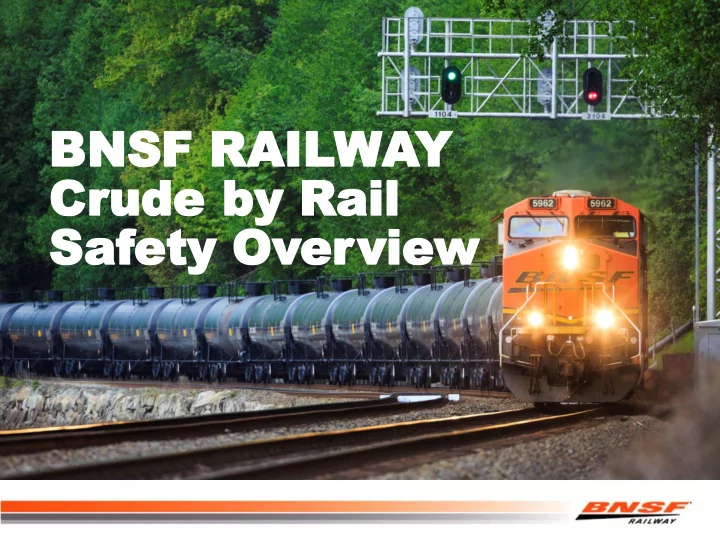
BNSF RAIL BNSF RAILWA WAY Y Cr Crude ude by Rail by Rail Saf Safety ety Ov Over erview view Rail Transports Crude Safely Record crude volumes delivered safely- 99.997% of crude shipments shipped without incident 2012 and 2013
Rail Transports Crude Safely
- Record crude volumes delivered safely- 99.997% of
crude shipments shipped without incident
- 2012 and 2013 safest years on record, with rail volumes
- f all kinds increasing as economy recovers
2
BNSF’s Safety Overview
3
- Rail is safest mode of land transportation
- BNSF’s safety vision is to prevent accidents in the first place
- BNSF has a broad-based risk reduction program
Prevention Mitigation Response
BNSF: BNSF: Saf Safety Le ety Leader f ader for Cont
- r Continuous
inuous Risk Risk Reduction eduction
4
BNSF vs. Industry Reportable Rail Equipment Incident Rate (Incidents per Million Train Miles)
4.1 4.4 4.1 3.7 3.4 3.2 2.9 2.7 2.8
2.4
2.3 3.4 3.6 3.5 3.3 3.3 3.2 2.6 2.6 2.7 2.2 1.9 2003 2004 2005 2006 2007 2008 2009 2010 2011 2012 2013
Industry RREI Rate BNSF RREI Rate
Source: FRA Ten Year Overview – 2013 Data Through October
42% 32% 11% 15%
Human Factor
Pr Preventio ention: n: Four M
- ur Main Causes f
ain Causes for
- r
Der Derailment ailments
5
BNSF Reportable Train Accident Causes - 2013 YTD
Track/ Signal Equipment Misc.
Pr Preven ention tion: : Act Actions ions Plans Plans To
- Red
educ uce e Risk Risk
6
Human Factor
- Training
- Remote monitoring
- Positive Train Control
- Self reporting protocol
Equipment/Mechanical
- Ultrasonic Inspection
- Detector Network, such as:
- Dragging equipment
- Technology, including:
- Force-based/strain gage systems
- Thermal/infrared scanning for warm bearing
detection
Track/Signal
- Enhanced track inspection training
- Continued elimination of jointed rail
- Strong capital program for tie renewal
- Technology, including:
- Ground penetrating radar
- Enhanced geometry testing
Miscellaneous
- Operating Practices/Alerts
- High wind: staging and/or speed requirements
- Tornado: requirements to stop, inspect trains
- Flood: speed restrictions, additional inspections
- Cold weather: speed restrictions
Pr Preven ention tion: : Ca Capita pital l sp spen ending ding key ey en enabler bler to to kee eep p st stron
- ng
g ph phys ysica ical l pla plant nt
7
- BNSF will spend a record $5 billion on capital projects in
2014 to support maintenance and expansion – $2.3 billion for network maintenance
Pr Preven ention tion: : Insp Inspec ection tion/Con /Condition dition Bas Based ed on
- n
Saf Safet ety y App pproa
- ach
8
- Bridge and track inspections
- BNSF inspects tracks and bridges more often than required by FRA
Most key routes on BNSF are inspected 4 times per week and the busiest main lines are inspected daily
- Track inspections include state-of-the-art technology to detect internal
and external flaws in the rail and track structure
- Weather and earthquake inspections
- Proactive Rail Equipment Defect Detection
Devices deployed across the network
- Wheel Impact Load Detector
- Warm Bearing Detection System
- Hot / Cold Wheel Detector
- Acoustic Bearing Detectors
9
- Longstanding BNSF/Rail Industry best practices for special handling hazardous
materials (“Key Trains”) now extend to crude and ethanol shipments
- Key Train Definition:
- 1 or more loads of Toxic Inhalation/Poisonous Inhalation (TIH/PIH)
materials
- 20 or more tank loads of any hazardous materials
- Special Handling for Key Trains:
- Special identification and tracking
- Speed Restrictions: 50 mph max speed limit on Key Trains
- Key Train Routes: wayside wheel bearing detector spacing, frequency of
track inspections, minimum track maintenance standards for tracks used to meet or pass Key Trains
- Key Trains will not be left unattended on main line or siding tracks,
- utside of yards & terminals, unless a detailed briefing regarding
securement procedures has taken place between train crew members and the train dispatcher. Key Trains left unattended will have reverser removed and cab will be locked when equipped
Pr Preven entio tion: n: Op Oper eratin ting g Pr Prac actic tices es for
- r
Key ey Trains ains
10
- Speed Restrictions:
- Speed restrictions of 40 mph for Key Trains carrying crude in DOT-111 tank cars through
High Threat Urban Areas (HTUAs) (additional 36% reduction in Kinetic Energy. 56%
- verall reduction in KE)
- Risk-based Routing
- Apply PHMSA’s Rail Corridor Risk Management System (RCRMS) and its 27 Risk Factors
that define the ‘most safe and secure’ route for trains carrying TIH/PIH, to the routing of unit crude trains
- Derailment Prevention
- Wayside Detector Network – a max of 40 mile spacing of Defective Bearing detectors on
Key Crude Oil routes (detects flaws with equipment wheels as they pass detector device)
- Rail Detection – At least one additional internal rail inspection than required by Federal
Regulations
- All Key Crude Trains operated with Distributed Power (DP) or an operative two-way End
- f Train Device All BNSF crude trains operate with DP
- Emergency Response (in addition to local training undertaken by BNSF already)
- Rail Industry commits up to $5M to develop and deliver crude-specific HazMat training to
First Responders
- Rail Industry commits to develop an inventory of emergency response resources
Pr Preven enti tion
- n:
: U.S. .S. DO DOT T Ag Agree eemen ment t Pr Provide vides Ad s Additi dition
- nal
al Ope Operating ting Pr Prac actice tice Risk Risk Red educ uction tions s
Pr Preven ention tion: : Pos
- sitiv
itive e Train ain Con Contr trol
- l
Dep Deplo loyme yment nt Wil ill l Enh Enhan ance ce Saf Safet ety
11
- Prevent train-to-train
collisions
- Enforce speed limits
- Protect roadway workers
and equipment
- Prevent movement of
train through a switch left in improper position Interoperability allows operating
- n other railroads
Predictive, advanced train control safety technology
FCC has ordered railroads to cease PTC construction since May 2013 due to tribal/historical notification process concerns
Digital wireless communication technology
Mitiga Mitigation: tion: Tank Car Standar ank Car Standards ds
“New” 1232 Cars vs. “Old” DOT 111 Cars
- 1/2” or 7/16” jacketed shell vs. 7/16”
- ½” extra protective head shield
- Roll over protection (top fitting protection)
- Larger pressure release valve
- 47 - 77% better crashworthiness
12
Rail industry voluntarily adopted stronger tank car standards in Oct. 2011 & November 2013: DOT 111
Mitigation: “Next Gen Gener eration tion Tank Car” NGT NGTC
3/20/2014 13
- Require jackets and
thermal protection
- n the 1232 tank
car
- BNSF NGTC RFP
issued to accelerate the tank car design, production, and to bring more certainty to the crude-by-rail tank car market
Mitiga Mitigatio tion: n: BNS BNSF F Tan ank k Ca Car r RF RFP P for
- r NGT
NGTC
- BNSF Railway has issued a request (RFP) to major railcar
manufacturers to submit bids for the construction of 5,000 Next Generation Tank Cars to be used for transporting crude oil.
- This BNSF tank car RFP is intended to help accelerate the
transition to the Next Generation Tank Car
- It will provide tank car builders a head start on tank car design
and production, even as the Department of Transportation, railroads and shippers continue to engage in the formal rulemaking process.
- BNSF believes that the RFP process will provide market
participants more certainty, sooner.
3/20/2014 14
Response: esponse: Fir First st Responder esponder Coor Coordina dination tion
- Shipment Information Access by First
Responders
- Training First Responders, Employees and
Customer Employees
- Mobilizing in the event of an incident
3/20/2014 15
Response: esponse: Fir First st Responder esponder Access Access to to Inf Infor
- rma
mation tion
BNSF already provides local first responders information about shipments upon request However, by July 2014, per agreement with USDOT
- Railroads will develop a nationwide inventory of
resources for “Key Route” emergency responders
- Locations for staging emergency response equipment
- Contacts for community notification
- Provide to U.S. DOT and available to appropriate
emergency responders
3/20/2014 16
Response: esponse: BNSF/Fir BNSF/First st Responder esponder Loca Local T l Training aining
- BNSF and the railroad industry train first responders in their communities
under a longstanding program called “TRANSCAER” (Transportation Community Awareness and Emergency Response)
- Hands-on equipment in field – Instructor lead
- Train list / shipping papers
- Placards
- Equipment
- Incident Assessment
- BNSF trains an average of 3,500 local
emergency responders each year in communities across network
- More than 65,000 emergency responders trained since 1996
3/20/2014 17
Res espo pons nse: e: Training aining Fir First st Res espo pond nder ers s at t Pue Pueblo blo, , CO CO Na Nation tional al Fac acil ility ity
- Security and Emergency Response Training Center
(SERTC) at Pueblo, Colorado national railroad research/training facility (TTCI)
- In-depth hazmat emergency response training to more
than 30,000 emergency responders and railroad and chemical industry employees.
- Going forward, additional $5 million industry commitment
to train additional first responders from across the rail network; railroad company cost share with local communities (80/20 local)
3/20/2014 18
Respo esponse: nse: Inciden Incident Mobiliza t Mobilization tion
BNSF pre-positions 212 first responders and equipment at 60 locations\ across the network.
- Industrial fire-fighting foam trailers
- Emergency breathing air trailers
- Chlorine kits
- Midland kits
- Air monitoring assets
3/20/2014 19
Res espo pons nse: e: Mob Mobil iliz ization tion of
- f P
Prep epos
- sitione
itioned d BNSF BNSF Hazma Hazmat t Res espo pond nder ers
212 responders at 60 locations
20
Klamath Falls Whitefish Seattle Stockton Bakersfield Mojave San Bernardino Los Angeles Needles Bele n Texico Amarillo Texline La Junta Denver Alliance Gillette Bridger Jct Billings Minot Mandan Hettinger Minneapolis/
- St. Paul
La Crosse Sioux City Lincoln Ravenna McCook Salt Lake City Fargo Superior Superior Kansas City Galesburg Chicago Machens
- St. Louis
Springfield Memphis Birmingham Norris Tulsa Oklahoma City Haslet
- Ft. Worth
Sweetwater Temple Teague Houston Spring New Orleans Phoenix El Paso Portland Vancouver Arkansas City Avard
21
Remedia emediation tion
BNSF will restore the site
Cameron, Texas, post derailment
- BNSF is responsible for
mitigation of the spill and any restoration tasks
- BNSF contracts with
pre-approved consultants and contractors to perform the remediation and restoration
- State agencies oversee
the work and BNSF must
- btain their concurrence
before a site is acceptably closed