
SLIDE 1
Book Report Series 3: Free Will
By Sam Harris
Patrick Drew - GSPS
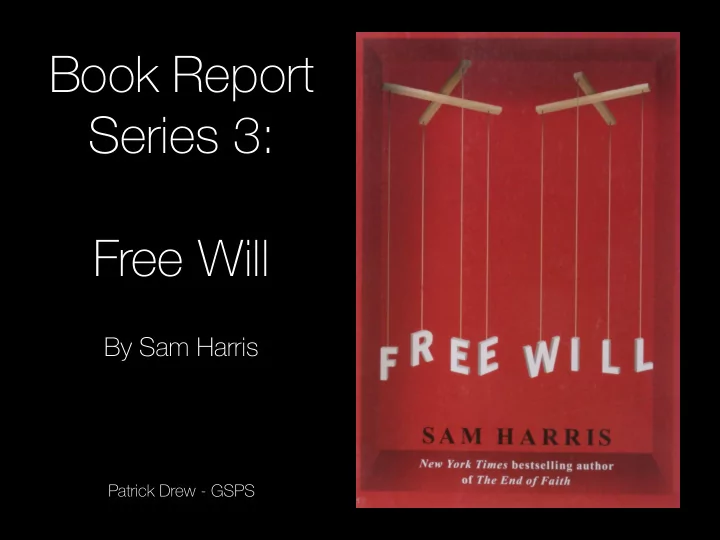
Book Report Series 3: Free Will By Sam Harris Patrick Drew - GSPS - - PowerPoint PPT Presentation
Book Report Series 3: Free Will By Sam Harris Patrick Drew - GSPS Why am I giving this talk? I like saying controversial things and trying my best to bring people along for the ride. I hope this will be fun. Maybe youll take
By Sam Harris
Patrick Drew - GSPS
things and trying my best to bring people along for the ride.
something away.
about this topic. It has a rich philosophical history.
Just to encounter a several-century old debate.
population finds these ideas psychologically destabilizing.
something else.
Can I get off this ride?
forgiving.
for things we didn’t earn.
more humble people.
behaved differently than we did in the past.
source of our thoughts and actions in the present.
could’ve would’ve should’ve
behaved differently than we did in the past.
Choice A Choice B
behaved differently than we did in the past.
Rewind the Universe to the precise state it was in
source of our thoughts and actions in the present.
But are there some things that force our hand?
Our Brains Gene Expressions Life Experience Upbringing Amount of sleep Need to survive Blood sugar Human interactions
(If you like this, check out Dan Dennett)
You can move freely according to the rules of chess. It’s not total freedom but it’s good enough.
will because we are not in control (the version I’m arguing)
Not in control In control to the degree it can be
(modulo upbringing, sleep, external forces)
narrating your life
in your head behind your eyes
consciousness
Not in control
I am authoring a thought
for it.
that your conscious self does not author your thoughts.
Try now (or later) to focus intently
Witness your stream of consciousness. Ask yourself, “Do I create these thoughts? Do I choose these thoughts? Or do they just appear to me?” This might take some practice.
my thoughts. I thought about the most random thing I could imagine.”
explain where fire trucks came from.
self from processes inside your brain that you have no control over.
You didn’t pick fire trucks any more than you pick my next sentence. You are a witness.
shaped by experience, not free will.
your brain chose that answer for you by processes you cannot control and have no influence over.
able to choose your next thought?
the possibilities of thoughts you could have?
Because once I list possibilities in sequence I have just authored my next thought?
not need to be conscious
process in order to have
me and I write it down.
because… Nobody else wrote them. He did.
but the thing that is steering is outside your control.
free to steer wherever you want.
great deal outside your control
forgiving of each other for faults and wrongdoings.
compassionate
Both camps agree we can be kinder!
less credit for our place in society.
parents, where we were born, opportunities.
born a psychopath.
Both camps agree we can be kinder!
serves no purpose
Justice
determined, why should I do anything?
(And not a good one)
The fact that our choices depend on prior causes does not mean they don’t matter! Nothing happens on its own!
efforts, goals, willpower, etc., are causal states of the brain leading to specific behaviors.
much an idea can change you.
in chair from back pain.
decide it's time to go see a doctor.
We still need prisons, deterrents to protect and keep
Feel bad for people in these circumstances. Feel thankful you are not them. You wouldn't have done differently
Can also focus more on rehabilitation